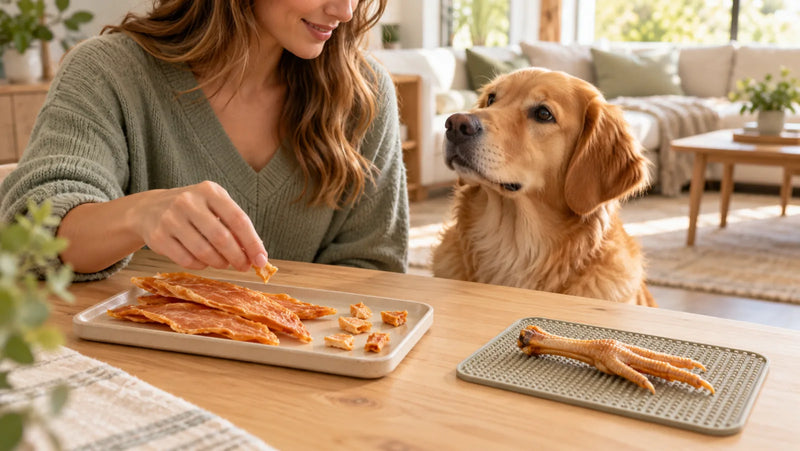

The best selling dog treats for pet stores are not one universal product. Strong assortments cover a few clear shopper missions—simple meat rewards, lightweight freeze-dried pieces, longer chewing occasions, and small training rewards—then keep the exact SKUs that earn repeat sales without excess waste or confusing overlap.
Start narrow, measure movement by SKU, and reorder from evidence rather than a supplier’s “top seller” claim. Your customer mix, price points, shelf space, local competition, product availability, and merchandising all shape what moves in your store.
Best Selling Dog Treats for Pet Stores: The Short Answer
| Shopper mission | Category to test | What the retailer should verify |
|---|---|---|
| A simple, recognizable meat reward | Single-ingredient meat jerky | Exact ingredient panel, strip size and variation, breakability, package sizes, and storage directions |
| A light reward that can be divided | Freeze-dried meat treats | Piece and crumb profile, moisture protection, calories where listed, and how the package performs after opening |
| A longer chewing occasion | Natural chews | Species, ingredient, dimensions, hardness, supervision language, and size fit for the intended dog |
| Frequent training repetitions | Small or soft training treats | Ingredient list, piece size, handling in a pouch, portioning, and whether the texture stays consistent in use |
These are shelf jobs, not a national sales ranking. A focused four-job set gives customers meaningful choices without asking the store to carry several nearly interchangeable bags. The register, reorder history, and customer feedback then show which exact product deserves more space.
“Best-Selling” Is a Store-Level Result, Not a Universal Label
A product can lead in one neighborhood and stall in another. A training-heavy customer base may favor small rewards. A store known for natural chews may sell more chew formats. A compact urban shop may prioritize light, easy-to-carry packages, while a destination store may support larger bags. Placement, staff recommendations, sampling rules, stockouts, and seasonal traffic can also change the result.
That is why “best-selling” should describe measured performance in a defined store and period. Record the exact SKU, opening inventory, receipts, units sold, returns, markdowns, samples, damaged stock, and ending inventory. Keep stockouts visible: zero sales during an out-of-stock week do not prove zero demand.
Do not turn one good weekend into a permanent ranking. Look for repeat purchases, stable replenishment, manageable waste, and a clear shopper reason to choose the item. If a category needs constant discounting or a long explanation to move, its gross sales may hide a weak shelf role.
Four Dog-Treat Categories That Cover Distinct Shopper Missions
Single-ingredient meat jerky: visible simplicity and a familiar reward format
Whole-cut meat jerky gives staff an easy story to explain: identify the protein, show the shape, and describe how the customer may break or portion it for the individual dog. A short ingredient panel can make comparison easier, but it does not make a product suitable for every allergy, prescription diet, chewing ability, or calorie plan.
For an American Paws example, the current single-ingredient chicken breast jerky page identifies whole-cut chicken breast jerky for dogs. Review that exact live page rather than extending the claim to every American Paws item. Different products have different formulas.
Freeze-dried treats: light pieces, strong product identity, and training flexibility
Freeze-dried meat treats can fill a distinct shelf job when customers want dry, lightweight pieces that may be divided for rewards. The retailer still needs to inspect the exact piece and crumb profile, label, package closure, storage directions, and calories where the manufacturer provides them. “Freeze-dried” is a process category, not a promise that every SKU handles or portions the same way.
The wholesale freeze-dried dog treats guide goes deeper on supplier evidence, moisture-sensitive handling, crumbs, sampling, and bulk versus private-label operations. In the current assortment, freeze-dried chicken breast pieces are one concrete product example.
Natural chews: a duration-led purchase with size and supervision questions
A chew shopper is solving a different problem from a training shopper. The useful retail conversation covers the animal part, dimensions, natural variation, hardness, expected use, supervision, and what to do when the piece becomes small enough to swallow. Avoid guaranteeing a number of minutes: dog size, chewing style, saliva, product variation, and interruption all change duration.
American Paws’ current dehydrated chicken feet provide a real natural-chew example. They should occupy their own shelf role rather than being treated as a substitute for tiny repeated training rewards.
Small training treats: repetition, portability, and easy portioning
Training shoppers usually care about speed: can the handler carry the treat, deliver it quickly, divide it when needed, and continue the session? Test the exact product in a clean treat pouch and with realistic hands, not only in a display bowl. Record crumbs, stickiness, odor transfer, piece variation, and how easily staff can explain the serving guidance.
The current training-treat collection shows available formats, but the exact label controls every claim. Some American Paws products are single-ingredient and some are not; a short shelf card must never erase that difference.
Build a Tight Assortment Before Adding More Flavors
Begin with one serious candidate per shopper mission. When two products perform the same job, identify the meaningful difference before stocking both: protein, texture, size, ingredient count, package weight, price point, or intended use. “Another flavor” is not automatically a new shelf role.
The detailed guide to stocking dog treats in a pet boutique explains how to map shopping missions, preserve item identity, sample consistently, and set reorder points.
A simple assortment card can keep the test disciplined:
- Job: the customer question this SKU answers;
- Exact item: product title, variant, package size, and supplier;
- Reason to believe: label facts and observable format, not a medical promise;
- Neighbor: the closest alternative already on the shelf;
- Trial rule: start date, starting units, planned placement, and sampling method;
- Decision date: when the store will review sales, stockouts, waste, and feedback.
Changing placement, price, sample policy, and staff script at the same time makes the test hard to read. Keep the trial conditions stable enough to learn why a SKU moved.
Measure What Actually Moves Off the Shelf
Units and sell-through by exact SKU
Units sold are the first signal, not the whole answer. Choose one written sell-through definition and use it consistently. A practical store method is units sold during the period divided by the units available for sale during that period, with receipts, transfers, returns, and stockouts documented. The value is comparison over time inside the same store—not an invented industry benchmark.
Review the smallest useful level: exact product, size, and variant. Combining several sizes or proteins can make one fast SKU hide two slow ones. Also compare like periods; a holiday weekend and an ordinary midweek window answer different questions.
Repeat demand, margin dollars, and inventory days
A first purchase may come from curiosity or a sample. A second purchase suggests the product solved a real need. Track repeat requests when the store can do so appropriately, and train staff to record product-specific questions without guessing at a customer’s medical situation.
Look at margin dollars alongside unit movement and days held. A high percentage margin on a slow item can tie up shelf space, while a fast item with frequent stockouts can lose future purchases. Freight, receiving labor, samples, breakage, markdowns, and discarded product belong in the decision even when they are not printed on the invoice line.
Waste, returns, complaints, and samples
Movement that creates excessive crumbs, torn bags, unclear labels, repeated returns, or expired stock is not clean performance. Use reason codes that staff can apply consistently: customer preference, texture, package failure, wrong size, ingredient mismatch, damaged stock, date issue, or other documented reason.
Samples should be recorded too. If sampling drives sales, that may be a workable merchandising cost; if open product creates uncontrolled waste or loses lot identity, the program needs a different method. Never pour different products into one anonymous sample jar.

Merchandise by Shopper Question, Not by Supplier
Customers shop in plain-language missions: “I need tiny rewards for class,” “I want a simple meat treat,” “my dog likes a longer chew,” or “I need a dry option for travel.” Organize shelf cards and staff questions around those decisions. Supplier or brand can remain visible without becoming the only navigation system.
Use factual, observable language. “Single ingredient” must match the exact label. “Small pieces” should match the actual package. “Chew” should come with supervision and size-fit guidance. Avoid disease, allergy-safe, dental-cleaning, calming, or therapeutic promises unless the exact product and applicable rules support them.
Cross-merchandising should still preserve the product’s identity. A training display can show a treat pouch beside sealed treats, but the bag, price, ingredient panel, and responsible company must stay easy to find. A chew display can include supervision guidance without hiding the label behind a prop.
Protect Labels, Dates, Lots, and Product Identity
The FDA’s animal-food labeling overview identifies core federal label information including proper product identification, net quantity, the manufacturer or distributor’s name and place, and an ingredient listing. FDA also notes that state requirements apply. Check the current rules for every market where the product will be sold.
AAFCO’s consumer overview explains that AAFCO develops model language but does not regulate, test, approve, or certify pet food. A retailer should therefore avoid casual “AAFCO approved” language and rely on the exact label and substantiated product documentation.
At receiving, capture the exact item, quantity, package condition, lot or date identity, and date received. Rotate the earliest applicable dates first, follow the printed storage directions, and never top off a working bin with a new lot. The guide to dog-treat shelf life for retailers covers date capture, earliest-date-first rotation, open-bin controls, quarantine, and complaint traceability.
Quarantine wet, torn, swollen, unsealed, mislabeled, unusually odorous, or otherwise questionable stock. Keep the package, photos, lot or date information, and remaining product for the supplier conversation. Do not return an unidentified item to the selling shelf.
How American Paws Fits a Focused Pet-Store Set
American Paws operates in Highland, California and lists FDA Food Facility Registration No. 13526766664. The current assortment includes whole-cut chicken jerky, freeze-dried chicken breast and beef liver, dehydrated chicken feet, toppers, and training formats. Each exact product page carries its own formula and directions; the catalog should not be described as one universal recipe.
Bulk pricing starts at $14 per lb in the current catalog, and the minimum is 10 lb per product. Use the American Paws wholesale page to share the shelf job, selected product, pounds per product, destination, and target date so current availability, pricing, freight, and timing can be confirmed.
Retail-ready wholesale uses current American Paws packaging. For a confirmed private-label project, the customer supplies approved bags; American Paws fills the selected product, adds an oxygen absorber, and heat-seals the bag within the agreed scope. Use the private-label inquiry for that route.
The private-label dog treat manufacturer guide covers product definition, packaging, minimums, responsibilities, and fulfillment questions. The separate guide to wholesale dog treats for pet stores owns the broader supplier-qualification decision.
Retailers can also review all current American Paws dog treats before asking for a quote. Confirm the exact live label, package, product availability, and channel fit rather than copying a claim from another SKU.
A Six-Step Test for the Next Dog-Treat SKU
- Name the shelf job. Write the customer question the item answers and the nearest existing alternative.
- Audit the exact SKU. Review ingredients, intended species, package size, observable format, storage, date or lot identity, and current documentation.
- Set the test. Record starting units, receipts, placement, price, sample method, start date, and review date.
- Track the full result. Capture sales, stockouts, returns, markdowns, samples, damage, crumbs or waste, and recurring customer questions.
- Protect identity. Keep sealed and working stock connected to the original product, label, lot or date, and storage directions.
- Make one decision. Reorder, adjust the documented merchandising method, reduce space, or replace the SKU. Do not add a near-duplicate before the first item has a readable result.
Frequently Asked Questions
What dog treats sell best in pet stores?
The answer varies by store. Jerky, freeze-dried treats, natural chews, and small training rewards cover common shopper missions, but the winning exact SKU depends on local customers, price, placement, availability, repeat demand, waste, and staff execution. Measure your own results instead of accepting a universal ranking.
How many dog-treat SKUs should a small pet store start with?
Start with the smallest set that covers distinct customer jobs without obvious duplication. One strong candidate in each of four roles—simple meat reward, freeze-dried reward, natural chew, and training treat—creates a readable test. Add another SKU only when it introduces a meaningful protein, texture, size, formula, pack, or price choice.
Are single-ingredient dog treats always the best seller?
No. A single-ingredient label can be easy to understand, but sales still depend on dog fit, texture, package, price, placement, availability, and repeat preference. Single ingredient also does not mean allergy-safe, medically appropriate, or suitable for every dog.
Should a pet store stock bulk or retail-ready dog treats?
Retail-ready bags are usually simpler for ordinary shelf sales because the product identity and label stay with the item. Bulk stock can support controlled repacking or store use only when the retailer has confirmed the legal, labeling, traceability, sanitation, and operating requirements. Private label is a separate scoped project, not an unlabeled scoop from a bin.
What is the American Paws wholesale minimum?
The minimum is 10 lb per product. Different products have separate minimums rather than one mixed 10 lb total. Send the selected product, pounds, format, destination, and target date for a current quote; availability, freight, and lead time are confirmed for the actual order.
Start With Four Jobs and Let the Register Decide
A useful pet-store assortment does not need a wall of nearly identical dog treats. Give each SKU a clear job, protect its product identity, teach staff one accurate explanation, and review the full result on a scheduled date. Products that earn repeat demand with manageable inventory deserve space; products that create overlap, waste, or confusion should not survive on a “best seller” label alone.
Ready to scope a focused set? Send the intended shelf jobs, selected products, pounds per product, retail-ready or private-label format, destination, and target date through the wholesale inquiry. For customer-supplied approved bags, use the private-label inquiry and include the bag, label, fill weight, and artwork status.