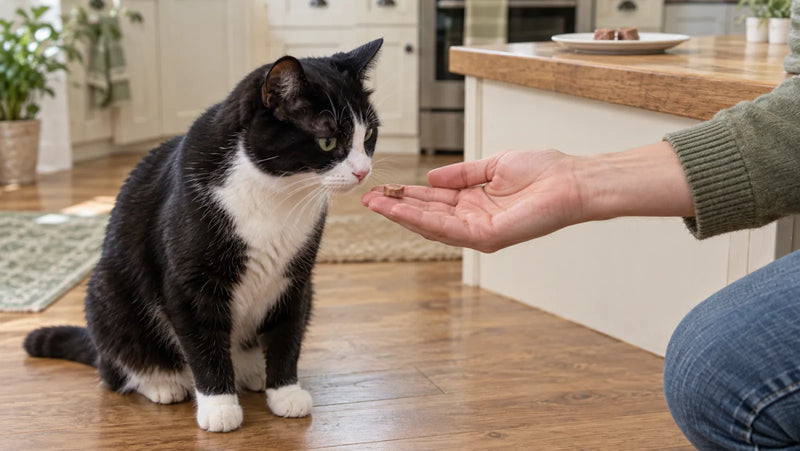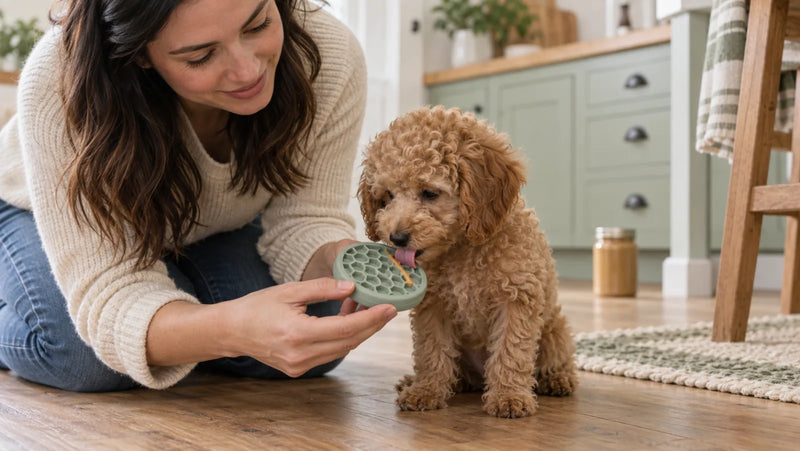

Chicken jerky for dogs can be a simple, high-value reward when it is made for pets, has a complete and readable label, comes from a transparent source, and is portioned for the individual dog. Choose a product without unsafe seasonings, check calories and the full ingredient list, break or soften pieces to match the dog's mouth and chewing ability, and keep all daily treats within the dog's veterinary nutrition plan.
“Chicken jerky” is not one uniform product. A whole-cut dehydrated strip, a softer multi-ingredient strip, a freeze-dried cube, and salty human jerky differ in ingredients, moisture, texture, calorie density, and intended use. The safest buying decision starts with the exact bag—not the category name alone.
Chicken Jerky for Dogs: Quick Buying Checklist
- Made for dogs: reject human jerky, restaurant jerky, or an unlabeled bag.
- Complete ingredient list: choose a short, understandable list that matches the product claim.
- Traceable source: look for the responsible company, manufacturing information, lot code, and a way to contact the brand.
- Useful label details: find calories, net weight, feeding or handling directions, and storage instructions.
- Appropriate texture: bend, break, or rehydrate only as the package allows, and match every bite to the dog's chewing and swallowing ability.
- Measured portion: count jerky inside the same treat-calorie allowance as chews, toppers, table bites, and training rewards.
- Fresh package: inspect the seal, smell, color, dryness, and best-by or lot information before serving.
American Paws offers single-ingredient whole-cut chicken breast jerky made in Highland, California. That specific product claim does not describe every soft strip or every item in the broader catalog, so always read the bag in hand.
What Is Chicken Jerky for Dogs?
Chicken jerky is chicken that has had much of its moisture removed to create a concentrated treat. Removing water changes texture and weight; it does not turn every strip into the same food. Cut thickness, ingredients, processing method, final moisture, and packaging all influence how a piece feels and how it should be stored.
Dehydrated chicken jerky
Dehydration uses controlled warmth and airflow to remove moisture over time. Whole-cut chicken breast can become a dense, chewy strip that can be held for a bite or broken into smaller rewards. A product may also be formulated as a softer strip with additional ingredients, so “dehydrated” does not automatically mean single-ingredient.
For a detailed format comparison, our guide to dehydrated versus freeze-dried chicken for dogs separates texture, training use, handling, and label questions without declaring one format universally better.
Freeze-dried chicken treats
Freeze-drying removes moisture under low-pressure conditions after the product is frozen. The result is usually light, dry, porous, and easy to crumble into small pieces. Freeze-dried chicken may suit rapid-reward training or dogs that prefer a less chewy texture.
Do not treat “freeze-dried” as a guarantee that pathogens are impossible or that storage instructions can be ignored. Read the manufacturer directions, handle the product with clean dry hands, keep moisture out, and wash hands after handling pet treats.
The 2007–2015 FDA Jerky-Treat Investigation
Chicken-jerky shoppers still encounter references to a major period of illness reports, product removals, and investigation. The history matters, but it must be described accurately rather than compressed into “all jerky was recalled” or “one contaminant caused everything.”
What FDA reported
In its jerky pet-treat investigation update, the FDA says that, from 2007 through December 31, 2015, it received about 5,200 complaints associated with chicken, duck, or sweet-potato jerky treats. Those reports involved more than 6,200 dogs, 26 cats, three people, and more than 1,140 canine deaths. The agency says many reports involved products imported from China and that most complaints involved chicken jerky.
FDA also documented product removals after New York State testing found low levels of certain antibiotic residues, and it described an import alert covering poultry jerky-type pet treats with specified antibiotic or antiviral residues. The current FDA Import Alert 72-07 remains the precise source for the products and residues within that action.
What the history does not prove
The same FDA investigation says it was not possible to conclude definitively in every report that eating jerky caused the illness. Testing did not reveal one root cause for the many different reported conditions. A complaint is important surveillance evidence, but it is not the same as a controlled trial or a confirmed diagnosis for every animal.
That distinction protects dogs from two bad conclusions. The first is dismissing the history because every case was not proven. The second is claiming that every imported jerky treat, every chicken strip, or every modern product shares the same risk. Buy the current product based on its own label, source, condition, and the individual dog's fit.
Why transparent USA production helps without guaranteeing safety
Domestic production can make questions about manufacturing location, responsible company, lot traceability, and communication easier to ask and verify. It can shorten the chain a buyer must understand. Those are meaningful selection advantages, especially after a history in which ingredient origin was not always obvious from a package.
However, “made in USA” is not a magic safety seal. Any pet treat can be mishandled, contaminated, mislabeled, damaged, or unsuitable for a particular dog. Our focused guide asks how to evaluate made-in-USA chicken jerky without turning origin into an absolute guarantee.

How to Read a Chicken-Jerky Label
Start with intended species and the ingredient list
Look for a product clearly labeled as a dog treat or pet treat. Then read every ingredient in order. A whole-cut product may list only chicken breast. A softer strip may include glycerin or other ingredients that change texture. Neither format should borrow the other's ingredient claim.
The FDA's pet-food overview explains that federal pet-food labeling includes product identification, net quantity, the responsible manufacturer or distributor, and ingredients listed from most to least by weight. State requirements may also apply. Use the complete label rather than a front-of-bag phrase as the buying record.
Check calories, feeding directions, lot code, and origin details
Find the calorie statement and determine whether it is listed per piece, per ounce, or another unit. “One strip” is useful only when strips are uniform and the label supplies a reliable calorie basis. Natural whole-cut pieces can vary, so weighing a portion may be more consistent than counting pieces.
Also look for the lot code, best-by information, storage directions, responsible company, and contact method. Save the bag until the treats are finished. If a problem occurs, the exact product, lot, purchase source, opening date, and feeding amount are more useful than a loose strip in an unmarked container.
Avoid human jerky and risky seasonings
Human chicken jerky is not interchangeable with dog treats. It may contain substantial salt, sugar, smoke flavor, chile, garlic, onion, sauces, preservatives, or other ingredients chosen for people. Recipe variation also makes a generic portion answer impossible.
Do not rinse a seasoned strip and assume the ingredients are gone. If a dog steals human jerky, save the package, read the full list, estimate the amount and time, and call a veterinarian or poison-control service promptly for garlic, onion, xylitol, another toxin, a large exposure, or any symptoms.
Portion Chicken Jerky by Calories, Then Prepare It by Dog Size
There is no honest universal answer such as “one strip per day.” Strips differ in weight and calories, while dogs differ in daily energy needs, health, diet, and everything else they receive. Use a veterinarian-confirmed daily calorie target and the exact treat's calorie statement.
The World Small Animal Veterinary Association treat guide recommends that treats supply no more than 10% of a dog's daily calories, leaving at least 90% for complete and balanced food. That 10% is a ceiling shared by chicken jerky, training treats, chews, toppers, table food, and food used for medication—not a target reserved for jerky.
Use this calculation: daily calories × 0.10 = maximum calories from all extras. Then subtract every other extra before deciding what remains for jerky. If a veterinarian sets a 400-calorie day, the shared ceiling would be 40 calories. If one hypothetical strip contains 20 calories and no other extras are given, two strips would mathematically use the whole ceiling; the appropriate amount may still be lower. Use the real label, not the example.
| Dog size | Starting texture preparation | Portion rule |
|---|---|---|
| Under 10 lb | Break a pliable strip into tiny, soft bites; never offer a large leathery piece to gulp | Calculate from label calories and the dog's own daily target; start below the available ceiling |
| 10–24 lb | Use small separated bites and pause between rewards | Count or weigh the portion before the session, including every other treat |
| 25–49 lb | Break a strip into several controlled bites rather than handing over repeated full strips | Body size does not cancel calorie density; use the same 10%-of-all-extras ceiling |
| 50–89 lb | Offer one piece at a time and watch for chewing rather than swallowing | Use actual calories per piece or ounce, not a visual guess |
| 90 lb and over | A larger mouth still needs supervision, an appropriate texture, and controlled bites | Do not scale up from a small-dog strip count; calculate from the individual's plan |
This is a preparation table, not a daily ration. Our dedicated chicken-jerky portion guide walks through the calorie math and shared treat budget in more depth.
Puppies, Senior Dogs, and Small Dogs Need Different Handling
Puppies
A puppy's complete growth food must do the nutritional work. Treats should stay small, soft enough for the puppy's current teeth, and limited so they do not displace balanced meals. Ask the veterinarian when chicken is new, the puppy has digestive signs, or a training plan uses many repetitions.
For age, texture, introduction, and portion questions specific to young dogs, use our chicken jerky for puppies guide. Do not copy an adult-dog serving pattern into a small puppy's day.
Senior dogs
Age alone does not make jerky unsuitable, but dental disease, missing teeth, jaw discomfort, swallowing changes, prescription diets, kidney disease, pancreatitis history, and weight goals can change the decision. Bend the strip, break it, and observe whether the dog can chew comfortably; do not use toughness as enrichment for a dog with oral pain.
Our senior-dog chicken-jerky guide goes deeper into texture and health screening for older dogs. A veterinary dental concern should be evaluated, not hidden by soaking every treat indefinitely.
Small dogs and gulpers
Small dogs have less room for calorie error and may face a large size mismatch with a full strip. Pre-break the day's portion while the dog is elsewhere, then offer one tiny piece at a time. Supervise and stop if the dog tries to swallow pieces without chewing, coughs, gags, paws at the mouth, or becomes distressed.
The small-dog chicken-jerky guide covers size, texture, pacing, and calorie planning without assuming all small breeds chew alike.
Chicken Jerky Versus Rawhide, Bully Sticks, and Freeze-Dried Chicken
Choose the format for the job. A jerky strip is usually a food reward, not a long-duration chew. Rawhide and bully sticks are chew formats with different ingredients, durability, calorie patterns, swallowing hazards, and supervision needs.
- For a quick high-value reward: a measured chicken-jerky bite may be more practical than beginning a long chew session.
- For many training repetitions: light freeze-dried pieces or finely torn jerky may make calorie tracking and rapid delivery easier.
- For chew time: use a product designed for that purpose and supervise; do not assume a jerky strip will last or provide dental cleaning.
- For an ingredient-sensitive plan: compare the exact ingredient lists. Chicken itself can be an unsuitable protein for an individual dog.
Use the full chicken jerky versus rawhide comparison or chicken jerky versus bully sticks guide for those separate decisions. This pillar does not declare every jerky strip safer than every chew.
How to Introduce and Serve Chicken Jerky
- Read the unopened bag. Confirm the product, intended species, ingredients, calories, lot, condition, and storage directions.
- Choose a normal day. Do not introduce jerky alongside several new foods or during active vomiting, diarrhea, or a diet trial.
- Prepare one tiny bite. Match the texture to the dog's mouth, teeth, and swallowing behavior.
- Offer it under supervision. Keep the bag closed and out of reach; do not let the dog self-serve.
- Watch tolerance. Stop for vomiting, diarrhea, repeated itching, hives, facial swelling, coughing, gagging, pain, or unusual behavior.
- Increase only within the plan. If tolerated, allocate future pieces from the daily extras budget rather than adding them on top.
For brands and pet parents making treats at home, the separate homemade chicken-jerky guide covers recipe control and food-safety steps. A household batch without validated moisture, shelf-life, and process data should not borrow the storage promise of a commercial product.
How to Store Chicken Jerky Dog Treats
Follow the package first. Keep the original lot and best-by information, close the seal completely, use clean dry hands, and store the bag away from heat, direct sun, humidity, insects, children, and pets. Do not pour a new bag on top of crumbs from an old batch.
If using a separate container, keep the original package with it or place the closed original bag inside the container. That preserves instructions and traceability. Do not assume refrigeration helps unless the manufacturer directs it; moving a dry product between temperatures can introduce condensation.
Discard treats with visible mold, insects, unusual moisture, a broken or swollen package, rancid or otherwise abnormal odor, unexpected slime, or a major color or texture change. Do not taste a questionable pet treat. Our full chicken-jerky storage guide covers opened bags, travel, containers, and discard decisions.
When to Stop Feeding and Call a Veterinarian
Stop the treat and contact a veterinarian for repeated vomiting or diarrhea, blood, marked lethargy, refusal of food or water, increased thirst or urination, weakness, collapse, facial swelling, hives, breathing changes, tremors, seizures, or other concerning signs. Coughing, gagging, pawing at the mouth, blue or gray gums, panic, or inability to breathe normally is an emergency.
Save the package and record the product name, ingredient list, manufacturer, lot, best-by date, purchase source, amount fed, timing, every other food or treat, and the dog's signs. The FDA investigation specifically emphasizes detailed reporting because “jerky” alone does not identify an exposure.
Do not induce vomiting or give peroxide, salt, oil, milk, bread, charcoal, medication, or a forced meal unless the professional handling the exact case directs it. If a veterinarian suspects a product problem, follow their care instructions and consider using the FDA Safety Reporting Portal identified on the agency's jerky-treat page.
Frequently Asked Questions
Is chicken jerky good for dogs?
It can be a useful high-value reward when the exact product, calories, texture, and dog's diet fit. If you are still deciding whether chicken jerky is a good idea at all, start with our article on whether chicken jerky is good for dogs; this guide focuses on how to buy, feed, portion, and store it.
How much chicken jerky can a dog have?
Use the label calories and a veterinarian-confirmed daily target. All extras together should stay within no more than 10% of daily calories, and the right jerky share may be below that ceiling. Strip count alone is unreliable because size and calories vary.
Can puppies eat chicken jerky?
A veterinarian may allow a tiny, appropriately soft piece for a weaned puppy whose complete growth diet and health permit it. Use puppy-sized pieces, supervise closely, and do not let jerky replace balanced puppy food.
Is chicken jerky suitable for senior or small dogs?
Sometimes, after adjusting texture and bite size. Dental pain, missing teeth, swallowing difficulty, prescription diets, medical conditions, gulping, and a tight calorie budget can make another reward better. Ask the veterinarian when any of those apply.
Is made-in-USA chicken jerky safer?
U.S. production can improve visibility into location, responsibility, lot traceability, and communication, but origin is not a safety guarantee. Evaluate the current label, manufacturer, package condition, handling directions, and the individual dog.
Is dehydrated or freeze-dried chicken better?
Neither is best for every dog. Dehydrated strips are typically denser and chewier; freeze-dried pieces are typically lighter and easier to crumble. Compare ingredients, calories, texture, handling, and how the treat will be used.
Can dogs eat human chicken jerky?
Do not choose it. Human jerky may contain high salt, garlic, onion, sugar, smoke flavor, chile, sauces, or other unsuitable ingredients. Use a product labeled for pets, and check the human package after an accidental exposure.
How should chicken jerky be stored?
Follow the package, close it fully, keep it cool and dry, preserve the lot information, and prevent pet access. Discard any treat with mold, abnormal moisture or odor, insects, package damage, or a major texture change.
Choose a Traceable Treat and Make Every Piece Count
The best chicken-jerky choice is specific: a pet product with a complete ingredient list, clear calories, traceable company and lot information, an intact package, and a texture that fits the individual dog. Portion it by calories, prepare it by mouth and chewing style, supervise it, and store it exactly as directed.
Compare American Paws chicken jerky dog treats or start with our single-ingredient whole-cut chicken breast jerky made in Highland, California. For other proteins and textures, browse all current American Paws dog treats and choose with the same label-first standard.