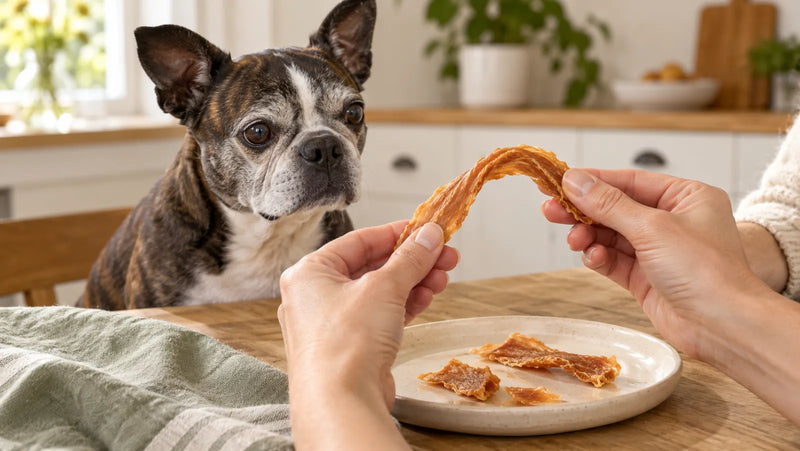
Wholesale dog treats for pet sitters work best when the product is simple to explain and every dog has written owner approval before a reward is offered. Keep the original ingredient and lot identity, portion only a short working supply into a dog-specific labeled container, and start with one product whose 10 lb minimum matches recorded use rather than a guessed serving size.
An independent sitter or home-boarding host has a different job from a retail shop or a large daycare. The buyer may care for several dogs in one home, but each dog still arrives with its own food history, owner instructions, treat budget, health considerations and emergency contact. A useful wholesale system preserves those differences instead of treating every guest as part of one feeding pool.
American Paws is based in Highland, California and lists FDA Food Facility Registration No. 13526766664. The current B2B program starts at 10 lb per product, with pricing from $14/lb in the current catalog. Exact product availability, price, sample scope, lead time, capacity, freight, packaging and project terms require written confirmation for the proposed order.
Wholesale Dog Treats for Pet Sitters: Quick Buying Facts
- Permission comes first: record approval for the exact dog and proposed treat before the first service day.
- Identity stays with the food: retain the original product name, ingredient statement, lot or date link and storage directions even when a small working portion is moved into another container.
- One simple option is enough to pilot: a short ingredient list can make owner review easier, but no product is automatically suitable for every dog.
- The minimum uses pounds, not guessed pieces: American Paws starts at 10 lb per product, so forecast from actual approved use, waste and storage capacity.
- Temporary portioning is not retail repacking: a sitter's identified working container serves a known dog during a defined service window; self-packed bags for sale require a separate compliant plan.
- Managed diets stay veterinarian-led: do not substitute a business recommendation for the owner's written instructions or the dog's veterinary plan.
Before comparing formats, decide what the treat must do. A quiet arrival reward, a brief handling reward, a crate-entry cue and a retail take-home bag are four different jobs. The exact product, portion system, packaging path and recordkeeping should match the intended job.
Get Written Permission Before the First Treat
Record approval for the exact dog and product
Ask the owner whether the sitter may provide treats, whether the owner will supply them, and whether a proposed product is acceptable. Show the current product name and complete ingredient statement rather than asking only, “Can your dog have chicken?” Preparation, added ingredients and the dog's existing diet can matter to the answer.
Record the decision with the dog's name, the approved product, any limit or prohibited use, the date, and the person who provided the instruction. If the owner changes the feeding plan, replace the old direction instead of relying on a memory or a chat fragment. A household with two dogs may give different answers for each dog.
Separate “no known allergy” from permission
“No known food allergy” does not mean the sitter has permission to introduce a new treat, and written permission does not prove that a dog cannot react. Keep those facts in separate fields. Ask about known ingredients to avoid, previous reactions, a prescription or elimination diet, and whether the dog must receive only owner-provided food.
When a dog has a diagnosed food allergy, pancreatitis, diabetes, a prescription diet or another medically managed condition, follow the owner and veterinarian's plan. A sitter should not interpret a label as a medical clearance, invent a portion, or use a reward to test tolerance during boarding.
Use a One-Dog Care Card
A concise care card gives every person in the home the same current answer. It can be paper or digital, but it should be available where treats are handled and protected from casual edits.
| Care-card field | What to record | Why it matters |
|---|---|---|
| Dog identity | Name, household, photo or another reliable identifier | Prevents a container or instruction from following the wrong dog |
| Treat permission | Approved exact product, owner-provided only, or no treats | Turns a general conversation into an actionable rule |
| Ingredients to avoid | Owner-reported restrictions and the source of the instruction | Supports label comparison without making a diagnosis |
| Daily budget | Owner's written limit or instruction to deduct rewards from a supplied allowance | Prevents several caregivers from each using the full allowance |
| Use and supervision | Approved situations, handling notes and any owner prohibition | Keeps the reward tied to the agreed care plan |
| Product identity | Name, full ingredient statement, lot/date link and opened or portioned date | Preserves traceability after a small amount leaves the master package |
| Contacts | Owner, veterinarian and authorized emergency contact | Shows whom to call when the written plan does not answer the situation |
| Use or incident log | Amount or count used under the owner's system, refusal, mix-up or unexpected response | Supports an accurate handoff and a better reorder forecast |
Do not put medication into a treat unless that task is specifically authorized and documented for the individual dog. Medication administration, missed doses, vomiting after a dose and emergency decisions belong to the dog's care instructions and veterinary guidance, not to a generic wholesale-treat procedure.
Why a Short Ingredient List Helps Review
A short ingredient statement can make a client conversation faster because the owner has fewer items to compare with the dog's known restrictions and current diet. A true single-ingredient option also makes it easier to state exactly what the treat contains. That is an information advantage, not a universal safety claim.
Single-ingredient does not mean allergy-proof, low-calorie, complete and balanced, or suitable for every dog. A dog can react to the one ingredient. Texture, piece size, total treat intake and the dog's medical plan still matter. Never replace the exact label review with a category phrase such as “natural” or “simple.”
The FDA's animal-food labeling overview identifies federal label basics including product identity, net quantity, the responsible company's name and place, and a complete ingredient list. It also notes that animal foods remain subject to state laws. Keep the current original label available so the sitter and owner can review the actual product rather than a handwritten nickname.
Portion Working Treats Without Losing Identity
Keep the master package or bulk container intact
Store reserve stock in its identified original package or in an identified food-safe master container together with the original label and lot or date information. Follow the product's current storage directions. Record when it was opened, keep the closure secure, and protect the reserve from heat, moisture, sunlight, pests and repeated handling.
Do not pour several products or lots into one master bin. Mixing removes the clean link between a piece and its source, makes an owner review harder, and complicates a complaint or recall check. Use one clean tool for one identified product at a time and avoid returning used working stock to the master supply.
Label small sitter portions by dog and service window
Load only the expected service-window amount into a clean, closed container assigned to one dog. The container or its care card should carry the dog, product, ingredient, lot/date link, portioned date and service window. Color can help staff recognize a container, but color alone is not an identity system.
If the owner supplied treats, keep them in the owner-labeled package whenever practical. If a short working portion is needed, link it back to that package. At checkout, return the owner's remaining stock as agreed and document what was used. Discard anonymous or contaminated leftovers rather than guessing which dog or product they belong to.

Prevent Mix-Ups in a Home-Boarding Setting
A home can feel informal while still needing professional controls. Give each guest a defined storage position. Separate owner-provided food, sitter-provided approved treats and products that another dog must avoid. Use dedicated closed containers instead of an open communal bowl, and do not leave treat bags within reach of dogs.
Handle one dog's reward at a time. Check the care card and container before opening, use clean hands and tools, close the container, then log use under the local procedure. Clean reusable containers and tools before assigning them to another dog. If strict avoidance or cross-contact control is medically important, ask the owner and veterinarian whether only sealed owner-provided portions are appropriate; a home operator should not promise a zero-contact environment it cannot verify.
When a mistake or unexpected response occurs, stop using the item for that dog, preserve the package and lot/date information, record what happened and contact the owner under the agreed care plan. Seek veterinary or emergency help when the dog's condition or instructions call for it. Do not hide the event by discarding the evidence or quietly switching products.
Match Treat Texture to the Care Job
Evaluate the product in the exact situation where staff will use it. For a brief reward, check whether an appropriate piece can be delivered promptly and eaten under supervision without interrupting the care task. Record natural size variation, breakability, crumbs, residue, odor transfer, storage needs and refusal. A piece that works in a calm kitchen may behave differently at a doorway with several excited dogs.
Do not create a universal serving chart for client dogs. The owner or veterinarian controls the individual feeding plan, and treats must fit inside it. A sitter can record actual use and deliver an accurate handoff; the sitter should not convert a wholesale case into a medical or nutrition prescription.
High-arousal sport practice is another buying job. Clubs comparing reward yield, handler control and training-day demand can use the separate guide to wholesale dog treats for agility clubs and dog sports. A sitter's default should remain the calm, client-approved care routine, not the most intense reward used in competition training.
Plan the First 10 lb-Per-Product Order From Records
Start with one product and a defined pilot group of approved dogs. During the pilot, record the working amount loaded, actual use, leftovers discarded, owner refusals, dog refusals and any service where the treat was not used. Those records show usable demand better than multiplying a natural piece count from one bag across every booking.
A simple planning sequence is:
- Count the service days for dogs whose owners approved the exact product.
- Apply each owner's written treat budget or the amount allocated to the sitter; do not invent one.
- Add recorded handling loss and discard only after the pilot establishes a real rate.
- Compare the result with the 10 lb per-product minimum and the product's storage life after opening.
- Choose a reorder point from usable stock, booked approved demand and the currently confirmed replenishment window.
Do not order a second protein merely to make the assortment look larger. Each product has its own 10 lb minimum and creates another label, permission, storage and mix-up lane. Add an option only when client demand and controlled storage justify it.
| Path | Best use | Identity rule | Commercial next step |
|---|---|---|---|
| Sitter working supply | Approved rewards used during a defined service | Master identity plus dog-specific temporary portion | Confirm wholesale product, pounds, destination and timing |
| Owner-provided supply | Dogs whose owners require their own product | Keep household and product separate; return as agreed | No substitute without new permission |
| Finished retail product | Sealed American Paws-branded take-home inventory | Keep the retail unit sealed with its current label | Confirm current wholesale assortment and resale terms |
| Private label | A sitter brand with an approved customer-supplied printed pouch | Approved artwork, product and lot controls stay connected | Define pouch, fill, pounds and target market before quoting |
How This Differs From Dog-Walker and Daycare Buying
A walking business optimizes for routes, pockets, weather exposure and rapid handoff while moving between client homes. That intent belongs to the guide on wholesale dog treats for dog walkers. This page instead owns a sitter or host's in-home permission file, boarding stay, dog-specific working container and owner handoff.
A larger daycare or boarding facility manages staff shifts, receiving, facility-use stock, front-desk retail and many dogs under an institutional SOP. Those controls belong to wholesale dog treats for dog daycares and boarding facilities. A home host can borrow good receiving and traceability habits without pretending a kitchen shelf is a multi-room facility.
American Paws Wholesale Fit for Sitters and Hosts
American Paws offers dog treats through a California-based B2B program with a 10 lb minimum per product. Buyers can review the current American Paws dog treats, then use the wholesale page to confirm the current assortment and apply. Pricing begins at $14/lb in the current catalog; contact the team for the exact item, price, availability, lead time, freight and terms for the proposed order.
The private-label dog-treat manufacturer guide explains the broader program and commercial choices. In the established private-label path, the customer supplies an approved printed pouch. American Paws fills the confirmed product and net weight, adds an oxygen absorber where specified, and heat-seals the pouch. The customer remains responsible for its brand, artwork, claims, target-market review and the information it authorizes for print.
FDA food-facility registration is one facility fact, not a shortcut for product review. FDA's food-facility registration guidance explains that FDA does not issue a food-facility registration certificate or product-status certificate. Registration should not be presented as FDA approval, endorsement, label clearance or product certification.
Pet-Sitter Wholesale Inquiry Checklist
A precise inquiry gets a more useful answer than “send wholesale information.” Include:
- business name, sitter or home-boarding service model, website and contact;
- the exact product or format under consideration;
- pounds per product and whether the use is sitter supply, sealed retail, bulk or private label;
- the approximate number of dogs already approved for that exact product and the recorded usage basis;
- destination, sales channel and target timing;
- sample need and the decision it must support;
- available dry storage and the temporary portioning system;
- for private label, pouch status, approved net weight and target market; and
- questions about current availability, price, freight, lead time, packaging and payment terms.
If private label is the intended path, submit the defined customer-supplied-pouch project through the private-label inquiry page. Do not order printed bags from a rough product assumption; confirm the product, package specifications, label responsibilities and commercial scope first.
Frequently Asked Questions
What is the American Paws wholesale minimum for pet sitters?
The current minimum is 10 lb per product. A sitter should pilot one approved product, record real use and compare expected demand with storage and the confirmed replenishment window before adding another product. Exact price, availability, lead time, freight and terms require contact.
Are single-ingredient treats safe for every dog with allergies?
No. A single-ingredient label can be easier to review, but a dog can react to that ingredient, have another medical restriction, or need an owner-provided prescription diet. Obtain written owner approval and keep diagnosed allergies and managed diets veterinarian-led.
Can a pet sitter divide bulk treats into smaller containers?
A sitter can prepare an identified short-term working portion for a known dog when the owner has approved the exact product. Keep the master identity and lot/date link, label the dog-specific container, use clean food-safe tools, and do not treat anonymous self-packed bags as compliant retail units.
Should every client approve the exact treat?
Yes. Ask whether treats are allowed, show the current product and complete ingredient statement, record the decision for that dog, and follow any owner or veterinary limit. General permission from another visit or another dog in the household is not a substitute.
Can boarding hosts use one treat for every dog?
Only dogs whose owners approved that exact product should receive it. Other guests may require owner-provided treats, a different approved product, or no treats. Keep each dog's instruction and working supply separate.
Can a pet sitter resell self-packed bags?
Temporary dog-specific working portions and retail packages are different. Do not assume an opened bulk supply can be divided into unlabeled bags for sale. Use sealed finished wholesale products or define a compliant private-label program with approved packaging, label responsibilities and target-market review.
What should a sitter include in a wholesale inquiry?
Provide the exact product, pounds per item, intended use, number of already approved dogs, destination, target timing, sample purpose, storage plan and packaging path. Ask for current item availability, price, lead time, freight and terms rather than assuming a generic catalog answer applies.
Start With One Product and a Written Permission System
The strongest pet-sitter assortment is not the largest one. It is the one every caregiver can identify, every participating owner has approved, every working portion can be traced, and the business can reorder from recorded use. Build that system with one product before adding another lane.
Ready to price a controlled sitter or home-boarding pilot? Send American Paws the product, pounds per item, number of approved dogs, intended use, destination, packaging path, sample need, storage plan and target timing through the wholesale program. The team can then confirm the current product, commercial scope and next step.