
Wholesale dog treats for agility clubs should be purchased by usable reward yield, member demand and handling fit—not by pounds alone. Start with one exact product, test it with the dogs who will actually use it, forecast a defined block of classes or practices, preserve the original label and lot record, and issue measured working quantities through named club staff.
American Paws operates in Highland, California, and lists FDA Food Facility Registration No. 13526766664. The public wholesale minimum is 10 lb per product, and pricing starts at $14/lb; confirm the exact product, package path, current price, freight, availability and timing through the American Paws wholesale program before announcing a club purchase.
Wholesale Dog Treats for Agility Clubs: The Buying Framework
A shared club order works when the purchasing team can describe where the reward will be used, who may receive it, how much the club actually consumes and who keeps the product identity attached. “High value” alone is not a purchasing specification.
| Club question | Evidence to collect | Purchasing use |
|---|---|---|
| What job will the treat do? | Class drills, practice runs, conditioning work or sealed member resale | Separates working stock from retail inventory |
| Can handlers deliver it quickly? | Cut size, breakability, crumbs, residue and chew time | Estimates usable rewards rather than package weight alone |
| Which dogs can use it? | Exact ingredients, current calorie information and handler approval | Prevents one protein from becoming a mandatory club reward |
| How much is actually used? | Issued, returned and consumed weight during a defined pilot | Builds the first order from club records |
| Who controls the stock? | Named receiving, storage, issue and reconciliation roles | Protects label, lot and inventory continuity |
| Which order path fits? | Opened club supply, supplier-sealed packs or customer-branded pouches | Routes the inquiry to the right package workflow |
Run a small product trial before treating a 10 lb minimum as proof of fit. A sample or existing retail package can reveal whether dogs accept the reward, whether handlers can prepare consistent small pieces and whether the texture survives the club's real training environment. The first wholesale order should follow those observations, not replace them.
Define Where the Club Will Use Food Rewards
Classes and practice sessions
Agility foundations, handling drills, contact work and canine fitness exercises can involve repeated reinforcement. The club needs a food station outside the active path, clean hands or tools for portioning, and a clear rule about who may offer food to each dog. Instructors can define the exercise; handlers still approve the reward for their own dogs.
Write the use setting into the purchase brief. Indoor weekly classes, outdoor field practices, seminars and volunteer-run club nights expose treats to different temperatures, carrying times and numbers of teams. The product should be evaluated in the setting where it will be opened and handled.
Trial grounds and the course area
Practice inventory should not be confused with competition-ring equipment. The current AKC Regulations for Agility Trials and Agility Course Test state in Chapter 4, Section 13 that food and toys are not permitted in the course area. The same rulebook also limits training on trial equipment.
A club hosting a trial should map any reward station to the event's current rules, premium, venue plan and officials' instructions. A sanctioning organization other than AKC may use a different rule set. Keep class-practice supply, crating-area use, volunteer food and course-area restrictions visibly separate.

“High Value” Is a Dog Response, Not a Label Claim
The American Kennel Club's food-reward guidance explains that reward value depends on the individual dog and the level of distraction. A food that works in a quiet room may not compete with movement, barking, novel equipment or an outdoor field. The same source recommends small training pieces—pea-sized or smaller—so repeated rewards do not fill the dog too quickly.
A club trial can record four observable facts for each participating team:
- whether the dog voluntarily takes the reward in the intended setting;
- how long the dog chews before returning attention to the handler;
- whether the piece crumbles, smears or drops on the surface; and
- whether the handler can deliver it safely at the planned pace.
Those observations are more useful than declaring one flavor universally motivating. Some dogs work better for a toy, praise or access to another activity. Some have dietary restrictions that remove the club's chosen protein entirely. Maintain an owner-supplied and non-food path so a central order does not become a participation requirement.
Choose a Piece That Keeps the Session Moving
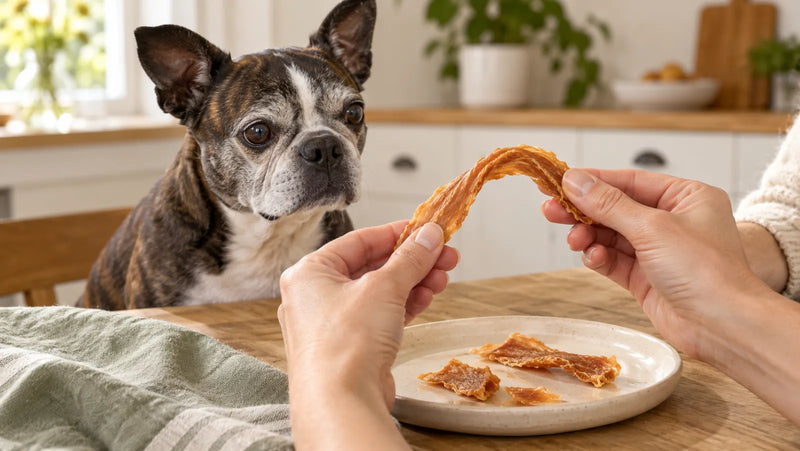
A working reward needs to reach the dog's mouth quickly, be swallowed comfortably and let the team resume the exercise. Compare the full piece and the prepared training piece. A strip that can be cleanly snipped may yield many working rewards; a brittle treat that turns to powder may create waste even when its price per pound looks low.
| Test | What to record | Why it affects a club order |
|---|---|---|
| Piece preparation | Scissors, hand-tear or ready-sized; time and consistency | Determines volunteer labor and portion control |
| Delivery | Grip, residue, pocket or pouch handling | Affects speed and surface cleanliness |
| Dog response | Acceptance and time to re-engage | Shows whether the reward fits the intended setting |
| Waste | Crumbs, rejected pieces and end-of-session leftovers | Changes usable yield from the purchased weight |
| Label fit | Ingredients, calories, feeding statement and storage | Supports handler screening and daily-budget planning |
Professional trainers buying for their own sessions can use the separate wholesale dog treats for professional trainers framework. The high-value dog-training reward guide goes deeper on motivation, texture and individual-dog fit. A club order adds shared receiving, member permissions and centralized inventory to those product questions.
Forecast Training-Day Demand Before Ordering 10 lb
Build demand from a measured pilot, not a generic “treats per run” assumption. Select two or more representative sessions, issue a weighed quantity to each participating handler, and record what returns unused. Keep the product and preparation method consistent during the measurement window.
Use the club's actual figures:
- Count active handler-dog teams. Exclude observers and teams bringing their own rewards.
- Define the schedule window. Use a named class block, seminar or number of practice nights.
- Measure use per participating team. Subtract clean, reusable returns from the issued weight.
- Add only a written reserve. State what the reserve covers and who may open it.
- Compare the result with the minimum. Ten pounds equals 160 ounces, but that arithmetic does not establish a piece count.
The minimum applies to each product. A club that orders chicken and beef must plan at least 10 lb of each rather than combining both proteins into one 10 lb threshold. If measured demand is too small, extend the planning window or choose a sealed purchasing path that is confirmed for the club; do not create consumption merely to reach the minimum.
Keep Each Dog's Treat Budget With Its Handler
The club can forecast inventory, but it should not assign a universal daily food allowance. The World Small Animal Veterinary Association treat guide says treats should remain under 10% of a dog's daily calorie intake and that the veterinary health-care team should determine a suitable amount and type for the individual dog.
Every handler should count the club reward with food used at home, chews, table tastes and supplements. Cutting one full treat into smaller pieces changes delivery size, not the calories in the full treat. The handler can reserve part of the dog's extras allowance before arriving and stop taking from the club supply when that measured amount is gone.
Puppies, dogs on weight plans, dogs with pancreatitis or other health conditions, and dogs eating veterinary-prescribed diets need case-specific guidance. A membership form, waiver or instructor preference cannot replace that guidance.
Screen Members Before You Standardize One Protein
Create an opt-in roster for the exact product. The handler supplies the dog's name, permission to use the product, known dietary restrictions, a no-share instruction and an emergency contact. Club staff record the product and lot in use; they do not diagnose allergies or decide that a reaction history has resolved.
Keep owner-supplied treats in a closed, clearly identified container. Do not pour several dogs' rewards into a common open bowl or return unused pieces to the club bag. Use separate clean tools or individually assigned cups when cross-contact matters to a handler's plan.
A club serving many dogs may need more than one reward path, but adding a second product also creates another 10 lb minimum, label record, storage location and reorder line. Add it because measured participation supports it, not to make the supply table look varied.
Receive, Store and Issue Club Working Stock
The FDA's pet-food and treat storage guidance recommends keeping food in its original container or bag so the product name, manufacturer, UPC, lot number and best-by information remain available. If another container is used, the FDA recommends placing the entire original bag inside it or preserving the identifying information.
Assign the controls before delivery:
- Purchasing lead: retains the written item, quantity, price, freight and timing confirmation.
- Receiving lead: checks product, pounds, package condition, lot/date information and storage directions.
- Inventory lead: keeps the original bag, separates lots, records openings and counts remaining sealed stock.
- Instructor or session lead: issues measured working quantities only to participating handlers.
- Handler: approves the exact reward for the dog and accounts for it in that dog's food plan.
Store sealed and opened stock according to the exact label. Use closed, clean, dry containers; keep the supply away from direct sun, damp equipment and unattended dogs; and reseal the bag after issue. Do not combine old and new lots in one bin. The bulk-reward controls for professional dog walkers cover portable pouch loading and multi-dog route separation when members need a field-ready comparison.
Separate Club Supply From Member Resale
Opened treats used by instructors and handlers during club-run sessions are an operating supply. Supplier-sealed packs sold unopened to members are retail inventory. Dividing bulk stock into new take-home bags, adding a club label or charging per repacked pouch creates packaging, labeling, traceability, facility and sales-state questions that need to be cleared before the order.
For sealed customer-branded pouches, review the American Paws private-label dog-treat manufacturer guide and use the American Paws private-label program to describe the intended bag, fill weight and channel. The FDA's animal-food labeling overview identifies federal label elements including product identity, net quantity, responsible company information and a complete ingredient list; state requirements may add more.
Evaluate the American Paws 2 lb Soft Chicken Strip Accurately
The current soft chicken training strips provide a concrete format to test. The live product information lists USA chicken breast with a touch of natural glycerin, a soft and chewy texture, strips approximately 2–5 inches long, about 15 kcal per full treat, and intermittent or supplemental feeding. The strips can be snipped into smaller working pieces.
This product is all-natural, but it is not single-ingredient. A club should share the full ingredient statement instead of shortening it to “chicken.” It does not fit a dog avoiding chicken or glycerin, and the listed calorie information must stay attached when a full strip is divided.
The retail 2 lb page demonstrates texture, ingredients and preparation. It does not establish the current wholesale case pack, bulk format or club price for that item. Ask American Paws to confirm which packaged or bulk path is available for the planned use.
Build a Reorder Point From Club Records
After the pilot and first order, calculate a reorder point from the club's average weekly use, the replenishment timing confirmed for the next order and a named reserve. Record cancellations, seasonal breaks and seminar spikes separately so one unusual month does not silently become the new baseline.
At each stock check, record sealed pounds, opened working stock, lot/date information and known upcoming sessions. Submit the next inquiry early enough to confirm current availability, freight and timing. Do not advertise a training date around inventory that has not been confirmed.
What American Paws Can Confirm Publicly
- American Paws operates in Highland, California.
- The facility lists FDA Food Facility Registration No. 13526766664.
- The wholesale minimum is 10 lb per product.
- Pricing starts at $14/lb; see the current catalog or contact American Paws for the selected item.
- Product, package path, current price, freight, availability and timing are confirmed for the specific inquiry.
Compare the exact labels and textures in the current American Paws dog treats, then send the club's measured use case through the wholesale page. Registration identifies the facility in the federal system; it does not mean that FDA approved or endorsed an individual product.
Frequently Asked Questions
What makes a dog treat high value for agility practice?
The individual dog's response in the intended setting determines reward value. Test whether the dog willingly takes a small piece, finishes it quickly and returns attention to the handler. Ingredient fit, calories, texture and safe delivery still matter even when the dog is enthusiastic.
Are food treats allowed in an AKC agility course area?
The current AKC agility regulations state that food and toys are not permitted in the course area. Clubs should check the current rulebook, premium, venue plan and officials' instructions for each event. Practice classes and other sanctioning organizations may operate under different rules.
How much should an agility club order?
Measure use during representative sessions, count only teams opting into the product, define the class or practice window and add a written reserve. American Paws' minimum is 10 lb per product. Confirm the current package path before converting the forecast into an order.
Can one club treat work for every dog?
No single reward should be mandatory for every dog. Some dogs have protein sensitivities, medical diets, calorie limits or low interest in the selected food. Keep owner-supplied and non-food reward paths available.
Is the American Paws 2 lb soft chicken strip single-ingredient?
No. The current ingredient statement lists USA chicken breast with a touch of natural glycerin for softness. It is all-natural and easy to snip, but it should not be described as single-ingredient.
Can a club divide bulk treats among members?
Issuing measured working portions for a controlled club session is operationally different from packing take-home or resale bags. Before repacking, relabeling or selling divided product, identify the responsible packer and clear the applicable facility, label, traceability and sales-state requirements.
What should a dog-sports club include in a wholesale inquiry?
Include the sport, use setting, number of active teams, schedule, preferred product and texture, measured or estimated pounds, opened-supply versus sealed-resale path, destination and target date. Ask for written confirmation of the exact item, package path, price, freight, availability and timing.
Send a Club-Use Brief Before Ordering
Bring one measured plan to the supplier: who will use the reward, where it will be used, which exact product passed the pilot, how the 10 lb minimum fits the schedule, and who will receive, store and issue it. That gives the club a controlled supply instead of an anonymous shared bag.
Send American Paws the agility-club wholesale brief with the sport, active teams, class or practice dates, product, planned pounds, packaging path, destination and target date. Confirm the current commercial details before collecting member money or publishing availability.