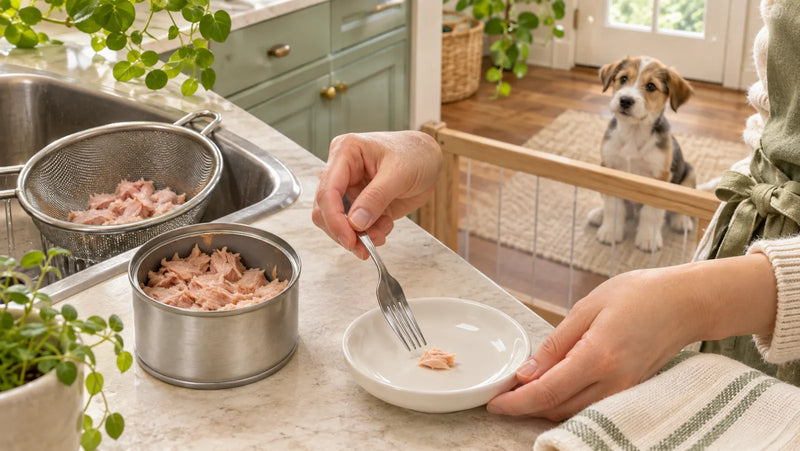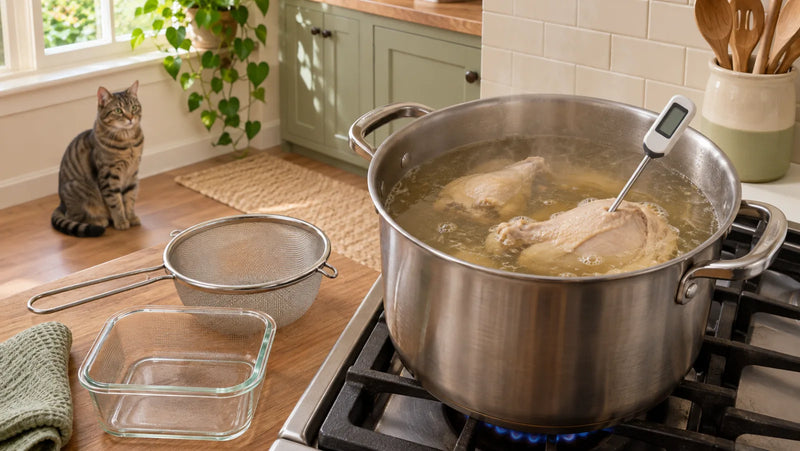


Can cats eat pork? An otherwise healthy adult cat may be able to try one or two tiny bites of plain, lean, boneless pork that has been cooked to a safe internal temperature, cooled, and allowed by the cat's veterinary feeding plan. Make the first piece no larger than one piece of the cat's regular kibble.
Pork is optional. It is not a complete feline diet, and a human-size bite is not a cat portion. Do not offer raw or undercooked pork, bones, visible fat, skin, grease, pan drippings, seasoned dishes, bacon, ham, sausage, or other cured pork. A kitten, a cat with a digestive or pancreatic history, or a cat on a prescription diet needs an individual answer from the veterinary team.
Can Cats Eat Pork? The Quick Form Check
| Pork form | Practical answer | Main reason |
|---|---|---|
| Plain lean boneless pork chop, roast, or tenderloin cooked to 145°F and rested three minutes | One tiny cooled bite may fit an eligible adult cat | Correct cooking and a cat-size portion reduce avoidable risk |
| Plain lean ground pork cooked to 160°F | One tiny cooled bite may fit | Ground meat has a higher cooking endpoint; confirm it is not sausage or pre-seasoned |
| Raw, rare, or undercooked pork | Do not offer | Parasites and foodborne germs are preventable hazards |
| Bacon, ham, sausage, salami, deli meat, or pork jerky | Skip as a planned treat | Curing, sodium, fat, smoke, sugar, and seasoning change the food |
| Fat cap, rind, crackling, grease, or pan drippings | Skip | Concentrated fat, calories, and recipe ingredients are easy to underestimate |
| Bone-in chop, rib, or raw or cooked pork bone | Do not give | Choking, dental injury, splintering, blockage, and internal injury are avoidable |
| Barbecue, glazed, breaded, marinated, sauced, or restaurant pork | Do not deliberately share | The complete recipe—not the word pork—determines the exposure |
This narrow answer applies to a small taste of fresh pork muscle meat. It is not permission to build a homemade cat diet around pork or to serve whatever pork dish is on the family table.
Fresh Pork Is Different From Bacon and Ham
A plain fresh pork cut can be cooked without anything added. Bacon and ham are cured human foods. Their brines, sodium, smoke, sugars, seasonings, fat distribution, and serving sizes vary, so they require different decisions.
For a cat that stole cured pork, use the exact package or recipe and the dedicated cat bacon safety article or cat ham safety article. Neither cured food becomes plain pork because it is cut into a smaller piece. Rinsing bacon or ham also does not reverse curing or establish a suitable sodium level.
Sausage, salami, deli pork, pork jerky, pepperoni, and pulled-pork mixtures are formulas rather than single cuts. They may contain salt, onion or garlic powder, sweeteners, smoke flavor, preservatives, hot spices, rich sauces, or a high proportion of fat. Keep those products out of the planned cat-treat rotation.
Raw or Undercooked Pork Is Not a Cat Treat
Trichinella is one reason cooking status matters. The Merck Veterinary Manual review of Trichinella infections in animals explains that susceptible hosts acquire the parasite by eating meat containing larvae and that mammals can be affected. Proper cooking is a core prevention control.
That does not mean every raw supermarket pork bite contains the parasite, and modern commercial pork is not the same risk as wild boar. It means there is no benefit to asking a cat or household to accept a preventable raw-meat risk.
Parasites are not the only concern. The CDC's pet-food safety guidance says raw animal protein can carry germs such as Salmonella and Listeria, can make pets and people sick, and is not recommended as raw pet food or treats. Freezing, searing the surface, curing, smoking, or calling meat “human grade” does not replace a verified cooking endpoint.
Keep raw pork and its juices away from the cat's bowl and ready-to-eat food. Wash hands, tools, the thermometer, cutting boards, and counters after raw-meat contact. Do not let a cat lick the raw package, prep plate, sink, or trimmings bin.
Cook Whole Cuts and Ground Pork to Different Endpoints
The FDA safe-food handling chart gives two useful endpoints: pork chops, roasts, and steaks reach 145°F with a three-minute rest, while ground meat reaches 160°F. Use a food thermometer in the thickest part. Color alone cannot confirm the endpoint.
Prepare the cat's possible taste as a truly plain portion. Cook it separately before the family adds salt, oil, butter, garlic, onion, rub, marinade, glaze, breading, barbecue sauce, gravy, or pan sauce. A piece removed after cooking in those ingredients is not reliably plain.
How to prepare one tiny plain pork taste
- Choose a fresh, lean, boneless whole cut or plain ground pork with no added seasoning.
- Use separate tools and surfaces for raw pork and ready-to-eat food.
- Cook a whole cut to 145°F and rest it for three minutes, or cook ground pork to 160°F.
- Move the cooked meat to a clean plate; do not return it to a raw-meat plate.
- Trim every visible fatty edge, rind, connective strip, and possible bone fragment.
- Let the meat cool, then cut one soft piece no larger than one piece of the cat's normal kibble.
- Offer it separately under supervision. Do not mix a large amount through the meal.
If the meat was cooked as part of a casserole, stew, restaurant entrée, sausage filling, stuffing, or barbecue dish, skip the improvised taste. The preparation above starts with plain pork; it is not a method for rescuing a seasoned recipe.
How Much Pork Can a Cat Eat?
For the first trial, use one soft bite no larger than one piece of the cat's regular kibble. Make it smaller for a small mouth or a cat that gulps food. Offer no other new ingredient that day, and watch for vomiting, diarrhea, itching, facial swelling, coughing, gagging, appetite change, or unusual behavior.
If the cat remains well and the veterinary feeding plan permits occasional table-food tastes, stop at one or two tiny bites total. That is a conservative boundary, not a daily serving, weekly schedule, nutritional goal, or reason to use the entire treat allowance.
WSAVA's cat-treat guidance says all treats together should stay below 10% of daily calories and should never replace a meal. Commercial treats, toppers, pill food, table tastes, and pork all share that one small extras budget. The individual cat's veterinarian may set a lower limit or no-extras plan.
The Cornell Feline Health Center emphasizes that cats need a complete, balanced diet and that occasional treats are not nutritionally complete. Pork muscle contains protein, but protein alone does not supply the full balance of amino acids, fatty acids, vitamins, minerals, and energy a cat needs.

Visible Fat, Skin, and Pan Drippings Stay Out
Trim the fat cap, fatty edge, rind, and skin before making a cat-size piece. Do not spoon grease or drippings over cat food. Those liquids concentrate fat and calories and may also carry salt, butter, garlic, onion, spice rub, or sauce from the family recipe.
A rich or fatty bite can upset an individual cat's stomach, but it would be inaccurate to say one fatty crumb automatically causes pancreatitis. The safer practical choice is to remove the unnecessary fat. A cat with previous pancreatitis, chronic digestive disease, obesity, high blood lipids, or a prescribed diet should not receive an improvised pork taste without veterinary approval.
Pork cooking liquid is not automatically broth for cats. If it contains salt, seasoning, fat, bone residue, onion, or garlic, it does not belong in the bowl. Use normal fresh water and the cat's established feeding plan instead.
Seasoning, Sauce, and Bones Change the Decision
Plain means no seasoning at all. The Merck Veterinary Manual's Allium safety review notes that cats are particularly susceptible to onion- and garlic-related red-blood-cell damage and that raw, cooked, dehydrated, and powdered forms matter. Read the whole label or recipe after an accidental exposure.
Barbecue sauce, gravy, marinades, rubs, butter, salt, alcohol, breading, glazes, and sweeteners add their own questions. Scraping off a sauce cannot prove the meat underneath is plain, because salt and other ingredients may have been present throughout cooking.
Do not offer pork bones. Raw bones can carry meat and pathogen risk; cooked bones can become brittle. Either form can cause choking, broken teeth, mouth injury, esophageal or intestinal obstruction, or internal damage. Cutting meat away from a bone is useful only when every fragment is removed and the meat itself was cooked plain.
Some Cats Should Skip the Experiment
Kittens need complete growth nutrition and predictable, age-appropriate pieces. They do not need pork exposure. Cats with kidney or heart disease, diabetes, obesity, food allergy, chronic digestive disease, pancreatitis history, poor appetite, a food-elimination trial, or a prescription diet should follow their current veterinary plan rather than a general table-food rule.
A pork reaction is also possible even though pork is a familiar animal protein. Stop after vomiting, diarrhea, itching, facial swelling, hives, coughing, breathing difficulty, or another new sign. Breathing trouble, collapse, or rapidly developing swelling requires emergency veterinary care.
Do not use pork to tempt a cat that is refusing normal food without first asking why the appetite changed. Sudden or persistent appetite loss in cats deserves veterinary attention; covering the problem with table meat can delay assessment.
Keep Cat, Adult-Dog, and Puppy Pork Questions Separate
Dogs and cats do not share one universal table-food portion. For a mature dog's pork-form decisions, use the adult-dog pork safety article. A growing dog has additional weaning, texture, and growth-diet constraints covered in the puppy pork article.
Other human foods need their own feline assessment too. For example, the cat banana article explains why “not classified as toxic” is not the same as nutritionally useful and why a cat-size sliver is different from a human slice. The same discipline applies here: identify the exact food form, protect the complete diet, and keep optional tastes truly small.
A Labeled Cat Treat Is Easier to Measure
A product made and labeled as a treat gives you an ingredient list, intended species, storage directions, and a repeatable piece. The cat treats selection article explains how to compare labels, calories, texture, piece size, intended use, and veterinary fit instead of assuming every meat scrap is a useful reward.
For cats that tolerate chicken and whose feeding plan allows it, American Paws' freeze-dried chicken treats for cats and dogs are currently labeled for both species and list 100% USA chicken breast, freeze-dried whole. The label says All Life Stages and intermittent or supplemental feeding only. Its dog feeding table is not a cat portion; choose the cat's amount with the veterinary plan and the total extras budget.
The broader American Paws dog treats collection includes products with different species labels. Check the exact live product page before buying for a cat; do not assume every dog-labeled item is also intended for cats or that every product is single-ingredient.
What to Do if a Cat Ate Pork
First, identify the exposure rather than treating every pork event alike. Was it fresh or cured, raw or cooked, whole-cut or ground, plain or seasoned, lean or fatty, boneless or bone-in? Estimate the maximum missing amount and time. Save the package, ingredient list, recipe, photo, bone, skewer, foil, string, or other relevant evidence.
If an otherwise healthy adult cat ate one tiny plain, fully cooked, boneless bite and remains normal, remove the rest, keep normal fresh water available, and observe. Do not create a home treatment for a trivial exposure.
Call the veterinary team, an emergency clinic, or an animal poison service promptly when:
- the pork was raw, undercooked, spoiled, cured, smoked, heavily salted, or from an unknown recipe;
- onion, garlic, sauce, marinade, alcohol, sweetener, or another concerning ingredient may be present;
- the amount was large relative to the cat or cannot be estimated;
- a bone, skewer, foil, string, absorbent pad, plastic, or packaging may be missing;
- the cat is a kitten, has a medical condition, or eats a prescription or elimination diet; or
- there is repeated vomiting, diarrhea, marked lethargy, severe pain, choking, trouble breathing, pale gums, weakness, tremor, collapse, or seizure.
Do not induce vomiting, force water or food, give human medication, add salt, or use oil, milk, bread, or another home remedy unless a veterinary professional specifically directs it for this cat and exposure.
Frequently Asked Questions
Can cats eat cooked pork?
Some healthy adult cats may try one or two kibble-size bites of plain, lean, boneless pork cooked to the correct safe temperature. Cool it, trim visible fat, and keep it within the veterinary feeding plan and total treat budget.
Can cats eat raw pork?
No deliberate serving. Raw or undercooked pork can expose cats and household members to parasites and foodborne germs. Freezing or searing is not a substitute for cooking the meat to a verified endpoint.
Can cats eat pork chops?
Only a tiny piece from a plain lean boneless portion may fit. Cook the chop to 145°F, rest it for three minutes, remove the bone and every fatty edge, cool it, and cut the piece to kibble size. Skip seasoned or pan-sauced chops.
Can cats eat ground pork?
Plain ground pork must reach 160°F. Confirm it is not sausage, meatball mix, dumpling filling, or pre-seasoned pork. If otherwise eligible, the cat portion is still one tiny cooled bite, not a spoonful.
How much pork can a cat eat?
Begin with one soft piece no larger than the cat's normal kibble. If the cat remains well and the veterinary plan allows extras, one or two tiny bites total are enough. Do not create a daily or weekly pork schedule.
Can kittens eat pork?
Kittens do not need pork. Complete-and-balanced growth food should remain the priority, and new textures must be sized for safe chewing and swallowing. Ask the kitten's veterinarian before adding table-food tastes.
Can cats eat pork fat, skin, or crackling?
Skip them. They concentrate fat and calories, may carry seasoning, and offer no advantage over one tiny lean piece. Grease and pan drippings should not be used as broth or a topper.
Is pork hypoallergenic for cats?
No protein is universally hypoallergenic. A cat can react to pork, and a food trial works only when the veterinary plan controls every ingredient. Do not introduce pork during an elimination or prescription-diet trial unless the veterinarian directs it.
Keep Pork Plain, Lean, Cooked, and Tiny
The safe edge is narrow: an eligible adult cat, one or two kibble-size bites, fresh lean boneless pork, no seasoning, and the correct whole-cut or ground-meat cooking endpoint. Raw pork, fat, bones, bacon, ham, sausage, and mixed recipes stay out. Complete cat food remains the meal.
Choose the next reward deliberately: compare clearly labeled cat treats, then verify the exact species label, ingredients, texture, calories, and veterinary fit. If chicken fits the cat's plan, see the current dual-species freeze-dried chicken label; otherwise choose a different veterinarian-approved option. A measured treat is easier to count than a changing table scrap.