Can cats eat bananas? A healthy adult cat may be able to try one or two tiny, paper-thin slivers of ripe, peeled, plain banana if the veterinary feeding plan allows extras. Banana is optional, not a food cats need. It adds natural sugar and carbohydrate to a very small treat budget and must never replace complete cat food.
Start with one sliver no larger than one normal piece of the cat's food, then stop and observe. Do not offer the peel, a whole human-size banana coin, a large or frozen chunk, sweetened banana chips, dried banana or a mixed banana dessert. If the cat sniffs and walks away, that is a perfectly good answer.
Can Cats Eat Bananas? The Quick Form Check
| Banana form | Routine cat choice? | Main decision |
|---|---|---|
| Ripe, fresh, peeled, plain banana | Possibly one tiny first sliver for an eligible adult cat | Optional calories, texture and individual tolerance |
| Banana peel, stem or stringy peel fibers | No | Tough, awkward to swallow and nutritionally unnecessary |
| Large coin or frozen solid piece | No | Poor size and texture for a cat |
| Dried banana or banana chips | No planned serving | Concentrated portion; may add sugar, oil or coating |
| Banana bread, muffin, pudding or smoothie | Recipe-specific; do not offer | Other ingredients determine the risk |
| Banana-flavored candy or sugar-free food | No | Not equivalent to fruit; ingredient review required |
The ASPCA lists the banana plant as non-toxic to cats. That classification is useful, but it is not a recommendation to feed the fruit, peel or plant. “Not classified as toxic” does not mean nutritionally necessary, suitable in every form or appropriate for every cat.
Why Most Cats Do Not Care About Banana’s Sweetness
People often expect a ripe banana's sweetness to attract a cat. Feline taste biology works differently. In a primary PLOS Genetics study of the feline sweet-receptor genes, researchers found that the cat's Tas1r2 gene is an unexpressed pseudogene. Without a functional T1R2 component, the usual mammalian T1R2/T1R3 sweet receptor cannot form.
In practical terms, cats likely do not detect sweet stimuli the way people and dogs do. This does not mean a cat has no sense of taste or cannot notice banana. A cat may investigate its moisture, texture, temperature, novelty, another aroma or simply the attention surrounding the food. Another cat may be completely indifferent.
Neither reaction creates a nutritional need. Do not smear banana on the nose, push it into the mouth or repeatedly present it to make the cat “learn” fruit. Voluntary interest is a prerequisite for an optional taste, not a goal every cat must reach.
Banana Adds Sugar and Carbohydrate, Not Essential Feline Nutrition
Banana is a carbohydrate-rich fruit with naturally occurring sugar. Those components are not a poison in a tiny plain sliver, but they do not turn banana into a useful substitute for the animal-derived nutrients a cat requires. The Cornell Feline Health Center explains that cats are obligate carnivores and rely on nutrients found in animal products. A complete and balanced cat food is designed to supply those needs in the right proportions.
“Obligate carnivore” does not mean one plant-food crumb is automatically toxic. The Merck Veterinary Manual's cat-nutrition guidance notes that cats can digest small amounts of some carbohydrates, depending on the type and life stage, while still needing a nutritionally balanced feline diet. The point is priority: banana supplies optional treat calories, not a missing feline requirement.
Do not use banana to treat constipation, diarrhea, low potassium, poor appetite or another health problem without veterinary direction. A cat eating less than normal can become ill quickly, and coating food with fruit may hide rather than solve the cause. Cats with diabetes, obesity, chronic gastrointestinal disease, a prescription diet or a veterinary food trial should not receive an improvised banana taste.
How to Offer One or Two Tiny Banana Slivers
Choose Ripe, Fresh and Plain
Use a fresh ripe banana with no mold, fermentation, chocolate, syrup, spice, dairy, sweetener or other ingredient. Wash your hands, peel the banana completely and put the peel and stem where the cat cannot reach them. Do not use fruit from a mixed bowl if its other ingredients or coatings are uncertain.
Remove Peel and Stringy Material
Take away the full peel and any long stringy fibers clinging to the fruit. The edible test is the soft inner fruit only. Set the rest of the banana aside before serving so the cat cannot turn one taste into free access.
Cut a Paper-Thin Cat-Size Sliver
Cut a sliver no larger in footprint than one usual piece of the cat's food, then flatten it so it is thin and soft. “One or two slices” means one or two of these cat-size slivers in total—not one or two round coins cut for a person. A full banana coin is unnecessarily large and may be awkward for a cat to pick up and swallow.
Offer One First, Then Stop and Observe
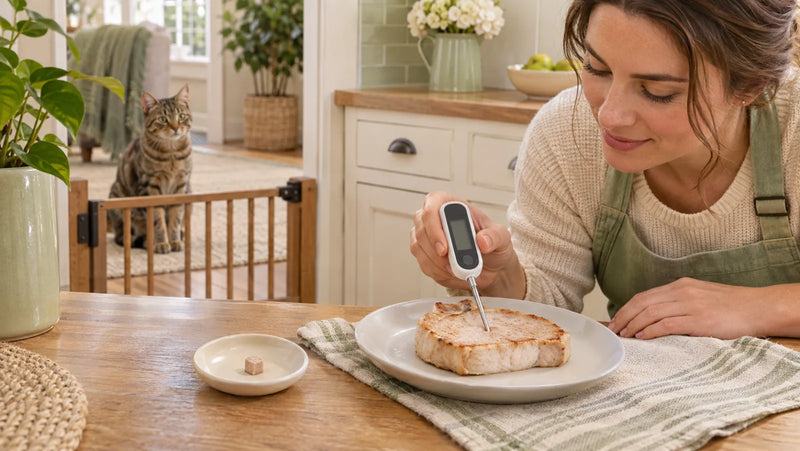
Place one room-temperature sliver on a clean shallow saucer beside, not mixed throughout, the regular meal. Let the cat approach and leave voluntarily. Do not hand-feed it into the mouth. If the cat eats the sliver, stop there the first time and watch for vomiting, diarrhea, repeated lip licking, apparent abdominal discomfort, itching, swelling or other unusual signs.

Why the Banana Peel Stays Out of the Bowl
The peel is not a treat. It is tough, fibrous, bulky relative to a cat's mouth and difficult to divide into a sensible reward. Its non-toxic plant classification does not make chewing or swallowing it useful. The stem and long peel fibers add more awkward shapes with no nutritional reason to offer them.
Put the peel directly into a lidded trash or compost container the cat cannot open. Do not leave it on the counter, in an open wastebasket or dangling from a plate. A curious cat may play with the peel even if the fruit's sweetness has no appeal.
If the cat swallowed peel, do not assume either “poisoning” or “nothing to worry about.” Record the piece size, amount and time and call the veterinary team for case-specific advice, especially for a large or uncertain amount. Repeated vomiting, retching, drooling, abdominal pain, appetite loss, marked lethargy or trouble passing stool needs prompt attention. Do not induce vomiting or give oil, fiber, milk, bread or a forced meal unless the treating professional directs it.
Banana Chips, Dried Banana and Banana Recipes Are Different Foods
Drying removes water, so a small-looking piece represents a more concentrated amount of fruit than the same size of fresh banana. Commercial dried banana and chips may also contain added sugar, oil, flavoring or coatings, and a crisp chip can be hard and wide. Do not transfer the fresh-fruit sliver rule to a dried product.
Banana bread, muffins, pancakes, pudding, smoothies, yogurt, ice cream and candy are recipes, not bananas. They may add dairy, fat, sugar, chocolate, coffee, alcohol, nuts, spices or sweeteners. Even when none of those ingredients creates an emergency, a rich mixed food is not a sensible cat treat.
If a cat ate a banana-containing recipe, save the package or recipe and inspect every ingredient rather than searching only for banana. A sugar-free label requires exact sweetener identification; do not guess from the front of the package. Contact the veterinarian or an animal poison service when a concerning ingredient, meaningful amount or symptom is involved.
How Much Banana Can a Cat Have?
For an eligible healthy adult cat, the first trial is one paper-thin sliver no larger than one normal food piece. If the cat tolerates it and the veterinary plan permits future banana, one or two tiny slivers in total on an occasional day is already enough. There is no reason to work up to a tablespoon, fraction of a banana or daily schedule.
The WSAVA Nutrition Committee's cat-treat guide says treats should remain below 10% of daily calories and should never replace a meal. That is a ceiling shared by every extra—commercial cat treats, table tastes, medication foods and banana—not a target to fill. A veterinarian may set a lower limit for the individual cat.
Kittens should not receive the adult test portion by default. Their growth diet and small stomach leave little room for nutritionally incomplete extras. Cats with diabetes, excess weight, chronic digestive signs, poor appetite, food allergy evaluation, an elimination trial or a prescription diet also need veterinary direction. “Only fruit” does not override a medical nutrition plan.
The cat-treat selection guide helps compare labels, calories, texture, intended use and life-stage fit. It is a better framework for a repeat reward than treating the shared 10% ceiling as permission for any food that fits under it.
What to Do If Your Cat Ate Banana
- Secure the food and packaging. Remove the remaining fruit, peel, recipe, wrapper and trash so the exposure cannot continue.
- Identify what was eaten. Was it plain inner fruit, peel, dried banana, a frozen chunk or a mixed recipe?
- Record the facts. Note the cat's weight and health, estimated amount, time, ingredient list and current behavior. Save the label or recipe.
- Use the highest-risk component. Peel, a large amount, a hard or frozen piece, an unknown recipe, a concerning co-ingredient or symptoms changes the response.
A tiny lick or cat-size sliver of plain peeled banana in a well adult cat is different from a swallowed peel or chocolate-banana dessert. Observe the first situation and contact the veterinary team if signs develop. Call promptly for the second situation, for an uncertain amount or ingredient list, or for repeated vomiting or diarrhea, retching, pain, marked lethargy, swelling, breathing changes, appetite loss or trouble passing stool.
Do not use peroxide, salt, oil, milk, charcoal, fiber, bread or human medication as a home response. A peel exposure and a mixed-recipe exposure have different concerns, and a professional needs the facts you collected to guide the next step.
Keep the Cat, Dog and Treat Choices Separate
Dogs have different food behavior, calorie ranges and serving decisions. Use the dog-specific banana guide instead of scaling this cat sliver upward. Within the cat line, the cat-specific blueberry guide handles berry shape, flattening and portions, while the cat-specific carrot guide explains why cooking and texture change that vegetable's answer.
An animal-protein reward is a different comparison. American Paws' current freeze-dried chicken treats for cats and dogs list 100% USA chicken breast, an All Life Stages designation and intermittent or supplemental feeding. That exact dual-species label does not make the product complete cat food or suitable for a cat with chicken restriction, but it is more aligned with feline food preferences than trying to persuade a cat to value banana sweetness.
Frequently Asked Questions
Can Kittens Eat Bananas?
Do not copy the adult sliver to a kitten. Kittens need complete growth nutrition, have very small calorie and stomach capacity, and vary in chewing skill. There is no benefit to introducing banana early; ask the kitten's veterinarian before offering any non-complete extra.
Can Cats Taste Bananas If They Cannot Taste Sweet?
Yes, a cat can still notice banana's aroma, moisture, temperature and texture. The missing functional sweet-receptor component means cats likely do not perceive sweetness the way people do; it does not erase their other senses or guarantee that every cat ignores the fruit.
Can Cats Eat Banana Peel?
Do not offer it. Peel is tough, fibrous, bulky and unnecessary. If a cat swallowed some, record the amount and time and call the veterinary team for advice, especially after a large or uncertain piece or if vomiting, pain, appetite loss or difficulty passing stool develops.
Can Cats Eat Dried Banana or Banana Chips?
Skip them as routine treats. They concentrate the fruit portion and may add sugar, oil, flavoring or coating. Chips can also be hard and wide. A fresh paper-thin sliver is easier to control if a veterinarian approves banana at all.
Can Cats Eat Frozen Banana?
Do not offer a frozen solid coin or chunk. It is hard and poorly sized for a cat. Thawing does not create a nutritional reason to serve banana; if an approved taste is desired, use a fresh, soft, room-temperature sliver instead.
Can Cats Eat Banana Bread?
Do not offer it. Banana bread is a mixed recipe that may contain butter, sugar, chocolate, nuts, spices or other ingredients and is not equivalent to plain fruit. If a cat stole some, check the exact recipe and amount before calling for advice.
How Much Banana Can a Cat Eat?
Begin with one paper-thin sliver no larger than one normal food piece. For an eligible adult that tolerates it, one or two tiny slivers in total on an occasional day is enough. All extras must share the veterinarian-set calorie budget and stay below the cat's complete-food priority.
Let the Cat Shrug and Keep Complete Food in Charge
A healthy adult cat may be able to taste one tiny sliver of ripe, plain, peeled banana, but there is no reason to persuade a disinterested cat or build toward a larger portion. Remove the peel, keep pieces soft and paper-thin, avoid dried and mixed forms, and let the veterinary diet plan decide whether any repeat taste fits.
Use the cat-treat guide to compare exact labels and roles. You can browse current American Paws dog treats, but the collection name is a reminder to check species labeling rather than assume every item fits a cat; the linked chicken product is the specific current dual-species option. Whatever the extra, complete cat food remains the meal.