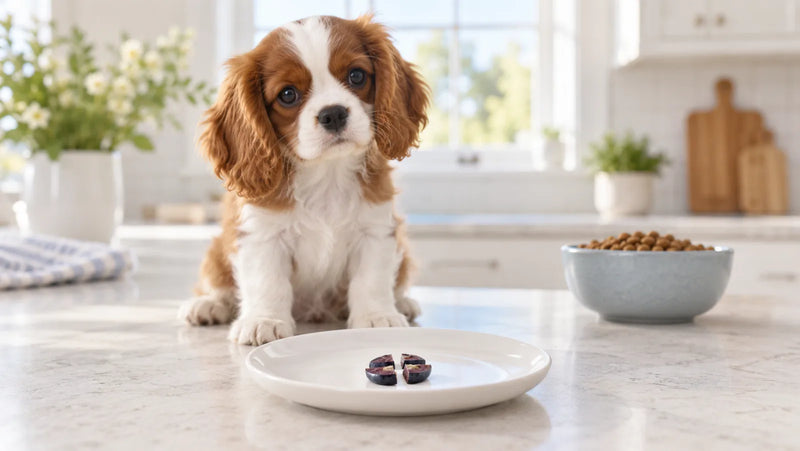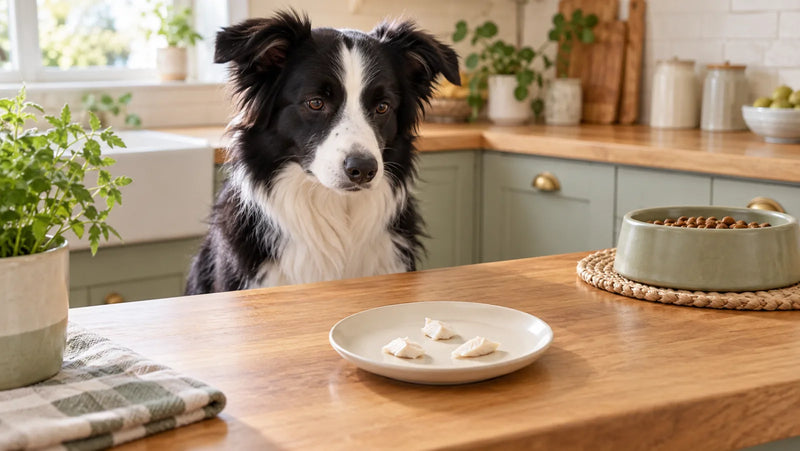

Yes—most dogs can eat a little ripe banana as an occasional treat. If you are wondering, “can dogs eat bananas?” the safe serving is peeled fruit cut into pieces that suit your dog's size. A whole banana, an oversized frozen chunk, or a swallowed peel is a different question.
Banana contains fiber and several familiar micronutrients, but it also contains natural sugar and calories. Start with one small piece, keep every treat within the dog's limited extra-food budget, and use a complete and balanced dog food—not fruit—as the nutritional foundation.
Can dogs eat bananas? The quick answer
For many healthy dogs, the answer is yes when the banana is ripe, plain, peeled, and modestly portioned. The ASPCA lists banana as non-toxic to dogs, and the American Kennel Club's banana guidance likewise says dogs can have the fruit in moderation.
A good first serving follows five simple checks:
- Use ripe fruit: choose the soft edible flesh rather than a very firm green banana.
- Remove the peel: the peel is fibrous and difficult to digest.
- Cut it small: match the piece to the dog's mouth, teeth, and tendency to gulp.
- Begin with one piece: introduce one new food at a time and watch how the dog responds.
- Count the calories: banana shares the same treat allowance as chews, toppers, and training rewards.
Banana is optional. A dog never needs to learn to like it, and refusing fruit is not a nutrition problem when the main diet is complete and appropriate.
Are bananas safe for dogs?
Ripe banana flesh is non-toxic
Plain ripe banana flesh is not considered poisonous to dogs. That is the reassuring part. It does not contain the well-known canine hazards associated with grapes, raisins, chocolate, or xylitol. It can be offered without seasoning, syrup, coating, or sweetener.
“Non-toxic” describes poison risk; it does not promise that every amount or texture is safe. A very large serving may cause vomiting, loose stool, gas, or abdominal discomfort simply because it is a sudden load of fruit, fiber, carbohydrate, and sugar. A large piece can also be swallowed without enough chewing.
Safe does not mean unlimited
Banana's sweet taste makes it easy to over-serve. The AKC recommends it as an occasional treat because of its natural sugar. That matters most for a small dog, a dog already receiving many rewards, or a dog whose calorie or blood-glucose intake is being managed.
Do not use a banana as a meal substitute. The fruit does not supply the complete balance of protein, fat, amino acids, vitamins, and minerals formulated into a dog's main food. Even a “healthy” extra can unbalance the routine if it displaces too much complete food.
Banana benefits for dogs—kept in perspective
Fiber and familiar micronutrients
Bananas contain fiber, potassium, vitamin B6, vitamin C, magnesium, copper, and other nutrients. These facts explain why the fruit can be a reasonable whole-food treat for a dog that tolerates it. The soft texture can also be easier to cut or mash than a hard biscuit.
The right claim stops there. A bite of banana is not a potassium supplement, bone treatment, immune booster, coat remedy, or digestive prescription. Nutrient content does not prove a medical effect, and more fruit does not automatically create more benefit.
A complete diet still does the nutritional work
Dogs eating complete and balanced food should already receive nutrients in appropriate amounts and ratios. Banana adds flavor and variety, not a missing foundation. For that reason, it is best treated like every other extra: useful if the dog enjoys it and the portion fits, unnecessary if it does not.
Fiber also deserves restraint. Some dogs tolerate a little banana well; others develop softer stool or gas. Do not use increasing amounts to self-treat constipation or diarrhea. Persistent digestive signs, blood, repeated vomiting, dehydration, pain, or lethargy call for veterinary advice rather than another fruit experiment.
Can dogs eat banana peels?
Non-toxic is not the same as digestible
Dogs should not be served banana peels. The peel is not generally classified as toxic, but it is tough, very fibrous, and difficult to digest. The AKC cautions that swallowed peel can contribute to an intestinal blockage. It may also trigger vomiting or stomach upset before it passes.
Remove the peel before cutting the fruit, keep the discarded peel out of reach, and do not let a dog carry away a whole banana from a grocery bag or counter. “My dog can chew it” is not a reason to make the digestive tract handle it.
What to do if a dog swallows peel
Take away the remaining peel and note approximately how much was swallowed, when it happened, and the dog's size. Call a veterinarian promptly for a large amount, a small dog, a dog with a previous obstruction, or any uncertainty. Do not induce vomiting unless a veterinary professional specifically directs you to do so.
Seek urgent help for repeated vomiting or unproductive retching, a painful or swollen abdomen, marked lethargy, refusal of food, repeated straining, inability to pass stool, collapse, or breathing difficulty. Those signs are not proof of a blockage, but they are reasons not to wait for a blog article to solve the problem.
How much banana can a dog eat?
Start with one small piece
For a dog trying banana for the first time, offer one peeled piece no larger than a familiar training treat. Give no other new food that day. Over the next several hours, watch for vomiting, diarrhea, unusual gas, itching, facial swelling, or another reaction.
If the first taste agrees with the dog, a deliberately modest serving might mean one thin slice cut smaller for a toy dog, one or two small half-moons for a medium dog, or a few small pieces for a large dog. These are conservative examples, not daily doses or maximum allowances. Banana size, slice thickness, body condition, activity, main food, and other treats all change the math.
Use size-aware examples, not a rigid dose chart
A fixed “half a banana for every large dog” rule ignores too much. Two dogs with the same body weight can have different calorie needs. A thick piece from a large banana can contain several times as much fruit as a thin coin from a small one. A dog losing weight has less room for extras than a highly active dog at ideal condition.
Make the piece physically safe first, then make the total nutritionally modest. Small dogs, puppies, seniors, dogs with dental pain, and fast gulpers need smaller, softer pieces. A dog that swallows food whole may be better served a tiny mash spread thinly on a lick mat rather than a round coin.
Count banana within the under-10% treat budget
The World Small Animal Veterinary Association's treat guide says treats should make up no more than 10% of a dog's daily calorie intake. The other 90% or more should come from complete and balanced food. Ten percent is a ceiling, not a banana target.
That small allowance includes every extra: banana, training treats, dental products, chews, table bites, toppers, and food used to give medicine. Our guide to the daily dog-treat calorie budget explains why a dog's body condition and main diet matter more than a generic piece count.
How to feed banana to a dog
Fresh peeled slices
Wash your hands, peel the banana completely, and cut a small amount into thin half-moons or tiny cubes. Serve the pieces plain. If the dog tends to bolt food, cut each slice again rather than handing over a large slippery coin.
Refrigerate the unused human portion in a covered container if desired, but discard fruit that is moldy, fermented, leaking, or has an off odor. Brown spotting on a ripe peel is normal; visible mold or spoilage is not.
Mashed banana as a measured topper
A teaspoon-size dab of lightly mashed banana can be spread thinly over a lick mat or mixed into the dog's normal food. Measure before adding it. Free-pouring a mash makes the amount hard to see and can turn a taste into a substantial extra.
Keep it plain. There is no need for sugar, honey, syrup, milk, cream, flavored yogurt, or granola. If a toy or lick mat is used, supervise it and clean it promptly so mashed fruit does not spoil in seams.
Frozen banana pieces for warm weather
For a simple summer option, peel the banana, cut a few dog-size pieces, arrange them separately on parchment, and freeze them before transferring them to a closed container. Freezing pieces separately prevents one solid mass and makes it easier to take out a measured amount.
Frozen banana is food, not a dental chew or a heat treatment. A rock-hard chunk can be difficult for a small dog, senior, or dog with dental disease. Let it soften briefly, cut it smaller if needed, supervise, and offer fresh water. Never freeze and hand over a whole peel-on banana.

Banana mixtures and label checks
Banana bread, pudding, smoothies, chips, sweetened yogurt, and desserts are not equivalent to plain fruit. They can add concentrated sugar, fat, salt, chocolate, raisins, macadamia nuts, alcohol flavorings, or sweeteners. Sugar-free does not mean dog-safe.
Read the complete ingredient list before sharing any mixed food. Xylitol—sometimes labeled birch sugar or wood sugar—is an emergency for dogs. If a dog eats a product that may contain xylitol or another toxic ingredient, contact a veterinarian or the ASPCA Animal Poison Control Center at 888-426-4435 rather than waiting for symptoms.
When banana is not the right treat
Ask the veterinary team before adding banana when a dog has diabetes, obesity, kidney disease, pancreatitis history, gastrointestinal disease, a food sensitivity, a prescription or elimination diet, or a veterinarian-set calorie or mineral plan. The issue may be sugar, calories, fiber, potassium, an unapproved ingredient, or simply less room for extras.
Banana may also be a poor physical fit for dogs with dental pain, swallowing difficulty, a prior obstruction, or a habit of gulping. A safer texture and portion can sometimes solve the problem; in other cases, the right choice is a different treat.
Stop serving banana if it repeatedly causes vomiting, diarrhea, itching, ear irritation, hives, facial swelling, or discomfort. Breathing difficulty, collapse, or rapidly worsening swelling is an emergency. An ingredient being generally safe does not rule out an individual intolerance or reaction.
Frequently asked questions
Can puppies eat bananas?
A weaned puppy may be able to taste a tiny peeled piece after the veterinarian confirms that treats fit the growth diet. Puppies have small calorie allowances and rely on complete puppy food, so fruit should stay especially limited and be cut into very small pieces.
Can dogs eat bananas every day?
There is usually no reason to make banana a daily habit. Occasional small pieces are easier to fit around a complete diet and other rewards. If a dog receives it regularly, include the calories in the full treat budget and ask the veterinary team whether it suits the dog's weight and health plan.
Can dogs eat frozen bananas?
Yes, many dogs can have a small peeled, pre-cut frozen piece. Avoid whole or oversized hard chunks, let pieces soften for dogs with sensitive teeth, and supervise. Frozen banana should cool the mouth briefly; it does not prevent heat illness or replace shade, rest, and water.
Can dogs eat banana bread?
Banana bread is not a recommended dog treat. It usually contains added sugar and fat, and some recipes include raisins, chocolate, macadamia nuts, nutmeg, or xylitol-containing ingredients. The safer way to share the banana flavor is one plain piece of fruit.
Can dogs eat green bananas?
Green banana flesh is not known as a canine toxin, but it is firmer, starchier, and may be less digestible or appealing. There is no advantage to testing it. Choose a ripe banana, remove the peel, and offer one small soft piece instead.
Keep banana small, peeled, and occasional
Banana can be one of many simple dog treats when the edible flesh is ripe, the peel is removed, the piece is sized for the dog, and the total stays within the calorie plan. Its fiber and micronutrients are real; so are its sugar, calories, and the digestive risk of too much.
American Paws does not currently sell a banana product, so we will not point you to an imaginary one. If a labeled, portionable reward fits your routine better than fresh fruit, browse all current American Paws dog treats and choose a protein and texture your dog already tolerates.