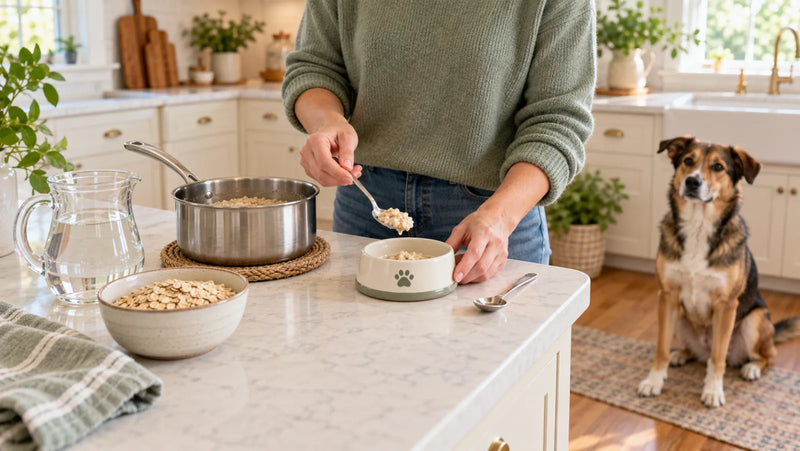

Can dogs eat kiwi? Yes—an otherwise healthy adult dog may try a small piece of plain, ripe kiwi flesh as an occasional treat. Wash the fruit, remove the fuzzy skin, and offer one thin slice or one to two dog-sized pieces. Do not hand over a whole kiwi, and do not turn “one or two” into a daily prescription or a target to increase.
The flesh, fuzzy skin, tiny black seeds, and a swallowed whole fruit are not the same question. The skin is not considered poisonous, but its tough, fibrous texture can be harder to chew and digest. The tiny seeds embedded in the flesh are not comparable to a hard plum pit and do not need to be picked out. The amount, preparation, the dog's health, and the full recipe matter more than the word “kiwi” on its own.
Kiwi is optional flavor variety—not a vitamin supplement, hydration treatment, digestive remedy, or replacement for complete-and-balanced dog food. A dog that dislikes it or has a sensitive stomach loses nothing by skipping it.
Can Dogs Eat Kiwi? The Short Answer by Form
| Kiwi form | Decision | Why |
|---|---|---|
| Washed, peeled, ripe flesh | One small piece may be an occasional first taste | The ingredient, texture, and portion are visible and controlled |
| Fuzzy skin | Remove before sharing | It is tough and fiber-rich, so peeling gives better chewing and digestive control |
| Tiny black seeds in the flesh | They may remain in the small serving | They are not considered toxic and are not a hard stone-fruit pit |
| Whole kiwi | Do not offer | A dog may gulp a large, slippery, skin-on fruit and create a choking or foreign-material concern |
| Frozen-hard chunk | Do not offer hard | Thaw until soft, peel if needed, and resize before considering a piece |
| Dried or candied kiwi | Fresh is easier to control | Drying concentrates the portion, commercial products may add sugar, and the texture may be sticky |
| Jam, smoothie, yogurt, candy, or dessert | Check every ingredient and the package | Sweeteners, chocolate, alcohol, dairy, supplements, skewers, or wrappers can change the response |
| Moldy or fermented fruit | Discard | Spoilage is not made safe by peeling away one visible spot |
The American Kennel Club's veterinarian-informed kiwi guidance also recommends small peeled pieces, warns against offering a whole fruit, and frames kiwi as an occasional taste rather than a dietary staple. That is the useful baseline; the rest of the decision is preparation and individual tolerance.
Can Dogs Eat Kiwi Skin or Seeds?
Skin and seeds often get grouped together online even though their size, texture, and practical risks are very different. Treat them separately.
Remove the fuzzy skin for texture and tolerance
Kiwi skin is not treated as a canine poison. The reason to remove it is simpler: it is tough, fuzzy, and rich in insoluble fiber. AKC notes that the skin can be hard for dogs to digest and that too much kiwi may lead to digestive upset. Peeling also makes the final piece easier to inspect, flatten, and cut below the size of the dog's usual reward.
A dog that steals a small patch of skin does not automatically have an intestinal blockage. Do not make that diagnosis from an article. The amount swallowed, whether the fruit was chewed, the dog's size and history, and any coughing, retching, vomiting, appetite change, abdominal discomfort, or stool change determine what the veterinary team needs to know.
The tiny black seeds are not plum pits
The PetMD kiwi guide, reviewed by a board-certified veterinarian, states that the tiny black seeds are not toxic to dogs and may be eaten with the flesh. There is no practical need to scrape every seed from one small prepared piece.
This does not create a rule for every fruit seed. A kiwi seed is tiny and embedded throughout soft flesh; a plum pit is a large hard object that can choke or obstruct and contains seed material with a different toxicology question. Use the dedicated plum flesh and pit guide when a stone fruit is involved instead of transferring the kiwi answer to it.
The honest seed rule is narrow: the natural tiny seeds may remain in the one small kiwi portion. The dog still should not receive a whole fruit, a bowlful of flesh, an unknown supplement made from concentrated seeds, or a product whose full ingredient list has not been checked.
How to Prepare Kiwi for a Dog
Prepare the fruit before inviting the dog near the counter. Begin with clean hands, a clean board, and a clean knife that have not just touched raw meat. Choose a ripe, sound kiwi without mold, leaking decay, fermentation, or extensive bruising.
- Rinse before peeling. Hold the whole kiwi under plain running water and rub the surface gently so dirt is not carried inward by the knife.
- Dry and peel. Remove the full fuzzy skin. Do not use soap, detergent, bleach, or commercial produce wash on the fruit.
- Inspect the flesh. It should look and smell fresh, with no mold, fermentation, or spoiled section.
- Slice on the board. Cut one thin, soft piece smaller than the dog's usual reward. Avoid a round plug or large slippery cube.
- Resize for the individual dog. A small dog, fast gulper, or uncertain chewer may need a flatter speck or a measured mash on a stable dish. A swallowing concern may make kiwi the wrong treat entirely.
- Offer calmly. Give one piece from an open hand or dish and watch pickup, chewing, and swallowing. Do not toss it through the air or create competition between dogs.
The FDA's fresh-produce guidance says to wash produce under running water before peeling or cutting, cut away damaged areas, discard rotten produce, and keep it separate from raw meat and its utensils. FDA does not recommend washing produce with soap, detergent, or commercial produce wash.

How Much Kiwi Can a Dog Eat?
Start with one small prepared piece. Choose an ordinary day when the dog feels well, is eating the usual food, and is not also trying another new ingredient. A clean one-food trial makes any digestive response easier to interpret.
If the dog has already tolerated kiwi and the veterinary plan allows human-food extras, one or two small pieces are enough for an occasional serving. “One or two” means pieces cut for that dog's mouth—not one or two whole kiwis, not large human snack wedges, and not a guaranteed maximum for every dog.
| Situation | Conservative approach | What not to infer |
|---|---|---|
| First-ever taste | One small peeled, thin piece | Do not increase during the same trial |
| Previously tolerated taste | One or two small pieces, occasionally | This is not a daily dose or universal maximum |
| Small dog, gulper, dental, or swallowing concern | Ask first; mash a tiny amount only if the veterinarian approves | Cutting smaller cannot guarantee safe swallowing |
| Unknown or large amount stolen | Record details and call the veterinary team | Do not convert the theft into a serving recommendation |
The World Small Animal Veterinary Association's treat guide recommends that treats provide less than 10% of a dog's daily calories, never replace a complete meal, and be appropriate in size and shape. It also directs owners to the veterinary health-care team for a suitable treat type and quantity.
Kiwi shares that extras allowance with every training reward, chew, topper, table taste, enrichment filling, and food used for medication. The shared daily treat-calorie budget explains how to count them together. Because calorie needs, fruit size, piece size, health, and every other extra vary, a universal kiwi chart by dog weight would suggest more precision than the evidence supports.
Why Kiwi Can Upset a Sensitive Stomach
Kiwi brings fiber, natural sugar, water, and an unfamiliar texture into the diet. A small amount may be uneventful, while a larger portion or the fibrous skin may lead to gas, loose stool, vomiting, or abdominal discomfort. A dog with a history of digestive sensitivity may be a poor candidate even for a small trial.
Stop kiwi after a reaction rather than testing through it. Contact the veterinary team for repeated vomiting or diarrhea, blood, marked lethargy, a painful or swollen abdomen, inability to keep water down, poor appetite, or symptoms that persist or worsen. Breathing difficulty, collapse, blue or very pale gums, or repeated choking or retching needs emergency care.
Those signs do not prove that kiwi caused an allergy, obstruction, pancreatitis, or another named disease. The veterinarian uses the dog's history, examination, timing, amount, and sometimes testing or imaging to decide what is happening.
Whole Kiwi, Dried Kiwi, and Mixed Products Are Different Exposures
A whole kiwi is not one serving
A whole kiwi is large, slippery, and wrapped in tough skin. A dog may gulp it with little chewing, especially if stealing food or competing with another pet. That creates a choking or gastrointestinal foreign-material question even though one properly cut piece of flesh can be an acceptable taste.
If a dog swallowed a whole kiwi, call the veterinary team with the dog's weight, the fruit's approximate size, the time, whether the produce sticker or packaging is also missing, and any symptoms. The Merck Veterinary Manual overview of gastrointestinal obstruction explains that foreign objects may create partial or complete blockage and that signs can vary with location and duration. Do not wait for a dramatic sign before reporting a swallowed whole fruit in a small dog or a dog with a swallowing history.
Dried kiwi is easy to overportion
Removing water makes dried fruit smaller and easier to overcount. Commercial dried kiwi may also contain added sugar, syrup, coloring, preservatives, or other fruit, and its chewy or sticky texture behaves differently from a thin fresh piece. Fresh peeled flesh is the clearer first trial.
An unsweetened dried ingredient is not automatically poisonous, but it still needs a complete label review and a much smaller visual portion. Candied kiwi and fruit snacks are confectionery, not a dog-serving shortcut.
The full recipe controls smoothies, yogurt, candy, and desserts
A kiwi picture on a package does not answer whether the product is safe. Smoothies, flavored yogurt, jam, baked goods, candy, cocktails, supplements, and desserts may contain ingredients or objects that need their own response. Check sweeteners, chocolate, alcohol, raisins or grapes, macadamia nuts, caffeine, medication or supplement powders, dairy, skewers, lids, and wrappers.
The FDA warns that xylitol is dangerous to dogs. If a sugar-free or unknown mixed product was eaten, keep the package and contact the veterinarian or ASPCA Animal Poison Control at 888-426-4435 rather than assuming the kiwi is the only relevant ingredient. A consultation fee may apply.
Which Dogs Should Skip Kiwi or Ask First?
Ask the veterinary team before adding kiwi for a puppy, a dog on a prescription or elimination diet, or a dog with diabetes, another medically managed diet, chronic vomiting or diarrhea, prior food reactions, dental pain, trouble chewing or swallowing, or a calorie-restricted plan. A dog that is currently ill, recovering from a procedure, or refusing normal food needs the veterinary feeding plan—not a new fruit experiment.
Kiwi should not be used to treat constipation, dehydration, low vitamin C, poor appetite, weight change, or another health concern. Dogs eating an appropriate complete-and-balanced diet already receive their required nutrients from that diet. Adding fruit can also undermine the clean controls of a veterinary elimination trial even when the fruit itself is not a common toxin.
What to Do If a Dog Eats Too Much Kiwi
- Identify the form. Was it peeled flesh, skin-on pieces, a whole fruit, dried kiwi, a mixed recipe, or packaging?
- Remove access. Secure the remaining fruit, product, wrapper, sticker, skewer, or container without chasing the dog into faster swallowing.
- Preserve evidence. Save the label or recipe, photograph what remains, and estimate the time and amount.
- Check the dog. Note breathing, coughing, gagging, retching, vomiting, stool, appetite, abdominal comfort, energy, and ability to keep water down.
- Call with specifics. Give the veterinary team the dog's current weight, health conditions, exact form, amount, time, missing objects, and symptoms.
Seek emergency help for breathing difficulty, collapse, blue or very pale gums, repeated choking or retching, or severe distress. Call promptly for a swallowed whole fruit, unknown or large amount, missing packaging or skewer, repeated vomiting or diarrhea, a painful or swollen abdomen, marked lethargy, poor appetite, or inability to keep water down.
Do not induce vomiting or give hydrogen peroxide, salt, oil, milk, bread, activated charcoal, or a forced meal unless a veterinarian specifically directs it for that dog and exposure. A whole fruit, a sugar-free product, and ordinary digestive upset may require very different responses.
Kiwi, Plum, and Orange Need Different Rules
“Fruit” is not one safety category. Kiwi has soft flesh with tiny embedded seeds and a fibrous skin. Plum has a hard pit and different plant-part concerns. Orange brings peel, pith, acidity, segment texture, and citrus-product questions. One fruit's preparation rule should not be copied to another.
Use the dog fruit safety guide for the wider map of safe flesh, pits, cores, rinds, skins, and fruits that should not be shared. For the assigned comparisons, the plum guide owns pit, stem, leaf, and whole-fruit decisions, while the orange peel and portion guide covers citrus-specific preparation and tolerance.
Returning to the exact ingredient prevents two common mistakes: treating every seed as a stone-fruit pit and treating every non-toxic flesh as an unlimited serving.
Frequently Asked Questions
Is kiwi toxic to dogs?
Plain ripe kiwi flesh is not considered toxic to dogs. A healthy adult dog may try one small peeled piece if the regular diet and veterinary plan allow human-food extras. Preparation, amount, individual tolerance, mixed ingredients, and swallowed packaging still matter.
Can dogs eat kiwi skin?
Kiwi skin is not treated as a poison, but it is tough, fuzzy, and high in insoluble fiber. Remove it to make the piece easier to inspect, cut, chew, and tolerate. Call the veterinarian for a swallowed whole skin-on fruit, a large unknown amount, or symptoms.
Can dogs eat kiwi seeds?
Yes. The tiny black seeds naturally embedded in the flesh are not considered toxic and may remain in one small prepared piece. They are not comparable to a large hard plum pit. This narrow answer should not be generalized to pits or seeds from unrelated fruits.
How much kiwi can a dog eat?
Begin with one small peeled piece. If kiwi was already tolerated and the veterinary plan permits it, one or two small pieces are enough for an occasional taste. That is not a universal daily dose or guaranteed maximum; all extras still share less than 10% of daily calories.
Can dogs eat golden kiwi?
Use the same conservative preparation for a plain ripe golden kiwi: wash it, remove the skin, inspect the flesh, and offer one small thin piece for a first trial. The color or variety does not override the dog's health, texture needs, calorie plan, or the full label of a packaged product.
Can dogs eat dried kiwi?
Fresh peeled kiwi is easier to size and inspect. Dried kiwi is concentrated, may be sweetened, and can be sticky or chewy. Check every ingredient and skip candied, syrup-coated, chocolate-covered, sugar-free, or mixed fruit products as dog treats.
What if my dog ate a whole kiwi?
Call the veterinary team with the dog's weight, the fruit's size, the time, whether the peel, sticker, wrapper, or another object was swallowed, and any symptoms. Breathing trouble, repeated choking or retching, collapse, or severe distress requires emergency care.
Keep Kiwi Small, Plain, and Optional
The dog-ready version is specific: one sound kiwi washed under running water, fuzzy skin removed, and one small thin piece offered calmly. The tiny embedded seeds may remain. Stop after one piece for a first trial, keep any later taste to one or two small pieces, and skip the fruit when the dog's health, diet, chewing, or digestive history makes it a poor fit.
Browse the current American Paws dog-treat assortment for rewards with a dog-specific label, then check the exact ingredients, calories, texture, size, and feeding guidance for your dog. A packaged dog treat may be easier to count and carry than wet fruit, but no collection name makes every item right for every dog, and every reward still belongs inside the same daily extras budget.