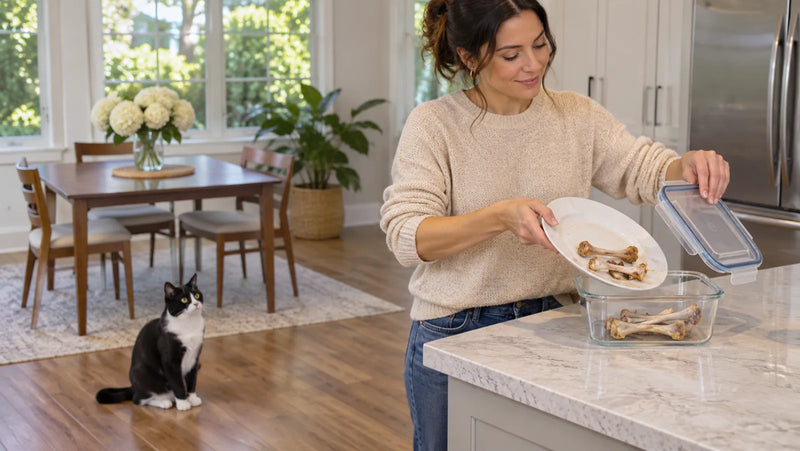
Can cats eat yogurt? Most cats do not need it, and many digest lactose poorly after weaning. If an otherwise healthy adult cat has no history of dairy trouble or diet restriction and the veterinary team permits people-food treats, one small lick of an exact plain, unsweetened, pasteurized yogurt can serve as a cautious first tolerance check.
Measure no more than 1/4 teaspoon onto a clean saucer, allow one lick, and remove what remains. That is a controlled first exposure—not a daily serving, probiotic dose, calcium supplement, or promise that every cat will tolerate dairy. Skip yogurt entirely when the label, cat, or medical plan leaves a question unanswered.
This page owns the feline decision: lactose, one-lick portion control, exact-container screening, probiotic evidence, and what to do after an exposure. The separate guide to yogurt for dogs owns canine portions and the well-established dog-specific xylitol emergency.
Can Cats Eat Yogurt? The Short Answer by Form
The word yogurt covers products with very different milk bases, fat levels, sweeteners, flavors, cultures, toppings, and handling. Decide from the exact container rather than the category name.
| Yogurt form | Main question | Decision for a cat |
|---|---|---|
| Plain, unsweetened, pasteurized yogurt | Lactose tolerance, fat, calories, medical fit | At most one measured lick for an eligible healthy adult cat |
| Plain Greek-style yogurt | Exact lactose, fat, calories, and ingredients still vary | Use the same one-lick screen; “Greek” is not automatic approval |
| Fruit, vanilla, flavored, or fruit-on-the-bottom yogurt | Sugar, syrups, flavor systems, fruit pieces, and other add-ins | Do not share |
| Sugar-free, keto, light, or sweetened yogurt | The front label does not identify every sweetener | Do not offer; inspect the full label after an accidental exposure |
| Frozen yogurt or yogurt dessert | Rich portions and mixed toppings | Do not share |
| Plant-based “yogurt” | Different base, oils, thickeners, sweeteners, flavors, and fortification | Not a dairy shortcut; assess every ingredient or skip |
| Raw or unpasteurized yogurt | Microbial contamination | Do not feed |
| Expired, warm-held, spoiled, or moldy yogurt | Unknown microbial growth and spoilage | Discard securely; do not taste-test with the cat |
“Plain” and “unsweetened” narrow the candidate list, but neither word proves low lactose, low fat, low calories, safe handling, or compatibility with a prescription diet. “Natural,” “organic,” and “live cultures” do not answer those questions either.
Many Cats Digest Lactose Poorly After Weaning
Lactose is the natural sugar in milk. Digestion requires the enzyme lactase. Kittens need to digest their mother's milk, but lactase activity commonly falls as cats mature. The Cornell Feline Health Center's feeding guidance says milk is not generally recommended as a treat because many cats are lactose-intolerant and can develop gastrointestinal problems.
The ASPCA's people-food guidance likewise explains that pets may lack enough lactase to handle milk and dairy. A poorly tolerated lick can be followed by gas, abdominal discomfort, loose stool or diarrhea, vomiting, or reduced appetite. The response can depend on the individual cat, exact product, and amount.
Fermentation changes yogurt, but it does not make every yogurt lactose-free. Straining can change the composition of a Greek-style product, yet brands and formulas differ. Read the actual nutrition and ingredient panels; do not transfer a tolerance result from one tub to another.
Lactose intolerance is a digestive problem. It is not the same as an immune response to milk protein, and one episode of vomiting or diarrhea does not diagnose either condition. Recurrent gastrointestinal or skin signs need a veterinary history and workup, not repeated home yogurt tests or an improvised elimination diet.
Screen the Exact Container Before Any Lick
Use the back panel, not a front-of-package impression. Formulas can change by flavor, package size, region, and reformulation. If the ingredient list is missing, damaged, unfamiliar, or unavailable on an individual cup, there is no nutritional reason to take a chance.
- Confirm the base: choose only a known pasteurized dairy yogurt for this narrow trial. The Merck Veterinary Manual's cat nutrition guidance advises against raw dairy products for cats.
- Require plain and unsweetened: reject fruit, vanilla, chocolate, coffee, caramel, alcohol, granola, cookie, syrup, dessert, and topping combinations.
- Read every ingredient: do not assume “low sugar,” “no added sugar,” “keto,” or “light” identifies the sweetener or every add-in.
- Check fat and calories: full-fat, low-fat, and nonfat versions are different products. A medical fat or calorie plan overrides this article.
- Check storage: the seal, date, refrigeration history, smell, surface, and texture should be normal for that exact product. When in doubt, discard it.
Keep the cup, foil lid, spoon, and trash away from the cat. A food question can become a foreign-body problem if packaging is chewed or swallowed. Do not let a cat place its head inside a narrow container, and do not return a licked spoon to the family tub.
Xylitol Screening Needs a Cat-Specific Explanation
Check for xylitol and other sweeteners, but do not copy canine toxicology into a cat article. Xylitol can cause dangerous hypoglycemia and liver injury in dogs; that established dog mechanism is why the dog yogurt guide treats a possible exposure as time-sensitive.
Cat evidence is different and limited. A University of Veterinary Medicine oral xylitol study in six healthy cats, later published in 2018, found no toxic effects at the studied doses during its short observation periods. The ASPCA Animal Poison Control Center's xylitol update also distinguishes cats from dogs and says cats are not expected to have the same harmful response.
That small short-term study does not establish a universal home-safe amount, prove safety for kittens or medically vulnerable cats, or approve a mixed yogurt product. At the same time, the WSAVA cat-treat handout includes xylitol in its list of ingredients to avoid. The practical answer is simple: do not intentionally choose xylitol-containing yogurt for a cat, and do not calculate a home dose.
If a cat ate a sugar-free or xylitol-containing yogurt, keep the package, photograph the full ingredient panel, estimate the maximum amount and time, and call the veterinarian or an animal poison-control service for case-specific advice about the whole product. Other ingredients, the cat's health, and swallowed packaging may matter even when dog-style xylitol poisoning is not expected. Never induce vomiting or give a home antidote unless the clinician handling the case directs it.
One Lick Is the First-Taste Ceiling
For an eligible adult cat, the first trial should answer one narrow question: does this cat appear to tolerate one lick of this exact product? It should not test appetite, probiotic effect, or a larger portion.
- Confirm eligibility: the cat is a healthy adult, has no prior dairy reaction or restricted diet, and the veterinary team permits ordinary people-food extras.
- Pass the product screen: the yogurt is pasteurized, plain, unsweetened, correctly refrigerated, in date, and fully reviewed for ingredients, fat, and calories.
- Measure before serving: place no more than 1/4 teaspoon on a clean shallow saucer. Do not hand over the tub.
- Allow one lick: remove the saucer even if yogurt remains. One lick, not the measure's capacity, is the intended first exposure.
- Change nothing else: introduce no other new food that day and keep the normal complete diet unchanged.
- Observe: over the next day or two, note appetite, comfort, gas, vomiting, stool, energy, skin, face, and breathing.
The 1/4-teaspoon measure is a preparation ceiling, not a target for the cat to finish. One lick is not a published toxic threshold, a prescription, or permission for daily yogurt. Smaller—or none—is reasonable.

Some Cats Should Skip the Trial
Do not run a casual yogurt test with a kitten. Growth nutrition has little room for incomplete extras, and an unweaned kitten needs a veterinarian-directed milk-replacement plan—not grocery-store yogurt. Ask the veterinarian before any dairy exposure during growth.
Skip yogurt or obtain individual veterinary direction when a cat has current vomiting or diarrhea, a prior dairy reaction, pancreatitis or a prescribed fat restriction, obesity or an active weight plan, diabetes, kidney disease, a food-allergy trial, a prescription diet, recent surgery, poor appetite, or another nutrition-sensitive condition. A food that appears harmless in a general article can undermine a carefully controlled plan.
Also skip when the cat must take medication. Yogurt should not be used as a pill wrapper or medicine vehicle unless the prescriber confirms that the exact drug may be given with that food. Some medicines have food, calcium, timing, or dose-completion requirements.
Yogurt Is Not a Proven Feline Probiotic Treatment
Yogurt cultures help make yogurt, but “contains live cultures” does not prove a clinical benefit for a cat. A useful probiotic claim would need the exact organism and strain, a viable amount at the time of use, an evidence-based dose for a defined feline problem, suitable storage, and a monitoring plan.
The Merck Veterinary Manual's microbiota overview explains that probiotic effects depend on the precise strain, mixture, and dose, and that scientific support remains limited for many proposed benefits. A human yogurt label usually does not answer the feline clinical questions.
Do not use yogurt to treat diarrhea, constipation, antibiotic effects, allergies, skin problems, immunity, urinary disease, or an undefined “microbiome imbalance.” Dairy can worsen digestive signs in a lactose-intolerant cat. Persistent or recurrent signs need diagnosis, hydration assessment, and a veterinary plan rather than a home food experiment.
If a veterinarian recommends a probiotic, ask for the product, organism or strain, amount, duration, storage method, purpose, and stop criteria. A veterinary product chosen for that cat and problem is not interchangeable with one lick of grocery-store yogurt.
Yogurt Still Shares the Treat-Calorie Budget
The WSAVA handout recommends keeping all treats below 10% of a cat's daily calories and leaving at least 90% for complete food. That is an upper boundary for all extras together, not a separate allowance for yogurt, table tastes, toppers, dental treats, training rewards, and commercial cat treats.
Cats are small, so a human spoonful is not a small serving in context. Even when one plain lick causes no obvious digestive sign, yogurt remains incomplete food and can displace more useful calories if it becomes routine. The veterinary team may set an extras ceiling below 10% or none at all.
Tolerance also does not prove benefit. A cat that appears normal after one lick has supplied information about one exposure to one product. It has not demonstrated better digestion, stronger immunity, improved hydration, or a need for another serving.
What to Do After a Lick or Larger Exposure
For one known lick of plain, pasteurized, in-date yogurt in a healthy adult cat, remove the rest, keep the label, note the time, offer the normal food and fresh water as usual, and observe. Do not add more yogurt to “see what happens.”
Call the veterinary team promptly when the amount is large or unknown; the ingredients or label are unknown; the product contains chocolate, coffee, alcohol, raisins, alliums, a sweetener, or other concerning additions; the yogurt was raw, spoiled, moldy, or improperly stored; packaging may have been swallowed; the cat is a kitten or medically vulnerable; or any symptom develops.
Repeated vomiting, bloody diarrhea, marked weakness, severe abdominal pain, collapse, tremors, seizures, breathing trouble, facial swelling, unresponsiveness, or suspected obstruction needs urgent veterinary care. Bring the exact package or clear photographs, estimated amount, earliest possible time, cat's weight, health conditions, medications, and current signs. Do not force food or water, induce vomiting, or give human medicine.
A Labeled Cat Treat Is Easier to Count
Yogurt is wet, easy to over-serve, and usually lacks a cat-sized calorie unit. The best cat treats guide compares ingredients, calories, texture, intended use, life stage, and medical fit. A labeled piece that can be divided and counted may be simpler for training or bonding than an open-ended lick from a human food tub.
American Paws' freeze-dried chicken breast treats for cats and dogs are publicly labeled as 100% USA chicken breast, freeze-dried whole, approximately 5 calories per piece, and intended for intermittent or supplemental feeding. Break a piece smaller for a cat and count it within the day's extras. The product is not appropriate when chicken, crunchy texture, or its calorie amount conflicts with the individual plan.
Dairy forms need separate answers. The guide to cheese for cats owns cheese-specific lactose, fat, sodium, mold, and medication questions. The page on salmon for cats owns cooked, raw, smoked, canned, bone, and portion decisions; neither food inherits yogurt's one-lick rule.
Frequently Asked Questions
Can kittens eat yogurt?
Do not give a kitten a casual yogurt trial. Complete growth food or a veterinarian-directed milk replacer must carry the nutrition plan. Ask the veterinarian before offering any incomplete people-food extra during growth.
Can cats eat Greek yogurt?
Some plain Greek-style products differ in lactose, protein, fat, and calories because of their formulation and straining, but “Greek” does not mean lactose-free, low-fat, unsweetened, or suitable for every cat. Screen the exact container and keep an eligible first trial to one lick.
Can cats eat vanilla yogurt?
Skip it. Vanilla yogurt is flavored and usually adds sugar, sweeteners, flavor systems, or other ingredients. The concern is the full recipe, not a claim that the word vanilla alone proves poisoning.
Can cats eat dairy-free yogurt?
Dairy-free does not mean cat-safe. Plant-based products can contain nuts, coconut, soy, oils, thickeners, sweeteners, flavors, chocolate, fruit, or fortification. Cats do not need a yogurt substitute, so an uncertain ingredient list is a reason to skip.
Can cats eat lactose-free yogurt?
Removing or breaking down lactose answers only one question. Fat, calories, sweeteners, flavors, milk proteins, medical restrictions, and incomplete nutrition still matter. Do not turn a lactose-free label into a routine cat serving.
Can cats eat yogurt every day?
Daily yogurt is unnecessary. A tolerated lick remains an incomplete extra and does not establish probiotic benefit. Use complete cat food as the nutritional foundation and ask the veterinary team before making any dairy product routine.
Is yogurt good for a cat with diarrhea?
No automatic yogurt remedy exists. Lactose can worsen digestive signs, and live-culture wording is not proof of a tested feline treatment. Diarrhea that is persistent, recurrent, bloody, painful, or accompanied by vomiting, weakness, dehydration, or appetite loss needs veterinary care.
What if my cat ate a spoonful of yogurt?
Secure the tub and wrapper, inspect the entire ingredient list, estimate the maximum amount and time, and note the cat's health and symptoms. Call the veterinarian for a flavored, sweetened, unknown, raw, spoiled, or large exposure; a kitten or medically vulnerable cat; swallowed packaging; or any concerning sign.
What if the yogurt contains xylitol?
Do not assume the dog response applies to the cat, and do not assume a small feline study approves the product. Preserve the label and contact the veterinarian or animal poison-control service for guidance on the exact yogurt, amount, cat, and any other ingredients. Do not induce vomiting at home.
Plain, Measured, and Optional
A careful yogurt decision is intentionally narrow: healthy adult cat, veterinary permission for people-food treats, exact pasteurized plain unsweetened product, complete ingredient review, no diet conflict, no more than 1/4 teaspoon prepared, one lick allowed, and the remainder removed. Stop after that exposure and watch the cat rather than turning tolerance into a daily habit.
If any gate fails, skip yogurt without concern. For a reward that is easier to divide and count, browse American Paws cat treats and compare the exact label, calories, texture, and ingredient fit with the cat's veterinary plan. Yogurt is optional; a complete diet and an individually suitable measured reward are the dependable foundation.