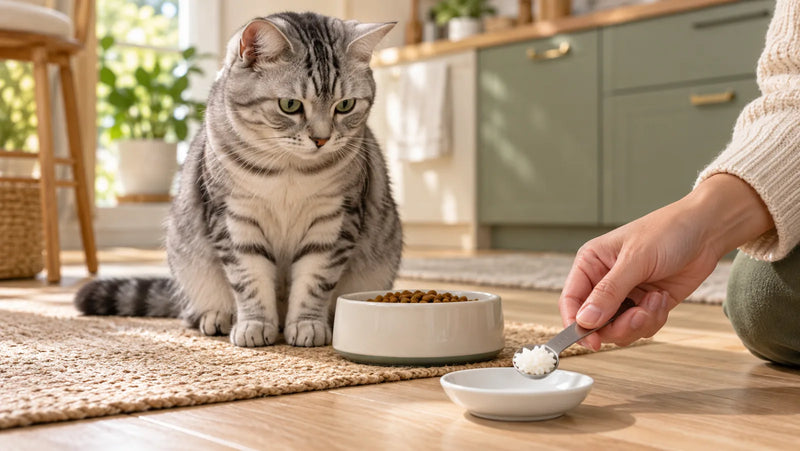
Can cats eat cheese? A healthy adult cat that is not on a restricted diet may tolerate one pea-sized bite of plain cheese, but cheese is a poor routine cat treat. Most cats lose much of their ability to digest lactose after weaning, and cheese can also be high in fat, sodium and calories. Skip blue-veined, mold-ripened, flavored, seasoned, spreadable and unknown cheeses.
For medication, do not use cheese by habit. First ask the veterinarian or pharmacist whether the exact drug can be given with food and whether dairy is compatible. If cheese is specifically approved and the cat already tolerates it, use only a paper-thin wrapper within that one pea-sized total—not a cube plus extra bites.
This is the feline decision. Dogs have different serving contexts and blue-cheese evidence, so dog owners should use the separate can dogs eat cheese guide.
Can Cats Eat Cheese? The Short Answer by Form
| Cheese form | Cat decision | Why |
|---|---|---|
| One pea-sized plain known cheese bite | Possible once for an eligible healthy adult cat | Still contains dairy, fat, sodium and calories; observe the cat afterward |
| Human-size cube, slice or string | Do not offer | Easy to overfeed relative to a cat’s small calorie budget |
| Soft or fresh cheese | Usually skip | May retain more lactose and can be rich; exact product varies |
| Aged hard cheese | Lower lactose is not automatic permission | It can still be salty, fatty and calorie-dense |
| Blue-veined or mold-ripened cheese | Do not offer | No useful reason to test a mold-ripened, often salty and rich human food |
| Herb, garlic, onion, chive, pepper or alcohol-flavored cheese | Do not offer | Added ingredients create separate risks |
| Cheese spread, dip or sauce | Do not offer | May contain salt, fat, alliums, spices, emulsifiers and an unknown serving size |
| Spoiled or unexpectedly moldy cheese | Keep away; call after an exposure | Spoilage changes the question from portion control to case-specific veterinary advice |
There is no nutritionally necessary cheese serving for a cat. “A pea-sized bite at most” is a conservative first-taste ceiling for a narrow healthy-adult scenario, not a recommendation to start feeding cheese. Choosing none is always acceptable.
Most Cats Digest Lactose Poorly After Weaning
Lactose is the sugar in milk. Young kittens need the ability to digest their mother’s milk, but that ability commonly falls as cats mature. VCA’s food-intolerance reference for cats describes lactose intolerance as a common feline carbohydrate reaction and lists diarrhea, vomiting, bloating and abdominal discomfort among the signs after dairy exposure.
Lactose intolerance is not the same thing as a food allergy. Intolerance is primarily a digestive problem. An allergy involves an immune response to a food protein and may include recurrent skin or gastrointestinal signs. A cat can also have ordinary digestive upset after a rich food without proving either condition. Repeated signs need a veterinary history and workup, not repeated cheese tests.
The Cornell Feline Health Center’s feeding guidance explains that cats are obligate carnivores, treats are usually not complete and balanced, and milk is not generally recommended because many cats are lactose-intolerant and can develop gastrointestinal problems. Cheese is not identical to milk—fermentation and aging change lactose—but the individual product and cat still decide tolerance.
Lower lactose does not make a cheese a good cat treat
Some aged hard cheeses contain less lactose than fresh cheeses. That comparison answers only one part of the screen. A low-lactose cheese can still carry substantial fat, sodium and calories, and it may still conflict with kidney, heart, urinary, weight or digestive management. Do not turn “lower lactose” into “safe every day.”
Fresh and soft cheeses can be easy to over-serve
Cottage cheese, cream cheese, ricotta and soft spreads look easy for a cat to lick, but softness is not a portion control. A spoonful is large in relation to a cat, while formulas vary in lactose, salt, fat and added ingredients. Skip a casual dollop and never let the cat lick from the tub or family plate.
Fat, Sodium and Calories Matter Without Lactose Symptoms
A cat can avoid diarrhea and still receive an unnecessary dose of fat, salt and calories. Cheese is designed as concentrated human food, not a complete feline reward. The exact values vary by variety, brand, aging, moisture and serving size, so one universal cheese number would be misleading. Read the package and compare the actual amount.
Fat makes cheese energy-dense and rich. That does not mean a pea-sized bite automatically causes pancreatitis or another disease. It means routine cheese is a poor fit for a small animal, especially one with obesity, a history of digestive problems, pancreatitis, a prescribed low-fat plan or a sensitive stomach.
Sodium also varies widely. A single tiny bite is not automatically salt poisoning, but salty cheese is an avoidable addition for cats whose veterinarian is managing kidney disease, heart disease, blood pressure, fluid balance, urinary disease or another condition through diet. Do not rinse, soak or trim a human cheese and assume the medical restriction disappears.
WSAVA’s cat-treat guidance recommends keeping all treats below 10% of daily calories and leaving at least 90% for complete food. The ceiling includes cheese, commercial treats, table tastes, toppers and food used for medication together. The veterinary team may set a lower limit.
Our cat treat-quantity guide explains the shared budget. Cheese without a measured calorie value is easier to manage as a one-time pea-sized taste than as a recurring daily reward.
One Pea-Sized First Taste Is the Ceiling
For an otherwise healthy adult cat whose veterinarian has not restricted dairy, fat, sodium, calories or table food, use these gates:
- Identify the exact cheese. Use a known plain product with a complete ingredient list and date.
- Check every ingredient. Reject blue-veined, mold-ripened, spoiled, seasoned, smoked, peppered, alcohol-flavored, garlic, onion, chive, leek, sauce, dip and unknown mixed forms.
- Measure before serving. Cut one piece no larger than a green pea. Put the package away first.
- Offer it separately. Do not mix it through a full meal or create a large smear the cat can keep licking.
- Stop after one bite. Introduce no other new food that day.
- Observe. Watch appetite, stool, vomiting, gas, abdominal comfort, skin, face, breathing and energy before deciding that cheese belongs in the cat’s life at all.
The pea is a visual ceiling, not a daily ration and not a toxic threshold. Smaller is reasonable. If the cat swallows the piece comfortably and has no obvious sign, that only describes one exposure; it does not prove every cheese, larger amount or future serving will be tolerated.
Kittens should not receive a casual cheese test. Growth food needs to remain in charge, their calorie room is small, and milk replacement for an unweaned kitten is a veterinary feeding question. Ask the veterinarian before offering any noncomplete extra.
Blue Cheese and Flavored Cheese Stay Out
Blue-veined and mold-ripened cheese
Do not intentionally offer blue cheese, Roquefort, Stilton, Gorgonzola or another mold-ripened cheese. These products add intentional mold cultures to an already rich, often salty food, and there is no nutritional reason to establish a feline serving. This advice does not depend on publishing a universal cat toxic dose, because no home dose should be used as permission.
If a cat ate blue cheese, preserve the exact package, estimate the maximum amount and time, note the cat’s weight, age, health and symptoms, and call the veterinarian or animal poison-control service for case-specific guidance. Do the same for cheese that has spoiled or developed unexpected mold.
Onion, garlic, chives and leeks
Cheese spreads, dips, cheese balls and flavored blocks can contain onion, garlic, chives or leeks as fresh pieces, powders or seasoning blends. The ASPCA identifies onion as toxic to cats and notes gastrointestinal signs and red-blood-cell damage. Scraping visible herbs off the surface does not establish that the cheese underneath is plain.
Smoke, peppers, alcohol and mixed recipes
Skip smoked, pepper-crusted, jalapeño, wine, beer, port, truffle, herb and deli-spread cheeses. “Only a little flavor” is not a complete ingredient review. Cheese sauce, queso, fondue, macaroni and cheese, pizza and cheeseburgers are mixed dishes whose salt, fat, seasoning, alliums and portion differ from one plain pea-sized bite.
Cured meat and cheese also compound the same problems. The feline ham guide handles cured-meat sodium, while can cats eat bacon separates one accidental crumb from raw bacon, grease and routine feeding. Neither food becomes a better cat treat when wrapped in cheese.
Using Cheese for Medication Requires Approval
A pill does not make cheese automatically appropriate, and cheese does not make every pill safe with food. The FDA’s questions to ask about pet medication explains that some oral medicines work better with food while others need an empty stomach. Ask the prescribing veterinarian or dispensing pharmacist:
- Can this exact tablet or capsule be given with food?
- Is dairy or its calcium compatible with the medication?
- May the pill be split, crushed or opened, or must it remain intact?
- What should follow the dose—water, a meal or nothing?
- What should you do if the cat spits it out or vomits?
If the professional approves cheese and the cat has already tolerated that exact plain product, flatten a paper-thin piece around the intact pill. Keep the entire wrapper plus any test crumb within one pea-sized total. Offer it separately from the regular meal, watch the cat swallow and check the floor and mouth area for a spit-out pill.

The American Association of Feline Practitioners’ cat-medication caregiver handout recommends a thin layer of a moldable pill treat, warns against placing medication in the cat’s regular food and emphasizes helping tablets or capsules reach the stomach. Follow the veterinarian’s specific food-or-water instructions rather than substituting a cheese routine.
If the cat needs repeated medication, has a dairy reaction, eats a therapeutic diet or learns to spit out the pill, ask about a compatible pill treat, a tiny amount of permitted wet cat food, a different formulation or professional technique. Do not keep increasing the cheese. Never redose after a spit-out or vomited medication until the veterinarian tells you what to do.
What to Do if a Cat Ate Cheese
- Remove access. Secure the cheese, rind, wrapper, toothpick and serving dish.
- Identify the product. Save the label or recipe and note blue mold, unexpected spoilage, onion, garlic, chives, leek, alcohol, spices, cured meat and any other additions.
- Estimate exposure. Record the maximum amount, time, cat’s current weight, age, health conditions, prescription diet and medications.
- Check the cat. Note vomiting, diarrhea, gas, abdominal discomfort, drooling, weakness, unusual walking, tremors, breathing changes, pale gums, collapse or another behavior change.
- Call when the case is not the narrow plain-bite scenario. Contact the veterinarian, emergency clinic or animal poison-control service for blue or moldy cheese, allium ingredients, an unknown recipe, a large amount, symptoms, or a cat with a medical or dietary restriction.
For one tiny known plain bite in an otherwise healthy adult cat that remains normal, remove the rest, keep normal fresh water available and observe. Do not induce vomiting, force water, give salt, oil, milk, charcoal, human medicine or another home remedy unless the veterinary professional managing the case directs it.
Repeated vomiting or diarrhea, blood, marked lethargy, abdominal pain, tremors, weakness, trouble walking, pale gums, breathing difficulty, collapse or seizure needs prompt veterinary care. The absence of immediate signs does not clear an exposure to onion or garlic, so call based on the ingredient—not only the cat’s current appearance.
A Labeled Cat Treat Is Easier to Measure
Cheese has no nutritional job a complete cat food and an appropriate measured reward cannot perform more predictably. The best cat treats guide compares exact ingredients, calories, texture, life stage, intended use and veterinary-diet fit rather than assuming a popular human food is high value for every cat.
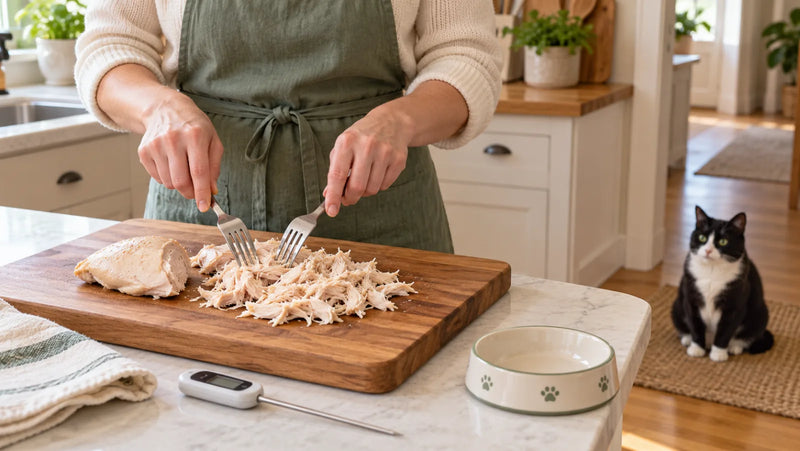
For cats whose veterinary plan permits chicken, the current American Paws freeze-dried chicken training treat for cats and dogs lists one ingredient—100% USA chicken breast—freeze-dried into naturally small crunchy pieces with nothing added. It is a supplemental treat, not a complete meal, and a full piece may still need dividing for the individual cat.
If chicken does not fit, choose another veterinarian-approved option rather than cheese. You can compare the current American Paws cat treats and dog treats assortment by exact label; no collection-wide claim makes every product suitable for every cat.
Frequently Asked Questions
Can cats eat cheddar cheese?
A healthy adult cat may tolerate one pea-sized plain cheddar taste, but cheddar can still be fatty, salty and calorie-dense even when aging lowers lactose. It is not a useful routine treat. Skip it for kittens, restricted diets and cats with prior dairy reactions unless the veterinarian directs otherwise.
Can cats eat cottage cheese or cream cheese?
Fresh and soft cheeses can retain more lactose, are easy to over-serve and vary in fat, sodium and additives. Do not offer a spoonful or let the cat lick the container. A labeled cat treat or a piece of the normal complete food is easier to control.
Can cats eat blue cheese?
Do not intentionally offer blue-veined or mold-ripened cheese. If a cat ate it, save the package and call the veterinarian or animal poison-control service with the amount, time, cat details and symptoms rather than applying a universal internet dose.
Can kittens eat cheese?
Skip casual cheese. Kittens need complete growth nutrition, and their small calorie budget leaves little room for unbalanced extras. An unweaned kitten needs an appropriate milk replacer and veterinary guidance—not cow’s milk or cheese.
Can I hide my cat’s pill in cheese?
Only if the veterinarian or pharmacist confirms the exact medicine can be given with food and dairy, the cat already tolerates that plain cheese and the diet permits it. Use a paper-thin wrapper within one pea-sized total, keep it out of the normal meal and watch for a spit-out pill.
What if my cat ate a whole cheese slice?
Remove access, identify the exact cheese and ingredients, estimate the amount and time and call the veterinarian. A human slice is a large exposure for a cat, and blue mold, alliums, seasoning, rich fat, sodium, medical conditions or symptoms can change the response.
Can cats eat cheese every day?
No daily cheese is needed. Even a cat without obvious lactose signs receives fat, sodium and calories from it, and repeated cheese can displace complete food. Use measured cat-appropriate rewards within the veterinarian-set extras plan instead.
One Plain Pea-Sized Taste at Most
The practical answer stays narrow: one known plain pea-sized bite may be tolerated by some healthy adult cats, but most cats digest lactose poorly after weaning and cheese brings fat, sodium and calorie tradeoffs. Blue, mold-ripened, flavored, seasoned, spreadable and unknown cheeses stay off the menu.
Medication is the only common reason owners reach for cheese repeatedly, and it still requires drug-specific approval. Use the smallest compatible wrapper the cat will finish, preserve the normal meal and watch the dose go down.
Choose a measured cat treat instead: if chicken fits the cat’s veterinary plan, review the current single-ingredient freeze-dried chicken treat and divide it for the individual cat. Otherwise, browse the current American Paws cat treats and dog treats by exact label and select a veterinarian-approved option.