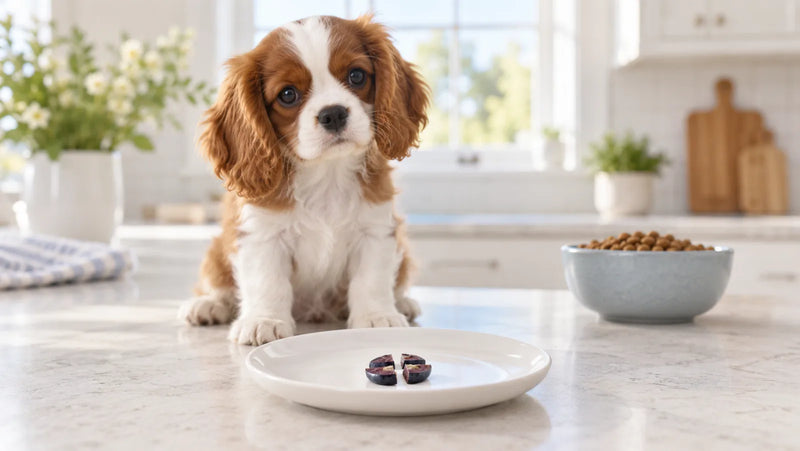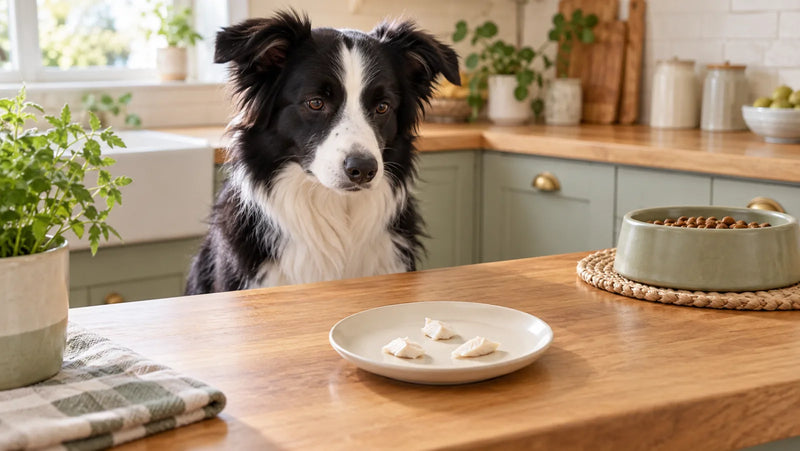

Yes, many healthy adult dogs can eat a tiny piece of plain, lower-fat cheese as an occasional high-value reward. The short answer to “can dogs eat cheese?” is conditional, however. Lactose intolerance, fat and calorie density, pancreatitis history, salt, blue mold, and onion- or garlic-flavored products can turn a small training treat into the wrong choice.
The useful question is not simply “is cheese toxic?” It is “what exact cheese, how much, and for which dog?” Check the ingredient and nutrition labels, begin with a crumb-size taste, and choose another reward if the dog has a medical diet, a history of digestive trouble, or no need for dairy.
Can dogs eat cheese? The conditional yes
| Cheese situation | Practical answer |
|---|---|
| One tiny piece of plain lower-fat cheese for a healthy dog that tolerates dairy | Often reasonable as an occasional training reward |
| A large cube, handful of shreds, cheese plate, or repeated daily portions | Too easy to overfeed; fat, calories, and sodium add up |
| Dog with lactose intolerance or a repeated dairy reaction | Skip cheese and use a non-dairy reward |
| Dog with pancreatitis history, obesity, or a prescribed low-fat diet | Use only a veterinarian-approved reward; cheese may be a poor fit |
| Blue, mold-ripened, onion-, garlic-, chive-, or leek-flavored cheese | Do not intentionally feed |
| Cheese dip, spread, sauce, pizza topping, or mystery party food | Skip; the fat, salt, seasonings, and mix-ins are difficult to control |
The American Kennel Club’s cheese guidance reaches the same conditional answer: some dogs can have cheese in moderation, while high fat, dairy intolerance, obesity, food sensitivity, and toxic flavor ingredients change the decision.
Why cheese can upset a dog even when it is not toxic
Lactose tolerance varies
Cheese generally contains less lactose than milk because cheesemaking removes whey and microbes use some of the milk sugar. “Less” does not mean “none,” and the amount differs by type and process. A dog that cannot digest much lactose may develop gas, loose stool, diarrhea, abdominal discomfort, or vomiting after dairy.
Lactose intolerance is also not the same as a milk-protein allergy. Intolerance usually produces digestive signs related to lactose digestion. An adverse immune response can involve itching, recurrent skin or ear problems, hives, facial swelling, vomiting, diarrhea, or other signs. Neither problem can be diagnosed from a blog post; repeated reactions deserve veterinary review.
Do not use a large serving as a “test.” For a healthy dog with no dairy history, one tiny plain piece is enough for the first exposure. Offer no other new food at the same time and stop if symptoms appear.
Fat, calories, and sodium add up quickly
Cheese is concentrated. A human-size cube can be a meaningful share of a small dog’s daily treat calories, and a handful used during training can quietly become a meal’s worth of extras. Reduced-fat does not mean calorie-free, and lower lactose does not mean lower fat or sodium.
Sodium also varies widely. A tiny shred from a plain product is different from a salty cheese plate, processed slice, cheese sauce, or seasoned snack. Dogs with heart, kidney, blood-pressure, fluid-balance, or other medically managed conditions need their veterinarian’s plan rather than a general “safe cheese” list.
Which cheeses are the least complicated choice?
Plain, lower-fat, lower-sodium options
If the dog tolerates dairy and the veterinarian has not restricted it, look for a plain cheese with lower fat and sodium and a short ingredient list. AKC identifies options such as mozzarella and cottage cheese as generally lower-fat choices. The label still decides: full-fat and low-fat versions differ, and cottage cheese can carry substantial sodium.
Use a solid cheese that can be cut into a tiny, clean training piece. Avoid added herbs, peppers, smoke flavor, sauce, sweetener, or seasoning. “Natural flavor” and a picture on the front are not substitutes for the ingredient panel.
Aged hard cheese is not automatically the best choice
Aged cheeses often contain less lactose than fresh milk products, but they may be high in fat and sodium. Parmesan, for example, can be very salty; rich cheddar can deliver substantial calories in a small volume. Lower lactose solves only one part of the decision.
Choose by the dog and the complete label rather than by a single claim. Our dog-treat label guide is written for pet products, but its core habit applies here too: identify every ingredient, then check calories, fat, serving size, storage, and any health-specific restriction.
Cheese dogs should not eat
Blue and mold-ripened cheese
Do not intentionally feed blue cheese or a mold-ripened cheese such as Roquefort, Stilton, or Gorgonzola. These products are made with molds that can produce tremorgenic compounds. Roquefortine C is often named in blue-cheese warnings, but it should not be treated as the only possible compound or used to calculate a home “safe dose.”
The MSD Veterinary Manual’s tremorgenic mycotoxicosis review describes several mold-derived tremorgens associated with moldy foods, including dairy products, and signs such as vomiting, tremors, loss of coordination, heightened sensitivity, rapid heart rate, and seizures. It also notes that cause-and-dose relationships for individual toxins are not simple. The practical rule is to skip blue and moldy cheese rather than experiment.
Ordinary cheese that develops unintended mold in the refrigerator belongs in secure trash, not in the dog bowl. Cutting off the visible spot does not create a pet treat.
Onion, garlic, chive, and leek flavors
Cheese spreads, dips, flavored curds, stuffed bites, sauces, pizza toppings, and party foods may contain onion, garlic, chive, or leek. Powders count; removing a visible onion piece does not remove seasoning dispersed through the food.
The MSD Veterinary Manual’s Allium toxicosis guidance explains that raw, cooked, dehydrated, and granulated onion or garlic can damage red blood cells in dogs and cats. Do not use a toxic-dose table to justify a taste. Choose a plain product with none of these ingredients.
Rich spreads, dips, sauces, and heavily processed products
Cream cheese, cheese dip, queso, nacho sauce, canned spray cheese, processed slices, cheese-filled pastries, and pizza combine variables that do not help a dog: more fat, sodium, emulsifiers, seasonings, and sometimes onion or garlic. A “cheese-flavored” product may contain an entirely different ingredient list from plain cheese.
Brie and other rich soft cheeses can be especially fatty, and their rinds add a mold variable. Feta and some hard grating cheeses can be very salty. There is no nutritional need to search for an exception when a simpler reward is available.
Cheese, high fat, and pancreatitis: keep the claim precise
It would be inaccurate to say that one tiny cheese crumb automatically causes pancreatitis. Many cases have no single identifiable cause, and diagnosis requires a veterinarian. The honest guardrail is that high-fat foods are a recognized concern in dogs, especially after a previous episode or when a low-fat therapeutic plan has been prescribed.
The Merck Veterinary Manual’s pancreatitis review notes that dietary fat management is important in affected dogs. A dog with pancreatitis history should not receive a new fatty reward based on a generic article, even if another dog handles it well.
Repeated vomiting, a painful or tense abdomen, marked lethargy, weakness, loss of appetite, diarrhea, dehydration, or a prayer-like posture after a rich-food exposure warrants veterinary advice. Those signs are not proof of pancreatitis; they are reasons for an examination.
How much cheese can a dog eat?
Start with one tiny plain piece
For a healthy adult dog that has no dairy restriction, begin with one crumb or pea-size piece—smaller for a toy dog. That is a tolerance test and a training reward, not a universal daily serving. Do not start with a human-size cube, slice, cheese stick, or spoonful.
Watch for gas, loose stool, vomiting, itching, ear irritation, hives, facial swelling, or discomfort. Stop after a reaction and call the veterinarian promptly for swelling, breathing difficulty, collapse, repeated vomiting, or another severe sign.
Count cheese inside the full treat budget
Cheese shares the same small allowance as every other extra: training treats, chews, toppers, dental products, table bites, and food used with medication. Keep all extras together below about 10% of daily calories unless the veterinary team has prescribed a different plan.
Our daily treat-calorie budget explains why a fixed cubes-by-weight chart would be false precision. Cheese moisture, fat, calorie density, cube size, and sodium vary, while two dogs of the same body weight may have different energy and medical needs.
How to use cheese as a training reward
Cheese can be motivating because it smells strong and feels novel. Make that value work for you with tiny pieces. A reward does not become more meaningful because it is large; delivery timing, reinforcement history, and the dog’s preference matter more.
- Pre-cut only the amount allocated to the session.
- Use crumb- or pea-size pieces that the dog can swallow without interrupting the exercise.
- Reserve cheese for difficult environments or new behavior instead of using it for every repetition.
- Keep it chilled and discard pieces that have sat warm too long.
- Reduce other extras so the total daily treat calories stay controlled.
- Stop if rich dairy causes soft stool, gas, itching, or loss of appetite.
For a broader reward hierarchy and ways to test what actually motivates an individual dog, use our high-value dog training treat guide. “High value” describes the dog’s response, not a claim that one food is nutritionally superior.
Why a single-ingredient meat treat is often easier to evaluate
Cheese is dairy, with variable lactose, fat, sodium, cultures, mold, and flavor additions. A clearly labeled single-ingredient meat treat removes several of those variables. It is not automatically low-fat, allergy-safe, or suitable for every prescription diet, but its ingredient identity is easier to audit.
For example, American Paws single-ingredient freeze-dried beef liver training treats contain beef liver rather than dairy. That makes them a simple high-value comparison for dogs that can eat beef; it does not make them appropriate for a beef allergy, liver restriction, pancreatitis plan, elimination trial, or unlimited feeding.

What to do if a dog eats the wrong cheese
- Remove access. Secure the cheese, wrapper, board, party food, dip, or trash.
- Identify the exact product. Save the label and record the cheese type, ingredients, estimated amount, time, dog’s weight, and current signs.
- Call for case-specific advice. Contact the veterinarian or a veterinary poison service after blue or moldy cheese, an onion/garlic/chive/leek product, a large rich-cheese exposure, swallowed packaging, or any concerning symptom.
- Follow professional directions. Do not induce vomiting or give human medication, oil, milk, bread, or another home remedy unless a veterinarian or poison professional specifically instructs you.
Tremors, seizures, loss of coordination, collapse, breathing trouble, repeated vomiting, severe weakness, or a painful abdomen requires urgent veterinary care. Mild gas or one soft stool after a tiny plain piece may reflect intolerance, but worsening or persistent signs still deserve a call.
Frequently asked questions
Can puppies eat cheese?
A weaned puppy may be able to have a tiny plain piece after the veterinarian agrees it fits the complete growth diet. Puppies have small calorie allowances and need nutritionally complete food, so cheese should not crowd out meals or become the default training reward.
Can dogs eat mozzarella or cottage cheese?
Plain lower-fat mozzarella or cottage cheese may be reasonable in a tiny amount for a dog that tolerates dairy. Check the actual product’s fat, sodium, ingredients, and portion. Cottage cheese is not automatically low-sodium, and neither food is suitable for every medical diet.
Can dogs eat cheddar cheese?
A tiny plain piece may be tolerated by some healthy dogs, but cheddar can be rich and calorie-dense. Choose no onion, garlic, chive, smoke flavor, or other mix-ins, and use a much smaller piece than a human snack cube.
Can dogs eat cheese every day?
There is usually no need. Daily use makes it easier for fat, sodium, and calories to accumulate and harder to notice a mild dairy reaction. Rotate only veterinarian-approved rewards and keep the total extras inside the dog’s calorie budget.
Can I hide a pill in cheese?
Ask the prescribing clinic first. Some medications have food, mineral, timing, or dose-handling instructions, and cheese may not suit the dog’s health plan. If the clinic approves it, use only the smallest plain piece needed to conceal the pill and confirm that the complete dose was swallowed.
Choose the reward the individual dog can tolerate
For some healthy dogs, one tiny piece of plain lower-fat cheese can be a useful high-value reward. That conditional yes does not extend to blue cheese, moldy cheese, onion- or garlic-flavored products, rich cheese dishes, or dogs whose dairy tolerance, weight, pancreas, prescription diet, or treatment plan says otherwise. For leaner alternatives, see our overview of protein sources for dog treats.
When label simplicity matters, choose a clearly identified dog treat instead of guessing about a party food or cheese blend. Browse all current American Paws dog treats, read the ingredient panel for the individual product, and select the protein, texture, and piece size that fit your dog’s training and health needs.