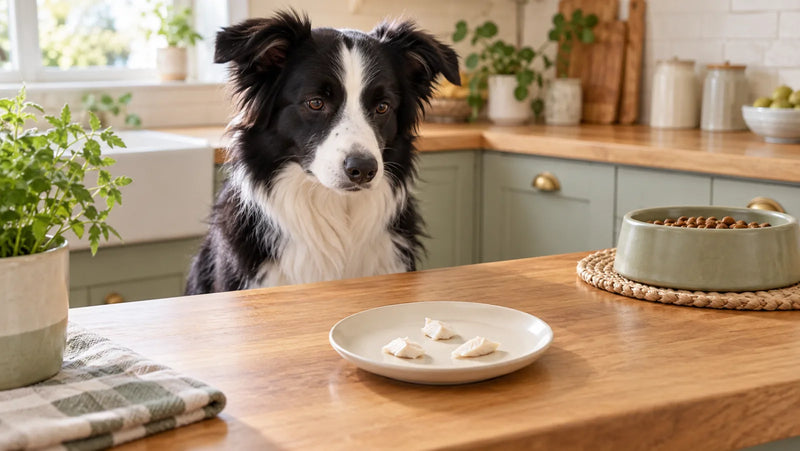

Can dogs eat kale? Yes—but only as a very small, occasional, plain extra for a healthy adult dog. Wash it, remove the tough central rib, chop the leaf finely, and serve it raw or lightly steamed with no oil, salt, seasoning, onion, or garlic. Kale contains oxalates and glucosinolate-derived compounds, including isothiocyanates, so it should not become a daily supplement.
Ask the veterinarian before offering kale to a dog with a history of calcium-oxalate stones, kidney or urinary disease, hypothyroidism, thyroid medication, or a prescribed diet. A tiny known piece and a daily scoop of smoothie powder are not the same exposure, and neither can be judged from the word “kale” alone.
Can Dogs Eat Kale? The Short Answer
For many healthy adult dogs, one tiny piece of fresh plain kale is unlikely to create a problem. That is a tolerance-minded answer, not a claim that kale is necessary, harmless in every amount, or appropriate for every medical history.
The American Kennel Club's kale guidance identifies calcium oxalate and isothiocyanates as reasons for caution and says occasional small amounts are unlikely to harm most dogs. It also cautions against regular feeding, particularly when a dog has an underlying condition.
Use a simple decision sequence:
- Confirm that the plant is culinary kale, not an unknown yard plant or decorative arrangement.
- Identify the exact form: raw leaf, steamed leaf, chip, salad, smoothie, powder, supplement, soup, or discarded package.
- Check every added ingredient and any missing nonfood object.
- Consider the dog's urinary, kidney, thyroid, digestive, and diet history.
- If the answer remains uncomplicated, keep the portion tiny and infrequent.
For the larger produce category, use our complete vegetable-safety guide. That pillar owns broad vegetable choices; this page stays with kale-specific compounds, forms, preparation, and portions.
Why Kale Needs Moderation
Kale is a fibrous Brassica vegetable with naturally occurring plant compounds. Their presence does not make every leaf poisonous, but it does make “more is healthier” a poor rule for dogs.
Oxalates are context, not a one-bite diagnosis
Oxalate can combine with calcium, and calcium oxalate is one type of urinary stone found in dogs. That shared chemistry does not prove that one kale bite creates a stone. Merck Veterinary Manual's review of canine urolithiasis describes calcium-oxalate stone formation as multifactorial: genetic, metabolic, and dietary factors can all play a role, and affected dogs need diagnosis-specific evaluation and prevention.
The practical boundary is therefore individual. A healthy dog receiving one tiny taste is different from a diagnosed stone-former whose veterinarian selected a therapeutic diet. Do not add kale, calcium, dairy, citrate, or another home “counterbalance” to that medical plan.
Isothiocyanates and gastrointestinal irritation
Kale's glucosinolates can break down into compounds that include isothiocyanates. In a larger or repeated serving, those compounds are one reason veterinary sources caution about stomach and intestinal irritation. Fiber, unfamiliar food, recipe fat, portion size, and the individual dog can also contribute to gas, soft stool, vomiting, or diarrhea.
Do not copy a broccoli percentage onto kale or treat ordinary gas as proof of “isothiocyanate poisoning.” There is no useful home threshold that clears every dog. The safer response is to keep a trial small, stop if the dog does not tolerate it, and call the veterinary team when signs are persistent, severe, or accompanied by pain or lethargy.
The thyroid question is about repetition and the individual dog
Cruciferous vegetables are often discussed as goitrogenic because some of their compounds can affect thyroid-related pathways under certain conditions. The AKC cautions that regular kale feeding may interfere with thyroid function, especially in dogs with hypothyroidism. That warning does not mean one tiny leaf causes hypothyroidism or cancels a medication dose.
If a dog has hypothyroidism, takes thyroid medication, or has a diet designed around an endocrine condition, ask the treating veterinarian before making kale routine. Do not change medication timing or dose because of a blog, and do not use kale as a thyroid supplement.
Dogs That Need Veterinary Guidance Before Kale
Skip the generic serving experiment and ask the veterinary team first when the dog has:
- a previous calcium-oxalate stone, crystals, urinary surgery, or recurrent urinary signs;
- kidney disease, another urinary disorder, or a prescription urinary or renal diet;
- hypothyroidism, thyroid medication, or another endocrine nutrition plan;
- a food-elimination trial, severe food sensitivity, or a tightly controlled therapeutic diet;
- recurrent vomiting, diarrhea, abdominal pain, or difficulty handling fibrous foods;
- growth, pregnancy, or another life stage in which extras can displace carefully balanced nutrition.
The relevant question is not simply “Is kale healthy?” It is “Does this exact form and amount fit this dog's complete diet and medical plan?” If the answer is uncertain, leaving kale out costs the dog nothing essential.
How to Prepare Kale for a Dog
Wash and inspect it
Choose fresh leaves without slime, mold, heavy bruising, or a spoiled odor. Wash your hands, keep produce away from raw-meat tools, and rinse the kale under plain running water while opening the folds. FDA produce-safety guidance recommends cutting away damaged areas, washing produce under running water, skipping soap, detergent, and commercial produce wash, and drying it with a clean towel. Washing reduces surface bacteria; it does not sterilize a spoiled leaf.
Remove the tough rib and chop across the leaf
Strip or cut away the thick central rib and woody lower stem. Those parts are fibrous and awkward for a gulper even though they are not a separate toxin. Chop the leaf finely enough that the dog cannot fold and swallow a long, leathery strip. Preparation should match the dog's size, teeth, chewing style, and history of gulping.
Raw or lightly steamed, always plain
A tiny finely chopped raw piece may suit a careful chewer. Light steaming can soften the texture; cool and drain it before serving. Cooking is a handling choice, not a proven way to remove every oxalate or thyroid-related concern, and it does not make an unlimited serving appropriate.

“Plain” means no butter, oil, salt, broth, bouillon, cheese, bacon, dressing, onion, garlic, chili, sweetener, or seasoning blend. Do not pour the cooking liquid over the dog's meal as a workaround; it may contain leached compounds or recipe ingredients and has no required nutritional role.
Raw, Cooked, Frozen, Canned, Chips, Smoothies, and Powders
The form changes texture, concentration, added ingredients, and how easy it is to estimate the exposure.
| Form | What to check | Practical answer |
|---|---|---|
| Fresh raw leaf | Identity, freshness, washing, tough rib, piece size | Only a tiny finely chopped plain amount for an appropriate healthy dog |
| Lightly steamed leaf | No cooking fat, salt, stock, onion, garlic, or sauce | Cool, drain, chop, and keep the portion tiny; cooking is not a medical clearance |
| Frozen kale | Ingredient list, clumps, freezer sauce, and whether it was previously cooked | Plain single-ingredient kale can be thawed, cooked if needed, drained, and chopped; never offer a hard frozen clump |
| Canned kale or greens | Sodium, broth, fat, smoke flavor, meat, onion, garlic, and seasoning | Usually skip; rinsing cannot reliably turn a seasoned recipe into plain kale |
| Kale chips | Oil, salt, cheese, garlic, onion, spice, flavor powder, sharp crisp pieces | Skip commercial chips unless every ingredient and portion is specifically cleared |
| Salad, soup, or side dish | Complete recipe, dressing, rich toppings, grapes or raisins, nuts, skewers, and packaging | Judge the whole dish; the plain-leaf answer does not transfer |
| Smoothie, juice, powder, or supplement | Concentration, sweeteners, chocolate or cocoa, grapes, raisins, caffeine, other botanicals, and serving scoop | Do not improvise a canine dose; concentrated products are not equivalent to one leaf |
A human “green” product can combine many ingredients and hide the amount of each. Keep the label, recipe, container, and scoop information after an accidental exposure. A missing plastic bag, desiccant, skewer, or blender part is a separate physical question.
How Much Kale Can a Dog Have?
There is no universal cup, leaf, or gram serving that fits every dog. For a healthy adult dog whose veterinarian has not restricted kale, begin with one tiny chopped piece or a small pinch—not a leaf, bowl, or daily scoop. That is a conservative first taste, not a toxic threshold or a promise that every dog will tolerate it.
Wait and observe before deciding whether kale belongs in the rotation at all. If stool loosens, gas becomes uncomfortable, appetite changes, or the dog dislikes the texture, stop. There is no reason to train the digestive tract to accept kale.
Count kale with every other extra: dog treats, chews, dental items, toppers, table tastes, and food used for medication. WSAVA's treat-feeding guide says treats should make up no more than 10% of daily calories. That ceiling covers all extras together; it is not a kale target and does not override an individualized veterinary calorie plan. Our daily dog-treat calorie guide explains how the pieces fit into the full day.
What If a Dog Eats Kale?
For one small piece of identified plain kale and a dog acting normally, remove access, check that no seasoning or packaging is involved, and observe. Mild digestive change is possible after any unfamiliar fibrous food, but a tiny exposure does not by itself predict stones, thyroid disease, or an emergency.
Call the veterinarian promptly when the dog ate a large or concentrated amount, the form or recipe is unknown, an unsafe co-ingredient or foreign object may be involved, the dog has a relevant medical history, or concerning signs develop. Seek urgent care for repeated vomiting, a swollen or painful abdomen, marked weakness, collapse, choking or breathing difficulty, inability to keep water down, blood in urine, straining to urinate, or repeated unsuccessful urination attempts.
Before calling, preserve:
- the exact product, recipe, label, and ingredient list;
- raw, cooked, chip, smoothie, powder, supplement, or mixed-dish form;
- the best estimate of amount and time;
- the dog's weight, age, conditions, medicines, and prescribed diet;
- current symptoms and any missing bag, tie, skewer, scoop, or container piece.
Do not induce vomiting or give hydrogen peroxide, salt, oil, milk, bread, charcoal, calcium, supplements, extra medication, or forced water unless the professional handling the exact case directs it.
Kale and Spinach Are Related Decisions, Not Identical Foods
Kale and spinach both raise oxalate questions, but one plant's serving rule or composition should not be copied onto the other. Our spinach and oxalate guide owns spinach-specific forms, preparation, and high-oxalate context. Use it when spinach—not kale—is the actual exposure.
Kale is also a Brassica, like cabbage, but that family relationship does not make every member interchangeable. The plain-cabbage guide owns cabbage cores, gas, varieties, and thiocyanate context. Here, the useful rule remains narrower: tiny plain kale for an appropriate dog, no routine supplementation, and veterinary guidance when urinary or thyroid history changes the decision.
Frequently Asked Questions
Can dogs eat raw kale?
A healthy adult dog may tolerate one tiny piece of fresh raw kale. Wash and dry it, remove the thick rib, and chop the leaf finely. Do not serve a whole leathery leaf or assume raw kale is nutritionally necessary.
Can dogs eat cooked kale?
A tiny amount of plainly steamed kale can be offered after it is cooled, drained, and chopped. Avoid oil, butter, salt, broth, onion, garlic, cheese, and sauce. Cooking softens texture but is not proof that kale is unlimited or appropriate for a dog with stones or thyroid disease.
Can dogs eat kale stems?
It is better to remove the thick center rib and woody lower stem. They are fibrous and can be difficult for a gulper to chew well. A small thin stem fragment is not automatically poisonous, but size and chewing behavior still matter.
Can dogs eat kale chips?
Usually skip them. Commercial kale chips often contain oil, salt, cheese, onion, garlic, or seasoning blends, and dehydration concentrates the leaf into an easy-to-overfeed form. Review the exact label after an accidental exposure.
Can dogs eat kale every day?
Kale should not be a daily supplement. Repetition increases the importance of oxalate, isothiocyanate, thyroid, calorie, and diet-balance questions. A complete dog food should remain the nutritional base; ask the veterinarian before adding any food routinely.
Can dogs with kidney or bladder stones eat kale?
Do not add kale without the treating veterinarian's approval. Calcium-oxalate disease is multifactorial, and the correct prevention plan depends on stone analysis, urine findings, metabolic factors, comorbidities, and the prescribed diet—not a generic list.
Can dogs with hypothyroidism eat kale?
Ask the veterinarian who manages the thyroid condition and medication. A tiny accidental piece is not proof of medication failure, but routine feeding deserves an individualized answer. Never change medication dose or timing on your own.
Keep Kale Tiny, Plain, and Optional
The cautious version is simple: identified fresh kale, washed and dried, tough rib removed, finely chopped, completely plain, and offered only as a tiny occasional extra to an appropriate healthy dog. If medical history, a therapeutic diet, a mixed recipe, or a concentrated product complicates that picture, pause and ask the veterinary team.
Prefer a more predictable reward? Browse the current American Paws dog treat assortment and choose by the exact ingredient list, physical form, feeding information, and the dog's complete calorie plan. There is no need to find a kale treat; whether the extra is a vegetable or a dog treat, keep complete food first and the serving deliberate.