
Dog treat samples for retailers are most useful when each sample answers a defined buying question—not when an unmarked handful of treats merely looks appealing. Ask the supplier to identify the exact item, ingredient statement, format, current label or specification, lot or date information when available, storage guidance, and the commercial path the sample represents. Then compare every candidate with the same checklist.
A sample is evidence about one identified item at one moment. It is not proof that every future batch will be identical, that a product will sell, or that a treat is safe for every dog. Before treating a sample as order-ready, confirm current pricing, minimums, packaging, availability, timing, shipping, and sample terms directly with the supplier.
Dog Treat Samples for Retailers: The Short Answer
Begin with a written request tied to a real retail decision. Name the product or category, intended species, use case, texture, ingredient constraints, proposed package size, sales channel, destination, and desired timing. Ask what item information will accompany the sample and whether the sample format differs from the production product or final retail package.
For qualified business projects, American Paws operates in Highland, California, under FDA Food Facility Registration No. 13526766664. The starting minimum is 10 lb per product, and pricing starts at $14/lb; see the current catalog for the selected item. Current sample availability, any fee, shipping terms, item availability, packaging scope, and timing must be confirmed through the American Paws wholesale program. Registration identifies a registered facility; it is not FDA approval, certification, or endorsement.
Decide What the Sample Must Prove
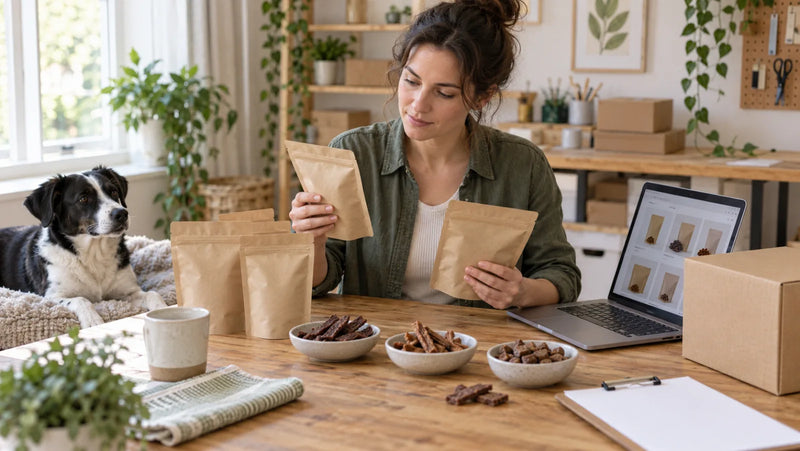
Write one or two questions at the top of the evaluation before contacting a supplier. A trainer may need to know whether a strip can be divided into small rewards without turning to crumbs. A pet-store buyer may need to compare shelf story, package fit, staff handling, and visible consistency. An ecommerce brand may need to understand how the item, final fill, pouch, label, and shipping plan work together.
“Please send your best sellers” gives the supplier little context and leaves the retailer with unrelated items that cannot be compared fairly. A stronger request names the shopper and job: a high-value dog training reward, a limited-ingredient option, a longer chewing format, or a product that fits a particular display and planned price position. Do not combine several unrelated questions into one verdict.
Define what the sample cannot establish as well. A visual inspection cannot replace laboratory testing, supplier records, label review, or veterinary advice. One dog's interest cannot predict universal palatability or sell-through. A temporary sample pouch cannot confirm final shelf presentation. These limits make the review more credible, not less useful.
What to Include in a Dog Treat Sample Request
A useful request gives the supplier enough detail to identify the right item and answer the right commercial questions. Include:
- business name, store type, sales channel, location, and contact information;
- exact item or category of interest and the intended species;
- planned use, such as training, everyday rewarding, chewing, or resale in a selected assortment;
- ingredient, protein, texture, size, or handling requirements that actually matter;
- proposed retail fill, package concept, and whether wholesale or private label is being considered;
- destination, desired timing, and any launch or review date;
- questions about the sample item, current label or specification, storage, lot/date information, minimum, quote, packaging, freight, and reorder path.
Ask how the supplier currently handles sample fees, sample quantity, and shipping instead of assuming that samples are free. Also ask whether the sample is drawn from the same item and format being quoted. If it is a demonstration cut, a temporary pack, or a close substitute, record that difference rather than silently treating it as the final specification.
Keep Every Sample Tied to Its Identity
Do not pour several samples into unlabeled containers and expect to reconstruct the decision later. Keep the item name, ingredient statement, supplier, sample date, lot or date details when supplied, storage instructions, and contact with the sample record. Photograph the sample and its identifying information before opening it, then preserve the original information for the duration of the review.
The FDA's animal-food labeling guidance identifies federal basics such as proper product identification, net quantity, the manufacturer or distributor's name and place of business, and an ingredient list. State requirements can also apply. A sample in a plain temporary pouch may not carry the complete final retail label, so ask for the current production label or specification rather than judging a blank bag.
Lot information deserves its own field. The FDA explains that a lot number helps identify a specific batch for a recall or product-problem report. Its pet-food lot-number guide also notes that lot codes can appear near a best-by date or elsewhere on a pouch. If no lot or date information accompanies a sample, write “not supplied” and ask how production orders are identified and traced.
Evaluate Appearance, Aroma, Moisture Feel, and Break Pattern
Use the same lighting, surface, and sequence for every item. Open one sample at a time, take a photo, and record observations before discussing favorites. Consistency matters, but natural products can vary; the goal is to describe the range and ask informed questions, not to declare that every color or shape difference is a defect.
- Appearance: note the size range, thickness, color range, visible fat, broken pieces, crumbs, edges, and any unexpected material.
- Aroma: describe the first impression with plain words such as mild, meaty, smoky, sour, rancid, or otherwise unusual. Do not mask an unexpected odor with fragrance or handling.
- Moisture feel: record whether the item feels dry, tacky, oily, brittle, firm, or pliable. This sensory impression is not a laboratory moisture result and does not establish shelf life.
- Break pattern: bend or divide a representative piece and note fibers, crumbs, sharp fragments, clean breaks, stretch, and the effort required.
- Cross-section: look for the internal texture and whether it appears reasonably consistent with the exterior and the stated format.
If a sample has an unexplained odor, condition, foreign material, damaged pack, or identity mismatch, separate it from feeding stock, keep its packaging and identifying information, photograph the issue, and contact the supplier. Appearance and smell can justify a question or a pause; they cannot diagnose a microbial, chemical, or storage problem.

Test the Retail Use Case, Not Just Palatability
Handle the sample the way staff and customers would. If it is meant for training, test whether it can be portioned into the intended reward size, whether it leaves residue on fingers or in a treat pouch, and whether repeated handling produces excessive crumbs. If it is a larger reward or chew, record the size range, supervision needs, package fit, display footprint, and how staff would explain the format.
Dog acceptance can be one recorded observation, but it needs guardrails. Obtain the owner's permission, use only an appropriately identified product, offer a small amount, and skip feeding when a dog has an allergy, medical restriction, unfamiliar diet, swallowing concern, or another reason the owner or veterinarian would avoid it. Never use a busy retail sampling moment to experiment on a dog whose history is unknown.
A dog's quick interest does not prove nutritional suitability, safety for every dog, repeat purchase, or product quality. Record the context—dog, portion, prior familiarity, and response—without converting a handful of reactions into a percentage or sales promise.
Review the Label and Supplier Documents Separately
A beautiful sample cannot answer every documentation question. Review the current label or specification for product identity, intended species, ingredient statement, final net quantity, company information, storage, feeding or use language, lot/date approach, and a way to contact the responsible business. Confirm which document applies to the exact quoted item and package.
Read claims literally. Words suggesting that a treat cures, treats, prevents, or mitigates disease raise a different regulatory issue than ordinary food statements; the FDA's labeling guidance warns that disease claims can indicate an intended drug use. A retailer should not fill a missing document with an assumption or repeat a supplier claim that has not been substantiated for the exact product.
Facility registration can be one documented fact, but it is not a substitute for the rest of the review. FDA's food-facility registration guidance states that assignment of a registration number does not convey approval or endorsement. Ask who actually manufactures, packs, labels, holds, and ships the item, then use our USA-made dog treat manufacturer vetting checklist for the deeper supplier review.
Use a Side-by-Side Retail Sample Scorecard
Give every item its own row and separate verified facts from observations. “Not supplied” is more useful than a guess because it creates a clear follow-up question.
| Field | What to record | Why it matters |
|---|---|---|
| Item identity | Name, protein, format, supplier, and sample date | Prevents sample mix-ups |
| Ingredients | Current ingredient statement or “not supplied” | Supports accurate comparison and shopper communication |
| Appearance | Size, thickness, color range, crumbs, and visible variation | Documents merchandising and consistency observations |
| Aroma and feel | Plain-language odor plus dry, tacky, oily, brittle, firm, or pliable feel | Creates a repeatable sensory note without pretending it is a lab test |
| Break and handling | Portioning effort, fibers, crumbs, residue, and intended use | Tests staff and customer use |
| Traceability record | Lot/date information received and where it appeared | Keeps observations tied to a batch when available |
| Label/specification | Document received, version or date, and open fields | Separates the sample pouch from the final retail presentation |
| Commercial scope | Current quote, minimum, sample terms, packaging, freight, availability, and timing | Shows whether the item fits the buying plan |
Avoid reducing everything to one magic score. Texture fit may matter greatly for a trainer and less for a store seeking a longer chew. Documentation is not interchangeable with dog interest, and dog interest is not interchangeable with margin or sell-through. Keep the component observations visible and make the decision against the original use case.
Compare the Commercial Path After the Product Review
Once an item survives the sample review, request the current order facts in writing. For American Paws, begin with the 10 lb per-product minimum and the current item quote, which starts at $14/lb; see the current catalog. Then confirm exact item, package or bulk format, availability, timing, freight, storage information, label responsibilities, and reorder terms. Do not build a launch around a sample until those inputs match the plan.
Wholesale and private label are related but not identical. Under the stated American Paws private-label route, the customer supplies approved branded pouches, and American Paws fills the confirmed treat, adds an oxygen absorber, and heat-seals the pouch. The small-batch private-label dog treat manufacturer guide explains the broader relationship, while the private-label inquiry page is the path for a current project.
You can review the consumer-facing range of American Paws dog treats for retail context, but do not assume that every live product is available in every wholesale or private-label format. Our wholesale dog treats for pet stores guide covers assortment, buying, and replenishment beyond the sample evaluation.
Run a Small, Documented Retail Trial
A sample review chooses a candidate; a retail trial tests the merchandising plan. Define the item, opening quantity, display, staff explanation, sampling rules, trial dates, price, customer questions, units sold, samples used, damage, remaining inventory, and the decision date. Keep a separate row for each item so one strong product does not hide another's weak result.
If in-store sampling is appropriate, set hygiene, portioning, supervision, permission, and cleanup rules before opening a pouch. Keep the product identity and lot/date information available. Staff should ask the owner before offering anything and should never present a treat as suitable for every dog.
Record repeat interest and objections, not just first reactions. Customers may care about protein, ingredients, size, texture, origin, package, price, or how the reward fits their routine. A small, documented test gives a retailer evidence for a reorder conversation without pretending that one weekend forecasts every store or season.
Red Flags Before a Trial Order
- the sample cannot be tied to an exact item or supplier;
- no ingredient information or current specification is available;
- the sample and quoted format do not match, and the difference is unexplained;
- an unusual odor, damaged package, foreign material, or condition concern is dismissed without review;
- sample packaging is presented as though it were the final retail label;
- registration, a logo, or a vague “approved” claim is used in place of specific documentation;
- the supplier will not clarify who manufactures, packs, labels, or ships the item;
- minimum, quote scope, packaging owner, availability, timing, freight, or sample terms remain vague while the buyer is pressured to commit.
A red flag calls for a pause and a factual question. It does not authorize the retailer to diagnose contamination, accuse a business, or invent the missing answer.
Frequently Asked Questions
Does American Paws offer dog treat samples for retailers?
Contact American Paws with the business type, sales channel, item or category, intended use, destination, and desired timing. The team can confirm current sample availability, format, any fee, shipping terms, and the appropriate next step; this article does not promise a particular sample program.
Are wholesale dog treat samples free?
Do not assume so. Suppliers may handle product, packing, and shipping differently. Ask for the current sample fee and freight terms before requesting or receiving anything, and record what the sample represents.
How much sample product should a retailer request?
Request enough for the specific evaluation, not an arbitrary universal amount. Explain whether the review covers appearance, breakability, staff handling, a small permitted dog-acceptance check, package planning, or another defined use, then confirm what the supplier can provide.
Can appearance or smell prove that a dog treat is safe?
No. Sensory observations can identify a question or reason to pause, but they cannot replace testing, records, label review, or professional assessment. Keep any concerning sample and its identifying information separate and contact the supplier.
What label information should come with a sample?
At minimum, ask for the exact product identity, intended species, ingredient statement, supplier contact, storage guidance, current label or specification, and lot/date information when available. If the sample uses temporary packaging, obtain the current production label separately.
Should retailers test samples with customers' dogs?
Only under a defined store policy with owner permission, accurate product identity, hygienic handling, a small portion, and appropriate supervision. Skip dogs with unknown histories, allergies, medical or dietary restrictions, or any owner or veterinary concern.
Does a good sample guarantee that the production order will match?
No. Record the exact sample and ask what specification, natural variation, packaging, and acceptance process apply to the order. Confirm current product and commercial terms in writing, and use the received order's own lot and label information.
Request a Sample With a Decision in Mind
A strong request is short but specific: identify the business and channel, item or category, intended use, ingredient and texture needs, proposed package, destination, desired timing, and the decision the sample must support. Ask for the current item information and sample terms, then use one consistent record from opening through trial-order review.
Ready to compare a current item? Use the American Paws wholesale page to request the current catalog and sample process. Ask the team to confirm the exact item, sample availability, any fee and shipping terms, 10 lb per-product minimum, current quote, packaging scope, availability, timing, freight, and next step. For customer-supplied approved branded pouches, submit the project through the private-label inquiry page.