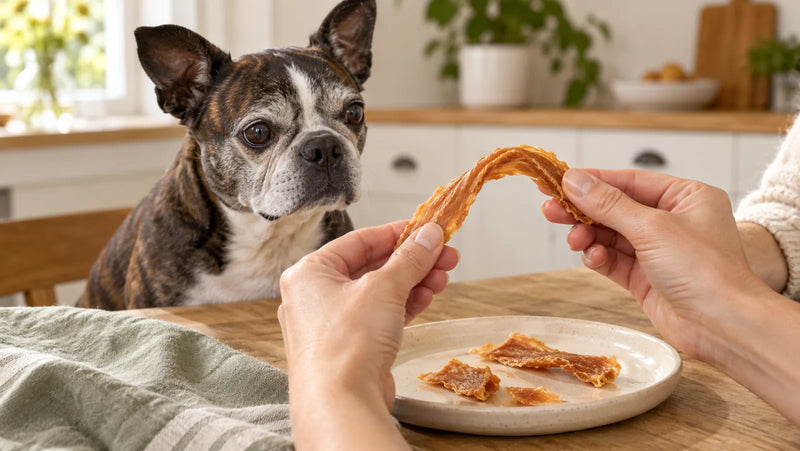

Salmon skin for dogs can be safe only when it is fully cooked, boneless, plain, and served in a small amount. Do not offer raw or undercooked salmon skin. For a dog treat, either cook sound fish to a safe temperature or choose a traceable commercial pet product with clear processing and feeding information; avoid smoked, salty, fried, or seasoned skin.
The word skin does not make salmon a harmless chew. Raw salmon can carry a fluke involved in salmon poisoning disease, raw animal foods can carry bacteria, thin fish bones may remain attached, and the finished skin can be rich in fat and calories. Safe use depends on source, processing, texture, portion, and the individual dog.
Is salmon skin for dogs safe?
A tiny piece of fully cooked, plain salmon skin may suit a healthy dog that tolerates fish and fat. The American Kennel Club's salmon guidance recommends thoroughly cooked, boneless salmon without seasoning, oil, or sauce and warns against raw and smoked fish. That conditional answer is very different from handing a dog skin from a raw fillet or restaurant plate.
Before serving, confirm all five conditions:
- Fully cooked or responsibly processed: not raw, undercooked, cold-smoked, or casually home-dried.
- Bone-free: inspect both sides and the attached flesh for pin bones or sharp fragments.
- Plain: no salt, brine, oil, butter, onion, garlic, sauce, spice rub, or glaze.
- Small and supervised: match the piece to the dog's mouth and remove any gulpable remnant.
- Appropriate for the dog: a veterinarian has not restricted fish, fat, calories, or extra foods.
If one condition is unknown, skip the skin. A complete and balanced food already supplies the dog's required nutrition, so there is no need to take a food-safety gamble for an optional extra.
Why raw salmon skin is risky for dogs
Salmon poisoning disease is an infection, not a toxin
Despite its name, salmon poisoning disease is not caused by a chemical poison in salmon. The Merck Veterinary Manual explains that dogs become infected after eating raw or undercooked salmonid fish containing the fluke Nanophyetus salmincola; the fluke can carry the bacterium Neorickettsia helminthoeca.
The disease is concentrated along the Pacific Northwest coast, but geography is not a home safety test. The source of a store, restaurant, found, or recreationally caught fish may be unclear, and raw salmon can present other microbial hazards anywhere. Do not conclude that raw Atlantic salmon, previously frozen salmon, or fish bought far from the Pacific Northwest is automatically safe for a dog.
Signs may develop days after exposure and can include fever, appetite loss, vomiting, diarrhea, lethargy, and enlarged lymph nodes. Prompt treatment matters. If your dog eats raw or undercooked salmon—especially wild-caught, beach-found, river, Pacific Northwest, or unknown-source fish—call a veterinarian now rather than waiting for symptoms.
Raw fish can carry other foodborne pathogens
Parasites are not the only concern. The FDA's raw pet-food guidance reports a higher likelihood of disease-causing bacteria in raw pet food and discusses Salmonella and Listeria monocytogenes risks to both pets and people handling contaminated food.
A dog can spread bacteria through saliva, stool, bowls, and household surfaces even without obvious illness. Keep raw seafood separate from ready-to-eat food, use a dedicated clean cutting surface, wash hands and utensils, and do not let a dog lick raw-fish prep areas. Thorough cooking is the practical control; a quick sear that leaves the skin or attached flesh undercooked is not enough.
Freezing and home dehydration are not safety guarantees
A household freezer is not a universal kill step for every bacterium and parasite. Likewise, “dehydrated” describes moisture removal, not a promise that a product is sterile. Safety depends on the species, starting material, time, temperature, moisture target, sanitation, and validated process.
Do not put raw salmon skin into a home dehydrator at an improvised low setting and assume dryness proves safety. If you want a dried chew, choose a product made specifically for pets by a traceable producer and evaluate the complete label. A commercial product can still be recalled or mishandled, so lot information, best-by date, package integrity, storage directions, and recall awareness still matter.
How to cook salmon skin for dogs
Start with a boneless, sound fillet
Cooking skin while it remains attached to a boneless fillet is easier to assess than trying to temperature-check a loose paper-thin sheet. Buy refrigerated or properly frozen fish from a traceable source. Reject fish or packaging that is leaking, swollen, damaged, or unusually warm.
Before cooking, run clean fingers gently over the flesh and use fish tweezers to remove pin bones. Check the skin side for hard scales or debris. Do not rinse raw fish in the sink; splashing can spread microbes. Instead, pat the surface with a disposable towel and clean the preparation area afterward.
Cook seafood to 145°F
The FDA recommends cooking most seafood to an internal temperature of 145°F (63°C). Bake, steam, or grill the salmon plainly and check the thickest attached flesh with a clean food thermometer. The flesh should be opaque and separate easily, but appearance alone is less reliable than temperature.
Do not partially cook salmon for the dog, and do not reserve a rare or medium-rare restaurant edge as a “special bite.” Once fully cooked, let the skin and fish cool completely, inspect again for bones, and cut off a tiny plain piece. The rest belongs in human storage or a veterinarian-formulated recipe, not automatically in the dog's bowl.
Serve it completely plain and cool
Dogs do not need salt, pepper, smoke flavor, lemon sauce, teriyaki, garlic butter, chili, or cooking oil on salmon skin. Plain cooking also makes it easier to know which new ingredient the dog is trying. If the fillet was cooked for people with a sauce or rub, do not assume the seasoning can be scraped off completely.
Cool the food before serving and cut the skin across its grain into a soft, small piece. Supervise from start to finish. A crisp edge may be sharp, and a flexible strip may be gulped; texture changes with cooking method, thickness, and attached flesh.

What about dehydrated salmon skin dog treats?
Read the ingredient and processing label
A useful label identifies the fish species, lists every ingredient, gives calorie or feeding information, names the responsible company, and carries a lot or best-by code. Ideally, the maker also explains its pathogen-control process and provides storage directions. “Natural,” “wild,” “human grade,” or a rustic package photograph does not replace those facts.
For a salmon-skin-only treat, the ingredient list should not hide salt, glycerin, smoke flavor, oil, sweetener, preservative, or another protein. More ingredients are not automatically bad, but every addition changes the nutrition and suitability. If a label is incomplete or the source cannot answer basic processing questions, choose another product.
Match texture and size to the dog
Dried salmon skin can range from paper-thin and crisp to thick, folded, hard, or chewy. No one texture is safest for every dog. Brittle pieces may break into sharp edges; flexible strips can become gulpable; very hard products may not suit puppies, seniors, or dogs with dental disease.
Choose a piece larger than the dog's immediate swallowing capacity, supervise active chewing, and take it away before the remnant becomes small enough to gulp. If the label presents the product as a small crunchy treat rather than a chew, break it into an appropriate reward size before offering. Never call fish skin splinter-proof or completely digestible.
Store fatty fish treats carefully
Fish fat can oxidize, and moisture can invite spoilage. Follow the manufacturer's after-opening directions, reseal the package tightly, keep it away from heat and sunlight, and do not mix an old lot into a new bag. A pantry jar is useful only if the label permits room-temperature storage and you retain the original lot and best-by information.
Discard skin that is moldy, damp when it should be dry, unusually soft or slimy, sour, paint-like, rancid, or ammonia-smelling. Do not try to bake an old treat “safe again.” Our broader dried fish-skin treat guide compares species, texture, freshness, and storage checks across the category.
Benefits of salmon skin without overpromising
Protein and omega-3 fatty acids
Salmon flesh and skin can provide protein and omega-3 fatty acids. Those nutrients are one reason fish appears in complete diets and supplements. A dog's actual intake, however, depends on salmon species, cut, attached tissue, cooking, dehydration, serving size, and the finished product's analysis.
Omega-3 fatty acids participate in normal body functions, including skin and coat biology. That does not turn one skin strip into a treatment for itching, arthritis, inflammation, heart disease, or cognitive decline. Medical use of fatty acids requires a veterinarian-selected source and dose that accounts for the complete diet.
A rich treat is not a medical supplement
Salmon is rich in beneficial fats but can also be calorie-dense. Skin with attached fatty tissue and concentrated dried skin may deliver more calories per bite than its size suggests. Finished products vary, so compare the label rather than assuming every salmon-skin treat has the same fat level.
A large fatty serving can cause vomiting or diarrhea and may be inappropriate for a dog with a history of pancreatitis, hyperlipidemia, a prescribed low-fat diet, or an obesity-treatment plan. Do not use salmon skin to self-treat dry coat, sore joints, or another symptom; ask the veterinarian to investigate the cause and choose an evidence-based plan.
How much salmon skin can a dog eat?
There is no universal strip count. A curled dehydrated skin, a paper-thin crisp, and a soft cooked piece can differ dramatically in size, fat, and calories. The package's calorie statement and your dog's veterinarian-approved treat allowance matter more than visual length.
For a healthy dog trying plain fully cooked skin for the first time, these are deliberately tiny starting portions—not daily maximums:
| Dog size | Conservative first taste | Serving note |
|---|---|---|
| Under 15 lb | One fingernail-size soft piece | Minced or crumbled; no hard strip |
| 15–40 lb | One piece about 1 inch square | Offer while calm and supervised |
| 41–70 lb | One or two 1-inch pieces | Give one piece at a time |
| Over 70 lb | Two small pieces | Do not substitute a whole skin |
A dog does not need to “graduate” to more. Stop after the first taste and watch for vomiting, diarrhea, itching, hives, facial swelling, discomfort, or appetite change. A commercial dried product may be much more calorie-dense than cooked skin, so use its label and break the listed serving down when introducing it.
Count calories, not just pieces
All extras together generally stay at about 10% or less of daily calories, leaving complete food in charge. Salmon skin shares that budget with training rewards, dental chews, toppers, table food, and every other snack. Our daily dog-treat calorie guide shows how to count the whole mix.
For a dog on a medical diet, even 10% may be too much or the ingredient may be excluded entirely. A treat ceiling is not permission to fill the full amount with rich skin.
Salmon skin dogs should skip
Raw, undercooked, cold-smoked, and beach-found fish
Never intentionally feed raw or undercooked salmon skin. Skip sushi trimmings, ceviche, lox, cold-smoked salmon, fishing bait, fish carcasses, and any salmon found on a beach, riverbank, trail, or dock. Smoking, curing, freezing, and drying are not interchangeable with a validated cooking or pet-food safety process.
Salty, seasoned, fried, sauced, or oily skin
Restaurant crispy skin is commonly salted and cooked with oil or butter. Smoked products are often brined. Glazes and rubs may contain sugar, onion, garlic, chili, or other ingredients a dog does not need. Do not rinse or scrape a seasoned skin and call it plain; choose a separate unseasoned piece prepared from the start.
Skin with bones, sharp scales, or spoilage signs
Pin bones can choke, lodge, or injure tissue. Hard scales and jagged brittle edges can also cause trouble. Inspect the actual piece under good light and discard questionable parts. Spoiled fish may smell sour, rancid, or like ammonia and can be dangerous even after heating.
Which dogs need veterinarian guidance first?
Ask before offering salmon skin to a puppy; a pregnant or nursing dog; a dog with pancreatitis, hyperlipidemia, obesity, diabetes, chronic gastrointestinal disease, kidney or heart disease, food allergy, dental disease, or swallowing trouble; or any dog on a prescription, elimination, low-fat, or calorie-restricted diet.
Fish can also be an ingredient in allergy workups. Adding an unplanned salmon treat during an elimination trial can invalidate the trial even if the skin is perfectly cooked. The veterinarian must approve every food, flavor, chew, medication carrier, and supplement during that period.
What to do if a dog eats raw salmon skin
- Call a veterinarian promptly. Do not wait for fever, vomiting, diarrhea, lethargy, or swollen lymph nodes.
- Describe the source. Say whether the fish was wild or farmed, fresh or frozen, river or ocean, Pacific Northwest or unknown, store-bought, restaurant, bait, trash, or beach-found.
- Record exposure. Note the amount, time, dog weight, bones, packaging, and any current symptoms.
- Save evidence safely. Keep packaging, receipt, lot information, or a photo, but prevent pets and people from touching remaining raw fish.
- Do not use home remedies. Do not induce vomiting or give oil, salt, peroxide, charcoal, or medication unless a veterinary professional directs it.
Emergency care is especially urgent for weakness, repeated vomiting or diarrhea, breathing trouble, tremors, collapse, severe abdominal pain, inability to swallow, or suspected bone obstruction. Salmon poisoning disease is treatable when recognized; delay is the dangerous choice.
Salmon skin vs other dried fish skins
Species names do not tell the whole story. Salmon skin often brings a rich fatty profile, while a finished cod-skin product may differ in thickness, texture, calories, and odor—but processing and attached tissue can reverse assumptions. Compare the actual ingredient list and guaranteed analysis rather than declaring one fish universally leaner or safer.
Our cod-skin safety and selection guide owns the cod-specific question. The category guide above compares cod, salmon, and pollock formats. This page stays focused on salmon's raw-fish risk, cooking rules, rich portions, and label checks.
Frequently asked questions
Can puppies eat salmon skin?
Only with veterinarian approval, and then as a tiny fully cooked, boneless, plain, soft piece. Puppies need complete growth food and have little room for calorie-dense extras. Hard dried skin can also be a poor match for developing teeth and fast swallowing.
Can dogs eat crispy salmon skin?
Only if “crispy” means fully cooked, bone-free, plain, and not fried or salted. Restaurant skin usually fails that test because it is seasoned and cooked in fat. Crisp edges can be sharp, so break an approved piece small and supervise.
Are dehydrated salmon skins safe for dogs?
They can be suitable when made as a pet treat by a traceable producer using controlled processing, with a complete label, lot code, feeding guidance, and proper storage. Dehydrated does not mean sterile. Avoid anonymous products and casual home-dried raw skin.
Can dogs eat smoked salmon skin?
Do not plan to feed it. Cold-smoked fish may not receive a full cooking step, and both cold- and hot-smoked products commonly contain salt or brine. The process and seasoning are too variable when a plain cooked alternative is available.
Can dogs eat salmon skin every day?
Daily use is unnecessary and can add substantial fat and calories. A veterinarian may formulate salmon into a complete diet, but that is different from adding skin as an extra every day. Use occasional measured pieces only when they fit the dog's health and total diet.
Choose cooked, plain, traceable, and small
The safe version of salmon skin is fully cooked, bone-free, unseasoned, fresh, and tiny—or a responsibly made pet treat with transparent processing and storage information. Raw, undercooked, smoked, salty, anonymous, spoiled, or unsupervised skin is not worth the risk.
American Paws does not currently sell a salmon-skin or other fish product. To compare the real products available today, browse all current American Paws dog treats by ingredient, texture, and serving size. Keep every choice inside the same treat budget, and let your veterinarian decide whether a rich fish-skin extra belongs in your dog's plan.