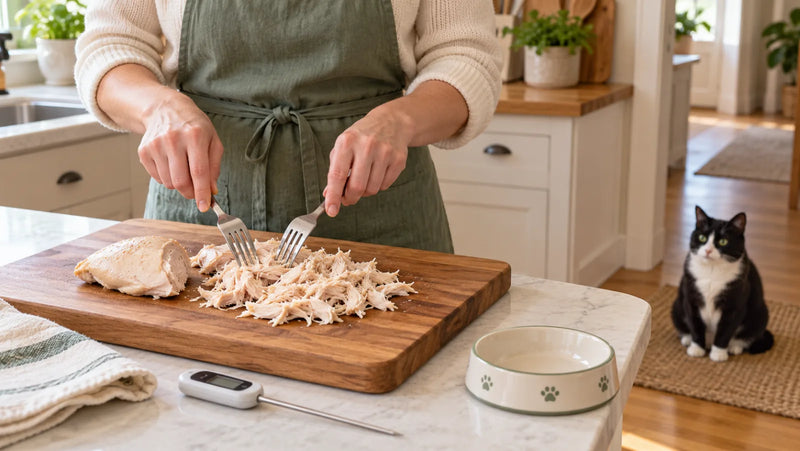

Can cats eat rice? An otherwise healthy adult cat may try a tiny amount of fully cooked, cooled, plain white rice. Start with one or two soft grains or about 1/4 teaspoon. Under this conservative guide, stop at one level teaspoon and count it with every other treat and topper.
Rice is not toxic simply because it is a plant starch, but it adds little a cat needs and should never replace complete-and-balanced cat food. Add no salt, butter, oil, broth, sauce, onion, garlic, or seasoning. If the cat has diarrhea, vomiting, poor appetite, a medical condition, or a prescribed diet, ask the veterinarian before changing the food.
Can Cats Eat Rice? The Short Answer by Form
| Rice form or situation | Practical answer | Why |
|---|---|---|
| Plain fully cooked white rice | An eligible healthy adult cat may try a few cooled grains | It is a simple soft starch, but it adds little useful feline nutrition |
| Plain fully cooked brown rice | Not automatically toxic, but unnecessary as a first cat taste | The retained outer layer makes it chewier and higher in fiber |
| Raw, dry, or undercooked rice | Do not offer | It is not the soft, controlled cooked form described here |
| Fried, seasoned, packet, restaurant, or leftover rice | Skip and assess the whole recipe after a theft | Fat, salt, broth, sauce, onion, garlic, or other ingredients change the question |
| Rice for diarrhea or vomiting | Use only if the veterinarian gives an exact plan | Rice is not a diagnosis, treatment, or complete recovery diet |
| Rice for a kitten or cat on a medical diet | Ask the veterinary team first | Growth and therapeutic diets leave little room for unplanned extras |
This is the feline answer. The established dog rice-safety guide owns canine white-versus-brown choices, dog portions, and dog health boundaries. Do not transfer a dog serving or bland-diet assumption to a cat.
Obligate Carnivore Does Not Mean Every Plant Ingredient Is Poison
Cats are obligate carnivores. Cornell Feline Health Center's feeding guidance explains that cats rely on nutrients found only in animal products and that complete feline food is formulated to supply nutrients in the right balance. That biological requirement is the reason rice should stay secondary.
It does not mean one cooked grain is a toxin. The Merck Veterinary Manual's small-animal nutrition overview notes that domestic cats can digest and absorb cooked plant starches. In the same discussion, it still classifies cats as obligate carnivores because nutrients such as taurine, arginine, arachidonic acid, and preformed vitamins must be supplied appropriately through a diet that includes animal tissues.
That distinction prevents two opposite errors. “Cats are carnivores, so rice is poison” is too broad. “Cats can digest rice, so a rice-heavy bowl is healthy” is also wrong. Tolerance is not nutritional necessity, and a human food does not earn a larger role simply because one tiny taste causes no immediate problem.
Choose Plain Fully Cooked White Rice
For the lowest-complexity test, use plain white rice whose only ingredient is rice. Cook it completely in water until the grains are soft, then cool it before measuring the cat's taste. A hard or chalky center means it needs more cooking. Do not serve the rice hot, dry, crunchy, or straight from a steaming pan.
Separate the cat's few grains before the household batch receives butter, oil, salt, stock, broth, soy sauce, vegetables, meat drippings, or seasoning. If the additions are already mixed in, do not rinse or pick them off and call the remainder plain. Make a clean water-only batch or skip the taste.
The detailed plain rice cooking and storage method covers the 1:2 long-grain white-rice workflow, softness check, cooling, measuring, and prompt refrigeration. Use that page only for the kitchen mechanics. Its dog-size tasting table and canine decisions do not apply to cats.

Start With a Few Grains, Stop at One Level Teaspoon
For an otherwise healthy adult cat already allowed ordinary treats, begin with one or two soft grains or about 1/4 teaspoon of cooled cooked rice. Offer it in a separate clean dish rather than hiding it throughout the meal. A separate taste makes the amount visible and lets the cat walk away.
One level teaspoon is the conservative ceiling in this article. It is not a daily serving, a target to reach, a treatment dose, or a universal safe maximum. A small cat, a cat who has already received treats, or a cat with a restricted plan may have no room for rice. Never use a heaped table spoon or let the cat eat from the saucepan.
All extras share one allowance. The WSAVA guide to feeding treats to cats says treats should provide no more than 10% of daily calories and should not replace meals. That ceiling includes rice, toppers, pill food, table tastes, dental items, and packaged treats together; it is not an instruction to fill 10% every day.
The companion guide to counting a cat's complete daily treat allowance explains why piece count alone is not enough. Use the cat's actual veterinary calorie plan and exact product information rather than inventing a rice allowance on top of everything else.
Rice Does Not Complete a Feline Meal
Plain cooked rice does not supply every nutrient a cat requires in the correct amount and proportion. It cannot replace wet or dry cat food labeled complete and balanced for the cat's life stage, and it cannot repair an incomplete homemade recipe. A bowl can add bulk and calories while displacing the food that has the real nutritional job.
Keep at least the overwhelming majority of intake in the cat's measured complete food and use less than the maximum extra allowance when possible. Kittens, pregnant or nursing cats, underweight cats, seniors with changing needs, and cats with diabetes, obesity, kidney disease, urinary disease, gastrointestinal disease, food reactions, or other conditions need an individual answer rather than this healthy-adult tasting example.
For choosing a purposeful reward, the best cat treats framework starts with the exact label, calories, texture, portionability, and fit with the individual cat. Rice has no feline-specific label, no complete nutrient statement, and little reason to compete with a reward chosen for a clear job.
Diarrhea Is a Veterinary Question, Not a Rice Recipe
Chicken and white rice is familiar as a “bland diet,” but familiarity does not make it the default treatment for a cat. VCA's current guidance on gastrointestinal diets says the term “bland diet” has lost favor because it is not specific. It explains that traditional chicken and rice is incomplete, difficult to standardize, and deficient in multiple essential nutrients for dogs and cats, while veterinary therapeutic gastrointestinal diets can be formulated for recovery needs.
Diarrhea has many possible causes, including an abrupt food change, parasites, infection, a toxin, foreign material, food intolerance, medication, and chronic disease. Rice cannot identify which cause is present. Adding a new ingredient can also make the history harder to interpret.
Do not fast a cat, withhold water, or choose a rice-to-chicken ratio from the internet. VCA's cat-diarrhea guidance emphasizes veterinary assessment and ready access to water because a cat with diarrhea can become dehydrated. The veterinarian may choose a therapeutic diet, another feeding plan, testing, medication, or a different intervention based on the cause and the cat.
Call promptly for a kitten; repeated vomiting; blood or black stool; marked lethargy; pain; weakness; dehydration; refusal to eat or drink; a possible toxin, string, bone, wrapper, or other foreign object; an existing medical condition; or diarrhea that persists or worsens. Cats can hide illness, and waiting for rice to “work” can delay needed care.
If the veterinarian specifically includes rice, ask for the exact rice type, cooked weight, companion food, meal frequency, storage instructions, duration, and transition back to the regular diet. Record how much is offered and eaten. A clinic-directed temporary plan is different from turning chicken and rice into an open-ended homemade diet.
Skip Seasoned Rice and Assess the Whole Dish
“Rice” on a plate may be only the base of a recipe. Fried rice can contain oil, soy sauce, onion, garlic, meat, egg, and seasoning. Pilaf may use butter, stock, bouillon, onion, and spices. Risotto often contains broth, cheese, butter, wine, onion, or garlic. Rice pudding introduces milk, sugar, spices, and sometimes raisins. Sushi rice is usually seasoned, and the full bite may add raw fish, sauce, avocado, or another filling.
Onion, garlic, chives, leeks, and shallots need special attention. The Merck Veterinary Manual's Allium toxicosis guidance says cats are especially susceptible and that raw, cooked, dehydrated, and granulated forms can cause illness. Powder in a seasoning blend or broth still counts. Signs can be delayed, so a known exposure warrants a prompt veterinary or poison-control call even if the cat looks normal immediately.
After a mixed-dish theft, save the package or recipe and estimate the maximum amount and time. Note missing wrappers, skewers, foil, string, bones, or other nonfood material. Call the veterinarian about an unknown recipe, meaningful amount, medical restriction, toxic ingredient, foreign object, or any symptoms. Do not induce vomiting or give salt, oil, milk, peroxide, charcoal, or a human medicine unless a veterinary professional directs that exact case.
White Rice Versus Brown Rice for Cats
White rice has had the outer layers removed, so it cooks soft and contains less fiber than brown rice. That makes plain white rice the simpler format for the tiny adult-cat tasting decision described here. It does not make white rice a necessary food, a balanced meal, or a medicine.
Brown rice retains its outer layer and has a chewier texture and more fiber. A healthy adult cat might tolerate a few fully cooked plain grains, but “brown” is not automatically healthier for an obligate carnivore. It is also not an automatic choice for diarrhea, constipation, weight control, or diabetes. Those conditions require an individualized diet.
The canine white-versus-brown rice comparison explains the dog-side decision in more detail. Its conclusions do not establish a feline portion. For a cat, the useful question is not which rice can occupy more of the bowl; it is whether rice earns any place beside complete feline food at all.
Watch the Cat After the First Taste
Test only one new food at a time when the cat is otherwise normal. Keep the rice package, write down the amount and time, and maintain the usual meal and water routine. Do not combine the first rice taste with a new meat, dairy product, topper, or medicine disguise.
Stop offering rice if vomiting, diarrhea, marked gas, discomfort, itching, facial swelling, coughing, gagging, unusual thirst, appetite change, or a behavior change appears. Breathing difficulty, collapse, repeated vomiting, severe weakness, a swollen or painful abdomen, or profound distress needs urgent veterinary care.
A normal first taste does not justify increasing the portion. Keep future use tiny and occasional, or simply stop. Cats do not need rice exposure to develop a balanced palate, and refusing the dish is not a nutritional problem.
Rice and Peanut Butter Share the Same Human-Food Problem
People foods often get reduced to a yes-or-no label even when form, recipe, amount, and purpose matter. Plain rice may permit a tiny taste, while a seasoned rice dish does not. The guide to cats and peanut butter makes a similar distinction between a trace accidental lick and planned feeding of a sticky, calorie-dense human food.
Neither rice nor peanut butter adds something a cat must obtain from a treat. Both can displace complete food, and both become more complicated when mixed with other ingredients. A narrow “may tolerate” answer should never be converted into a routine serving recommendation.
A Feline-Labeled Chicken Reward When It Fits
When a cat already tolerates chicken and the veterinary feeding plan permits a separate reward, the current American Paws freeze-dried chicken training treat is labeled for cats and dogs and lists 100% USA chicken breast, freeze-dried whole, as its ingredient. It is intended for intermittent or supplemental feeding rather than as a complete diet.
Natural pieces vary, so break one to a comfortable cat-sized fragment when needed, supervise the bite, and count the portion with every other extra. The exact label and the individual cat control. Chicken is unsuitable for a cat with a chicken reaction or a veterinary plan that excludes it.
This product is not an ingredient for an improvised chicken-and-rice diet, a diarrhea treatment, or proof that every item in a mixed collection suits cats. You can compare current American Paws cat treats and dog treats by exact label, but confirm species, ingredients, texture, calorie information, and feeding directions item by item.
Frequently Asked Questions
Can cats eat cooked white rice?
An otherwise healthy adult cat may try one or two soft grains or about 1/4 teaspoon of fully cooked, cooled, plain white rice. Keep it water-only and separate from the complete meal. Stop at one level teaspoon under this conservative guide and use less when other extras already fill the allowance.
How much rice can a cat eat?
There is no universal rice serving. One level teaspoon is the conservative ceiling used here for an eligible healthy adult, not a target, daily allowance, or treatment dose. A kitten, small cat, cat on a medical diet, or cat who already received treats may need none.
Can cats eat brown rice?
A few fully cooked plain grains are not automatically toxic to a healthy adult cat, but brown rice is chewier and higher in fiber and offers no necessary advantage. Do not use it as a home treatment for diarrhea, constipation, diabetes, or weight control.
Can kittens eat rice?
Do not apply the adult teaspoon estimate to a kitten. Complete growth food needs to supply the kitten's nutrition, and a small body leaves little room for incomplete extras. Ask the veterinarian before adding rice, especially when the kitten has diarrhea, vomiting, poor appetite, weak growth, or a prescribed diet.
Can cats eat rice for diarrhea?
Only if the veterinarian recommends an exact plan for that cat. Traditional chicken and rice is incomplete and may not fit the cause of diarrhea. Ask what food, amount, frequency, and duration to use, and seek prompt care for red flags or worsening signs.
Can cats eat chicken and rice?
Do not build a routine homemade diet from chicken and rice. The mixture is not complete-and-balanced feline nutrition. If a veterinarian prescribes it temporarily, follow the exact recipe and transition instructions; approval of one ingredient does not automatically approve the other.
Can cats eat fried rice or rice cooked in broth?
Skip both as planned treats. Fried rice and broth can add fat, salt, onion, garlic, sauces, and other ingredients. After a theft, assess the entire recipe, amount, time, cat's health, and symptoms rather than judging the rice alone.
Can cats eat uncooked rice?
Do not offer raw, dry, or undercooked rice. It is not the soft controlled form in this guide and gives a cat no nutritional advantage. Secure the pantry and package, and call the veterinarian if a meaningful amount or packaging was swallowed or signs develop.
Keep Complete Feline Food in Charge
The careful answer is narrow: a healthy adult cat may tolerate a few fully cooked, cooled grains of plain white rice. Begin around 1/4 teaspoon and stop at one level teaspoon under this conservative guide. Rice adds little a cat needs, receives no separate calorie budget, and never becomes a complete meal or owner-prescribed diarrhea treatment.
For a measured animal-protein reward when chicken already fits the cat, review the exact dual-species freeze-dried chicken label. Break the natural piece to a comfortable size, supervise it, and count it within the same extras allowance while complete-and-balanced cat food continues to do the nutritional work.