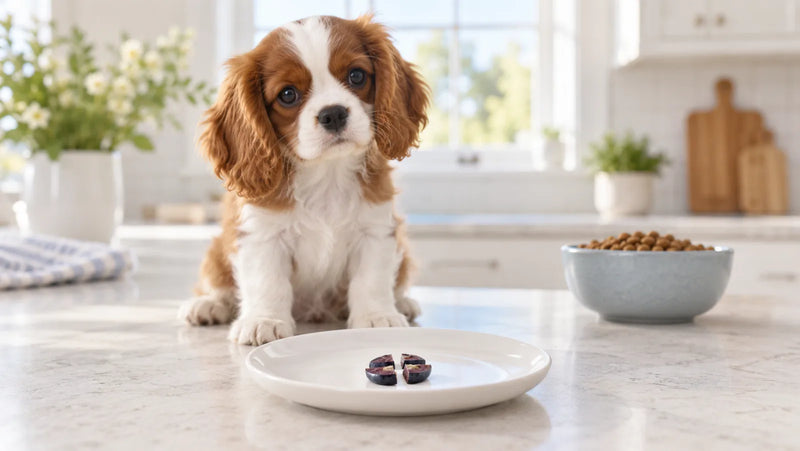

Can dogs eat mushrooms? It depends on the source. A small amount of a clearly identified grocery-store mushroom—such as a white button, cremini, or portobello mushroom—served plain and cooked is generally safe. A mushroom from a yard, trail, park, planter, or other unknown source is a completely different case and must be treated as potentially toxic.
If your dog ate any wild or unidentified mushroom, contact your veterinarian, an emergency clinic, or ASPCA Animal Poison Control at (888) 426-4435 immediately—even if your dog looks normal. ASPCA Poison Control is available 24 hours a day, and a consultation fee may apply. Call first; photograph or collect evidence only if doing so will not delay care.
Do not wait for vomiting, do not rely on a phone identification app, and do not induce vomiting or give hydrogen peroxide, salt, milk, food, oil, charcoal, or another home remedy unless the veterinarian or poison professional directing this specific case tells you to. Different mushroom toxins affect different organs and can begin on very different timelines.
Can Dogs Eat Mushrooms? First Identify the Source
There is no single safety answer for everything called a mushroom. The practical first question is not “What color was the cap?” but “Where did it come from?” Use four lanes:
- Identified grocery-store food mushroom: generally low risk by itself; a small, plain, cooked piece is the clearest sharing case.
- Wild, yard, trail, park, or unidentified mushroom: possible poisoning emergency; call immediately and do not attempt a home clearance.
- Prepared mushroom dish: assess butter, oil, onion, garlic, salt, wine, cream, sauce, and every other ingredient—not just the mushroom.
- Psychoactive mushroom or edible: call immediately; the mushroom compound, chocolate or other carrier, dose, and packaging may all matter.
The ASPCA Poison Control mushroom guide says mushrooms sold in grocery stores for human consumption are generally considered safe for pets and are not expected to cause adverse effects if ingested. It also warns that toxic wild species can cause severe stomach upset, breathing difficulty, seizures, liver or kidney damage, and death.
Our complete toxic-food guide for dogs shows where mushroom poisoning fits among other urgent kitchen and yard hazards. Readers often screen mushrooms alongside produce, so our broader guide to vegetables dogs can and cannot eat gives the surrounding meal-planning context, although mushrooms are fungi rather than vegetables.
Store-Bought Mushrooms: Plain and Cooked Is the Low-Risk Case
Use an identified grocery variety, not a foraged look-alike
A white button, cremini, or portobello mushroom from a mainstream grocery produce section has a known food supply and is not handled like an unknown lawn mushroom. “Grocery-store” is about reliable identity and intended human food use; it is not a visual category an owner can assign to something growing outside.
If you choose to share, offer only a tiny dog-sized piece from a fresh mushroom that was plainly cooked. Let it cool, cut it small enough for the dog's size and swallowing style, and introduce no more than a taste. Dogs do not need mushrooms to complete a balanced diet, so there is no nutritional reason to press the issue if the dog has a sensitive stomach, a prescribed diet, or no prior tolerance.
Why “plain” matters more than the mushroom
People rarely eat mushrooms plain. Sautéed mushrooms may arrive in butter or oil with garlic, onion, salt, pepper, cream, cheese, wine, gravy, soy sauce, or a concentrated seasoning blend. Those ingredients can turn a low-risk grocery mushroom into a dish that should not be shared.
Garlic and onion are not harmless garnish for dogs. Our dog-specific garlic poisoning guide explains the concentrated and delayed red-blood-cell risk without asking this mushroom page to recreate it. If a dog stole a prepared dish, save the recipe or restaurant ingredient information and report the whole meal.
Raw, cooked, canned, and dried are not identical
| Form | Practical guidance | What changes the case |
|---|---|---|
| Plain cooked grocery mushroom | A small, cooled, dog-sized piece is generally low risk | Species identity, amount, dog tolerance, and any added ingredients |
| Raw grocery mushroom | Not classified like a wild mushroom, but unnecessary and potentially harder to digest; do not make it a routine reward | Whole pieces can be gulped; freshness and identification still matter |
| Canned or jarred mushroom | Usually a poor sharing choice | Brine, sodium, preservatives, oil, garlic, onion, and seasoning |
| Dried culinary mushroom | Do not improvise a dog serving | Concentrated product, chewy texture, seasoning, uncertain variety, and rehydration |
| Wild or home-foraged mushroom | Never clear it for feeding and never wait after accidental ingestion | Professional identification and immediate veterinary toxicology guidance are required |
Cooking does not make an unknown wild mushroom safe. Some mushroom toxins remain dangerous despite ordinary kitchen preparation. The “plain and cooked” recommendation applies only after the mushroom has been reliably identified as a grocery-store food variety.
Wild or Unidentified Mushrooms: Treat Every Ingestion as an Emergency
Visual identification is unreliable
The Merck Veterinary Manual overview of poisonous mushrooms explains that many mushrooms are edible but some contain toxins that can cause mild illness, severe organ injury, or death. It also says visual identification can be difficult even for experienced mycologists, especially after a mushroom has been chewed or altered by stomach contents or treatment.
Cap color, spots, gills, odor, the presence of insects, the tree nearby, and whether wildlife touched it cannot safely clear a mushroom. A phone app or image search may help organize a photograph for a trained identifier, but it cannot turn an unknown ingestion into a home observation case. Look-alikes exist, photos may miss the stem base or gills, and more than one species can grow in the same patch.
The AKC's mushroom safety guide therefore advises treating all wild mushrooms as potentially toxic and contacting veterinary or poison resources immediately. Do not assume dogs avoid toxic species by smell; indiscriminate eating is precisely why dogs are exposed.
A normal-looking dog is not cleared
Some mushroom toxins cause signs quickly, while others have a silent period before serious organ injury becomes apparent. A dog who trots home normally, eats dinner, or seems better after an episode of vomiting has not necessarily cleared the danger. The exact source, time, amount, and toxin pattern matter more than a reassuring first impression.
Do not wait for a symptom list to become complete. Early vomiting can occur in both comparatively limited gastrointestinal cases and life-threatening poisonings. Conversely, absence of early vomiting does not rule out a delayed liver or kidney toxin. Prompt care matters because some veterinary decontamination and monitoring decisions are time-sensitive.
Mushroom Poisoning Symptoms in Dogs
Symptoms vary by species and toxin. They may involve the digestive tract, autonomic nervous system, brain, liver, kidneys, or several systems at once. The same patch can contain more than one species, so a fast onset does not guarantee that a delayed toxin was absent.
| Pattern | What an owner may notice | Why it matters |
|---|---|---|
| Gastrointestinal | Vomiting, diarrhea, abdominal pain, appetite loss, weakness, dehydration | Can be the whole syndrome or the first phase of serious liver injury; symptoms cannot identify the mushroom |
| Excess secretions | Heavy drooling, watery eyes, urination, diarrhea, breathing changes, weakness | Some muscarine-containing species affect autonomic functions and require urgent treatment |
| Neurologic | Wobbling or ataxia, disorientation, agitation, unusual vocalizing, tremors, seizures, profound sleepiness or coma | Requires emergency evaluation; psychoactive products and co-ingredients may complicate the history |
| Liver | Vomiting and diarrhea followed by apparent improvement, then lethargy, jaundice, weakness, abnormal bleeding, collapse | Delayed amatoxin injury can progress despite a deceptive quiet period |
| Kidney | Vomiting, appetite loss, dehydration, changes in thirst or urination, worsening weakness | Some kidney-toxic mushrooms have delayed signs; normal early behavior does not provide clearance |
| Immediate red flags | Trouble breathing, collapse, repeated seizures, severe tremors, extreme weakness, unresponsiveness | Begin emergency transport now and call on the way when another adult can do so safely |
Jaundice may look like yellowing of the whites of the eyes, gums, or lightly haired skin, but owners should never wait for yellow color before calling. Likewise, changes in drinking or urination are late clues, not a screening test. Tell the clinic about every observed sign and when it began.
Why Delayed Liver Injury Is Especially Dangerous
Amatoxin-containing mushrooms illustrate why “wait and see” is unsafe. Merck's veterinary review of delayed mushroom toxins describes a possible sequence: a 6–12-hour phase with no clinical signs, gastrointestinal illness, a period of apparent recovery, and then a liver and kidney phase that can become fatal.
Not every mushroom poisoning follows that sequence, and the clock is not a household diagnosis tool. Its value is operational: looking normal for several hours or briefly improving does not make a wild mushroom safe. If the mushroom is unknown, the professional call happens at discovery, not after the silent window ends.
Merck identifies Amanita phalloides as the mushroom most often implicated in human and animal mushroom fatalities worldwide, but owners should not spend treatment time deciding whether a chewed fragment resembles a death cap. A trained mycologist and the veterinary team can use a complete specimen, photographs, location, timing, clinical findings, and laboratory data; an owner cannot safely rule out amatoxin from cap appearance alone.
What to Do If Your Dog Ate a Wild Mushroom
1. Prevent another bite and call immediately
Move the dog away calmly and prevent other pets or children from reaching the patch. Call your veterinarian, the nearest emergency clinic, or ASPCA Animal Poison Control at (888) 426-4435. If the dog is having trouble breathing, collapsing, seizing, severely trembling, or becoming unresponsive, leave for emergency care immediately and call during transport if another adult is available.
2. Photograph the intact mushroom and growing site
If it can be done without delaying the call or transport, photograph an undamaged mushroom from several angles. Capture the cap from above, the underside and gills or pores, the full stem and base where it meets the soil, nearby mushrooms, and the surrounding grass, mulch, wood, tree, or compost. Add an object for scale without covering important features.
A photograph supports professional identification; it does not supply clearance. Do not upload it to a public group and wait for votes while the dog remains at home.
3. Collect a separate sample only if safe and without delay
AKC recommends bringing a specimen wrapped in a damp paper towel and placed in a paper bag. If collection is safe, use gloves or an inverted bag, include the full mushroom and stem base when possible, keep it separate from food, and wash hands afterward. Do not use the chewed material from the dog's mouth as your only sample, and do not let sample collection postpone departure.

4. Report time, maximum amount, symptoms, location, and other exposures
- The earliest and latest possible ingestion time
- The maximum number or portion missing, including chewed fragments
- The dog's weight, age, current symptoms, medical conditions, and medications
- Where the mushroom grew: lawn, mulch, tree roots, woods, compost, planter, or indoor product
- Weather and recent irrigation if known, plus photographs of the whole patch
- Any fertilizer, pesticide, slug bait, compost, medication, recreational substance, food, wrapper, or other possible co-exposure
Use the largest plausible amount, not the amount you hope was eaten. If pieces were spat out, collect them separately but still report what could be missing.
5. Do not induce vomiting or give a remedy unless directed
Veterinary decontamination may be useful in some recent exposures, but it must be chosen for the specific dog and case. A seizing, sedated, vomiting, weak, or poorly coordinated dog can inhale stomach contents, and the wrong home method can add chemical injury, salt poisoning, or delay. Do not use hydrogen peroxide, fingers, salt, mustard, milk, oil, bread, food, charcoal, or supplements unless the professional managing the case gives exact instructions.
Prepared Mushroom Dishes Need a Whole-Recipe Check
A dog stealing sautéed grocery mushrooms is usually more a recipe question than a mushroom-identification question. Check for onion, garlic, butter or oil, heavy salt, cream, cheese, gravy, wine, soy sauce, bouillon, hot spices, and packaging. Report the restaurant dish or exact home recipe and the maximum serving missing.
A psychoactive mushroom product is always a prompt professional call. Gummies, chocolates, brownies, capsules, dried material, and other edibles may combine an active mushroom or drug with chocolate, xylitol, caffeine, cannabis, raisins, or wrappers. Be candid about the product; accurate information helps the veterinary team treat the dog and is more important than embarrassment.
Do not assume cooking, baking, or sauce neutralizes mushroom toxins. It may change texture and moisture, but it cannot be used as a household detoxification method for an unknown species.
Prevent Mushroom Exposure in Yards, Parks, and Trails
ASPCA notes that mushrooms can appear quickly, sometimes overnight, and are common in warm, wet conditions, though they may grow year-round in mild climates. Scan the yard before letting a dog out after rain or irrigation. Remove mushrooms before access, including the visible cap and as much of the base as practical, and dispose of them where pets cannot reach the waste.
On walks, use a leash in mushroom-rich areas and practice “leave it” with ordinary training objects before relying on it outdoors. Supervision and distance are stronger safety controls than scent discrimination. Keep dogs out of compost, rotting wood piles, damp mulch, and areas where mushrooms repeatedly emerge until the area can be managed.
Guests and children should know that no yard mushroom becomes a dog treat. Keep grocery mushrooms in the kitchen, purpose-made dog treats in their own closed container, and wild specimens or photographs solely for professional identification.
Frequently Asked Questions
Can dogs eat white button mushrooms?
A small amount of a fresh white button mushroom purchased for human food is generally considered safe when served plain and cooked. Cut it into a dog-sized piece and do not add butter, oil, salt, garlic, onion, sauce, or seasoning. It is optional, not a nutritional need, and a dog with a prescribed diet or sensitive stomach should follow veterinary guidance.
Can dogs eat cooked mushrooms?
Cooking does not answer the identity question. A small amount of an identified grocery mushroom cooked plain is the low-risk case; a wild or unidentified mushroom does not become safe through sautéing, boiling, drying, or baking. Prepared dishes also require a check of every added ingredient.
What if my dog ate one mushroom from the yard?
Call your veterinarian, emergency clinic, or ASPCA Animal Poison Control at (888) 426-4435 immediately. “One” is not a safety category because species, mushroom size, toxin distribution, dog size, and individual exposure differ. Do not wait for symptoms or try to identify it alone. Photograph the intact patch and collect a specimen only if this does not delay care.
Can a phone app identify a safe mushroom?
No app result should be used to clear a dog after ingestion. Identification can be difficult even for experienced mycologists, and a photo may omit the gills, stem base, scale, habitat, or another species growing nearby. Share images with the veterinary team or trained identifier while following immediate poison-control advice.
How quickly do mushroom-poisoning symptoms start?
The range is broad. Some toxin groups can cause signs within minutes to a few hours, while serious liver toxins may have a silent period of six hours or longer and kidney effects can be delayed further. Timing can help professionals narrow possibilities; it must never be used as permission to wait at home.
Should I bring the mushroom to the veterinarian?
Yes, if a safe collection can be made without delaying the call or transport. Photograph the intact mushroom and habitat first, then preserve a separate complete specimen in a damp paper towel inside a paper bag. Keep it away from pets and food, label the location and time, and follow the clinic's transport instructions.
Store-Bought Can Be Food; Wild Is a Veterinary Call
The answer has a bright line. An identified grocery-store mushroom, served as a tiny plain cooked piece, is generally safe but unnecessary. A wild, yard, trail, park, or otherwise unidentified mushroom is never a home taste test: prevent another bite, call immediately, and preserve photographs or a sample only without delaying care.
For everyday training and enrichment, skip the identification problem. Choose a measured, appropriately sized option from current American Paws dog treats that fits your dog's chewing style, medical needs, and main diet. Keep those rewards in a closed container, scan outdoor areas after wet weather, and make ASPCA Animal Poison Control at (888) 426-4435 part of the household emergency plan.