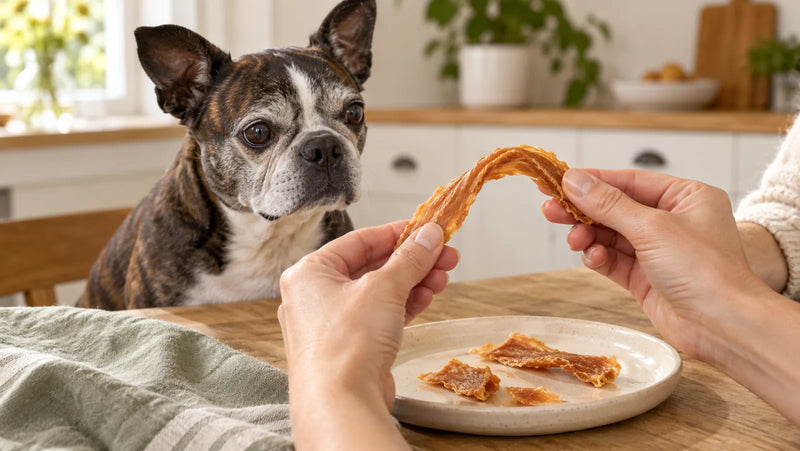

When comparing dehydrated vs freeze-dried treats for private label, evaluate the complete commercial system—not just the drying method. Dehydrated treats often fit a familiar jerky-style reward, while freeze-dried treats often fit a light, crisp, premium-positioned format. Neither process automatically delivers a lower landed cost, longer shelf life, or higher margin. The answer depends on the exact protein and cut, finished specification, pouch, freight, breakage, retail price, and sell-through.
American Paws is a pet-treat manufacturer in Highland, California, with FDA Food Facility Registration No. 13526766664. Qualified wholesale and private-label projects start at 10 lb per item. For the stated private-label route, the customer supplies approved branded pouches; American Paws fills the confirmed treat, adds an oxygen absorber, and heat-seals the pouch. Request the current catalog and confirm item availability, price, specifications, and lead time for the actual project. Registration is not FDA approval, certification, endorsement, or approval of a product or label.
Dehydrated vs Freeze-Dried Treats for Private Label: The Short Answer
| Buyer question | Dehydrated format | Freeze-dried format |
|---|---|---|
| Typical physical impression | Dense, flexible to firm, often visibly jerky-like or whole-cut | Light, porous, crisp, and often easy to crumble |
| Best commercial use to test | Recognizable reward pieces, chewier formats, and jerky-led assortments | Small rewards, crunchy bites, toppers, or a premium lightweight assortment |
| Cost question | Confirm yield, trim, drying loss, labor, and actual item quote | Confirm equipment/process cost, yield, cycle, breakage, and actual item quote |
| Packaging question | Check oil transfer, irregular edges, puncture resistance, pouch fit, and seal cleanliness | Check moisture barrier, oxygen control, headspace, crushing, fines, and reseal performance |
| Shelf-life question | Request evidence for the exact product, process, pouch, and storage condition | Request the same evidence; the word “freeze-dried” is not an expiration date |
| Margin question | Model landed cost, sale price, portions, sell-through, discounts, and returns | Model those inputs plus cubic freight, breakage, and premium-price acceptance |
This is a procurement comparison. Pet parents choosing between textures, feeding uses, and storage habits should use our consumer guide to freeze-dried versus dehydrated dog treats. The broader American Paws program, packing route, minimum, and account-opening questions belong to the private-label dog treats manufacturer guide.
How the Two Processes Differ
Dehydration removes moisture with controlled warm airflow
Dehydration exposes prepared food to controlled heat and moving air so moisture leaves over time. The exact temperature, duration, loading pattern, slice thickness, starting material, and validated safety steps matter. A thin breast strip and a thick organ piece do not behave identically, and “dehydrated” alone does not reveal the finished texture or microbial controls.
For a buyer, this process often creates a denser product with visible meat structure. That can help a jerky-style item communicate familiarity at first glance. It can also create natural variation in shape, thickness, color, and flexibility. Decide whether that variation supports the brand story or conflicts with a tightly standardized merchandising plan.
Freeze-drying freezes the product and removes ice under vacuum
Freeze-drying first freezes the product, then uses reduced pressure so frozen water leaves primarily through sublimation. The resulting structure is commonly porous and light. Those physical traits can make pieces easy to snap, crush, or rehydrate, but actual performance still varies by ingredient, cut, pre-treatment, cycle, and finished specification.
Freeze-dried does not automatically mean raw. A product may be raw, cooked, or otherwise prepared before freeze-drying. Ask for the exact process and use only the claims that the supplier can substantiate for that item. Likewise, neither process name proves that a treat is single-ingredient, complete and balanced, low-fat, safer, or appropriate for a medical diet.

Compare Product Fit Before Comparing Price
Begin with the job the product must do. A training reward needs small, repeatable portions and quick delivery. A larger reward may need visible whole-muscle character and a satisfying texture. A topper needs controlled crumbling. An ecommerce hero product needs a strong photo, predictable bag presentation, and enough perceived value to support its parcel cost.
Write a one-page target specification before asking for a quote:
- Species and intended use: dog treat, cat treat, training reward, topper, or another confirmed use
- Protein, cut, ingredient statement, and any pre-treatment the buyer needs disclosed
- Target piece shape, size range, texture, color tolerance, and acceptable natural variation
- Planned net weight, pouch dimensions, case pack, sales channel, and destination
- Claims the brand wants to make and the evidence needed to support each claim
- Expected order quantity, reorder pattern, launch timing, and fulfillment route
Then ask the supplier which current items come closest. Do not force a product into a marketing concept built before the sample existed. Browsing the American Paws dog treat collection can help a buyer see consumer-facing formats, but it is not a private-label catalog or a promise that every retail item is available for every program.
Cost: Build a Landed-Cost Model, Not a Process Stereotype
“Dehydrated is cheaper” and “freeze-dried has better margins” are both unsafe shortcuts. A quote can change with protein cost, cut, yield, process time, batch requirements, package, labor, volume, and current availability. A lightweight freeze-dried item may reduce shipped weight but occupy more pouch and carton volume. A dense dehydrated item may pack efficiently by volume but place more weight in each sellable unit.
Build the model from the customer backward. For each proposed SKU, record:
- Confirmed product cost for the exact item and quantity
- Customer-supplied pouch, printing, inbound freight, and unused-package exposure
- Fill weight, expected units per ordered pound, and expected sample or production variance
- Inbound or direct-fulfillment freight, cartons, packing materials, and handling
- Breakage, dust, irregular pieces, damaged seals, reships, returns, and refunds
- Payment, marketplace, storage, advertising, promotion, and customer-service costs
- Expected retail price, discount rate, sell-through window, and unsold inventory risk
A useful contribution model is net selling price minus product, package, fulfillment, channel, promotion, and expected exception costs. Compare contribution dollars per pouch and per order—not markup percentage alone. Our private-label dog treat cost-driver guide provides a deeper checklist without pretending one number fits every brand. Request a current quote for the shortlisted item; this article does not publish a negotiated price or margin forecast.
Shelf Life: Ask for Evidence for the Exact Product and Pouch
Shelf life is a supported date under defined conditions, not a benefit that can be inferred from a process label. The product formula, kill step where applicable, finished water activity, moisture, oxygen exposure, package barrier, seal integrity, storage temperature, light, handling, and post-opening use can all matter. A different protein, piece thickness, pouch film, zipper, or fill can change the relevant evidence.
FDA Guidance for Industry #245 on hazard analysis and preventive controls for animal food describes water activity as a factor in classifying moist, intermediate-moisture, and low-moisture animal food. It identifies low-moisture animal food as below 0.60 water activity and intermediate-moisture food as 0.60 to 0.85, while also explaining that preventive controls and other product factors matter. Those categories are useful technical context; they are not permission for a brand owner to invent a shelf-life date.
Ask the supplier what shelf-life statement applies to the exact item in the proposed pouch, how it was established, what storage conditions apply, how lots and dates will be coded, and what changes would require review. Confirm post-opening directions too. If the answer is still under evaluation, treat that as an open launch dependency rather than filling the label with a guess.
Packaging and Shipping Change the Economics
Dehydrated-treat packaging questions
Whole-cut or jerky-like pieces may be irregular, dense, flexible, or firm. A buyer should inspect whether corners stress the pouch, surface oils or crumbs reach the seal area, pieces settle attractively, and the planned net weight leaves enough room for a reliable seal and customer use. Test the actual production-style sample rather than a hand-selected photo piece.
Freeze-dried-treat packaging questions
Porous pieces can be light yet occupy meaningful volume. Headspace may protect the product, but it can also make the pouch look underfilled if the package architecture and net weight are poorly matched. Compression in cartons can create fragments and dust. Moisture-barrier performance and a dependable reclosure matter because a crisp product can change after the customer repeatedly opens the bag.
For the stated American Paws private-label route, the customer supplies approved branded pouches and American Paws fills the confirmed item, adds an oxygen absorber, and heat-seals the pouch. That does not mean pouch printing, artwork creation, regulatory review, a particular film structure, or a universal pouch size is included. Submit the pouch specifications for approval and keep the oxygen absorber clearly outside the edible product experience.
Run a practical shipping test: fill and seal the intended pouch, place it in the planned parcel, ship it through representative routes, and inspect piece condition, seal integrity, dust, odor transfer, and presentation on arrival. Repeat with the carton orientation and protective materials the real workflow will use.
Consumer Positioning and Merchandising
Dehydrated formats can communicate a recognizable, meat-first, jerky-style experience when the sample supports that story. Freeze-dried formats can communicate lightness, crisp texture, portability, or topper versatility. Those are positioning possibilities, not automatic claims. The actual ingredient list, processing specification, package, feeding directions, and evidence control what the brand may say.
The FDA animal-food labeling overview lists federal basics such as proper product identification, net quantity, the manufacturer or distributor name and place, and all ingredients. It also notes that state rules apply and warns that therapeutic claims can cause a food to be treated as a drug. The ecommerce listing, package, ad, product sheet, testimonial, and sales pitch should all describe the same actual product.
A format should also have a clear shelf role. In a physical pet store, compare bag silhouette, shelf stability, visible fill, shopper explanation, and price ladder. Online, compare thumbnail recognition, parcel economics, breakage, repeat-purchase cadence, and how much education the page needs. A premium story only works when the received product and customer experience support it.
A Sample-and-Quote Test That Prevents Expensive Surprises
- Request current options. Share the target species, use, protein, channel, net weight, quantity, package route, and desired timing.
- Compare physical samples. Record piece-count distribution, dimensions, texture, aroma, crumbs, dust, color variation, and how easily pieces portion.
- Fit the real pouch. Use the intended film and dimensions. Check fill appearance, zipper clearance, seal area, puncture risk, and customer hand access.
- Test the shipment. Pack a representative order, send it through the intended route, and measure damage rather than relying on an office drop test.
- Verify the evidence. Confirm the ingredient statement, process description, applicable shelf-life support, storage directions, lot coding, and label inputs.
- Request the commercial details. Confirm the item-specific quote, minimum, availability, lead time, shipping path, payment, and reorder terms.
- Model three cases. Use base, discounted, and exception-heavy sales cases so one optimistic assumption does not carry the launch.
- Choose a narrow first SKU. Launch the product with the clearest customer job, then use real sell-through and complaint data before expanding.
Which Format Fits Which Private-Label Strategy?
| Strategy | Format worth testing first | Why it may fit | What can overturn the choice |
|---|---|---|---|
| Visible whole-meat reward | Dehydrated | Dense, recognizable jerky-like presentation | Actual toughness, variation, pouch fit, or landed cost |
| Small crisp training bites | Freeze-dried | Light pieces that may portion or crumble readily | Dust, breakage, piece consistency, or customer texture preference |
| Topper or mix-in use | Freeze-dried | Porous pieces may crumble conveniently | Package moisture control, mess, and serving instructions |
| Jerky-led brand story | Dehydrated | Format aligns with familiar jerky cues | The exact ingredient, texture, and product evidence |
| Compact premium assortment | Either | Both can support premium positioning when product and story agree | Shopper willingness to pay and repeat-purchase economics |
| Two-use assortment | Both | One dense reward and one crisp reward can serve distinct jobs | Complexity, inventory turns, duplicate claims, and cash tied across SKUs |
The best answer can be “both,” but only when each SKU has a distinct use, customer promise, and place in the price ladder. Two products that differ only in a technical process word create education cost without necessarily creating a useful assortment.
Questions to Ask the Supplier Before You Commit
- Which exact dehydrated and freeze-dried items are currently available for this program?
- What is the complete ingredient statement, and is the item cooked, raw, or otherwise prepared before drying?
- What finished specification covers size, texture, moisture or water activity where applicable, and natural variation?
- What shelf-life and storage statements apply to the exact item and proposed pouch, and what evidence supports them?
- What pouch material, dimensions, zipper, seal area, oxygen control, and fill-weight range should the customer submit?
- What is the 10 lb per-item minimum applied to this assortment, and what are the current item quote and availability?
- What lead time applies after product, pouch, artwork facts, and commercial terms are confirmed?
- How are lots identified, and what records should the brand owner preserve?
- What breakage or natural piece variation should be expected, and how should claims and photos represent it?
- Which wholesale, private-label, or arranged fulfillment path fits the planned sales channel?
Frequently Asked Questions
Are freeze-dried treats always more expensive than dehydrated treats?
No universal rule can replace an item-specific quote. Protein, cut, yield, cycle, batch, package, quantity, freight, and availability all affect cost. Compare landed cost and expected exceptions for the exact SKUs.
Which format has the longer shelf life?
Neither process name establishes a date by itself. Ask for the shelf-life statement and supporting basis for the exact product, process, pouch, seal, and storage conditions. Also confirm what changes after opening.
Does freeze-dried mean raw?
No. Freeze-drying describes moisture removal, not whether the ingredient was raw or cooked before the cycle. Request the product-specific process description and do not put “raw” on a label or listing without support.
Which format is better for ecommerce shipping?
Test both in the actual pouch and parcel. Freeze-dried pieces may be light but bulky or fragile; dehydrated pieces may be denser or have irregular edges. Cubic freight, package protection, damage, customer presentation, and reships decide the outcome.
Can one private-label brand sell both formats?
Yes, if the confirmed items serve different customer jobs and the brand can support the inventory, education, and cash requirements. Keep each SKU's claims, use, price position, and package distinct.
What is the American Paws minimum order?
The starting minimum is 10 lb per item. Confirm how that applies to each selected product, package, quantity, and reorder plan rather than treating 10 lb as a mixed-cart total.
Does American Paws print private-label pouches?
The program described here uses customer-supplied approved branded pouches. American Paws fills the confirmed treat, adds an oxygen absorber, and heat-seals. Ask for pouch specifications and receiving instructions before ordering printed packaging.
Is an FDA-registered facility the same as FDA-approved treats?
No. American Paws lists FDA Food Facility Registration No. 13526766664 for its Highland, California facility. Registration is not FDA approval, certification, endorsement, or approval of a particular treat, process, package, or claim.
Choose the Format With a Verified Commercial Case
A good private-label decision connects one real product to one customer job, one protective pouch, one supportable label, one tested shipment, and one conservative margin model. Compare samples and evidence before comparing marketing adjectives.
Ready to evaluate the two formats? Request the current catalog through the American Paws wholesale application or describe a branded-pouch project through the private-label inquiry. Include the intended species and use, protein, sales channel, target fill weight, quantity, customer-supplied pouch plan, destination, and desired timing so the team can confirm the right current options.