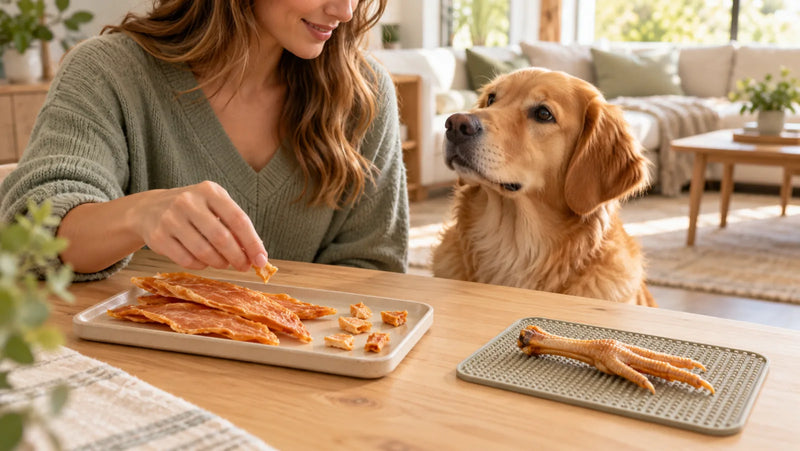
Holiday dog treat gift sets for retailers work best when each bundle has a named shopper, a clear price tier, an exact component list, a verified shelf-life window and a dated sell-through plan. Start with a small pilot, then calculate the possible set count from the component that will run out first. That turns a festive idea into inventory a store can receive, explain, rotate and reorder.
American Paws can discuss eligible wholesale products and a private-label workflow that begins at 10 lb per product. Timing is always a project-specific “contact us” answer. A retailer should not assume that printed pouches, outer gift boxes, ribbons, inserts, kitting, warehousing or consumer fulfillment are included unless those responsibilities appear in the written scope.
A holiday bundle also does not make every treat appropriate for every dog. Keep each component’s identity, ingredients, intended species, net quantity, lot or date information, storage directions and warnings traceable. The goal is a gift that is easy to understand at the shelf and easy to control behind it—not a decorative box that hides the evidence a buyer needs.
Holiday Dog Treat Gift Sets for Retailers: The Short Plan
Build the bundle in six gates. Each gate should produce a concrete record before the next spending decision. The broader private-label dog-treat manufacturer guide explains how to qualify the supplier and packing relationship; this article applies that discipline to a short Q4 selling window.
| Gate | Decision | Evidence to keep |
|---|---|---|
| Shopper | Who is buying and for what gift moment? | Recipient, occasion, dog-household assumption and exclusions |
| Tier | Entry, core or premium presentation? | Current component quote, packaging cost, labor and freight basis |
| Components | Which exact products and quantities go inside? | Item names, labels, lots or dates, storage and approved claims |
| Package | How are components presented and protected? | Physical sample, dimensions, materials and responsibility map |
| Calendar | When must each decision and delivery happen? | Target floor date, confirmation dates and reorder stop |
| Pilot | Does the set survive handling and make sense to shoppers? | Pack test, receiving check, staff questions and early sell-through |
A gift set becomes a new retail unit even when its contents are familiar SKUs. It has its own price, presentation, inventory count, damage risk, online description, return questions and seasonal deadline. Assign an owner for those decisions instead of treating the bundle as a last-minute display project.
Pick One Shopper and One Gift Moment
A bundle designed for everyone usually explains nothing. Choose one primary use: a host gift for a dog-owning household, a modest stocking stuffer, a premium present for a multi-dog home or a ready-to-wrap pet-store gift. That choice guides component count, package size, price tier and the amount of explanation needed on the shelf.
Define the recipient without promising a universal fit. A multi-protein sampler may create choice, but it may not suit a dog with a known food restriction. A larger chew can make a box feel substantial, but it can introduce size, dental and supervision considerations. A compact reward treat can be easy to portion, yet the exact calories and feeding directions still belong to the exact label. Staff should be able to tell a shopper what is inside and when to ask the recipient to check with a veterinarian.
Set the retail tier from current costs rather than a desired holiday margin alone. Include the eligible treat components, outer package, inserts, labor, damage allowance, inbound freight, payment terms and any outbound fulfillment. American Paws pricing, if part of the project, begins from $14/lb; see the current catalog and request a current item-specific quote. That starting reference does not establish the finished gift-set cost.
Build the Bundle Around Complementary Roles
Use variety a shopper can understand
A useful set gives each component a job. One item might be positioned as a small reward, another as a longer supervised activity and another as a meal-adjacent extra, but only when the exact products and their labels support those uses. A concise card can explain the difference without turning the package into a wall of claims.
Do not force variety merely to raise the item count. Two clearly different products can be more coherent than five near-duplicates. Start by reviewing the current American Paws dog-treat collection item by item, then ask which products are eligible for the intended wholesale or private-label scope. A live retail page does not automatically prove wholesale inventory, private-label availability, a Q4 delivery date or inclusion in a finished gift set.
Keep component identities intact
Record the exact product name, every ingredient, intended species, net quantity, lot or date code, storage directions, feeding language and relevant warning for each component. Do not extend a “single-ingredient” statement from one verified item to the full assortment. Do not describe all-natural, made-in-USA or other claims at the gift-set level unless every affected component supports the wording and the placement is appropriate.
Individually sealed and labeled components are easier to trace than loose treats transferred into a decorative container. Repacking changes the package, label and responsibility questions. If a retailer wants a custom inner pouch, treat that as a defined private-label or packing project—not as an informal holiday assembly step.
Make the Shelf-Life Window Cross the Holiday
A bundle is controlled by its earliest-dated component. The detailed dog-treat shelf-life guide for retailers owns the full date, lot, storage, rotation and quarantine process. For a holiday gift set, use that process to answer one practical question: will every component retain an acceptable documented selling window through the planned display, purchase, gifting and reasonable use period?
Capture the exact item, lot or date, quantity received, condition, storage requirement and earliest relevant date at receiving. Keep source cartons and records connected to the finished sets. If sets are assembled from more than one lot, decide whether the store can preserve traceability and how it will identify affected bundles if a component is quarantined or recalled.
Build the calendar backward from the last date the store is willing to sell the set as a holiday gift. Add the floor-set date, receiving and inspection, assembly or kitting, packaging approval, component confirmation and purchase commitment. Then set a reorder-stop date and a markdown, break-apart or removal decision. Do not conceal or override component dates with a decorative outer sticker, and do not invent one universal shelf life for mixed items.
Decide What the Customer Sees at Each Price Tier
Price tiers should change the value story, not merely the amount of filler in the box. Use physical prototypes to see whether the package looks intentional, protects the contents and can be stocked efficiently.
| Concept tier | Useful design question | Cost elements to confirm |
|---|---|---|
| Entry | Can one or two clearly identified components feel gift-ready without excess packaging? | Component cost, simple outer presentation, labor and freight |
| Core | Do complementary formats create an obvious sampler or use-case story? | All components, divider or fill, card, assembly and damage allowance |
| Premium | Does the added item or presentation provide real value for the intended household? | Larger package, protection, weight, freight, handling and return exposure |
Those are planning concepts, not offered pack sizes or price promises. Build the retail price only after current quotes and actual package tests. A beautiful box that ships poorly, consumes too much shelf depth or requires slow hand assembly can erase the value of an extra component.

Separate the Treat Pouch From the Outer Gift Package
American Paws’ established private-label workflow uses customer-supplied approved branded pouches. American Paws fills the approved product, adds an oxygen absorber and heat-seals the pouch. The starting minimum is 10 lb per product. Different products do not share one mixed 10 lb minimum.
That inner-pouch workflow does not automatically include the outer gift carton, sleeve, ribbon, insert, divider, gift-set assembly, finished-set storage, direct-to-consumer shipping or retail returns. Put each responsibility in writing. Identify who buys and owns packaging inventory, who approves artwork, who receives components, who assembles the sets, who checks the finished unit and who handles unsold or damaged stock.
The private-label dog-treat labeling guide covers the detailed planning checklist. The FDA’s animal-food labeling overview describes federal basics such as proper product identification, net quantity, the manufacturer or distributor’s name and place of business, and a complete ingredient listing. State requirements can also apply. Keep the exact component labels visible or accessible and obtain qualified review for the final sales configuration.
An outer holiday package is not a substitute for the component evidence. If the outer presentation makes new claims, obscures required information or creates a new net-contents statement, review those changes before printing. A generic seasonal phrase should never imply FDA approval, medical benefit or suitability for every dog.
Calculate a Pilot From the Limiting Component
The number of possible sets is the lowest available component count after approved allowances. Suppose a purely illustrative pilot concept needs one pouch from Product A and two pouches from Product B. If the retailer has 70 approved A pouches and 120 approved B pouches after samples, damages and holds, A supports 70 sets while B supports 60. The pilot can produce no more than 60 complete sets.
If a private-label component is planned from a 10 lb product minimum, 10 lb equals 160 oz. Dividing 160 oz by a proposed 2 oz net weight gives 80 theoretical units before allowances. That example does not confirm a two-ounce offered size, finished yield, package availability or final set count. Setup material, samples, retained product, weight control, damaged bags and other approved uses must be addressed in the actual plan.
Write the bill of materials for one set, then multiply it by the pilot quantity. Add approved allowances separately instead of hiding them in a rounded order. The same sheet should show leftover components, because an uneven remainder may be sold as normal inventory, held for replacement, used in another approved configuration or become stranded stock.
Build the Q4 Calendar Backward
There is no universal holiday lead time. Product eligibility, current inventory, packaging readiness, customer-supplied pouch delivery, label review, freight, assembly and destination all affect timing. Contact American Paws with a defined request and obtain the current schedule in writing before promising a floor date.
| Milestone | Evidence before moving on |
|---|---|
| Scope locked | Audience, components, pounds per product, set count, destination and target floor date |
| Items confirmed | Eligibility, current quote, remaining shelf life, storage, freight and service scope |
| Package approved | Physical pouch and outer-package samples, artwork revision and responsibility map |
| Pilot accepted | Fill or component check, finished appearance, protection, coding and handling test |
| Inventory received | Counts, condition, lots or dates, earliest date, discrepancies and quarantine status |
| Floor set live | Accurate sign or listing, staff brief, storage and replenishment location |
| Reorder decision | Observed weekly sales, complete-set inventory, remaining selling days and current availability |
Do not reorder from gross revenue alone. Count complete sets, not only individual components. Compare recent weekly unit sales with the remaining full-price selling days and the current replenishment path. If a replacement would arrive after the useful window, a smaller reorder, waitlist or planned sellout may be safer than late seasonal inventory.
Merchandise for Fast Comprehension
The shopper should understand the set in a few seconds: who it is for, exactly what is inside, how many individually packaged items it contains and any important feeding or supervision cues. The online listing, shelf card and actual contents must agree. Use photographs of the real finished configuration, not a concept image that shows unavailable products or a different count.
Protect products from heat, moisture, direct sunlight and damaged closures according to each label. Store backup inventory so the earliest relevant dates can be selected first. Keep lots or dates accessible in the store’s records even if the gift presentation covers part of the component pouch on the shelf.
Train staff on three answers: what the components are, what the package does not promise and how to handle a damaged or returned set. A returned food item, crushed pouch, broken seal, missing component or unreadable code needs a defined disposition rather than an automatic trip back to the shelf.
Keep Corporate Gifts and Retail Gift Sets Distinct
The corporate dog-treat gifting guide is built around an employer, client, event or recipient-list program. A retailer gift set is different: the store chooses inventory before knowing every final recipient and carries the risk of seasonal sell-through.
That distinction changes quantity planning, personalization, fulfillment and returns. A corporate project may have a fixed distribution date and a known recipient count. A retail project needs shelf appeal, replenishment decisions, unsold-inventory rules and accurate listings across multiple purchases. Do not borrow a corporate fulfillment assumption for a retail bundle simply because both use holiday packaging.
Use a Pilot Before Committing to the Full Season
Assemble enough pilot units to test the real work: opening source cartons, protecting pouches, fitting components, closing the outer package, applying any approved label, packing a shipping carton, receiving it at the store and placing it on the intended shelf. Record time, damage, confusing steps and excess material.
Show the pilot to the staff who will sell and replenish it. Ask what they think is inside, which dog it is for, how they would answer an ingredient question and where they would find the earliest date. Confusion in the stockroom will become confusion at checkout.
Event-specific packaging has its own handoffs. The dog-treat wedding-favor planning guide, for example, deals with a known event date, identified dog-owning recipients and venue distribution. It is a useful contrast: reuse the discipline of an exact product, sealed pouch and written handoff, but do not copy the wedding quantity or display logic into a Q4 retail assortment.
What American Paws Can Confirm
American Paws is a California company operating under FDA Food Facility Registration No. 13526766664. A registration number confirms registration; it does not convey FDA approval or endorsement of the facility or its products. The accurate phrase is “FDA-registered facility.”
The current starting minimum is 10 lb per product. For an approved private-label project, the customer supplies approved branded pouches; American Paws fills them, adds an oxygen absorber and heat-seals them. Current pricing begins from $14/lb; see the current catalog and request an exact quote. Product eligibility, pounds, pouch plan, remaining shelf life, freight, schedule and every service outside that defined pack-out need project-specific confirmation.
For a holiday retail project, begin with the American Paws wholesale inquiry path when the store wants current eligible products and commercial terms. Use the private-label inquiry path when the project includes approved customer-branded pouches. In either case, state whether the request is for component inventory only or whether the retailer is asking about any separate outer gift-set work. Do not assume the latter is offered.
Retail Holiday Bundle Checklist
- Audience: one primary shopper, gift moment, recipient assumption and clear exclusions.
- Components: exact products, ingredients, intended species, quantities, claims and approved availability.
- Evidence: labels, lots or dates, remaining shelf life, storage directions and current quotes.
- Package: inner-pouch and outer-package materials, physical samples, protection and ownership.
- Label: exact contents, component information, approved claims and applicable review.
- Calendar: target floor date, confirmation milestones, receiving, reorder stop and exit plan.
- Pilot: assembly, shipping, receiving, shelf-fit, staff comprehension and damage checks.
- Inventory: bill of materials, limiting component, complete-set count and leftover plan.
- Sell-through: observed weekly units, remaining selling days and current replenishment reality.
- Handoff: named owners for assembly, acceptance, storage, returns, complaints and unsold stock.
Frequently Asked Questions
What is the minimum order for a private-label holiday dog treat?
The current American Paws starting point is 10 lb per product. Each eligible product is planned separately, so two products generally require at least 10 lb of each rather than one mixed 10 lb total. Confirm the item, proposed net weight, package, current quote, allowance, finished count, freight and timing in writing.
Does American Paws assemble finished holiday gift boxes?
Do not assume that service is included. The established private-label scope uses customer-supplied approved pouches that American Paws fills, equips with an oxygen absorber and heat-seals. Outer boxes, inserts, ribbons, kitting, warehousing and consumer fulfillment are separate responsibilities unless a written project scope specifically confirms them.
How far ahead should a retailer order?
There is no universal number of weeks. Timing depends on the exact products, current availability, packaging, label review, customer-supplied materials, freight, assembly and destination. Send a defined request and obtain the current schedule before publishing a floor date or preorder promise.
How should a retailer check shelf life for a multi-item bundle?
Record the exact lot or date and remaining shelf life for every component at receiving. Plan the set around the earliest relevant date, preserve traceability and define storage, rotation, quarantine and exit rules. Never replace the component dates with an unsupported outer-package date.
Can different products share one 10 lb minimum?
No. The current starting minimum is 10 lb per product. A chicken item and a beef item, for example, are separate products with separate pounds, labels, package decisions and records.
What should appear on the outer gift package?
Make the exact contents and responsible seller clear, keep required component information visible or accessible, and ensure every claim matches the affected products. Outer-package needs vary with the final configuration and sales states, so obtain qualified review before printing. A decorative sleeve does not replace the underlying animal-food labels.
How many gift sets should a retailer test first?
Use a quantity small enough to inspect, merchandise and learn from without creating damaging leftover inventory, but large enough to expose real assembly and shelf issues. Base the number on the store’s audience, prior seasonal sales, component availability and selling window—not a universal industry percentage.
Start With One Pilot Bundle and a Written Calendar
A strong holiday dog-treat bundle is easy to identify, easy to trace and easy to exit at the end of the season. Choose one shopper, one component list and one presentation. Verify the earliest shelf-life constraint, assign every packaging responsibility, test the physical set and decide the reorder stop before the first unit reaches the shelf.
Prepare a defined Q4 request: send the exact products, pounds per product, proposed inner pouch or component format, pilot and season set counts, sales states, destination and target floor date through the wholesale or private-label inquiry page. Ask for item eligibility, current quote, remaining shelf life, freight, packaging and kitting responsibilities, and timing in writing before committing to holiday packaging.