
Can puppies eat raw chicken? The conservative veterinary answer is no. The American Veterinary Medical Association discourages raw or undercooked animal-source protein because pathogens can threaten pets and people. Puppies are a higher-consequence group: young animals are still developing immune defenses, and public-health guidance identifies puppies among the pets more likely to become sick from foodborne germs.
Raw chicken is not a poison, so a puppy that steals one small boneless piece is not automatically poisoned. The concerns are different: possible Salmonella or Campylobacter infection, germs carried into the home, physical injury from bone or packaging, and an unbalanced food crowding out complete puppy nutrition. Remove access, identify exactly what went missing, clean the contact path and call the puppy's veterinarian for case-specific direction.
Raw wings, necks and ground bone do not solve the problem. A bone can break a tooth, lodge or obstruct, while uncooked chicken alone is not a complete growth diet. Plain boneless chicken cooked to 165°F is the lower-risk home form when chicken fits the individual puppy, but it remains an occasional extra rather than the main meal.
Can Puppies Eat Raw Chicken? The Veterinary Answer Is No
The current AVMA policy on raw or undercooked animal-source protein discourages feeding it to dogs and cats because of risks to animal and human health. It supports cooking, pasteurization and other scientifically validated technologies that reduce or eliminate illness risk; it does not treat the word “raw” as a health advantage.
CDC likewise says it does not recommend raw pet food or treats. The agency's pet-food safety guidance defines raw products by uncooked animal protein that has not been heated enough to kill germs. That definition can include grocery meat, raw frozen diets, raw freeze-dried or dehydrated products, toppers and treats.
| Chicken form | Puppy decision | Main reason |
|---|---|---|
| Boneless grocery raw chicken | Do not intentionally feed | Possible pathogens, household contamination and no complete puppy nutrition |
| Bone-in raw wing, neck or piece | Do not offer as a chew or meal | All raw-food concerns plus tooth, choking, obstruction and tissue-injury hazards |
| Commercial product labeled raw | Veterinarian-led exact-label review | Commercial and complete are not synonyms; raw risk and growth adequacy require evidence |
| Plain boneless chicken cooked to 165°F | Possible occasional extra when cleared | Lower microbiological risk, but still supplemental and individually portioned |
| Packaged freeze-dried chicken not labeled raw | Read the exact label; do not infer process | “Freeze-dried” alone does not say raw, cooked, sterile or complete |
Why the Same Exposure Can Matter More to a Puppy
The Merck Veterinary Manual's explanation of infection defenses states that very young animals are still developing their immune systems. That does not create one age when every puppy suddenly becomes “immune mature,” and it does not predict that every exposure causes illness. It does explain why age belongs in the risk decision.
CDC lists young pets such as puppies among those more likely to get sick from foodborne germs. FDA's Salmonella safety guidance for pet households goes one step more specific: puppies and kittens are more likely than adult dogs and cats to show signs when Salmonella illness occurs.
A puppy's real risk also depends on age, vaccination and weaning status, current illness, medications, diet, the form and amount swallowed, and whether bone, spoiled food or packaging was involved. Small body size is not a home dose calculator. There is no responsible universal “safe bite,” guaranteed incubation window or wait-and-see period for raw chicken.
Salmonella and Campylobacter Can Start With Raw Chicken
CDC's chicken food-safety guidance says raw chicken can be contaminated with Campylobacter, Salmonella or Clostridium perfringens. AVMA also lists Salmonella and Campylobacter among pathogens reported in raw or undercooked animal-source proteins. The phrase “can be” matters: it describes a credible risk without claiming that every package is contaminated.
A puppy exposed to a pathogen may show no obvious change, may carry and shed an organism or may become ill. Possible Salmonella signs listed by FDA include vomiting, diarrhea that may be bloody, fever, reduced appetite and lower activity. Those signs are not unique to Salmonella, and an online checklist cannot diagnose the cause. The veterinarian uses the history, exam and any appropriate tests.
Call promptly when a puppy has repeated vomiting or diarrhea, blood, fever, marked lethargy, weakness, refusal to eat or signs of dehydration. Choking, breathing trouble, collapse, severe weakness, a painful or distended abdomen, or uncontrolled repeated vomiting needs emergency veterinary care. Do not start antibiotics, anti-diarrheals or another medication from a household supply.
The Risk Travels From the Puppy to the Family
The contact path extends beyond the bowl: raw package and juice can reach hands, refrigerator shelves, boards, knives and counters; food reaches the bowl and mat; then the puppy's mouth, fur, paws, saliva and stool can move organisms again. A puppy looking healthy does not prove that the food or the household is clear.
AVMA notes that apparently healthy dogs and cats can have subclinical infections and pose risk to other animals and people. CDC identifies children under five, adults 65 and older, pregnant people and people with weakened immune systems as more likely to become seriously ill from foodborne germs. Those groups raise the stakes, but everyone in the household still needs safe handling.
After a raw-chicken exposure, do not let the puppy lick faces, mouths, open wounds, dishes or food-prep surfaces. Wash hands after handling the food, puppy bowl, vomit or stool. Clean up feces promptly and prevent children from doing the cleanup. A human family member with symptoms should contact a human healthcare professional; the puppy's veterinarian does not diagnose people.
Raw Chicken Bones Are Not a Puppy-Safe Chew
Uncooked does not mean harmless. The World Small Animal Veterinary Association's raw meat-based diet safety reference says bones can cause broken teeth, esophageal or intestinal obstruction and constipation. It also states that feeding bones does not reduce the risk of plaque or tooth loss from periodontal disease.
FDA separately warns that bones can become lodged in a pet's esophagus, stomach or intestines. A puppy's changing teeth and inexperienced, excited chewing do not create a safe-size formula. A wing, neck or bone-in thigh that one puppy chews slowly can be swallowed differently by another.
Grinding bone changes the shape; it does not remove pathogens or prove that calcium, phosphorus and the rest of the growth diet are balanced. For the broader decisions about cooked versus raw bones, accidental ingestion, teething and veterinary triage, use the dedicated puppy bone safety guide.
Commercial Raw Puppy Food and Kitchen Raw Chicken Are Different
Kitchen raw chicken is an ingredient, not a puppy-food formulation. It has no pet-food nutritional adequacy statement, puppy life-stage claim, feeding directions, calorie declaration, lot system or disclosed pathogen-reduction control. Feeding more of it does not fill those gaps.
A commercial raw product can provide a label, lot and storage instructions, but “commercial” does not automatically mean complete, suitable for growth or pathogen-free. Read whether the package actually says raw, whether it says complete and balanced or intermittent/supplemental, which life stage it supports, what ingredients and bones it contains, and how the manufacturer substantiates any pathogen-control claim. Discuss the exact product with the veterinarian or a board-certified veterinary nutritionist before making it the main diet.
FDA tested commercially available raw dog and cat foods and found that raw food in that study was more likely than the other tested categories to contain disease-causing bacteria. The agency's raw pet-food study and handling guidance supports possible contamination and household controls; its sample results are not a prediction for every package on a shelf.

Freezing, dehydration and freeze-drying raw animal protein do not kill every germ, according to CDC. AVMA recognizes that scientifically validated technologies can reduce or eliminate pathogen risk, but a process word on the package is not the validation itself. Ask for the exact product evidence instead of transferring a claim from another brand or format.
Raw Chicken Alone Is Not a Puppy Growth Diet
A growing puppy needs more than animal protein. The complete diet must provide appropriate energy, amino acids, fatty acids, vitamins and minerals in the right relationships for growth. A bowl of raw breast, thigh or ground chicken cannot establish that balance by appearance or ingredient simplicity.
WSAVA warns that home-prepared cooked and raw meat-based diets may contain important nutrient deficiencies and excesses. It says imbalance is especially detrimental for puppies and kittens, which may suffer painful skeletal disorders and pathological fractures. That warning applies to a repeated meal pattern, not to a claim that one accidental bite instantly causes a bone disease.
Look for complete-and-balanced growth or appropriate all-life-stages language on the puppy's main food and follow the veterinary feeding plan. Keep every extra inside the same calorie budget so chicken does not displace growth nutrition. The puppy treat selection guide covers readiness, size, texture, calories and ingredients; the guide to daily puppy treat limits turns the shared extras ceiling into a practical plan.
What to Do If a Puppy Ate Raw Chicken
- Remove access. Move the puppy away from the food, drip area, trash and package without putting a hand into the mouth of a choking or panicked puppy.
- Identify the exposure. Note the credible maximum, time, boneless or bone-in form, skin/fat, spoilage, seasonings, absorbent pad, plastic wrap and any missing package piece.
- Call the veterinarian. Give the puppy's age, weight, medical history, normal diet, current signs and exact food details. Bones, packaging, spoiled food, a large or unknown amount, illness or a very young puppy increase concern.
- Follow the professional plan. Monitor only the signs and time frame the veterinarian specifies; go to emergency care for breathing trouble, choking, collapse or another directed emergency sign.
- Clean the contact path. Wash hands, then clean and disinfect surfaces and objects that touched raw chicken. Handle vomit and stool as potentially contaminated.
Do not induce vomiting or give hydrogen peroxide, bread, oil, milk, salt, charcoal, antibiotics, anti-diarrheals or another home remedy unless the veterinarian specifically directs it for this puppy. Bone and packaging can make vomiting more dangerous, and an improvised treatment can delay the care that the actual exposure needs.
If Raw Chicken Is in the Home, Break the Contact Path
Keep raw chicken sealed on the lowest refrigerator shelf so juice cannot drip onto puppy food or family food. Put the puppy behind a closed gate before opening the package. Use a separate board and utensils, do not wash raw chicken in the sink, and never return cooked food to a plate that held it raw.
Wash hands with soap and water for at least 20 seconds after handling raw chicken. Clean, then disinfect contacted boards, utensils, counters, refrigerator areas, bowls and mats. Launder a contaminated cloth rather than using it around the kitchen. These controls reduce household exposure; they do not convert intentional raw feeding into a recommendation.
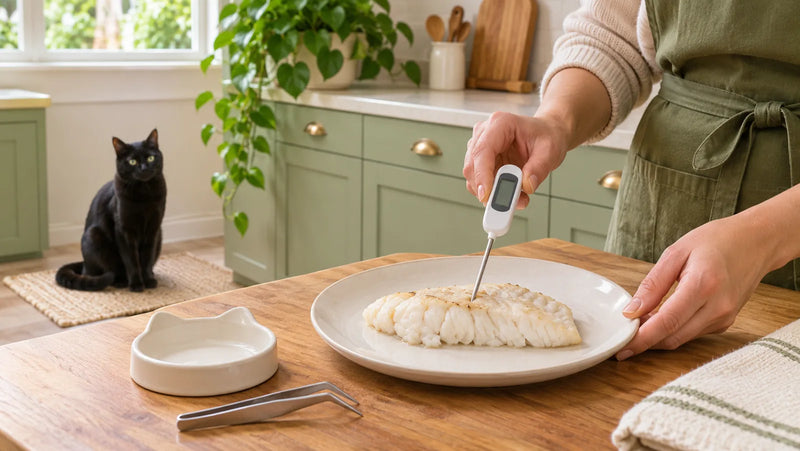
CDC gives 165°F as the safe internal temperature for chicken. Check the thickest part with a food thermometer. After an accidental puppy exposure, clean the floor or gate area, wash the puppy bowl, remove stool promptly and prevent face or wound licking even when the puppy appears normal.
Plain Cooked Boneless Chicken Is the Lower-Risk Home Route
When chicken fits the individual puppy, plain fully cooked boneless chicken is the lower-risk home form. The full puppy chicken guide covers weaning readiness, suitability, cooking, tiny first portions and reactions. It also keeps raw meat, bones, skin, drippings and seasoned family chicken out of the puppy's serving.
Reserve the puppy's piece before salt, oil, sauce, garlic, onion or another seasoning touches it. Cook to 165°F, cool, remove skin and every bone, and cut across the fibers into a piece the puppy can swallow comfortably. Use it as an occasional extra beside complete puppy food, not as a meal or a bland-diet prescription.
Adult Dog and Cat Raw-Chicken Questions Have Their Own Owners
An adult dog's exposure, household context and raw chicken feet or giblet questions belong in the adult dog raw-chicken safety guide. Age does not make raw poultry risk disappear, but puppy growth and developing defenses deserve their own emphasis.
Cats have different nutrient requirements, eating patterns and bone decisions. The cat raw-chicken guide covers the feline and household pathway. Do not apply a puppy portion or monitoring instruction to a cat in the same home.
Freeze-Dried Does Not Automatically Mean Raw
Some raw pet foods are freeze-dried, but that does not mean every freeze-dried product is raw. CDC advises looking for “raw” on the exact label or checking with the company. The format word alone does not tell a shopper whether the starting ingredient was raw, previously cooked, treated by a validated process or sterile.
The current American Paws freeze-dried chicken training treat for cats and dogs page identifies 100% USA chicken breast, All Life Stages and intermittent or supplemental feeding. It does not label the product raw and does not publish a sterility or pathogen-kill claim. American Paws therefore does not add either claim.
For a veterinarian-cleared puppy whose diet allows chicken, read the live label, break a piece below the puppy's comfortable swallow size and count every fragment within the shared extras budget. It is a packaged treat, not complete puppy food and not a treatment after raw exposure. Owners can compare current American Paws dog treats and cat treats by their exact labels rather than extending one product's facts to the entire collection.
Keep Tuna and Popcorn as Separate Puppy Decisions
Tuna brings a separate fish-form, mercury and feeding-frequency question. The puppy tuna guide owns that decision. It does not provide a remedy or substitute after a raw-chicken exposure.
Popcorn is a kernel, hull, texture and topping question. The puppy popcorn guide handles the narrow eligible form and hazards. Neither tuna nor popcorn replaces complete growth food or changes the veterinarian's raw-poultry plan.
Frequently Asked Questions
Can a puppy eat one small piece of raw chicken?
Do not intentionally offer it. If the puppy stole one small boneless piece, remove access, note the amount and time, clean contacted surfaces and call the veterinarian for advice based on age, health and the exact chicken. One bite is not automatically poisoning, but there is no universal safe raw amount.
Can puppies get Salmonella from raw chicken?
Yes, raw chicken can carry Salmonella, and puppies are more likely than adult dogs to show signs when Salmonella illness occurs. A puppy may also carry and shed the organism without obvious illness, so household cleanup matters.
Can puppies get Campylobacter from raw chicken?
Raw chicken can be contaminated with Campylobacter. Exposure does not diagnose an infection. Contact the veterinarian if a puppy has diarrhea, vomiting, fever, appetite loss, lethargy or another concerning change, and tell the clinic about the raw-chicken history.
Are raw chicken bones safe for puppies?
No raw chicken bone has a universal safe size or age. Bones can break teeth, choke, lodge in the esophagus or obstruct or injure the digestive tract. Call the veterinarian after a bone exposure rather than inducing vomiting or trying to pad it with food.
Is commercial raw puppy food safer than kitchen raw chicken?
It can provide a pet-food label, lot, storage directions and possibly a nutritional adequacy statement or disclosed control, but “commercial” alone does not prove completeness or pathogen freedom. Have the veterinarian review the exact product, life-stage statement and evidence.
Does freezing raw chicken kill Salmonella or Campylobacter?
No. CDC says freezing raw animal protein does not kill all germs that may be present. Keep frozen raw products separated, thaw them under the exact safe-handling directions and do not treat a freezer as a sterilizer.
Is freeze-dried chicken raw?
Not necessarily. Some raw products are freeze-dried, but “freeze-dried” alone does not disclose the starting state, cooking or validated pathogen reduction. Look for raw language and exact evidence on the product label or from the company.
Can plain cooked chicken be a puppy treat?
For a fully weaned, veterinarian-cleared puppy whose diet allows chicken, a tiny piece cooked plain and boneless to 165°F can be an occasional extra. Keep complete growth food primary and count it with all other treats.
Should I make my puppy vomit after eating raw chicken?
No home vomiting method should be used unless a veterinarian specifically directs it. Bones, packaging and the puppy's condition change the risk, while peroxide and other improvised methods can cause additional harm.
Choose a Labeled, Measured Chicken Reward Instead
Keep intentional raw chicken and raw bones out of the puppy's bowl. Protect the young dog's developing defenses, the family contact path and the complete growth diet at the same time: use veterinarian-approved complete puppy food, choose a clearly labeled measured reward, and use the 165°F plain boneless method when a home-cooked chicken extra is appropriate.