
How many treats can a puppy have per day? There is no responsible universal piece count. Use calories instead: keep dog treats and every other noncomplete extra at no more than 10% of the puppy's veterinarian-confirmed daily calories, while complete-and-balanced growth food supplies at least 90%. Count training rewards, chews, toppers, pill foods, enrichment food, and table tastes together.
Only after that calculation can you turn the calorie budget into pieces. Ten crumbs from one treat do not contain fewer calories than the original treat, and two products that look the same size can have very different calorie values. A growing puppy's current weight and age also change the starting estimate, so an adult dog table should not be copied into a puppy plan.
How Many Treats Can a Puppy Have Per Day? Use One Calorie Budget
The practical rule has four parts:
- Confirm the puppy's current daily calorie target. Use the veterinarian's recommendation and the complete growth food's current feeding information as the working plan.
- Multiply that target by 0.10. The result is a ceiling for all extras together, not a goal to fill.
- Subtract extras that are not training rewards. Chews, toppers, lick mats, pill food, supplements with calories, and tastes from family members all use the same budget.
- Divide what remains by the exact treat's calories. Read kcal per piece or gram, and weigh irregular pieces when the label unit is not practical.
A puppy eating 600 kcal per day, for example, would have a maximum extras ceiling of 60 kcal under the 10% rule. If 15 kcal is already assigned to a chew or medication food, no more than 45 kcal remains for every training session and other taste that day. That is an arithmetic example, not a calorie prescription for a particular puppy.
Why Puppies Need Their Own Calculation
Puppies change quickly. Current body weight rises, growth rate changes, body condition can shift, and large breeds may remain in a growth stage longer than small breeds. A plan that fit several weeks ago can become outdated even when the treat bag has not changed.
The AAHA energy-requirement calculation box gives a starting framework:
RER = 70 × current body weight in kilograms0.75
Estimated daily energy = RER × life-stage factor
For canine growth, that AAHA box lists a starting life-stage factor of 3.0 for puppies under 4 months and 2.0 for puppies 4 months and older. It also states that these factors are general estimates and that intake should be adjusted by monitoring body weight and body condition. The broader AAHA Nutrition and Weight Management Guidelines emphasize individualized recommendations and regular nutritional assessment.
Use current weight, not expected adult weight. The formula is a conversation starter, not a replacement for the puppy's veterinary plan, feeding response, growth curve, breed considerations, or body-condition checks. For the mature-dog question, use the separate daily treat guide for adult dogs; its body-size examples should not be copied into a growth-stage calculation.
Puppy Treat-Calorie Ceiling by Current Weight and Age
The table below applies the AAHA starting formula, then takes 10% of the resulting estimate. Values are rounded to the nearest whole calorie. They show how the math changes by current weight and age band; they are not feeding targets, guaranteed needs, or permission to fill the entire allowance with treats.
| Puppy's current weight | Under 4 months: example 10% ceiling | 4+ months to maturity: example 10% ceiling |
|---|---|---|
| 2 kg / 4.4 lb | 35 kcal/day | 24 kcal/day |
| 4 kg / 8.8 lb | 59 kcal/day | 40 kcal/day |
| 6 kg / 13.2 lb | 81 kcal/day | 54 kcal/day |
| 10 kg / 22 lb | 118 kcal/day | 79 kcal/day |
| 15 kg / 33 lb | 160 kcal/day | 107 kcal/day |
| 20 kg / 44 lb | 199 kcal/day | 132 kcal/day |
| 30 kg / 66 lb | 269 kcal/day | 179 kcal/day |
Do not choose a row from projected adult size. Weigh the puppy, confirm the current daily target, and recalculate as growth continues. If the veterinary team's current calorie recommendation differs from the formula example, use the individualized recommendation and take up to 10% of that number.
The WSAVA guide to feeding dog treats says treats should provide no more than 10% of daily calorie intake and directs owners to the veterinary team for the dog's individual daily energy requirement. Its printed body-weight table is for an average healthy adult dog in ideal body condition, which is precisely why a growing puppy needs a separate calculation.
Convert the Calorie Ceiling Into a Treat Count
Once the daily extras ceiling and the calories already used by other extras are known, use this equation:
Remaining extras calories ÷ calories per whole treat = whole-treat equivalents available
If 20 kcal remains and one treat contains 5 kcal, that equals four whole-treat equivalents. Those four pieces might be divided into forty tiny training rewards, but the forty deliveries still total 20 kcal. Breaking changes reward count and speed; it does not erase energy.
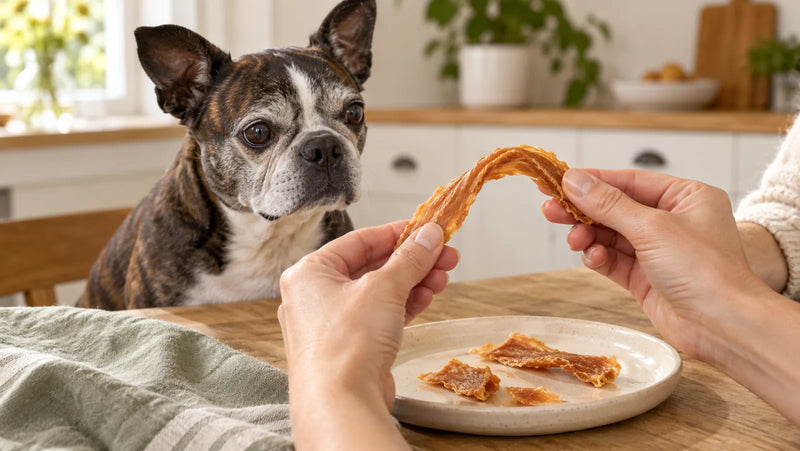
The current American Paws freeze-dried chicken training treats for dogs and cats page lists 100% USA chicken breast and approximately 5 kcal per piece. Re-check the live product page before calculating, because labels and products can change. A full piece may use too much of one session's budget for a small puppy, while tiny fragments can deliver more reinforcement opportunities inside the same calorie total.
For an irregular jerky strip or chew, the label may not give a convenient fragment value. Weigh several representative full pieces, calculate calories per gram from the package information when possible, and weigh the amount prepared for the day. Do not invent a universal pieces-per-ounce number from one unusually large or small piece.
A Training-Day Allocation That Does Not Lose Count
Do the daily accounting once, before the first session:
- Write the confirmed daily calorie target. Multiply it by 0.10.
- List every planned extra. Include chews, toppers, lick mats, pill food, table tastes, and food-dispensing toys.
- Subtract those calories. What remains is the training-reward ceiling.
- Decide how many short sessions are planned. Divide the remaining calories across them rather than grabbing from the bag.
- Measure one daily container. Refill session cups only from that container; when it is empty, the planned treat budget is finished.
- Return unused food to the day's accounting. Do not silently carry leftovers into tomorrow and then prepare a second full budget.

For high-repetition practice, use part of the puppy's measured complete-and-balanced meal as rewards when that food is motivating and the veterinary plan allows it. Reserve the smaller extras budget for harder moments or environments. This preserves nutrient balance more easily than replacing a large share of growth food with nutritionally incomplete snacks.
The guide to choosing and using puppy training treats covers reward texture, delivery speed, and early training mechanics. The calorie budget answers a different question: how all those tiny deliveries fit inside one day.
Make Each Reward Puppy-Sized
A training reward should be small enough to finish promptly so the puppy can return attention to the task. It should not be a powder cloud, a sharp shard, or a chunk the puppy tries to gulp. The right fragment depends on mouth size, teeth, swallowing behavior, product texture, and the situation; there is no universal cube measurement.
Prepare pieces before training rather than tearing a large strip while the puppy jumps or grabs. Deliver one piece at a time with the hand position recommended by the trainer, and supervise eating. Stop for coughing, gagging, repeated gulping, vomiting, diarrhea, pain, unusual lethargy, or any other concern and contact the veterinary team as appropriate.
Jerky has its own texture and readiness decisions. The chicken jerky guide for puppies covers label review, introduction, cutting, and supervision without turning jerky into the default answer for every training session.
What Counts Toward the 10% Ceiling?
Count anything that contributes calories but is not part of the planned complete-and-balanced growth diet:
- commercial puppy or dog treats;
- jerky, freeze-dried pieces, chews, and dental products with calories;
- food in puzzles, lick mats, and stuffed toys;
- meal toppers and broth with calories;
- pill pockets, cheese, peanut butter, or other medication foods;
- table tastes and food dropped by children;
- calorie-containing supplements; and
- rewards offered by trainers, walkers, sitters, and every family member.
A shared daily container and a simple household rule prevent four people from each believing they gave “only a few.” Ask the veterinary team before reducing the complete growth food to compensate for a large treat day. Puppies need adequate energy and nutrient density for growth; the cleaner fix is often to plan fewer extra calories or use measured meal food for training.
When the Simple 10% Math Is Not Enough
Ask the veterinarian to set or review the plan when the puppy is underweight or overweight, gaining unexpectedly, eating poorly, vomiting, having persistent diarrhea, or showing pain or swallowing trouble. The same applies to puppies with a medical condition, a sensitive gastrointestinal history, a prescribed diet, a suspected food reaction, or medication that changes appetite.
Large- and giant-breed growth deserves particular care because energy and mineral balance affect healthy development. Do not use a generous formula result as permission to add calcium-rich foods, bone products, or large chew calories. Growth food, body condition, expected adult size, and treat choices should be reviewed together.
A very young or not fully weaned puppy needs a feeding plan, not a treat-count formula. The question of when a particular puppy is ready for its first food reward is separate from the daily calorie math. Start only when the veterinary team agrees that the puppy's developmental stage, diet, texture, and health make the selected reward appropriate.
Keep Neighboring Puppy Questions Separate
A calorie ceiling does not answer every puppy-food question. Use the right decision for the right format:
- Adult daily allowance: the adult dog treat-calorie guide handles mature-dog examples.
- Training delivery: the puppy-training guide covers tiny size, timing, and reinforcement use.
- Chicken jerky: the jerky-specific puppy guide covers texture, label, introduction, and supervision.
- Whole chicken feet: the chicken-feet readiness guide for puppies covers a bone-in chew that cannot be converted into a routine training-piece count.
Keeping those questions separate prevents a calorie formula from being mistaken for dental, swallowing, developmental, or chew-safety clearance.
Frequently Asked Questions
Does the 10% rule apply to puppies?
Yes, as a ceiling for all noncomplete extras, not a goal. First confirm the puppy's current daily calorie target with the veterinary team. Growing puppies should receive at least 90% of calories from complete-and-balanced food appropriate for growth unless the veterinarian directs another plan.
How many training treats can an 8-week-old puppy have?
There is no universal piece count. Confirm that the individual puppy is ready for the selected food and texture, obtain the current daily calorie target, calculate up to 10% for all extras, subtract other extras, and divide by the product's calories. Use tiny pieces and count their combined calories.
Can I use kibble as puppy training treats?
Often, part of the measured complete-and-balanced daily food can be used for training when the puppy finds it motivating and the feeding plan allows it. Measure that portion from the day's meals so it is not added twice.
Should I reduce puppy food on a heavy training day?
Do not make a large or routine reduction without veterinary guidance. Replacing too much growth food with treats can dilute essential nutrition. Plan the training budget in advance, use tiny rewards, and use measured meal food for repetitions when appropriate.
Does breaking one treat into ten pieces create ten treats?
It creates ten reward deliveries, but the calories remain those of the original treat. That can be excellent for training efficiency as long as the original piece fits the daily extras budget and the fragments fit the puppy's mouth and swallowing behavior.
Can a puppy have treats every day?
A healthy, weaned puppy may be able to receive appropriate treats daily when the veterinary plan allows them, the product and texture fit, all extras stay within the calorie ceiling, and the complete growth diet remains the nutritional foundation. Stop and ask the veterinarian when appetite, stool, skin, weight, growth, or behavior changes.
Recalculate as the Puppy Grows
The useful answer to “how many treats can a puppy have per day?” is a small daily calculation, not a permanent number. Update current weight, use the current calorie target, keep all extras below the shared 10% ceiling, read the exact treat's calories, and divide the measured amount across short sessions.
When the calorie budget and texture are known, compare current American Paws dog treats by live ingredient, calorie, size, and storage information. Choose the format the puppy can handle, prepare the day's amount once, and let tiny rewards create more learning moments without quietly creating more calories.