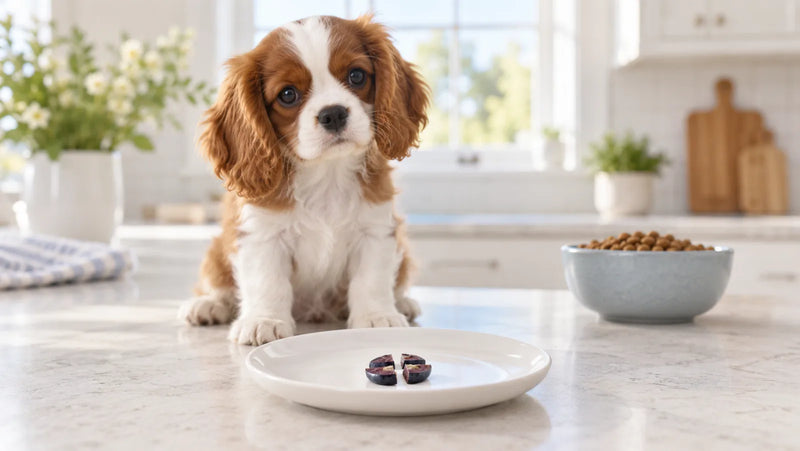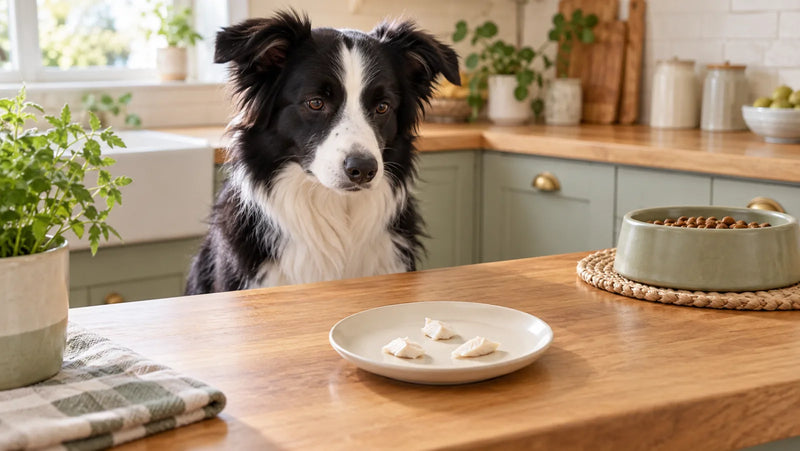

Chicken feet for puppies are not a “start at 12 weeks” treat. A conservative time to consider one whole dehydrated foot is after the puppy's permanent teeth are in—often around seven months—and only if the puppy is fully weaned, eats complete puppy food reliably, has a comfortable mouth, chews slowly, and can handle the whole foot under uninterrupted supervision.
During active teething, or for a tiny puppy, gulper, food guarder, or puppy with a veterinary diet, choose a small soft boneless reward instead. Age opens the conversation; it does not guarantee that a bone-in chew fits the individual puppy. Our best treats for puppies guide compares those softer options by age and size.
Chicken Feet for Puppies: The Conservative Answer
There is no evidence-based chicken-foot birthday that applies to every breed and mouth. A whole dehydrated foot is a chew-style treat with multiple small bones, skin, and connective tissue. Readiness therefore depends on dental development, current body size, chewing behavior, diet, health, and the owner's ability to supervise the entire session.
The conservative rule in this guide is to wait until permanent teeth are in, then pass six additional readiness gates before offering one. A veterinarian may recommend waiting longer or skipping chicken feet entirely for a particular puppy. Our guide on whether dogs can eat chicken feet covers the general dog question. Below, the focus is puppy age, teething, frequency, and the first serving.
What Age Can Puppies Have Chicken Feet?
The Merck Veterinary Manual's dental-development guide says permanent teeth usually begin to appear around four to five months and are generally all present by seven months. That timeline explains why “12 weeks” is a poor universal answer: a very young puppy is still using baby teeth and has months of tooth replacement ahead.
| Age or stage | What is happening | Chicken-foot decision |
|---|---|---|
| Not fully weaned or not reliably eating solid puppy food | Complete growth food and basic chewing skills are still being established | Do not offer a whole chicken foot |
| About 3–4 months | Baby teeth are present; early teething and chewing behavior vary widely | Use tiny soft rewards; do not use age alone to approve a foot |
| About 4–7 months | Permanent teeth are erupting; loose teeth, gaps, sore gums, or frantic chewing may occur | Generally defer during active tooth replacement, especially with mouth soreness or bleeding |
| About 7 months or later | Permanent teeth are generally present, although development and dental health still vary | Consider one only if every readiness gate below passes |
These ages describe typical tooth development, not a veterinary endorsement of chicken feet. Toy breeds can retain baby teeth, individual puppies can develop differently, and an older puppy can still be a gulper. Ask the veterinarian to examine the mouth when teeth appear crowded, loose, broken, painful, or retained.
Use Six Readiness Gates Before Offering One
- Complete puppy food remains reliable. The puppy eats an appropriate complete growth diet consistently; a chew will not replace a meal or solve poor appetite.
- The mouth is comfortable. No loose or broken teeth, bleeding gums, obvious pain, recent dental procedure, difficulty picking up food, or unexplained chewing change.
- The whole foot fits the puppy. It is not so small that the puppy can inhale it or so large and hard that the mouth cannot work around it comfortably.
- The puppy chews rather than gulps. The puppy pauses, repositions, and works a chew instead of clamping once and attempting to swallow.
- There is no rushing trigger. Feed away from other pets and do not use a high-pressure hold, chase, or forced removal that encourages guarding and rapid swallowing.
- The diet and health plan allow it. Chicken tolerance, digestive history, calorie plan, swallowing safety, and any veterinary or prescription-diet instructions all support the choice.
Failing one gate means choose another format, not “try a smaller piece.” The dedicated guide on chicken feet and choking risk explains why gulping history, dental pain, food guarding, and prior obstruction matter more than enthusiasm.
Match the Whole Foot to Puppy Size and Chewing Style
Natural chicken feet vary in length, width, and shape. Inspect the individual foot before the session. Discard one that is damaged, unusually sharp, damp, moldy, pest-exposed, or otherwise questionable. A label's size category cannot inspect the piece or watch the puppy for you.
Do not cut a chicken foot into bite-size chew pieces for a small puppy. Short fragments may be easier to swallow whole and harder to retrieve safely. If the whole foot does not clearly fit, choose a soft boneless training reward rather than redesigning the chew with scissors or a knife.
Toy puppies and puppies with very narrow mouths may never be good candidates for this format. Large puppies can still gulp, so a bigger body does not erase choking or obstruction risk. The useful match is a whole foot that the puppy must chew deliberately, paired with a dog that has already shown calm chew behavior under supervision.
How Often Can a Puppy Have a Chicken Foot?
Begin with one foot in one supervised session, then wait several days while watching appetite, stool, comfort, and chewing behavior. The table below is a conservative starting framework for a puppy whose permanent teeth are in and who passes every readiness gate. It is not a medical prescription or a reason to fill the treat allowance.
| Current puppy size and fit | First session | Conservative starting frequency | Important limit |
|---|---|---|---|
| Toy or very small; whole foot could be swallowed or cannot be worked comfortably | Skip | Use a different treat format | Do not make the foot smaller |
| Small, under 25 lb, with an appropriately sized whole foot | One foot | Once weekly at first | Stay below the product label's every-other-day upper frequency and within the calorie budget |
| Medium, 25–60 lb, calm deliberate chewer | One foot | Once or twice weekly at first | One per session while the puppy is still learning the format |
| Large, over 60 lb, calm deliberate chewer | One foot | Once or twice weekly at first | Large size does not justify two feet in a first or early session |
The current product label may allow a higher size-based frequency after tolerance is established, but that maximum is not a puppy target. Growth food must remain nutritionally dominant, and training rewards can use much of the day's available extras before a chew is added.
The World Small Animal Veterinary Association's treat guide recommends keeping treats and other extras below or no more than 10% of daily calories, selecting an appropriate size and shape, and supervising treats and chews. Count the chicken foot together with training treats, table tastes, chews, toppers, and medication foods. The detailed chicken-foot amount and frequency guide owns the broader all-dog portion question.
How to Serve the First Dehydrated Chicken Foot
- Read the current label. Confirm the exact ingredient, feeding role, storage directions, and calorie information. Do not borrow numbers from another product.
- Choose an ordinary day. Do not combine the first foot with a new kibble, vaccine reaction, stomach upset, stressful event, or several other new treats.
- Set up a quiet washable area. Separate other pets, remove distractions, provide fresh water, and keep a high-value trade available before the foot appears.
- Offer one whole foot. Let the puppy approach calmly. Do not toss it into a group or push it into the mouth.
- Watch without interruption. Stay close enough to act, but avoid hovering, grabbing, or creating competition. Look for slow repositioning and chewing rather than an immediate swallow attempt.
- End the session if the fit changes. Trade the foot away when it becomes a small swallowable remainder, breaks into a concerning piece, or the puppy begins gulping, guarding, coughing, gagging, or chewing frantically.
- Observe afterward. Do not offer another for several days. Watch for vomiting, diarrhea, constipation or straining, appetite change, mouth pain, lethargy, abdominal discomfort, or unusual behavior.
Supervision means watching the puppy for the full chew, not checking from another room. Do not rely on a camera, crate, or the sound of chewing as a substitute for being present.
Teething Changes the Decision
Teething can increase a puppy's desire to chew while making a whole bone-in treat a worse fit. Loose teeth, erupting permanent teeth, sore gums, bleeding, retained baby teeth, and a habit of crushing objects frantically all call for a pause. The need to chew is not proof that every chew is appropriate.
Use a veterinarian-approved puppy chew toy, a chilled item designed for teething, part of the puppy's normal food, or a small soft boneless reward. Do not use chicken feet to pull baby teeth, “strengthen” the jaw, clean disease from the teeth, or treat joint development.
Our separate article on the benefits and tradeoffs of chicken feet covers whether they are good for dogs at all. This puppy guide makes no promise that connective tissue repairs joints or that chewing replaces tooth brushing and veterinary dental care.

Dehydrated vs Raw Chicken Feet for Puppies
A commercially packaged dehydrated chicken foot avoids preparing raw poultry in the household and offers a dry, labeled treat format. It still is not sterile or risk-free. Wash hands after handling, keep the package dry and closed, follow the label, discard questionable pieces, and supervise the puppy.
Raw chicken feet introduce raw-poultry hazards for the puppy and the household. The FDA's raw pet food guidance reports that, compared with other types of pet food tested, raw pet food was more likely to be contaminated with disease-causing bacteria such as Salmonella and Listeria monocytogenes. This guide's own conclusion is that a puppy household is better served by a labeled dehydrated product than by raw poultry.
This guide does not recommend raw chicken feet for puppies. Freezing does not reliably eliminate bacterial risk, and a puppy can shed pathogens without appearing sick. Households with young children, older adults, pregnant people, or anyone with weakened immunity have additional reason to avoid raw animal products around shared surfaces.
Never Boil, Bake, Fry or Grill a Bone-In Foot
Do not boil, bake, roast, grill, air-fry, fry, or microwave a whole bone-in chicken foot and then give it to a puppy. Conventional cooking turns it into cooked poultry bone, which can become brittle and create sharp fragments. Plain cooked boneless chicken is a different food.
The dedicated guide on preparing chicken feet for dogs explains why ordinary cook-and-serve methods are the wrong route and why home dehydration is not automatically a validated pathogen-control process. Do not improvise a time and temperature from the dry appearance of a finished foot.
Stop the Session and Know When to Call
End the session immediately if the puppy repeatedly tries to swallow the foot whole, coughs, gags, retches, paws at the mouth, drools excessively, panics, or cannot settle into deliberate chewing. Trouble breathing, blue or pale gums, collapse, or obvious airway obstruction is an emergency: go to the nearest emergency veterinary service now.
Call the veterinarian promptly after a whole-swallow event, especially for a small puppy or large piece, and for repeated vomiting, abdominal pain, marked lethargy, refusal of food or water, straining, bloody stool, or difficulty passing stool. Do not induce vomiting or give a home remedy unless the treating veterinary professional directs it.
Use the dedicated chicken-foot choking guide for the full risk screen and response boundaries. A puppy that has rushed or swallowed one whole has shown that this treat format is a poor fit, even if no immediate injury occurs.
When a Boneless Puppy Reward Fits Better
Training and teething do not require the same treat. A whole chicken foot is a supervised chew; a tiny boneless reward is meant for quick delivery and swallowing during a lesson. If the puppy is still replacing teeth, is too small for the whole foot, or needs many rewards, use the second format rather than cutting the foot.
The chicken jerky for puppies guide explains readiness, label differences, texture, and tiny training pieces. Jerky is not a chew substitute and must still fit the puppy's chicken tolerance and calorie allowance, but its portion can be prepared before a session without creating bone fragments.
American Paws Dehydrated Chicken Feet
American Paws Dehydrated Chicken Feet contain one ingredient: 100% USA chicken feet, slowly dehydrated with nothing added. The current page describes a crunchy chew, labels it for all life stages, and identifies it for intermittent or supplemental feeding only.
“All life stages” does not mean every puppy is individually ready. Apply the dental, size, behavior, diet, and supervision gates above. Store the bag in a cool, dry place, reseal it after opening, inspect each naturally variable foot, and follow the current label rather than an article screenshot or memory.
If a bone-in chew does not fit, browse all current American Paws dog treats for a different labeled texture. Do not assume every product is single-ingredient or appropriate for every puppy; check the exact item.
Frequently Asked Questions
Can a 12-week-old puppy have a chicken foot?
This guide recommends no. At 12 weeks a puppy is still using baby teeth and has not reached the permanent-tooth stage. Use complete puppy food and tiny soft training rewards, then reconsider a whole foot after permanent teeth are in and every readiness gate passes.
Can a teething puppy chew a chicken foot?
Active teething is a reason to defer. Loose or erupting teeth, sore gums, bleeding, and frantic chewing can make the format uncomfortable or unsafe. Choose a veterinarian-approved teething item or small soft reward and have mouth concerns examined.
Should I cut a chicken foot in half for a puppy?
No. Cutting can create a shorter piece that is easier to swallow whole. If the whole foot is not an obvious fit for the puppy's mouth and chewing style, choose a different treat format.
Can a puppy have chicken feet every day?
Daily use is not the conservative starting point. Begin with one supervised session and wait several days. If the puppy remains a suitable candidate, start at once weekly for a small puppy or once or twice weekly for a medium or large puppy, always within the current label and total calorie allowance.
Are raw chicken feet better for puppies?
No evidence makes raw the better default. Raw poultry can expose pets and people to harmful bacteria, and this guide does not recommend raw chicken feet for puppies. A labeled dehydrated product avoids household raw preparation but still requires hygiene and supervision.
Do chicken feet clean puppy teeth or help joints?
Do not use them as dental or joint treatment. Chewing does not replace brushing, veterinary dental exams, or professional care, and connective tissue in a foot is not proof of preventing or treating joint disease. Choose the chew for fit and enjoyment only.
Wait for Readiness, Then Start With One Supervised Session
The safest useful answer is not a calendar date. Wait until permanent teeth are in, confirm the mouth is comfortable, match the whole foot to the puppy, rule out gulping and guarding, protect the complete growth diet, and watch the entire first session.
If those gates pass, review the current American Paws Dehydrated Chicken Feet label and begin with one whole foot on an ordinary day. If any gate fails, a small soft boneless reward is the better decision.