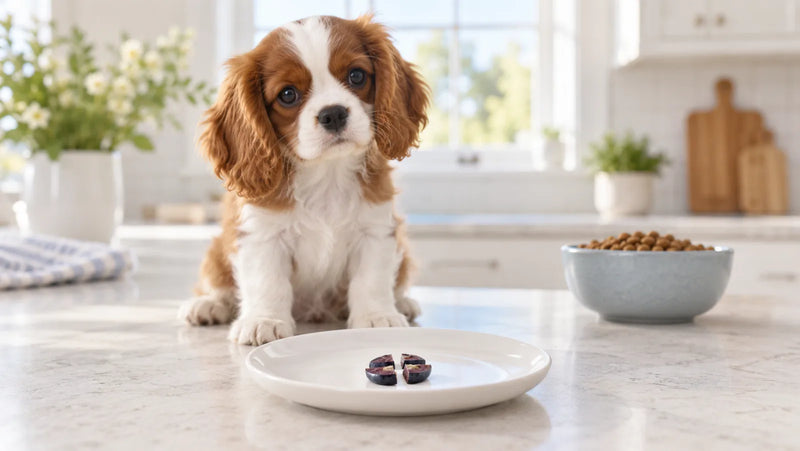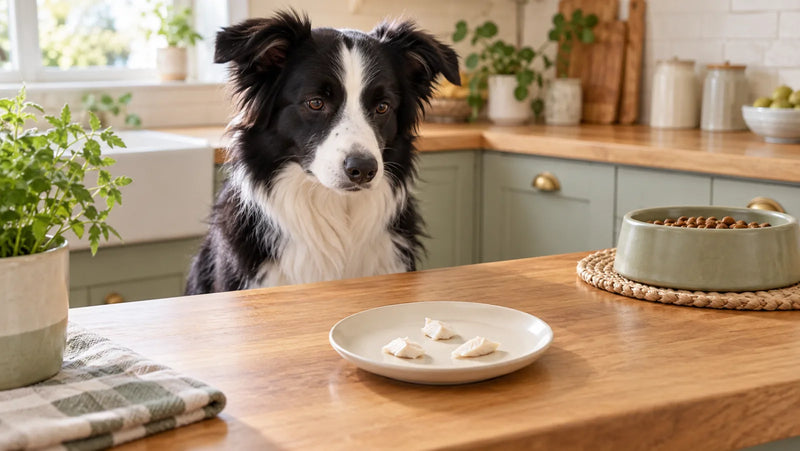

Yes, puppies can eat chicken jerky when they are weaned, eating solid puppy food reliably, and able to handle the texture. Choose a product with a clear ingredient list, tear it into tiny pieces, supervise every bite, and count it within the puppy's daily treat calories. There is no single starting age that fits every puppy: size, teething stage, chewing style, diet, and health history all matter.
Chicken jerky for puppies should remain a reward, not a meal or a substitute for complete and balanced puppy food. If your puppy has a prescribed diet, a history of food reactions, ongoing stomach trouble, or difficulty chewing or swallowing, ask your veterinarian before introducing it.
Can puppies eat chicken jerky?
For many healthy puppies, an appropriately sized piece of chicken jerky can be used as an occasional reward. The useful question is not simply whether chicken is acceptable. You also need to check the full ingredient list, the strip's firmness and thickness, the puppy's ability to chew, and the total calories offered that day.
A treat labeled for dogs is still not complete puppy nutrition. Growing puppies rely on a properly formulated puppy diet for the nutrients and energy needed during development. Treats should add enjoyment or training value without displacing that foundation. For background on quality and sourcing, see our guide on whether chicken jerky is good for dogs.
Do not use a blog article to override individual veterinary advice. A puppy recovering from illness, eating a therapeutic diet, or showing repeated vomiting, diarrhea, itching, or appetite changes needs personal guidance rather than another trial treat.
When can puppies start eating chicken jerky?
Use readiness signs instead of choosing an arbitrary birthday. A puppy should be fully weaned, comfortable eating its regular solid puppy food, and capable of chewing and swallowing the selected texture without gulping. The treat should also be labeled and portioned appropriately for the dog's size.
Many puppies arrive in new homes around the same period that their diet, routine, and environment are changing. Adding several unfamiliar treats immediately can make stomach upset harder to trace. Let the puppy settle into a dependable meal routine, then follow a gradual new-treat introduction plan.
Teething matters too. The American Kennel Club notes that puppies often benefit from softer treats during teething. A pliable strip that can be torn into tiny rewards may be more practical than a thick, firm piece, but “soft” does not mean supervision is optional. Toy breeds and puppies that gulp food need especially small portions.
How to choose chicken jerky for puppies
Read the complete ingredient list
Choose a product whose ingredients you can identify and discuss with your veterinarian if necessary. A short label can make troubleshooting simpler, but no ingredient count guarantees that a food suits every dog. Our guide to chicken jerky for dogs explains how to read a jerky label before you buy.
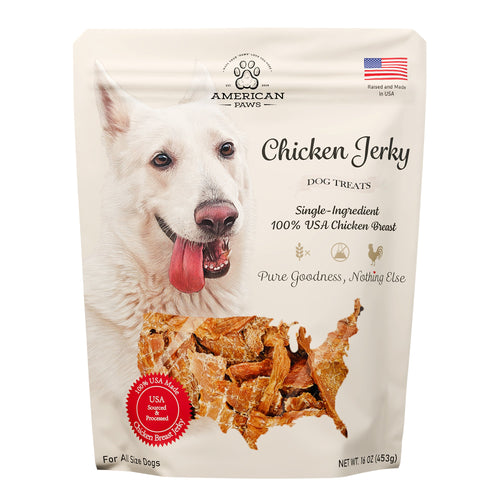
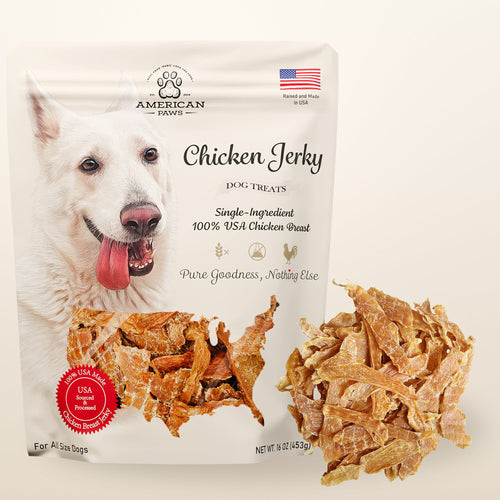
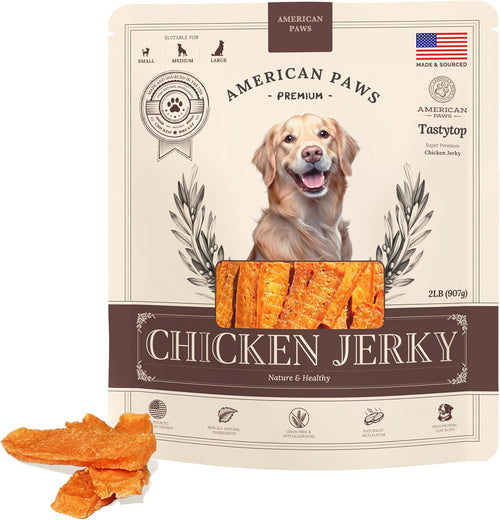
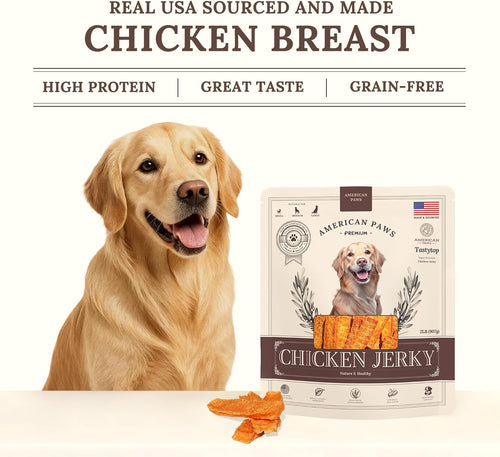
Product differences matter. American Paws single-ingredient whole-cut chicken breast jerky contains chicken breast. The softer chicken jerky with natural glycerin contains chicken plus a touch of natural glycerin and should be described as all-natural, not single-ingredient. Check the current label rather than assuming every jerky recipe is identical.
Match the texture and size to your puppy
Before offering a piece, test whether you can tear or cut it cleanly into very small portions. A puppy training reward should be small enough to swallow after a brief chew, not a full strip that encourages tugging, gulping, or prolonged unsupervised chewing.
Watch the first bite closely. If your puppy tries to swallow pieces whole, coughs, struggles, or cannot break down the texture, stop using that format. Trouble breathing or an apparent airway blockage is an emergency and requires immediate veterinary help.
Check calories and feeding directions
Piece count is unreliable because strip size and thickness vary. Review the package's calorie information and feeding directions. Your puppy's daily energy needs also change with age, expected adult size, activity, body condition, and the calorie density of the main diet.
Chicken jerky for puppies: a safe first-serving routine
- Check restrictions. Review the label and confirm that chicken and every other listed ingredient fit your puppy's current plan.
- Prepare one tiny portion. Tear the treat before your puppy sees a whole strip.
- Choose a calm moment. Offer the piece by hand while your puppy is settled and fully supervised.
- Watch chewing and swallowing. Do not offer another piece until the first is completely swallowed.
- Wait and observe. Keep the rest of the diet stable while watching appetite, stool, skin, and behavior.
- Stop if something changes. Repeated vomiting or diarrhea, swelling, hives, marked itching, lethargy, or breathing trouble warrants prompt veterinary advice; breathing trouble is urgent.
Introducing one new item at a time gives you a clearer record if your puppy does not tolerate it. It also keeps the first serving small enough to be useful rather than turning a test into an accidental meal.

How much chicken jerky can a puppy have?
There is no responsible universal answer in strips or pieces. The AKC's puppy nutrition guidance says treats should not exceed 10% of a puppy's daily caloric intake. That limit covers all extras—jerky, training rewards, chews, table food, and treats offered by other family members—not 10% from each category.
The 10% guideline refers to calories, not the weight or volume of food. A small puppy has a small treat allowance, and a calorie-dense strip can use it quickly. Ask your veterinarian how many daily calories are appropriate, read the treat's calorie statement, and use crumbs or tiny torn pieces when training.
Keep a shared daily total if several people reward the puppy. A handful from each caregiver can become a large amount even when every individual serving looks small. If a training day requires many repetitions, use part of the measured puppy kibble for easier skills and reserve jerky for the moments that need a higher-value reward.
Use chicken jerky as a puppy training reward
Jerky's aroma can make a tiny piece meaningful, which is useful when teaching attention, recall foundations, polite handling, or calm behavior. Prepare all pieces before the session. This keeps the puppy focused and prevents oversized rewards when you are moving quickly.
- Keep sessions brief and stop while the puppy is still engaged.
- Deliver the reward immediately after the desired behavior.
- Use pieces no larger than needed to motivate your puppy.
- Count every piece toward the day's treat calories.
- Pair food with praise, play, or access to an activity so food is not the only reward.
A reward can be high-value because the puppy likes it, not because the portion is large. One strip divided into many tiny pieces often creates more useful learning opportunities than handing over the entire strip.
Common chicken jerky mistakes to avoid
- Replacing regular food: jerky is not formulated to replace complete and balanced puppy meals.
- Offering a whole large strip: prepare puppy-sized pieces and supervise rather than letting a puppy manage an oversized portion.
- Assuming “natural” means unlimited: ingredient wording does not remove calories or individual sensitivities.
- Changing several foods at once: introduce one item gradually so you can identify what changed.
- Ignoring recipe differences: read each label; even two chicken jerky products may have different ingredients and textures.
- Leaving treats accessible: reseal the package and store it out of reach. Follow our chicken jerky storage guide to limit moisture and quality loss.
Which American Paws chicken jerky format fits?
The American Paws chicken jerky collection includes formats for different uses. Owners prioritizing the shortest label can consider the single-ingredient whole-cut chicken breast jerky, then cut or tear it to match the puppy. Where a more pliable texture is useful, the softer chicken-and-natural-glycerin format may be easier to portion for training.
Neither option is automatically right for every puppy. Compare the current ingredient label, texture, calorie information, and feeding directions with your puppy's needs. American Paws makes these real-meat treats in Highland, California, but where a product is made does not replace careful selection and supervision.
Frequently asked questions
Can an 8-week-old puppy eat chicken jerky?
Some 8-week-old puppies may be weaned and eating solid food, but age alone does not establish readiness. Ask your veterinarian when needed, choose an appropriate soft or breakable texture, and begin with one tiny supervised piece. Do not give every 8-week-old puppy a full strip.
Is chicken jerky too hard for teething puppies?
Some jerky can be too firm or thick for an individual teething puppy. Choose a pliable product you can tear into tiny pieces and watch how the puppy manages the first bite. Stop if the puppy struggles, gulps, coughs, or cannot chew it comfortably.
Can I use chicken jerky every day for puppy training?
It may fit a daily training plan if your veterinarian has no concerns, the puppy tolerates it, and all treats remain within the daily calorie allowance. Use very small pieces and rely on complete puppy food for the puppy's primary nutrition.
What if chicken jerky upsets my puppy's stomach?
Stop offering it and keep a record of the product, ingredients, amount, and symptoms. Contact your veterinarian for repeated vomiting or diarrhea, blood, lethargy, appetite loss, swelling, hives, or other concerning changes. Seek urgent care for breathing trouble.
Is single-ingredient chicken jerky better for every puppy?
No. A single-ingredient label is simple to understand, but chicken is not suitable for every puppy and texture still matters. Individual diet history, veterinary restrictions, chewing behavior, and portion size remain important.
Start with one tiny, supervised reward
Good puppy treat choices are specific, not universal: confirm readiness, read the ingredients, match the texture to the puppy, prepare tiny pieces, and count every reward. Compare the American Paws chicken jerky collection, choose the clearly labeled format your puppy can manage, and begin with one small supervised serving.