
The best treats for puppies are tiny enough to deliver comfortably, soft or friable enough for the puppy’s current mouth, low enough in calories to repeat, and simple enough to audit from the full label. For a newly weaned puppy, measured pieces of the puppy’s own complete growth food are usually the easiest first reward. Add a separate treat only after checking readiness, ingredients, calories, texture, and any veterinary restrictions.
No package word—“natural,” “premium,” “training,” or even “puppy”—can make that decision by itself. The right choice depends on the individual puppy today, and it may change as the mouth, body size, training job, and daily calorie needs change.
Best Treats for Puppies: The Five-Gate Screen
Put every candidate through five gates before buying a large bag. A treat that fails one gate does not become suitable because it performs well on the other four.
| Gate | What to check | Reason to pause |
|---|---|---|
| Readiness | Fully weaned, reliably eating growth food, able to chew and swallow the proposed texture | The puppy is not fully weaned, gulps, coughs, or has a veterinary diet restriction |
| Delivery size | One reward can be made tiny and consistent for that puppy | The piece is a mouthful, awkward shard, or impossible to divide predictably |
| Texture | Soft, pliable, or easily crumbled with low chewing effort | Rock-hard, thick, sticky, sharp-edged, or sized like a long-lasting chew |
| Calories | Calories are available and the day’s measured amount fits one extras budget | No calorie information, or a useful training session would consume too much of the budget |
| Ingredients | Every ingredient is named and compatible with the puppy’s current plan | Vague ingredients, unsafe foods, a known trigger, or conflict with a prescribed diet |
The foundation is still complete growth food. AAHA feeding guidance recommends that at least 90% of calories come from complete and balanced nutrition, leaving no more than 10% for treats and other extras. The smaller share is a ceiling, not a goal to fill.
Age-by-Age Puppy Treat Picks
Age ranges are useful checkpoints, not permission slips. Weaning status, growth-food intake, body size, mouth development, chewing pattern, health, and the veterinarian’s plan all matter more than the calendar alone. VCA’s growing-puppy guidance notes that puppies are typically weaned around eight weeks and that breed size changes the length of the growth period.
Before full weaning: no casual treat program
A puppy still transitioning from the mother or a properly formulated milk replacer needs a controlled feeding plan, not assorted snacks. Do not use a human food, jerky strip, hard chew, or marketing age on a bag to rush this stage. The veterinarian or responsible breeder should guide the transition to an appropriate complete puppy food.
Around 8–12 weeks: familiar food and one tiny new reward
Once the puppy is fully weaned and consistently eating a complete growth diet, reserve part of the measured meal as training rewards. Familiar kibble keeps the ingredient and calorie picture simple. If a higher-value reward is useful, introduce one precisely labeled food at a time, make the delivery piece very small, and watch chewing, swallowing, stool, skin, and appetite.
The puppy treat-readiness guide covers the full readiness check. An eight-week birthday alone does not prove that every puppy is ready for every texture.
Around 3–4 months: small, quick rewards as training expands
Short sessions may now create many reward moments. The practical answer is not a larger calorie allowance; it is smaller delivery pieces. Use meal food for easy repetitions and save a tiny amount of a more valued food for a recall, calm handling, or a distracting environment. The reward should be eaten quickly enough that the puppy can return attention without prolonged chewing.
For timing, pouch setup, reward hierarchy, and cutting a daily allowance into more repetitions, follow the puppy training treat guide.
Around 4–6 months: active teething changes texture decisions
Adult teeth commonly emerge during this period, and the mouth may be tender. VCA’s puppy teething guidance advises against extremely hard objects that may damage teeth. A quick edible training reward and a supervised teething item perform different jobs; do not turn a training treat into an improvised hard chew.
Use the teething-puppy treat and chew guide to compare texture, durability, supervision, and discard points. Remove any item that becomes small enough to swallow or develops sharp or loose pieces.
Around 6–12+ months: adult teeth do not end the growth stage
A puppy with adult-looking teeth still needs growth nutrition. AAHA’s age- and breed-specific nutrition guidance places skeletal maturity around one year for many small and medium dogs and later—about 15–16 months—for many large and giant breeds. VCA notes that some large and giant dogs may mature even later.
Keep complete growth food in charge until the veterinary team recommends a transition. Recheck treat size as the puppy grows, but do not assume a larger mouth needs larger rewards. Tiny rewards remain efficient for training.
Size: One Reward Should Not Become a Mouthful
Judge the size that enters the mouth, not the size that came in the bag. A strip, cube, biscuit, or freeze-dried piece may be sold as one unit but still need to be divided into many rewards. The useful delivery piece should disappear comfortably without gulping, repeated chomping, or a long pause in the session.
- Prepare before training. Divide the day’s measured allowance at the counter, not while the puppy jumps at the pouch.
- Use clean cuts. Snip pliable strips into small, even bites. Crumble friable pieces into usable fragments, but discard sharp shards or powder the puppy may inhale.
- Supervise the first trials. Stop if the puppy gulps, coughs, paws at the mouth, vomits, or struggles with the texture.
- Count the original amount. Ten fragments from one piece still contain the calories of that entire piece.
WSAVA’s treat guide emphasizes appropriate size and shape and supervised feeding. For a very small puppy, “pea-sized” may still be too large; use the individual mouth and swallowing pattern rather than a household-object comparison.
Softness: Choose Low-Force, Quick-to-Eat Textures
Soft or pliable treats are often convenient because they can be cut small and eaten quickly. Friable treats that break with light finger pressure can also work. But soft does not automatically mean safe: an oversized sticky lump can be harder to manage than several properly prepared fragments.
Likewise, freeze-dried does not mean soft. Many freeze-dried pieces are light and crunchy. Test whether the exact piece breaks cleanly, then decide whether the resulting texture fits the puppy. Moistening a product changes handling and storage; prepare only what will be used promptly and follow its label.

Calories: Keep All Extras Inside One 10% Ceiling
Puppies have small bodies and demanding growth nutrition, so repeated rewards can crowd out complete food quickly. Put treats, chews, toppers, table bites, pill foods, and every family member’s handouts into one shared extras budget. Do not assign 10% to each category.
There is no honest universal answer in “pieces per day.” Piece weights vary, and a strip divided into twenty rewards is still one strip’s calories. Find the puppy’s veterinarian-confirmed daily calorie target, calculate the extras ceiling, read the treat’s calories per piece or by weight, and pre-portion one daily container. The daily puppy-treat amount guide walks through that calculation and shows how to subtract other extras.
When a label does not provide usable calorie information, ask the manufacturer before making it a frequent training food; the two American Paws formats compared below list approximately 5 kcal per freeze-dried piece and approximately 15 kcal per training strip on their product pages. “Low calorie” without a quantity does not let you plan a session.
Ingredients: Prefer Simple, Exact Labels
A short ingredient list is easier to audit and easier to discuss if the puppy reacts. A single-animal-protein treat can also help avoid introducing several new foods at once. However, “single ingredient” does not prove that a treat is low calorie, soft, nutritionally complete, or suitable for a puppy with a suspected allergy.
AAFCO’s label-reading guidance explains that treats and snacks generally are not intended to be complete and balanced. Read the entire current label: product name, species, ingredients, calorie statement, net quantity, manufacturer or distributor, feeding directions, lot information, and any storage directions. Do not infer the formula from a front-panel photo or an old listing.
Introduce one new treat in a small amount when the puppy is otherwise well. Stop and contact the veterinary team for repeated vomiting or diarrhea, marked lethargy, facial swelling, hives, breathing difficulty, or another concerning change; urgent symptoms need prompt care.
What to Avoid in Puppy Treats
- Products containing xylitol, chocolate, grapes, raisins, currants, onion, garlic, chives, leeks, macadamia nuts, alcohol, or caffeine.
- Seasoned human jerky, fatty table scraps, gravy, and foods with an incomplete or unreadable ingredient list.
- Cooked bones, raw animal protein, and extremely hard chews that can introduce injury, infection, or tooth risks.
- Large sticky pieces, sharp fragments, or any size the puppy tries to swallow whole.
- Foods that conflict with a prescription or elimination diet, even when the ingredient looks familiar.
Keep treat bags, household food, trash, and daily containers out of reach. If a puppy eats a potentially toxic food, swallows a bone or package piece, or shows choking or breathing trouble, contact a veterinarian or emergency service promptly rather than waiting for a routine feeding adjustment.
Two Current American Paws Formats to Compare
Single-ingredient freeze-dried chicken pieces
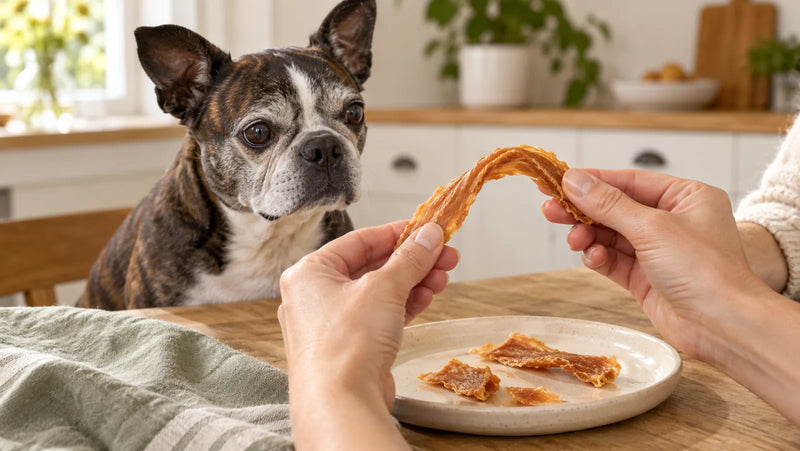
The current 4 oz freeze-dried chicken training treats list 100% USA chicken breast as the sole ingredient. The light crunchy pieces can be divided, which may turn one full piece into several delivery moments. They are not automatically soft, and dividing a piece does not reduce its total calories. Check the current label, test the exact texture, and decide whether it suits the individual puppy.
Pliable chicken training strips with natural glycerin
The current 2 lb chicken training treats are pliable strips made with USA chicken and a touch of natural glycerin. They can be snipped into tiny training bites. They are not single-ingredient, and the product page’s all-ages language does not override readiness, mouth size, calorie limits, prescribed diets, or veterinary guidance. The chicken jerky for puppies guide covers the format in more detail.
Neither option replaces complete growth food. Compare the live labels, choose the texture that passes the five gates, and start with less than the full daily ceiling.
Match the Treat to the Job
| Job | Practical first choice | Key control |
|---|---|---|
| Easy repetitions at home | Measured pieces of the puppy’s own meal | Subtract them from the meal portion |
| Harder training moment | A tiny piece of a well-tolerated higher-value food | Pre-portion the session from the shared extras budget |
| Calm handling or grooming | Many very small, quick-to-eat pieces | Avoid a sticky mouthful that interrupts handling |
| Teething relief | An age- and size-appropriate supervised teething item | Use the separate teething criteria; do not improvise with a hard treat |
A single bag does not need to perform every job. Familiar meal food can cover most repetitions, a carefully chosen treat can handle difficult moments, and a separate supervised item can address chewing. This reduces novelty and makes calorie accounting easier.
A Seven-Step Puppy-Treat Label Check
- Confirm readiness. The puppy is fully weaned, eating the prescribed growth food, and able to manage the proposed texture.
- Read every ingredient. Check for unsafe foods, known triggers, and conflicts with the veterinary plan.
- Find calorie information. Record calories per piece or per weight; do not rely on “light” or “training.”
- Test the delivery size. Make one reward appropriately tiny before committing to a large package.
- Test the texture. Look for a low-force bite without sharp shards, excessive stickiness, or prolonged chewing.
- Plan the daily amount. Share one extras ceiling across every treat, chew, topper, and handout.
- Check the exact package. Follow current storage directions and keep the lot and best-by information until the food is used.
When the Veterinarian Should Choose the Rules
Ask the veterinary team before adding treats when the puppy is on a prescription or elimination diet, has poor growth, repeated digestive signs, suspected food allergy, pancreatitis risk, a swallowing problem, dental or mouth pain, or another medical condition. Large- and giant-breed growth also deserves individualized calorie and mineral planning; random extras should not dilute that plan.
The veterinarian can help decide whether meal food should be the only reward, what calorie ceiling fits the current body condition and growth rate, and whether a proposed ingredient belongs in the diet trial. Bring the full label or a clear photo of every panel.
Frequently Asked Questions
What are the best treats for an 8-week-old puppy?
For a fully weaned puppy that reliably eats a complete growth food, measured pieces of that same food are usually the simplest first rewards. If a separate treat is needed, choose one tiny, easy-to-manage, precisely labeled option and introduce it gradually. Eight weeks is not automatic approval for every puppy or texture.
Are soft treats better for puppies?
Soft or pliable treats can be easy to cut into small training pieces, but softness alone does not make a treat suitable. Check delivery size, stickiness, calories, ingredients, swallowing pattern, and supervision. Some puppies may do well with a friable crunchy piece divided appropriately.
Are single-ingredient treats best for puppies?
They are often easier to audit, but they are not automatically low calorie, soft, complete, or allergy-safe. The named ingredient still has to fit the puppy, and the texture and measured amount still matter.
How many treats can a puppy have per day?
Use calories, not a universal piece count. Keep all extras together at no more than 10% of the puppy’s veterinarian-confirmed daily calories, and use less when possible. Divide the measured amount into as many appropriately tiny rewards as the training plan needs; the daily puppy-treat amount guide walks through the calculation.
Can puppies have freeze-dried treats?
A fully weaned puppy may be able to have a precisely labeled freeze-dried treat when its ingredients, calories, delivery size, and texture fit the individual plan. Freeze-dried pieces may be crunchy rather than soft, so divide and test the exact product under supervision.
Can puppies have chicken jerky?
A pliable dog-labeled chicken strip may be cut into tiny pieces for a puppy that is ready and tolerates its exact ingredients. Avoid seasoned human jerky, hard or oversized strips, and unknown calorie information. Chicken jerky remains an extra, not growth food.
What treats should teething puppies avoid?
Avoid extremely hard objects, cooked bones, sharp or loose fragments, and pieces that can be swallowed whole. Choose teething items by the puppy’s current mouth and chewing behavior, supervise use, and replace or discard them according to their condition and label.
Pick the Smallest Useful Reward and Recheck as the Puppy Grows
The most useful puppy treat is not the biggest, richest, or most heavily marketed one. It is the smallest reward that does the current job while passing readiness, delivery-size, texture, calorie, and ingredient checks. Keep complete growth food at 90% or more of calories, prepare the daily extras in advance, and reassess the choice as the puppy grows.
Ready to compare exact formats? Review the current labels and textures of the single-ingredient freeze-dried chicken and pliable chicken training strips, then prepare the smallest useful reward for the session. You can also browse the current American Paws dog treats by exact ingredient and texture rather than treating any collection as a blanket puppy-safety promise.