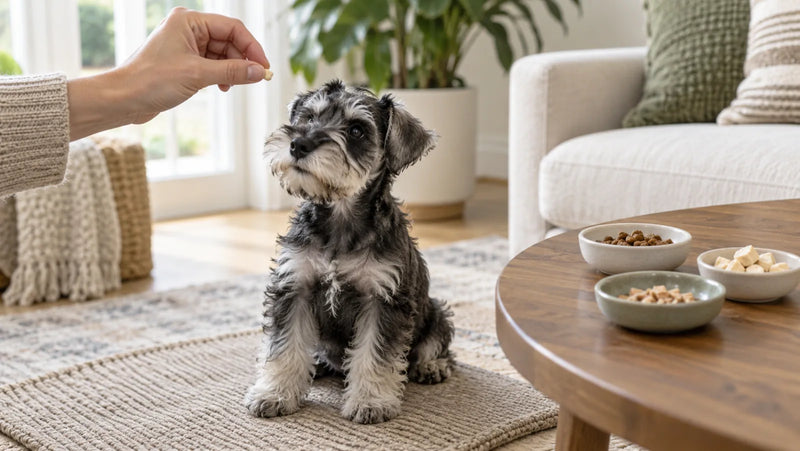

When can puppies have treats? Many puppies can begin receiving tiny food rewards around 8 weeks, but a birthday is not automatic clearance. Wait until the puppy is fully weaned, reliably eating a complete-and-balanced puppy food, healthy enough for ordinary feeding, and able to handle the selected size and texture safely. The simplest first reward is usually a few pieces taken from the puppy's measured meal.
Separate dog treats can come next, one new food and one tiny test at a time. “Around 8 weeks” is useful context because many puppies are fully weaned and entering new homes then. It is not a deadline, a guarantee, or permission to ignore a breeder's feeding plan, a veterinary restriction, or an individual puppy's swallowing and digestive readiness.
When Can Puppies Have Treats? After Weaning and Stable Puppy Food
The practical answer is after full weaning and once the puppy's regular growth food is going well. The AAHA canine and feline behavior-management guidelines describe puppies beginning semisolid food at about 3 weeks, solid food at about 5 weeks, and normally completing weaning by about 7 weeks. Those are typical developmental milestones, not a treat schedule for every litter.
The AKC discussion of puppy homecoming age notes that puppies usually transition gradually to solid food and that many go to new homes at 8–10 weeks, after they are fully weaned. That helps explain why “8 weeks” appears so often in first-treat advice. The actual decision still depends on the puppy in front of you.
A puppy younger than that may already be eating solid food under a breeder's or veterinarian's care, but that does not make casual extras helpful. During weaning, each food choice can affect whether the puppy receives the planned energy and nutrients. Follow the person managing the litter's feeding program rather than adding a commercial treat independently.
Five Readiness Checks Matter More Than the Birthday
Before offering anything outside the regular diet, check all five conditions:
- The puppy is fully weaned. The puppy eats independently and is no longer relying on the dam's milk or milk replacer. A puppy still in the transition to solid food needs a managed feeding plan, not bonus snacks.
- The complete puppy food is stable. The puppy is eating an appropriate complete-and-balanced growth diet reliably, without a current unexplained appetite problem, repeated vomiting, or diarrhea.
- The selected texture is manageable. The piece can be prepared small enough for the puppy to chew or swallow calmly under supervision, without being a powder, sharp shard, rock-hard object, or gulpable chunk.
- There is no diet restriction. The veterinarian has not prescribed fasting, an elimination trial, a therapeutic diet, or another plan that excludes extra foods.
- The household can track the test. Everyone knows which food was offered, how much was given, and what changed afterward. Multiple new foods make a reaction much harder to interpret.
Passing four of five is not enough. If the puppy is fully weaned but currently has loose stool, wait. If digestion is stable but the only available reward is an oversized hard chew, choose a safer format. If the puppy is on a veterinary diet, ask before using even a single-ingredient product.
A Practical Puppy-Treat Timeline
This timeline puts common development into context. It is not individualized medical clearance:
| Typical stage | Practical food-reward approach |
|---|---|
| Roughly 3–5 weeks | Transition toward solid food is breeder- or veterinarian-managed feeding work. Do not add casual treats. |
| Around 7 weeks | Weaning is often complete, but verify that the individual puppy eats independently and is thriving on the planned growth food. |
| Around 8–10 weeks | Many home puppies can begin tiny rewards if every readiness check passes. Start with food measured from the regular meal. |
| As growth continues | Recheck texture, calories, ingredients, body condition, and veterinary guidance. Yesterday's piece size and allowance are not permanent. |
The Merck Veterinary Manual's small-animal feeding guidance describes puppies between weaning and 6 months as generally eating multiple meals of a complete growth diet and emphasizes monitoring weight and adjusting feeding for the individual. Treat timing should fit inside that growth plan, not compete with it.
Use the Puppy's Own Food as the First Reward
For a newly home, fully weaned puppy, familiar food is the cleanest starting point. Measure the day's normal puppy-food amount, then move several pieces from one meal into a small training cup. Those pieces become rewards; they are not an extra ration.
This approach has three advantages. The ingredient profile is already familiar, the calories remain inside the planned growth diet, and you can test the mechanics of taking food from a hand without introducing a second food at the same time. It is especially useful for name recognition, checking in, entering a crate, or following a person for one or two steps.
If the current food is wet, unusually large, or otherwise awkward to deliver by hand, ask the breeder or veterinary team how to reserve a suitable portion. Do not dry, bake, freeze, or substitute food in a way that conflicts with storage directions or a medical plan. The goal is a familiar, safe reward—not forcing kibble to work in every situation.
Measure first and train second. Repeatedly reaching into the food bag can turn “just a few pieces” into an uncounted second meal, while taking food from the measured daily amount keeps the accounting visible.
How to Introduce the First Separate Treat
Once the puppy handles familiar-food rewards comfortably, a separate treat can be tested without making the moment complicated:
- Read the entire label. Check every ingredient, the calorie statement, storage directions, and any feeding or age language. Front-of-package words such as “natural” do not replace the ingredient panel.
- Choose one product. Do not add a new chew, topper, supplement, and treat on the same day.
- Prepare one tiny piece. It should suit the puppy's mouth and current chewing behavior and should not have sharp edges.
- Offer it while the puppy is calm. Supervise the bite and swallow rather than testing it during frantic play or competition with another pet.
- Watch what happens afterward. Track appetite, stool, vomiting, itching, facial swelling, pain, coughing, gagging, or unusual behavior.
- Pause if anything concerns you. Do not keep feeding to “see if the puppy gets used to it.” Contact the veterinary team as the symptoms warrant.

The full step-by-step plan for introducing a new dog treat explains how to stage the following days and why a food log matters. Use that plan after the initial readiness decision; changing several foods quickly defeats the purpose of a controlled introduction.
Ingredients and Formats to Avoid
Do not offer a puppy food containing known dog toxins such as xylitol, chocolate, grapes or raisins, onion, garlic, chives, alcohol, caffeine, or macadamia nuts. The WSAVA dog-treat guide lists these and other foods that should not be fed and recommends asking the veterinary team about appropriate treats.
Also avoid seasoned human jerky, very salty or sugary scraps, fatty leftovers, unlabeled homemade mixtures, cooked bones, and pieces that can splinter or be swallowed whole. A simple ingredient list does not make an unsafe size or texture safe. “Natural” does not mean suitable for a small mouth, sensitive stomach, medical diet, or current developmental stage.
Use particular caution with very hard items. If the puppy attacks a dense object with force, cannot make an impression on it, breaks off sharp fragments, or tries to gulp it, remove it. Teething and long-lasting chew choices require a different texture-and-supervision decision than a quick food reward.
How Much Is Appropriate Once a Puppy Is Ready?
Readiness answers when a puppy can begin; it does not create a universal daily piece count. WSAVA advises that treats supply no more than 10% of a dog's daily calories. For puppies, complete-and-balanced growth food should remain the nutritional foundation, and 10% is a ceiling for all noncomplete extras together—not a target to fill. The same ceiling logic for mature dogs is explained in the guide to how many treats a dog can have per day.
The separate guide to calculating how many treats a puppy can have per day shows how to use a veterinarian-confirmed calorie target, subtract chews and other extras, and translate the remainder through the exact product's calories. Use that calculation rather than guessing from the number of pieces in another owner's hand.
Breaking one treat into ten training crumbs creates ten reward moments, not ten calorie-free foods. Count the calories of the original amount. For a very small puppy, meal-food rewards often give far more repetitions before a separate-treat budget is even necessary.
First Rewards During Training
Early learning works best when rewards are fast and easy to finish. Set aside part of the measured meal for simple repetitions and use one piece at a time. A prolonged chew is not interchangeable with a quick reward: it changes the activity, takes longer to consume, and may be harder to account for.
After a separate treat has been introduced successfully, a higher-value morsel can be reserved for a harder moment, such as calmly noticing a new sound or returning attention outdoors. That does not mean every cue needs a richer food or that the puppy should skip complete meals to make room for training extras.
The detailed guide to puppy training treats covers size, texture, speed, motivation, and delivery. Keep sessions short enough that the puppy can stay comfortable and successful, and stop if eating mechanics or behavior become frantic.
Multi-Pet Homes: Keep Cat Treats Separate
A puppy may race toward the cat's food because it smells interesting, but cat treats should not become the default puppy reward. They may be sized, calorie-dense, or formulated with a cat rather than a growing dog in mind. Separate containers and reward stations make accidental swapping less likely.
One stolen piece is a different question from routine use. Check the exact ingredients and amount, monitor the puppy, and call the veterinarian or poison resource promptly when the product contains a concerning ingredient or symptoms appear. The guide to whether dogs can eat cat treats explains the accidental-bite versus repeated-feeding decision in more detail.
Wait and Ask the Veterinarian First When…
Do not start a new treat when the puppy is not fully weaned, is refusing food, has repeated vomiting or diarrhea, struggles to chew or swallow, appears painful, is losing weight, or is not growing as expected. Ask first when the puppy has a suspected food reaction, a sensitive gastrointestinal history, a prescribed or elimination diet, or instructions to fast for a procedure.
Large- and giant-breed puppies also need careful control of energy and mineral balance during growth. An extra that seems small can still displace part of a deliberately selected growth diet. Discuss the entire feeding pattern—not just one ingredient—with the veterinary team.
Trouble breathing, facial swelling, collapse, active choking, repeated vomiting, or marked weakness after food exposure can require urgent veterinary care. Do not rely on an online age chart to judge an emergency.
Frequently Asked Questions
Can an 8-week-old puppy have treats?
Many 8-week-old puppies can have tiny, appropriate food rewards if they are fully weaned, reliably eating a complete growth diet, healthy, and able to handle the texture safely. Start with measured meal food. Age alone is not clearance, so follow any breeder or veterinary restrictions.
Can puppies have treats before 8 weeks?
A breeder or veterinarian may use food strategically during a puppy's transition to solids, but owners should not add casual treats to a puppy that is still weaning. The litter's feeding professional needs to control the diet, texture, sanitation, and growth monitoring.
What should a puppy's first treat be?
A few pieces or a small reserved portion of the puppy's familiar, measured complete growth food is often the simplest first reward. When adding a separate treat, choose one clearly labeled product, prepare one tiny suitable piece, and supervise the first test.
Can I use puppy kibble as training treats?
Yes, if the puppy eats that food safely and finds it motivating. Measure it from the day's meals rather than adding it on top. If the food is not practical by hand or the puppy is on a special diet, ask the veterinary team for an appropriate delivery option.
How do I know whether a treat is too hard?
Do not use a piece that the puppy cannot manage calmly, that breaks into sharp fragments, or that prompts forceful biting or gulping. Size, tooth stage, chewing style, and product density all matter. Remove damaged pieces and supervise every new format.
Can puppies have adult dog treats?
An “adult” label is a reason to inspect rather than guess. Check the feeding statement, complete ingredient list, calories, size, texture, and manufacturer directions, then ask the veterinarian when the label or puppy's health leaves any doubt. Treats should not replace complete puppy food.
Start With Familiar Food, Then Add One New Thing
The safest useful answer to “when can puppies have treats?” is not a date by itself. Look for full weaning, steady intake of complete puppy food, a manageable texture, no medical restriction, and a household that can supervise and track the test. Around 8 weeks is common because many puppies meet those conditions then; some do not.
Begin with part of the measured meal. When the puppy is ready for a separate reward, compare the live labels in the American Paws training-treat collection, introduce only one tiny new food, and keep every extra inside the day's shared calorie ceiling. The freeze-dried chicken pieces there, for example, list approximately 5 kcal per piece and a 0.5–1 inch size on the current product page, which is why one piece can be broken into several first rewards. You can also browse all current American Paws dog treats after checking ingredients, calories, size, texture, and storage instructions for the individual puppy.