
Can puppies eat bones? The safest default is no: never give a puppy a cooked bone, and do not treat a raw bone as a safe workaround. Cooked bones can break into dangerous pieces, while raw bones can still fracture teeth, lodge in the throat or digestive tract, injure tissue, and expose a puppy and household to bacteria. A veterinarian who knows the puppy is the right person to discuss any proposed chew.
Puppies add special uncertainty. Their teeth are changing, their chewing skills are developing, and curiosity can turn chewing into gulping. There is no universal safe bone size, breed, age, cooking method, or supervised chewing time. If a puppy already got a bone, response comes before research.
Act now after a possible bone ingestion. If the puppy is choking, struggling to breathe, collapsing, repeatedly gagging or swallowing, drooling heavily, or showing severe pain, go to an emergency veterinarian now. If the bone was swallowed and the puppy looks normal, call the veterinarian or emergency clinic promptly anyway; do not wait for symptoms and do not induce vomiting. For a mixed holiday-food exposure or uncertainty about a toxic ingredient, call ASPCA Animal Poison Control at 888-426-4435 or Pet Poison Helpline at 855-764-7661. Consultation fees may apply.
Can Puppies Eat Bones? The Default Answer Is No
Do not offer cooked chicken, turkey, beef, pork, lamb, or other bones to a puppy. Baking, boiling, roasting, smoking, grilling, or pressure-cooking does not turn a bone into a puppy chew. A large bone is not automatically safe, and supervision cannot stop a tooth from cracking or a fragment from breaking loose in an instant.
Raw is not a permission slip either. The World Small Animal Veterinary Association guide to dog treats says both cooked and raw bones can be very dangerous. It also warns against very hard chews and treats with sharp or broken edges. That is why this guide starts at no rather than trying to calculate a safe bone-to-puppy ratio.
A veterinarian may consider the individual puppy's mouth, behavior, diet, health, household, and the exact proposed item. That conversation is case-specific direction, not a guarantee that a raw bone will be harmless. Until that discussion happens, choose a lower-risk tool designed for the actual job.
Why Cooked Bones Never Belong With Puppies
Cooking changes moisture and structure, and a cooked bone can crack into irregular points or pieces under pressure. A piece may cut the mouth, become caught behind teeth, lodge in the esophagus, block the stomach or intestine, or damage the digestive tract. The danger is not limited to tiny poultry bones: a large cooked bone can still be hard enough to injure a tooth and can shed smaller pieces.
Removing visible marrow does not remove the bone hazard. Neither does holding one end, watching closely, or taking the bone away after a few minutes. Those practices cannot establish a safe bite force, fragment shape, or swallowed amount.
The separate guide on chicken bones and dogs owns the broader chicken-bone question. This page focuses on what makes puppy mouths and behavior less predictable and what to do when a young dog has already reached any kind of bone.
Raw Bones Still Carry Three Separate Risks
A raw bone may be less brittle than a cooked one, but less brittle does not mean safe. It retains at least three independent risk paths: mechanical damage to teeth and oral tissue, choking or foreign-body injury, and exposure to organisms in raw animal tissue. Solving one of those concerns would not erase the other two.
Hard Bones Can Damage Teeth and Gums
The American Animal Hospital Association's hard-chew guidance identifies bones among items capable of damaging or fracturing teeth. A puppy does not need to swallow the bone for harm to occur. A hard bite can expose sensitive inner tooth tissue, while a sharp edge can cut the tongue, gums, palate, or lip.
A puppy's visible enthusiasm is not evidence that the texture is suitable. Chewing drive, jaw strength, and willingness to keep biting through discomfort vary. Avoid improvised tests that claim an object is safe if it passes a fingernail, knee, or bend test; those shortcuts do not evaluate the individual mouth.
Pieces Can Choke, Lodge, Obstruct, or Perforate
The Merck Veterinary Manual review of esophageal foreign bodies notes that bones are a common object found in dogs. Drooling, gagging, trouble swallowing, regurgitation, and repeated attempts to swallow are important warning signs. A puppy that can still breathe may nevertheless have something lodged and needs veterinary evaluation.
If a piece moves farther, it can still create a gastrointestinal obstruction or injure tissue. Merck's overview of gastrointestinal obstruction explains that young dogs are among the animals at risk from foreign objects. No home observation can tell an owner the exact location, shape, or effect of a swallowed fragment.
Raw Animal Tissue Can Carry Pathogens
A raw meaty bone also creates a food-safety issue. The American Veterinary Medical Association policy on raw or undercooked animal-source protein addresses pathogen risk to pets and people. A puppy may carry organisms without looking ill, and hands, bowls, floors, toys, and faces can spread contamination around the household.
Freezing, a trusted butcher, an organic label, or a clean-looking surface does not make raw animal tissue sterile. Households with young children, older adults, pregnant people, or immunocompromised people have additional reasons to discuss exposure control with medical and veterinary professionals.
Puppy Teeth and Chewing Skills Keep Changing
Puppies move from temporary teeth toward an adult set while they are also learning how strongly to bite, how long to chew, and whether to spit out or swallow a piece. Sore gums can increase the urge to chew. Excitement or competition with another pet can turn a slow chew into a fast gulp.
That changing picture is why there is no birthday at which every puppy becomes bone-ready. Breed label and body weight do not reveal tooth health, bite style, or foreign-body behavior. A veterinary oral exam and a truthful description of the puppy's habits are more useful than a month count.
For puppy-specific reward selection, use the guide to choosing treats for puppies. For chewing and gum comfort, the teething-puppy guide separates flexible enrichment tools from edible rewards instead of asking one item to do both jobs.
Holiday Turkey Bones Create a Multi-Hazard Scene
A holiday plate or trash bag can combine several problems: a cooked carcass, wishbone, drumstick or wing; skewers, foil, string, or plastic; fatty scraps; and stuffing or gravy made with onion or garlic. Do not assume the bone is the only exposure. Secure the puppy, keep the discarded food available for identification, and call with the complete ingredient and object list.
The dedicated turkey-bone emergency guide covers the holiday scenario in more detail. It keeps the bone response, mixed-food questions, and symptom handoff together without pretending that one toxin dose or one waiting period fits every recipe.
What to Do If a Puppy Ate a Bone
- Remove access. Secure remaining bones, plates, trash, and other pets without chasing the puppy or creating a tug-of-war.
- Check the puppy's immediate state. Notice breathing, alertness, gum color, repeated swallowing, gagging, drooling, pain, and collapse. Breathing difficulty or severe distress means emergency care now.
- Call a veterinarian or emergency clinic. Call even when the puppy appears normal. Use poison services when a mixed dish may also contain a toxic ingredient.
- Gather evidence. Report whether the bone was cooked or raw, the animal source, approximate shape and missing amount, time of access, puppy details, symptoms, and any packaging or recipe information.
- Follow the professional plan. The clinic may direct transport, examination, imaging, or another response based on details that cannot be assessed in an article.
Do not give hydrogen peroxide, salt, bread, oil, milk, pumpkin, cotton, or a bulky meal to force, coat, or cushion a bone. Do not reach blindly into the throat, pull a lodged object, push a visible object deeper, or try to make the puppy vomit. A sharp piece can cause more injury when it comes back up, and a struggling puppy can bite without intending to.
Symptoms Can Start at Different Points
Airway or esophageal trouble may show as coughing, gagging, repeated swallowing, drooling, regurgitation, pawing at the mouth, a stretched neck, noisy or difficult breathing, pale or blue-gray gums, weakness, or collapse. Those signs require urgent veterinary attention; do not spend time trying to identify the exact fragment at home.
Later digestive signs can include vomiting, appetite loss, abdominal pain or guarding, lethargy, diarrhea, black or bloody stool, straining, or failure to pass stool. These signs can overlap with many conditions, so they do not prove where a bone is or what it has done. They are reasons to contact a veterinary professional, not reasons to start a home treatment.
A symptom-free interval does not clear the puppy. There is no dependable online countdown after which every swallowed bone can be declared passed or harmless. Continue only with the monitoring and follow-up instructions supplied by the clinic that reviewed the actual case.
A Broken Tooth Also Needs a Veterinary Exam
Watch for sudden reluctance to chew, dropping food, chewing on one side, pawing at the mouth, bleeding, facial swelling, a visible crack, or an unusual reaction when the face is touched. Some dental injuries are easy to miss because a dog may keep eating despite pain.
Do not file a sharp tooth, pull a loose piece, apply household glue, or wait for a cracked tooth to heal itself. A veterinarian can examine the mouth and decide whether dental imaging or treatment is needed. Removing the bone prevents another bite; it does not resolve damage that already occurred.

Safer Jobs Need Different Tools
Start by naming the job. For teething or quiet enrichment, ask the veterinary team about a puppy-appropriate flexible toy sized for that individual, then supervise and replace it if it cracks or sheds pieces. For training, use tiny, quick-to-eat rewards that do not interrupt the lesson with prolonged chewing. For food interest, choose a small boneless item only after checking its label and the puppy's diet.
Edible treats and durable chew tools are not interchangeable. A food reward is meant to be eaten; a toy is selected for supervised interaction and inspected for wear. No chew is indestructible, and no label removes the need to match the object to the puppy's current mouth and behavior.
Count every edible reward inside one shared daily allowance. The guide to setting a puppy's daily treat budget explains why training rewards, chews, table extras, and food used in enrichment cannot each receive a separate invisible budget.
Keep Chicken, Turkey, Grape, and Cat Questions Separate
An adult dog with a chicken bone, a puppy at a holiday turkey carcass, and a young dog that reached grapes do not share one response script. The puppy grape safety guide routes a toxic-food exposure and deliberately avoids a home dose calculation. Bone incidents add mechanical injury and foreign-body questions, so the veterinarian needs a different evidence set.
Cats also need species-specific guidance. The article on chicken bones and cats addresses feline mouth, behavior, and response considerations. Do not use a cat article to decide what a puppy can chew, and do not use this puppy article to treat a cat exposure.
Boneless American Paws Options Are Rewards, Not Chews
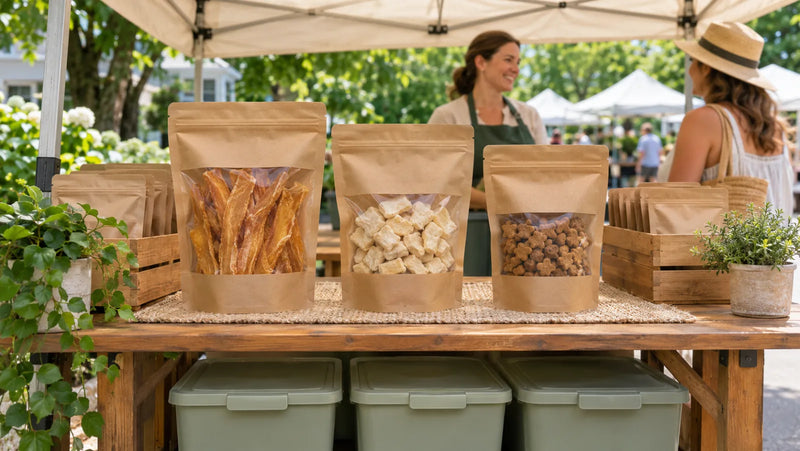
If the veterinarian has cleared chicken and an edible training reward, American Paws freeze-dried chicken breast labeled for dogs and cats is a boneless, single-ingredient option. Break a piece to fit the individual puppy and count it inside the daily treat allowance. It is food, not a teething device, dental treatment, or obstruction-proof toy.
The training-treat collection offers reward formats to compare by exact label, ingredient list, texture, and piece size. The broader American Paws dog-treat and cat-treat collection includes different formulas and formats, so evaluate each product separately rather than assuming the entire catalog has one ingredient or suits every puppy.
Frequently Asked Questions
Can an 8-week-old puppy chew a bone?
Do not give an eight-week-old puppy a cooked bone, and do not assume a raw bone is safe because the puppy is small or supervised. Ask the veterinarian for a teething or enrichment tool matched to that puppy's mouth, diet, and behavior.
Are cooked bones ever safe for puppies?
No cooked bone is recommended here. Animal source, size, cooking method, supervision, and removing marrow do not eliminate fracture, choking, lodging, obstruction, or tissue-injury risks.
Are raw bones safer than cooked bones for puppies?
Raw bones are not a safe default. They can still break teeth, injure the mouth, choke or obstruct, and expose pets and people to pathogens. Discuss the exact item and puppy with a veterinarian instead of substituting raw for cooked.
What should I do if my puppy swallowed a chicken bone?
Call the veterinarian or emergency clinic promptly even if the puppy looks normal. Go immediately for breathing trouble, collapse, repeated gagging or swallowing, heavy drooling, or severe pain. Report whether the bone was cooked, what appears missing, the timing, and all symptoms.
Should I make my puppy vomit after eating a bone?
No. Do not induce vomiting or give a home remedy unless a veterinary professional who assessed the exact case directs a specific action. A sharp or irregular object can cause additional injury on the way back up.
Can a large bone still choke or hurt a puppy?
Yes. A large bone can be hard enough to fracture a tooth, damage oral tissue, or shed a smaller piece that can be swallowed. Size alone does not establish safety.
How long after eating a bone can symptoms start?
There is no universal safe waiting period. Airway or esophageal signs may be apparent quickly, while digestive signs may emerge later. Call promptly after the ingestion and use the clinic's case-specific monitoring instructions.
What can a teething puppy chew instead?
Ask the veterinary team about a flexible, puppy-appropriate toy sized for the individual and supervise its use. Keep tiny edible training rewards separate from the chew tool, inspect toys for damage, and remove anything that begins to break apart.
Remove the Bone and Match the Alternative to the Job
The practical answer is consistent: no cooked bones for puppies, and no assumption that raw means safe. After any ingestion, call the veterinarian instead of waiting for a symptom or trying to force the bone through. Bring the most exact account possible of the object, recipe, missing amount, timing, and puppy's behavior.
Once the immediate question is resolved, choose one supervised tool for teething or enrichment and a separate tiny boneless food for training. That separation is easier to manage than asking one hard edible object to clean teeth, soothe gums, occupy the puppy, and deliver a reward at the same time.