Can cats eat raw chicken? The conservative veterinary answer is no. The American Veterinary Medical Association discourages feeding raw or undercooked animal-source protein to cats and dogs because pathogens can threaten both animal and human health. Cornell's Feline Health Center also does not recommend raw diets or raw meat treats for cats.
Raw chicken bones do not make the meal safer. They can damage teeth, lodge in the esophagus or intestine, and cause constipation or other injury. Commercial raw food can provide a label, lot code, storage directions, and sometimes a complete-and-balanced claim that kitchen chicken lacks, but “commercial,” “frozen,” “ground,” or “freeze-dried” does not automatically mean pathogen-free. Plain boneless chicken cooked to 165°F is the lower-risk home route.
Can Cats Eat Raw Chicken? The Veterinary Answer Is No
The current AVMA raw-diet policy discourages raw or undercooked meat, poultry, fish, egg, and other animal-source proteins for cats and dogs. Its concern is not that every piece contains a pathogen. The concern is that contamination can occur, illness can affect pets and people, and an apparently healthy animal may still carry organisms and expose others.
Cornell's Feline Health Center likewise does not recommend raw or gently cooked diets that may contain viable bacteria, viruses, or parasites. It also advises against raw meat as cat food or a treat because it can carry infectious disease.
That answer covers raw breast, thigh, wing, neck, skin, giblets, mince, trimmings, and raw chicken juice. A cat's status as an obligate carnivore means the cat needs animal-derived nutrients; it does not sterilize poultry or make one piece of muscle meat nutritionally complete. For the broader cooked-versus-treat question, use the parent guide on chicken for cats.
Salmonella and Listeria Can Reach the Cat and the Household
The AVMA policy names Salmonella species and Listeria monocytogenes among the pathogens that may contaminate raw or undercooked animal protein. Cats may develop foodborne illness, but a cat can also have a subclinical infection—infection without obvious illness—and still create risk for other animals and people.
In one official sampling project described by the FDA Center for Veterinary Medicine, laboratories tested 196 commercial raw dog and cat food samples. Fifteen were positive for Salmonella and 32 for L. monocytogenes. Those results demonstrate possible contamination; they do not predict that every package or every raw chicken piece is contaminated.
The exposure route can extend well beyond the bowl:
- Raw food contaminates hands, knives, counters, floors, bowls, or refrigerator surfaces.
- The cat contacts the food with the mouth, whiskers, paws, or coat.
- Organisms may move through saliva, contaminated surfaces, vomit, or feces.
- A person touches the cat, litter, bowl, floor, or preparation area and then touches the mouth or food.
Young children, older adults, pregnant people, and immunocompromised people face greater consequences from foodborne infection, but they are not the only people who can become sick. A cat that looks normal after eating raw chicken is not proof that the food or household stayed free of pathogens.
Watch the Cat Without Waiting for a “Raw Diet Illness” Pattern
Foodborne illness does not announce itself with one raw-chicken-specific symptom. Vomiting, diarrhea, reduced appetite, fever, lethargy, abdominal discomfort, or dehydration can have many causes. Contact the veterinary team when these signs follow a raw exposure, especially when they repeat, worsen, include blood, or occur in a kitten, senior, pregnant cat, or medically vulnerable cat.
Breathing difficulty, collapse, severe weakness, uncontrolled repeated vomiting or diarrhea, inability to keep water down, or suspected choking needs urgent or emergency veterinary care. A swallowed bone, absorbent meat pad, plastic wrap, string, skewer, or clip adds a separate foreign-object problem.
Give the veterinary team the cat's age and weight, the chicken form, estimated amount, time, bone and skin status, seasonings, package or lot information, and current signs. Do not start antibiotics, anti-diarrheals, human medication, force-feeding, or home-induced vomiting unless a veterinary professional gives case-specific instructions. If a person develops symptoms after handling raw food, contact a human healthcare professional.
Raw Chicken Bones Are Still Bones
The WSAVA cat-treat guide warns that both raw and cooked bones can cause significant damage when cats chew or ingest them. Raw bone may be less brittle than a cooked bone, but that does not make a wing, neck, rib, chopped bone, or fragment safe.
- Teeth can fracture. Hard bone can exceed what a tooth can tolerate.
- Pieces can lodge. A fragment can stick in the mouth, throat, esophagus, stomach, or intestine.
- Tissue can be injured. Pointed or irregular edges can scrape or puncture.
- Passage can fail. Bone can contribute to constipation or obstruction.
Grinding changes the shape but does not remove pathogens or automatically create the right calcium-to-phosphorus balance. A home guess at ground bone is not a complete feline formulation. Bones also are not a substitute for evidence-based dental care.
If a cat swallowed a raw chicken bone, do not induce vomiting or give bread, oil, or bulky food to “wrap” it. Call the veterinary team with the type and size of bone and watch only as directed. Gagging, drooling, repeated swallowing, pawing at the mouth, vomiting, pain, a tense abdomen, straining, blood, or loss of appetite warrants prompt assessment.
Commercial Raw and Kitchen Raw Are Not the Same—but Neither Is Automatically Safe
| Form | What it can document | What it does not prove |
|---|---|---|
| Kitchen raw chicken | Human-food package, cut, sell-by information, and ingredients if seasoned | Feline nutritional adequacy, pathogen control, cat feeding amount, or safe bone use |
| Commercial raw complete diet | Species/life-stage adequacy statement, ingredients, calories, lot/date, storage, feeding, and disclosed processing when provided | Zero pathogens, suitability for every cat, or safety for every household |
| Commercial raw topper or treat | Exact ingredients, calories, format, lot, and handling directions | Complete nutrition or permission to replace a meal |
| Plain cooked boneless chicken | Home control of temperature, bones, seasoning, and final piece size | Complete feline nutrition or a universal treat allowance |
A commercial product can be easier to audit than an unmeasured kitchen mixture. Look for the exact cat species and life stage, a nutritional-adequacy statement, whether the food is complete and balanced or only intermittent/supplemental, the full ingredient and bone list, calories, lot and date codes, storage instructions, and the company's description of any validated pathogen-reduction step.
The AVMA supports production methods that have been scientifically validated to reduce or eliminate illness from pathogenic contaminants. That is an evidence standard, not a blanket endorsement of a package labeled “raw.” If the manufacturer does not disclose the control or the label is unclear, ask directly and let the veterinarian evaluate the answer.

Freezing, Grinding, and Freeze-Drying Do Not Answer the Safety Question
Refrigeration and freezing control growth and storage time; they are not the same as a validated pathogen-kill step. Grinding changes the shape and can distribute surface material through a batch. Neither action makes raw chicken a complete cat food.
Freeze-drying removes water under cold or low-temperature conditions. The word describes a process family, but it does not by itself disclose whether the starting meat was raw, previously cooked, pasteurized, or treated by another scientifically validated method. Cornell notes that raw or gently cooked commercial diets can appear in fresh, frozen, or freeze-dried forms. In other words, some raw products are freeze-dried, but “freeze-dried” is not automatically a synonym for “raw.”
Read the exact label and product evidence. Do not assume that frozen means sterile, that ground means digestible, or that freeze-dried means raw, cooked, or pathogen-free.
A Veterinarian-Led Decision Starts With the Cat and the Home
Tell the veterinarian what the cat actually eats, including the exact raw product, toppers, treats, bones, supplements, and table food. Bring the label or product page. The decision needs to cover nutrition, pathogens, physical hazards, the cat's health, and who lives in the home.
Extra caution is needed for kittens, seniors, pregnant or nursing cats, cats taking immunosuppressive medication, cats with gastrointestinal disease or a weakened immune system, cats on therapeutic diets or food trials, and cats living with vulnerable people. In a multi-pet home, another animal can also contact the bowl, floor, feces, or leftover food.
If someone wants a home-prepared complete diet, ask for referral to a board-certified veterinary nutritionist. This guide does not provide a raw recipe, bone ratio, supplement list, or pathogen workaround. If a caregiver continues a commercial raw diet despite the guidance, the veterinarian should know the exact product and the household context; following its label can reduce handling mistakes, but cannot turn raw food into zero risk.
If Raw Food Is in the Home, Control the Contact Path
The AVMA pet-food handling guide notes that contamination is especially concerning with raw products and can cause serious illness in pets and people. Use these controls for an accidental exposure or for a household that continues to store raw pet food:
- Keep raw food sealed and separate from human food and ready-to-eat cat food.
- Thaw it in the refrigerator in a leakproof container, never on the counter.
- Do not rinse raw chicken in the sink, where splashes can spread contamination.
- Wash hands with soap and water for at least 20 seconds after handling food, bowls, utensils, spills, or litter.
- Use dedicated tools and clean and disinfect the preparation area, bowl, floor, and contacted surfaces.
- Do not let the cat lick faces or climb onto human food-prep surfaces after eating.
- Pick up leftovers promptly and follow the product's storage and discard directions.
Feces and litter belong in the control plan because an infected pet may shed organisms. A young, older, pregnant, or immunocompromised household member should not be assigned raw-food, contaminated-bowl, or litter cleanup.
What to Do If a Cat Ate Raw Chicken
| Exposure | Immediate action | Veterinary handoff |
|---|---|---|
| Tiny fresh boneless unseasoned bite, cat normal | Remove the rest, clean the area, record amount and time | Call the regular veterinary team for cat-specific monitoring advice |
| Raw wing, neck, or bone fragment | Do not induce vomiting or give a padding meal | Call promptly; emergency care for choking, breathing trouble, collapse, severe pain, or repeated vomiting |
| Spoiled, unknown, or long-unrefrigerated chicken | Save source details and block further access | Call promptly because the contamination context is less controlled |
| Seasoned or marinated raw chicken | Keep the ingredient label or recipe | Call with salt, onion, garlic, sweetener, alcohol, skewer, and package details |
| Absorbent pad, plastic, string, clip, or wrapper involved | Do not pull visible string or induce vomiting | Contact a veterinarian promptly for foreign-object guidance |
| Commercial raw food | Save package, lot, date, storage history, and amount | Call the veterinarian and check current manufacturer/FDA notices |
| Vomiting, diarrhea, feverish behavior, lethargy, pain, or appetite loss | Separate the cat from food-prep areas and clean contamination | Seek same-day or urgent advice based on severity |
One tiny bite is not proof that illness will occur, and it is not a reason to wait through serious signs. The proportionate response is to preserve the facts, clean the contact path, and let the veterinary team set the monitoring or examination plan.
Cooked Boneless Chicken Is the Lower-Risk Home Option
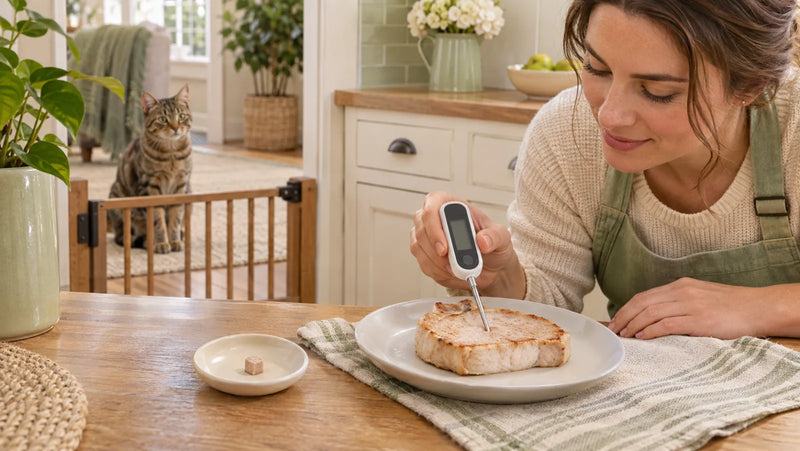
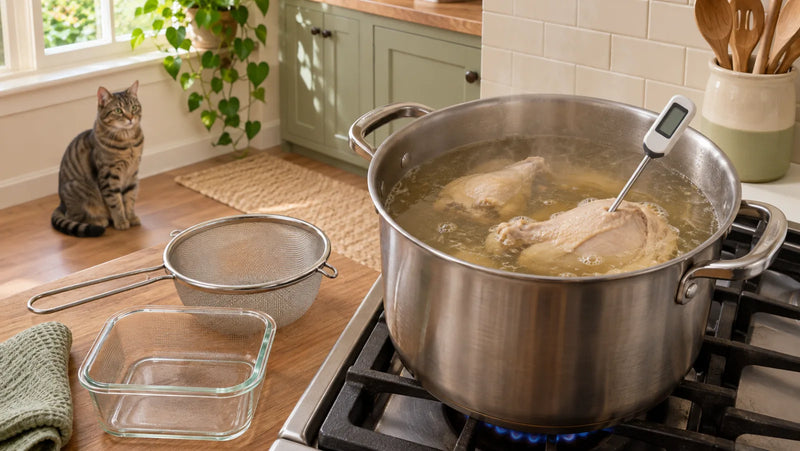
When chicken fits the cat's veterinary plan, use a small boneless, skinless portion, keep raw tools separate, and verify 165°F in the thickest center. The dedicated guide to cooking chicken for cats covers the full no-rinse, bake-or-simmer, thermometer, cooling, fine-shredding, and storage method.
Plain cooked chicken is still a treat or topper, not complete cat food. The best cat treats guide helps compare species labeling, calories, texture, and medical fit. If the question is liver rather than breast meat, use the separate method for cooking chicken liver for cats; liver is nutrient-concentrated, remains occasional, and is not interchangeable with breast.
The dog-side household risk overlaps, but dog exposure and dog bone questions have their own owner. Use can dogs eat raw chicken rather than transferring a cat response plan to a dog.
The Current American Paws Freeze-Dried Chicken Is Not Labeled Raw
The current American Paws Freeze-Dried Chicken Training Treats for Cats & Dogs page lists 100% USA chicken breast, freeze-dried whole at low temperatures with nothing added. Its public specifications describe a crunchy and light All Life Stages training treat, approximately 5 kcal per piece, in a 4 oz package. The feeding statement says it is intended for intermittent or supplemental feeding only.
The page does not label the product “raw,” and it does not publish a validated pathogen-reduction claim. Do not invent either answer. “Freeze-dried” describes the stated process; it is not automatic proof that a product is raw, cooked, pasteurized, sterile, or complete nutrition.
Read the current label as written, use clean hands, keep the package dry and resealed, and ask the veterinarian whether the exact treat fits the cat. You can compare other current American Paws cat treats and products, but the catalog is not blanket approval for every cat or diet.
Frequently Asked Questions
Can a cat eat one small piece of raw chicken?
A small bite may not cause illness, but raw chicken is not recommended. Remove the rest, clean contacted surfaces, note the amount and time, and call the veterinary team for monitoring advice. Bone, seasoning, spoiled meat, packaging, or symptoms raises the urgency.
Can cats get Salmonella from raw chicken?
Yes. Raw poultry can carry Salmonella, and cats can become ill or have an infection without obvious signs. Contaminated food, bowls, paws, surfaces, and feces can also expose people and other animals.
Can cats get Listeria from raw chicken?
Listeria monocytogenes is one of the pathogens the AVMA identifies in contaminated raw or undercooked animal protein. FDA testing has found it in commercial raw pet food samples. Risk extends to the animal and the people handling food or contaminated surfaces.
Are raw chicken bones safe for cats?
No raw-bone serving is recommended here. Raw bones can fracture teeth, lodge, obstruct, constipate, or injure tissue. Call a veterinarian after ingestion and seek emergency care for choking, breathing trouble, collapse, severe pain, or repeated vomiting.
Does freezing raw chicken kill bacteria?
Do not treat household freezing as sterilization or a validated pathogen-kill step. It helps store food and slows growth, but the raw chicken still needs controlled handling and cooking to 165°F for the lower-risk home route.
Is commercial raw cat food safer than kitchen raw chicken?
A commercial product can provide nutritional-adequacy, ingredient, calorie, lot, storage, and processing records that kitchen scraps lack. That improves auditability, not a guarantee of zero pathogens or suitability. Review the exact evidence with the veterinarian.
Is freeze-dried chicken raw?
Not necessarily. Some raw diets are sold freeze-dried, while another freeze-dried product may start with cooked or otherwise treated meat. The word alone does not disclose starting state or pathogen control. Read the exact label and ask the manufacturer when it is unclear.
Can kittens eat raw chicken?
Raw chicken is not recommended for kittens. Kittens need complete-and-balanced growth nutrition and have less reserve when illness or nutrient imbalance occurs. Ask the veterinarian before adding any chicken treat, and use a plain fully cooked boneless method when chicken is permitted.
Should I make my cat vomit after eating raw chicken?
No. Do not induce vomiting unless a veterinarian specifically directs it for that cat and exposure. Bones and foreign objects can add injury risk on the way back up, and common home methods can cause harm.
Choose Cooked Boneless Chicken and Keep Raw Risk Out of the Bowl
The practical answer is straightforward: AVMA and Cornell advise against raw chicken for cats; Salmonella and Listeria can involve the cat and household; a normal-looking cat does not prove there was no exposure; and raw bones remain physical hazards. A commercial label can supply better records than a kitchen scrap, but it cannot turn a category name into proof of safety.
Use the cooked-chicken guide for the plain boneless 165°F method, keep complete cat food in charge, and ask the veterinarian to review the exact cat, product, and household. For a packaged treat, read the current freeze-dried chicken page exactly as written rather than assuming the process word means raw, cooked, or sterile.