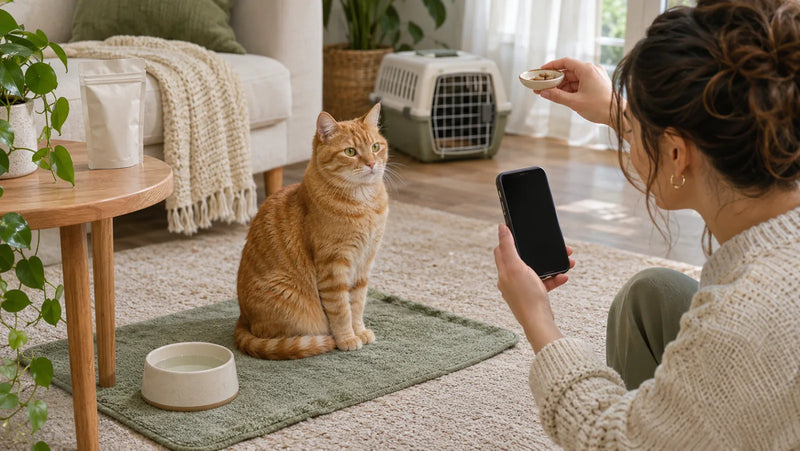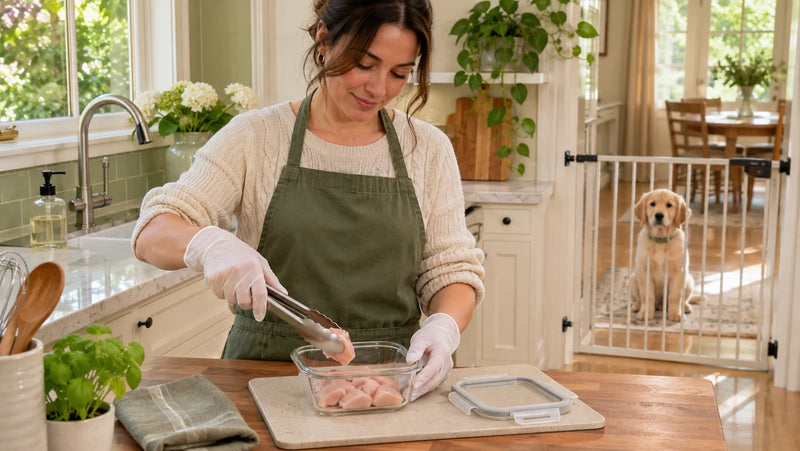

To learn how to cook fish for cats, start with a plain boneless fillet of cod, tilapia or pollock: bake, poach or steam it until the thickest part reaches 145°F, cool it on a clean plate, remove the skin and inspect every flake for bones. If the cat's veterinarian has cleared that fish, offer one tiny flake as an occasional first taste—not a bowlful and not a replacement for complete cat food.
Set the cat's portion aside before oil, butter, salt, broth, lemon, garlic, onion, herbs, breading or sauce touches the family meal. “Whitefish” is a cooking description, not a guarantee that every species suits every cat. Kittens, cats on prescription diets and cats with medical conditions, weight plans or suspected food reactions need an individual veterinary decision before trying a new protein.
This method covers plain fillets of mild white fish. Salmon has a different texture and fat profile, so use the separate salmon cooking method for cats. Canned tuna and sardines add questions about packing liquid, sodium, species and frequency; those belong in the tuna safety guide for cats and sardine safety guide for cats.
How to Cook Fish for Cats in Seven Controlled Steps
- Confirm the fish and the cat. Choose one identifiable, unseasoned fillet and ask the veterinarian before feeding it to a kitten or a cat with a special diet or health concern.
- Thaw it cold. Thaw frozen fish in the refrigerator on a rimmed plate, separated from cooked and ready-to-eat food.
- Reserve the plain portion. Cut the cat's piece before preparing the household recipe. Add no fat, salt, broth, seasoning, batter or garnish.
- Bake, poach or steam. Use clean equipment and a gentle plain-water or dry-heat method.
- Verify 145°F. Place a food thermometer in the thickest flesh; do not use a timer or surface color as the only test.
- Cool, skin and debone twice. Transfer to a clean plate, remove skin and visible bones, then feel each flake again.
- Offer one tiny taste. Keep complete cat food in charge, count the flake with all other extras and store the remainder promptly.
Each control solves a separate problem. A fillet can be fully cooked and still contain a sharp bone. A boneless piece can still be unsuitable because it was seasoned, held too warm or offered to a cat whose diet excludes that protein. The safe sequence is selection, separation, cooking, measurement, clean transfer, bone inspection and portion control.
Choose Plain Cod, Tilapia or Pollock
Buy a fillet whose species and ingredient statement are clear. Plain fresh or properly frozen cod, tilapia and pollock are practical examples because their pale flesh makes seasoning, skin and bone checks visible. Choose a piece with an intact package, a reliable cold-storage history and no marinade, smoke treatment, brine, breading or sauce.
“Boneless” lowers the chance of finding a large bone; it does not eliminate pin bones or fragments. Plan to inspect the cooked fish twice. Skin-on fish can be cooked, but remove the skin before flaking so the flesh is exposed for inspection and the first taste stays simple.
Do not use a restaurant leftover, a seasoned frozen entrée, fish sticks, imitation seafood or an unlabeled freezer piece. If fresh fish smells sour, rancid, strongly fishy or ammonia-like, the FDA advises against eating it. Cooking is not a way to rescue seafood with an uncertain identity, damaged package or questionable time and temperature history.
Thaw Fish in the Refrigerator and Prevent Cross-Contamination
The FDA's guidance on selecting and serving fresh and frozen seafood safely recommends gradual thawing in the refrigerator. Keep the wrapped fillet in a container low in the refrigerator so liquid cannot drip onto complete cat food, produce or another ready-to-eat item.
Keep the cat away from the preparation area. Use a dedicated raw-seafood plate, board and knife, wash hands with soap and water, and clean the sink and work surfaces after preparation. Never move cooked fish back to the plate that held it raw. The serving plate, thermometer probe and flaking utensils should be clean before they touch the finished piece.
If quick thawing is necessary, follow the package and FDA directions for cold-water or microwave thawing and cook the fish immediately afterward. Do not leave it on the counter to drift through room temperature. Avoid washing raw fish in the sink, where splashes can move contamination to nearby surfaces without making the fillet safer.
Method 1 — Bake Whitefish Plain
- Heat the oven to 375°F and prepare a small clean baking dish or plain parchment.
- Place the unseasoned fillet in one layer. Add no oil, butter, spray, salt, pepper, lemon, garlic, onion or herbs.
- Bake until a thermometer inserted into the thickest flesh reads 145°F.
- Check a second thick area when the fillet has uneven ends, then transfer the fish with a clean utensil to a clean plate.
There is no dependable universal baking time. A thin tilapia fillet and a thick cod loin heat differently, and the starting temperature, dish and oven also matter. Begin checking before the fish dries out, but let the thermometer—not the clock—decide when it is done.
Method 2 — Poach or Steam Without Broth
For poaching, place the plain fillet in a small pan with enough water to surround it and bring the water to a gentle simmer. Avoid a hard boil that breaks the flesh apart before the center can be measured. Add no stock cube, broth, milk, salt, oil, aromatics or seasoning. Turn the piece only if needed for even heating and verify 145°F in its thickest part.
For steaming, put the fillet in a clean steamer above plain simmering water, cover and cook until the thickest flesh reaches 145°F. Open the lid away from the face and hands because the escaping steam can burn. Move the fish to a clean plate with a clean utensil.
Poaching water and liquid collected below a steamer are not complete cat food or a necessary “fish broth.” They may contain cooking juices, but they share the fish's storage history and do not need to be poured over the cat's meal. Discard them unless the cat's veterinarian has provided a specific use.
Measure 145°F in the Thickest Part
The federal safe minimum internal temperature chart lists 145°F for fish such as cod, tilapia and pollock. Insert the thermometer probe into the center of the thickest flesh. For a thin fillet, slide the probe in from the side so the sensing area stays inside the fish instead of touching the pan.
Avoid a gap, bone or hot dish surface, all of which can distort the reading. Opaque flesh that separates with a fork is a useful visual clue, but it is not as precise as measuring the center. Clean the probe according to its instructions before and after use.
Write down a successful time only as a reminder of when to begin checking a similar piece next time. It is not a guarantee. Species, thickness, equipment and starting temperature can change from one fillet to the next.

Cool, Remove the Skin and Check Every Flake for Bones
Put the fully cooked fish on a clean plate and let it cool until it is comfortable to handle. Remove the skin in one piece where possible and place it in a discard dish. Run clean fingertips slowly over both surfaces, along the center and around every edge. Lift any firm point with clean fish tweezers and discard it.
Next, separate the flesh across its natural layers into very small flakes. Feel each flake a second time. Discard every sharp, hard or uncertain fragment rather than trying to crush it. Do not blend the fillet first; a blender can hide a fragment instead of removing it.
The World Small Animal Veterinary Association's treat guidance for cats warns that raw and cooked bones can cause serious injury. “Cooked,” “whitefish” and “boneless fillet” do not cancel the physical hazard of a missed bone.
Offer One Tiny Flake Beside Complete Cat Food
For a veterinarian-cleared adult cat trying this fish for the first time, one tiny cooled flake is enough. Place it separately or beside the normal meal so the cat's complete food remains recognizable. Watch the cat eat; do not offer a strip that encourages gulping and do not keep adding flakes because the first one disappeared quickly.
One flake is a cautious introduction, not a universal serving size. WSAVA recommends keeping treats at no more than 10% of a cat's daily calories, with at least 90% coming from complete and balanced food. Fish shares that extras budget with every other treat and topper. The veterinarian should set the actual calorie plan for a kitten, senior, underweight or overweight cat, or any cat with a medical condition.
Stop the new food and contact the veterinarian if the cat develops vomiting, diarrhea, marked itching, swelling, coughing, gagging, repeated swallowing, pawing at the mouth, lethargy, breathing trouble or another concerning change. A suspected bone or airway problem needs direct professional help, not bread, oil, more food or an attempt to push the fragment through.
For the broader calorie decision, use the guide to how many treats a cat can have per day. It explains why the 10% ceiling is a boundary rather than a feeding target and why the cat's complete diet remains the nutritional foundation.
Raw Freshwater Fish Is Not a Shortcut
Raw fish adds microbiological and nutritional hazards rather than preserving a special benefit for the cat. WSAVA advises that raw animal-based treats can carry pathogens and can expose both pets and people through handling and environmental contamination. Freezing does not make a home raw-fish routine equivalent to validated cooking.
The Merck Veterinary Manual's small-animal nutrition reference notes that thiaminases occur in raw freshwater fish and clams and that cooking destroys the enzyme. That statement is specific: it does not mean every fish contains thiaminase, and it does not turn cooked fish into a complete home diet.
Do not use a fish-only menu or copy a human seafood pattern for a cat. Cats need a complete balance of amino acids, fatty acids, vitamins and minerals that a plain fillet alone does not provide. A home-prepared primary diet should be formulated for the individual cat by a board-certified veterinary nutritionist.
Refrigerate Promptly or Freeze Tiny Portions
After cooking, cooling and deboning, divide the fish with clean utensils into covered, single-use containers. Mark the species and date so it cannot be confused with seasoned family food. Refrigerate the batch within two hours, or within one hour when the surrounding temperature is above 90°F.
Keep the refrigerator at 40°F or below. USDA food-safety guidance gives cooked leftovers a general three-to-four-day refrigerated window; use that as a ceiling, not a promise that every mishandled piece remains safe. Freeze portions that will not be used promptly instead of repeatedly warming and cooling one container.
Thaw one portion in the refrigerator and serve it cool or gently brought to a comfortable temperature with no seasoning. Discard fish left out too long, any flake that touched the cat's saliva and any container with an uncertain date, damaged seal, off odor or changed surface.
Keep Salmon, Tuna, Sardines and Dog Portions in Their Own Lanes
Salmon should follow its own plain cooking and deboning method. Tuna questions depend on whether the product is fresh, canned in water, canned in oil or formulated as complete cat food. Sardines bring their own packing-liquid, sodium and bone questions. Moving from cod to one of those foods is a new ingredient decision, not a one-for-one recipe substitution.
A dog in the same household needs a dog-specific decision. The fish safety guide for dogs covers dog portions, forms and hazards. Do not enlarge a cat flake into a dog serving or shrink dog guidance and assume it fits a cat.
If fish is unavailable or unsuitable, plain chicken is also a separate protein decision. The chicken cooking method for cats uses a poultry-specific temperature and preparation sequence; it should not be cooked to the fish endpoint or offered to a cat whose diet excludes chicken.
American Paws Does Not Make a Fish Treat
American Paws does not make a fish treat. For a cat whose veterinarian has cleared chicken, the current freeze-dried chicken breast labeled for dogs and cats is a different protein in a ready-to-use form. Its current product page lists 100% USA chicken breast and no additives.
Chicken is not a fish substitute for a cat avoiding chicken, and the product does not treat a reaction or replace a prescription diet. Read the exact label and feeding directions, break an appropriate cat treat into a manageable piece and count it within the same extras budget. The guide to choosing cat treats helps compare ingredient evidence, texture and intended use without assuming every cat needs the same option.
Browse current American Paws dog treats and cat treats by their live labels. Product availability and claims should come from the current page, while the cat's veterinary and calorie decisions stay with the veterinary team.
Frequently Asked Questions
What kind of fish can I cook for my cat?
A plain, identifiable, properly stored fillet of cod, tilapia or pollock can be a practical occasional option for a veterinarian-cleared cat. Choose no marinade, brine, breading, smoke treatment or seasoning, and inspect every cooked flake for bones.
What temperature should fish reach for cats?
Cook finfish to 145°F in the thickest part. Insert a food thermometer from the side for a thin fillet, avoid touching the pan and check a second thick area when the piece is uneven.
Is baked, poached or steamed fish better for cats?
Any of the three can work when the fish stays completely plain, reaches 145°F and moves to clean equipment afterward. Choose the method that makes temperature measurement, separation and deboning easiest in the kitchen.
How long should I bake fish for a cat?
Use time only to decide when to begin checking. Species, thickness, starting temperature, dish and oven calibration change the answer. At 375°F, remove the fillet only after its thickest center measures 145°F.
Can I use frozen fish?
Yes, when it is a plain identifiable fillet with an intact package and reliable storage history. Thaw it in the refrigerator on a contained plate, then cook it promptly and verify 145°F.
Should I remove fish skin for a cat?
Remove it for this simple first-taste method. Taking off the skin exposes the flesh for a careful bone check and keeps the occasional portion consistent.
How much cooked fish can a cat try?
Begin with one tiny flake for an eligible veterinarian-cleared adult cat. That is a conservative introduction, not a daily allowance. Count fish with every other treat and topper inside the cat's individual extras budget.
Can cooked fish replace a cat's regular food?
No. A plain fillet is not a complete and balanced cat diet. Keep complete cat food in charge and consult a board-certified veterinary nutritionist before considering a home-prepared primary diet.
How long can cooked fish stay in the refrigerator?
Chill it promptly in a clean covered container and use a conservative three-to-four-day ceiling. Freeze tiny single-use portions that will not be used in that window, and discard anything with uncertain time, temperature, odor, surface or packaging.
Cook Plain, Verify the Center and Debone Every Flake
The dependable sequence is short: choose one plain identifiable fillet, thaw it cold, separate it from ready-to-eat food, bake, poach or steam it without additions, verify 145°F, cool on a clean plate, remove the skin and inspect every flake twice. Offer one tiny veterinarian-cleared taste, refrigerate the rest promptly and let complete cat food continue doing the nutritional work.