To learn how to cook salmon for cats, begin with one plain boneless portion: bake or poach it until the thickest flesh reaches 145°F, cool it on a clean plate, remove the skin, and inspect twice for pin bones. Flake the fish across the fibers and offer only one or two tiny pieces as a first veterinarian-cleared taste.
Prepare the cat's portion before salt, oil, butter, sauce, lemon, garlic, onion, herbs or another part of the family recipe touches the fish. Cooked salmon is an occasional extra, not complete cat food and not a reason to change a medical or prescription diet. If the veterinarian has not cleared salmon for this cat, stop before the kitchen step.
The method below is for plain fresh or safely thawed salmon. For questions about raw fish, smoked salmon, canned products, skin, bone ingestion or an accidental exposure, use the separate cat salmon safety guide.
How to Cook Salmon for Cats in Eight Controlled Steps
- Clear the cat first. Ask the veterinarian before offering salmon to a kitten, a cat on a prescription diet, or a cat with a food sensitivity, weight plan or medical condition.
- Reserve one plain portion. Use an unseasoned fillet and separate the cat's piece before preparing the family meal.
- Thaw and separate safely. Thaw in the refrigerator and keep raw seafood away from cooked food, the cat and ready-to-eat surfaces.
- Bake or poach without additions. Use a clean dish or plain water—no broth, fat, seasoning or garnish.
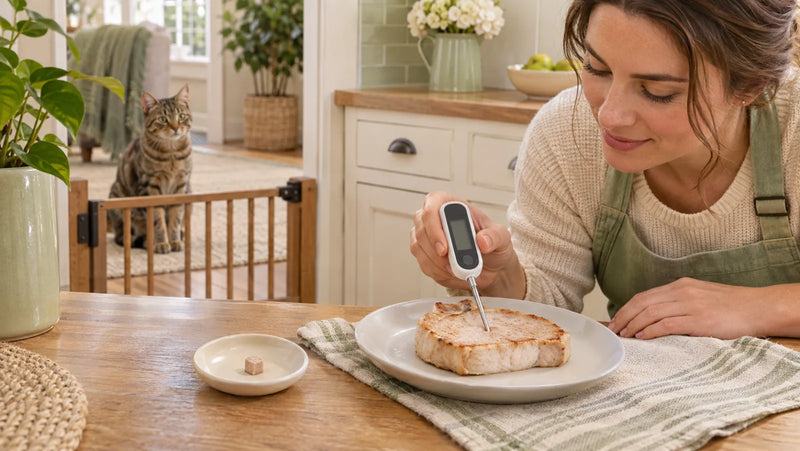
- Verify 145°F. Measure the thickest flesh with a food thermometer; do not rely on color or a timer alone.
- Cool on clean equipment. Move the cooked fish to a clean plate and let it cool until comfortable to handle.
- Remove skin and debone twice. Feel along the pin-bone line, then inspect again while flaking.
- Serve tiny and store promptly. Offer one or two small flakes and refrigerate or freeze the rest in single-use portions.
The steps are intentionally separate. Reaching 145°F does not remove a pin bone. Finding no bone does not make a seasoned or medically unsuitable serving appropriate. A safe kitchen process requires the right cat, plain fish, complete cooking, a clean transfer, two-pass deboning and a measured extra.
Start With a Plain Boneless Salmon Fillet
Choose a fresh or properly frozen salmon fillet with no marinade, glaze, brine, smoke treatment or added seasoning. A center-cut piece of reasonably even thickness is easier to measure than a very thin tail with one thick edge. “Boneless” is useful purchasing language, but it is not permission to skip the pin-bone check.
Before the household recipe begins, cut off only the amount needed for the cat batch using a clean knife and board. Put that portion in its own dish. Once salt, sauce, oil, butter, onion, garlic, citrus or seasoning has touched the fish, do not try to rinse or scrape it back into a cat portion.
Skin can make the final piece richer and can hide the surface that needs inspection, so remove it after cooking when it separates cleanly. Do not use loose trimmings, unknown restaurant leftovers or a package whose storage history is uncertain. If the fish smells sour, rancid, strongly fishy or ammonia-like, discard it rather than cooking it for a pet.
Thaw in the Refrigerator and Separate Raw Seafood
The FDA's guidance on selecting and serving seafood safely recommends gradual refrigerator thawing and keeping raw seafood away from cooked or ready-to-eat food. Place the wrapped fillet on a rimmed plate or in a container low in the refrigerator so liquid cannot drip onto another food.
Keep the cat out of the preparation area. Use a raw-seafood board, knife and plate, then wash hands, utensils and surfaces with hot soapy water before handling the cooked portion. Do not put cooked salmon back on the plate that held it raw. The same raw-protein controls matter elsewhere in the kitchen; our raw-chicken safety guide for cats and the household explains why a cat's access can also spread contamination beyond the bowl.
There is no benefit to splashing sink water over the salmon. Keep the fish chilled until the cooking equipment is ready, and cook it promptly after a cold-water or microwave thaw. Refrigerator thawing is the easiest method when the goal is a controlled cat portion.
Method 1 — Bake Salmon Plain
- Heat the oven to 350°F.
- Place the plain salmon portion in a small clean baking dish or on plain parchment. Add no oil, butter, salt, pepper, herbs, garlic, onion, lemon or sauce.
- Keep the piece in one layer. If one end is much thinner, position the thermometer check in the thickest center rather than judging the whole piece by the tail.
- Bake until the center reaches 145°F. Begin checking early enough to avoid drying the fish; thickness and starting temperature determine the time.
- Move the fish with a clean utensil to a clean plate. Do not return it to the raw dish.
A parchment packet can reduce surface drying, but it is optional. It must contain only the fish. Opening the packet carefully prevents hot steam from contacting the hand, and the thermometer still needs to reach the thickest flesh before the fish is considered done.
Method 2 — Poach Salmon in Plain Water
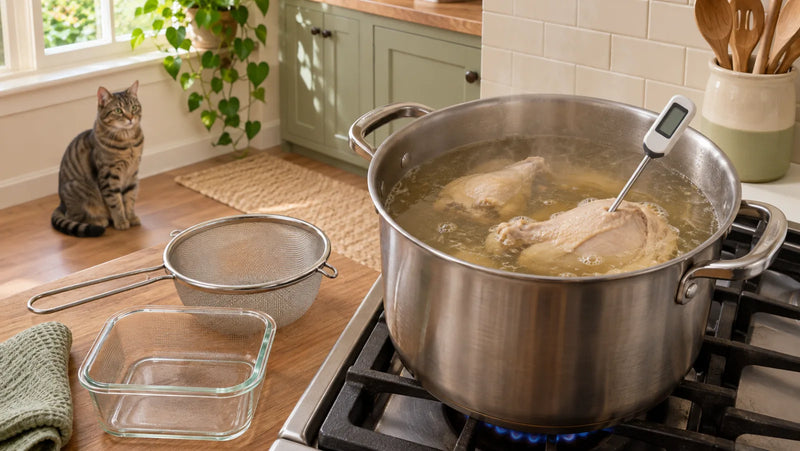
- Place the plain portion in a small pan and add enough water to surround it without filling a large pot.
- Bring the water to a gentle simmer. A hard rolling boil can break the fish apart before the center is checked.
- Keep the pan plain: no broth, stock cube, milk, salt, oil, aromatics, onion, garlic or herbs.
- Turn the piece once only if needed for even heat, using a clean utensil.
- Check the thickest center and continue cooking until it reaches 145°F.
- Lift the salmon onto a clean plate and allow it to cool.
The poaching liquid is not automatically cat broth. It contains cooking juices but is not complete nutrition, and its safety depends on the same handling and storage history as the fish. Discard it unless the cat's veterinarian has given a specific reason and method for using it.
Verify 145°F in the Thickest Flesh
The FDA's safe food handling chart lists 145°F for finfish as measured with a food thermometer. Insert the probe into the center of the thickest part. For a thin portion, enter from the side so more of the sensing area stays inside the flesh.
Do not let the probe touch the hot pan, baking dish or a gap under the fish; those contacts can make the reading misleading. Check a second thick area if the fillet is uneven. Opaque flesh that separates with a fork is a useful visual sign, but temperature is the clearer endpoint when a thermometer can be used.
There is no single correct baking or poaching time. A cold thick center, a thin tail, oven calibration, pan material and portion size all change the clock. Record the successful time for that method only as a planning reference; confirm the next batch again with the thermometer.

Cool, Remove Skin, and Debone Twice
Move the cooked salmon to a clean plate and let it cool until it is safe to handle. Warm is different from hot: test a flake with clean fingers before it comes near the cat. Remove the skin in one sheet when possible and set it in a discard dish so it cannot be mixed back into the serving portion.
For the first bone pass, run clean fingertips slowly along the line where pin bones are commonly found. Feel against the direction of the flesh, lift any firm point with clean fish tweezers and discard it. Inspect the cavity and edges as well as the center line.
For the second pass, separate the salmon into small flakes on a clean plate. Look and feel again as each flake opens. Discard every hard, sharp or uncertain fragment. The WSAVA guide to treats for cats warns that cooked and raw bones can cause significant harm, which is why a “boneless” label does not replace inspection.
Do not blend the fish into a paste before checking it. Blending can hide a fragment instead of removing it. Debone first, then make the final pieces small enough for the cat to lick up or chew without taking a long strip.
Flake Small and Serve One or Two Tiny Pieces
For an eligible adult cat trying salmon for the first time, one or two tiny flakes are enough to test acceptance. Think of pieces smaller than a fingernail, not a salmon “serving.” This is a conservative first taste, not a universal allowance, daily schedule, recipe or maximum.
Offer the flake separately or place it beside the normal meal so the complete food remains recognizable. Do not replace a meal with salmon, and do not keep adding fish because the cat asks for more. The Cornell Feline Health Center's cat-feeding guidance explains that treats are usually not complete and balanced and should remain occasional.
WSAVA recommends that treats stay within no more than 10% of a cat's daily calories. Salmon shares that budget with every other extra; it does not receive a separate allowance. A veterinarian should set the cat's actual calorie plan, especially for a kitten, an older cat, a cat with a medical condition, a cat on a prescription diet or a cat whose weight is being managed.
Watch while the cat eats. Stop and contact a veterinarian if there is coughing, gagging, repeated swallowing, pawing at the mouth, vomiting, diarrhea, marked lethargy, breathing difficulty or other distress. A suspected bone or airway problem needs direct professional guidance rather than another piece of food or a home maneuver.
Refrigerate Promptly or Freeze Single-Use Portions
Divide the fully cooked, cooled and deboned salmon with clean utensils. Put only a few one-use flakes in each clean covered container. Mark the plain batch and date so it cannot be confused with seasoned family salmon. Refrigerate or freeze within two hours of cooking, or within one hour when the surrounding temperature is above 90°F, following FDA seafood guidance.
Keep the refrigerator at 40°F or below. FoodSafety.gov advises eating leftovers within three to four days; use that conservative ceiling for refrigerated cooked salmon. If the batch will not be used in that window, freeze tiny single-use portions instead of repeatedly warming and cooling one large container.
Thaw one portion in the refrigerator and serve it cool or gently brought to a comfortable temperature without seasoning. Discard food left warm too long, food that touched the cat's saliva and any portion with an uncertain storage history, off odor, surface change or damaged container.
Keep Raw, Smoked, Canned, and Dog-Side Salmon Separate
Plain cooked salmon is only one form. The cat safety guide covers raw and undercooked fish, smoked or cured salmon, brine, human canned products, skin and accidental bone exposures. Use that decision before changing the ingredient or package; a cooking method cannot turn a salty smoked slice or seasoned leftover into the plain fillet described here.
A household dog needs its own portion and rules. Use the separate salmon-cooking method for dogs for dog-size preparation and serving decisions, and the broad fish-safety guide for dogs for species, bones and other fish forms. Do not scale a cat flake into a dog portion or apply a dog table back to the cat.
If salmon is not available, switching to turkey or chicken is a new ingredient decision, not a substitution formula. The plain turkey-cooking method for cats uses a poultry-specific endpoint, while the plain cat cooking guide for chicken handles chicken selection, cooking and fiber size. Each food keeps its own temperature and preparation controls.
American Paws Does Not Make a Fish Treat
American Paws does not make salmon or another fish treat. For a cat whose veterinarian has cleared chicken, the current single-ingredient freeze-dried chicken breast labeled for dogs and cats is a different protein and a ready-to-use format. Its live page lists 100% USA chicken breast and no additives.
Chicken is not a fish equivalent and does not fit a cat avoiding chicken. Read the exact product label and feeding information, keep it inside the same extras budget and preserve complete cat food as the diet foundation. It has no role in treating a reaction to salmon or replacing a veterinary diet.
Owners can compare current American Paws cat treats and dog treats one label at a time. Our guide to choosing cat treats by label, texture and calorie evidence helps match a product to the cat's mouth, intended use and existing nutrition plan.
Frequently Asked Questions
What is the safest way to cook salmon for a cat?
Reserve a plain boneless portion before seasoning, bake or poach it until the thickest flesh reaches 145°F, move it to a clean plate, cool it, remove the skin, inspect twice for pin bones and flake it small. Offer only a tiny veterinarian-cleared taste beside complete cat food.
What temperature should salmon reach for cats?
Measure 145°F in the thickest flesh with a food thermometer. Enter from the side for a thin fillet, avoid touching the pan and check a second thick area if the piece is uneven.
Is baked or poached salmon better for cats?
Either method can produce plain salmon when no oil, butter, salt, broth or seasoning is added and the fish reaches 145°F. Baking is tidy; poaching can keep a small portion moist. Choose the method that makes temperature and cross-contamination control easiest in the kitchen.
How long should I bake salmon for a cat?
Use time only to plan when to check. Thickness, starting temperature, oven accuracy and portion size change the answer. Bake at 350°F and remove the fish only after the thickest center reaches 145°F.
Should I remove salmon skin for a cat?
Yes for this simple first-taste method. Removing the skin makes the portion more consistent and exposes the flesh for a careful bone check. Put the removed skin in a discard dish so it cannot be mixed back into the flakes.
How do I find pin bones in cooked salmon?
Run clean fingertips slowly along the bone line and edges, lift every firm point with clean fish tweezers, then inspect again as the fish is separated into flakes. Discard every hard, sharp or uncertain fragment.
How much cooked salmon can a cat try?
For a veterinarian-cleared adult cat, begin with one or two tiny flakes. That is a cautious first taste, not a daily allowance. Count salmon with all other treats inside the cat's veterinarian-set extras budget.
Can cooked salmon replace cat food?
No. Plain salmon is not a complete and balanced cat diet. Keep the cat's normal complete food in charge, and use a veterinary nutritionist for any home-formulated diet.
How long can cooked salmon stay refrigerated?
Refrigerate the cooled fish promptly in a clean covered container and use a conservative three-to-four-day ceiling. Freeze tiny single-use portions that will not be used promptly, and discard anything with uncertain time, temperature, odor, appearance or container integrity.
Cook Plain, Verify, Debone, and Keep the Portion Tiny
The reliable sequence is simple: clear the cat with the veterinarian, reserve an unseasoned fillet, thaw it cold, bake or poach it plain, verify 145°F, cool on clean equipment, remove the skin, debone twice and flake only one or two tiny pieces. Store the remainder in dated single-use portions, and let complete cat food continue doing the nutritional work.