How to cook carrots for dogs: wash and trim fresh carrots, cut them into uniform pieces, then steam for about 6–10 minutes, gently boil for about 8–12 minutes, or roast plain at 425°F for about 20–30 minutes. Add no salt, oil, butter, broth, sweetener, onion, garlic, or seasoning. Stop when a fork passes through easily, cool the carrots completely, and cut them again for the individual dog's mouth and eating style.
Those times are planning ranges, not a doneness guarantee. Thin coins cook sooner than thick chunks; carrot age, batch size, pan crowding, equipment, and oven performance change the clock. The useful endpoint is a soft piece you can pierce and mash with a fork, without a hard center or dry sharp edge.
This guide owns the kitchen process. The broader carrot safety and nutrition guide for dogs explains which dogs may have carrots and how raw, canned, mixed, and cooked forms differ. The frozen-carrot guide separately handles hardness, teeth, teething, and chewing decisions.
How to Cook Carrots for Dogs: Three Plain Methods
| Method | Prep cut | Planning time | Done when |
|---|---|---|---|
| Steam | About 1/4-inch coins or half-moons | 6–10 minutes after steam is active | Fork passes through easily and the center mashes |
| Boil or simmer | About 1/4-inch coins, half-moons, or small dice | 8–12 minutes at a gentle boil | No firm core; drain promptly |
| Roast plain | Roughly 1/2-inch even pieces | 20–30 minutes at 425°F; turn once | Soft throughout, with no burnt or hard-dried edge |
The prep cut helps the batch cook evenly. It is not automatically the final serving cut. After cooking and cooling, a round coin may need to be quartered, finely diced, or mashed so it fits the dog rather than the saucepan.
Before You Cook: Wash, Trim, and Separate
Choose firm fresh carrots without slime, rot, or deep damaged areas. Remove the green top and thin root tip. Peeling is optional for a sound carrot, but washing is not. The FDA's produce-safety guidance says to rinse produce thoroughly under running water before preparing it—even when it will be peeled—and not to use soap, detergent, or commercial produce wash. Rub the surface with clean hands or a clean produce brush, then dry it.
Use a clean knife, board, pot or pan, and finished-food container. Keep the carrots away from raw meat, poultry, seafood, their juices, and the tools that touched them. If the kitchen is also preparing the plain chicken method for dogs, finish the produce work on clean equipment or completely wash the tools and surface between jobs.
Cut one test piece before committing the entire batch. A 1/4-inch coin or half-moon works for steaming and boiling because water or steam reaches the center quickly. A roughly 1/2-inch irregular piece tolerates roasting better without drying as rapidly. Keep each method's batch uniform so the smallest pieces do not harden while the largest remain firm.
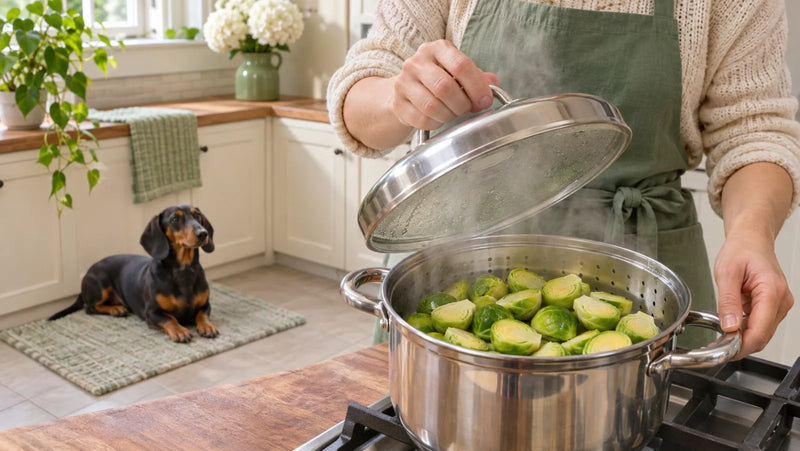
Method 1: Steam Carrots for Dogs
Steaming keeps the carrot out of the cooking water and gives direct control over softness. It is a useful first method for a small batch, a mash, or a dog that needs a softer texture.
- Bring plain water to a boil. Use enough water to keep the pan from running dry, but keep the water below the steamer basket.
- Add uniform pieces. Place about 1/4-inch coins or half-moons in a loose layer so steam can circulate. Do not add salt, broth, butter, oil, or seasoning.
- Cover and steam for 6–10 minutes. Start checking thin pieces at 6 minutes. A crowded basket or thicker cut may need longer.
- Test the center. Lift out one piece with a clean fork. It should pierce without resistance and mash between the fork and plate. Continue in 1–2-minute intervals if the center is firm.
- Cool completely. Move the finished carrots to a clean shallow plate or container. Let steam escape, then make the dog-specific serving cut only after the pieces are comfortable to touch.
The Utah State University Extension carrot guide likewise describes steaming cut carrots until tender. “Tender” is the controlling result here; color alone cannot show whether the center is soft enough for the intended dog.
Method 2: Boil or Simmer Carrots for Dogs
Boiling is straightforward for a mash or uniform dice. Use fresh plain water, not stock, bouillon, soup, meat drippings, or a pot already seasoned for the family meal.
- Cut evenly. Use about 1/4-inch coins, half-moons, or small dice. Place them in a saucepan and cover with plain water.
- Bring to a boil, then reduce slightly. Keep a gentle active boil rather than splashing water from the pan.
- Cook for about 8–12 minutes. Begin checking at 8 minutes. Very small dice can finish sooner; thicker pieces can take longer.
- Use the fork-and-mash test. A finished piece has no hard center and yields easily. If needed, cook 1–2 minutes more and test again.
- Drain and cool. Pour into a clean colander, let excess water and steam escape, then spread the carrots in a shallow clean container. Do not serve the hot cooking water as “broth.”
Boiling does not create a medical diet. It simply changes texture. A dog with vomiting, diarrhea, appetite loss, or another illness needs a veterinary plan; carrot water, carrot-and-rice, and improvised bland-food mixtures should not delay care.
Method 3: Roast Carrots Plain for Dogs
Roasting creates a drier surface and stronger aroma, but it also makes thin edges easier to dry or burn. Use parchment and a uniform, slightly larger cut. The dog batch stays completely plain even if the family tray will later receive oil or seasoning.
- Heat the oven to 425°F. Line a clean rimmed sheet pan with plain parchment paper.
- Cut roughly 1/2-inch pieces. Keep thickness consistent. Do not coat them with oil, cooking spray, salt, butter, honey, maple, garlic, onion, or herbs.
- Spread one uncrowded layer. Leave a little space between pieces so they roast rather than steam in a pile.
- Roast 20–30 minutes. Turn the pieces around 12–15 minutes and begin testing at 20. A small, young carrot may finish sooner.
- Reject hard or burnt pieces. Keep only carrots that are soft through the center with no charred, leathery, or sharp-dried edge.
- Cool, then resize. Move the plain pieces off the hot pan. A roasted chunk that was ideal for even cooking may still need quartering or mashing before it reaches the dog.
Utah State's guide uses 425°F and a 20–30-minute range for cut roasted carrots. Its human recipe includes oil and seasoning; this dog-specific method deliberately leaves both out and relies on parchment, turning, early checking, and the final softness test. Do not borrow carrots from a glazed or seasoned family tray.

How to Cut Cooked Carrots for the Individual Dog
Let every piece cool first. Then separate the cooking cut from the serving cut. No measurement can guarantee that a dog will chew safely: jaw and muzzle shape, dental health, swallowing history, excitement, and gulping behavior matter more than a weight label. Supervise the first piece from start to finish.
| Dog profile | Conservative cooked format | Avoid |
|---|---|---|
| Puppy, toy or small dog | Fork-mash or very small soft irregular pieces after the dog's feeding plan permits a new extra | Whole baby carrots, thick coins, long sticks, or a pile of pieces |
| Senior or dog with dental limitations | Very soft mash or veterinarian-approved texture | Firm center, dried roast edge, or any texture that causes pain or repeated dropping |
| Calm medium adult that chews | Soft quartered coins or small irregular dice; begin with one | A round coin large enough to slide back intact |
| Calm large adult that chews | Soft irregular pieces, still smaller than a whole carrot; watch the first bite | Assuming a large mouth makes a whole carrot or baton safe |
| Any-size gulper, prior choking, or swallowing concern | Fine mash or another texture approved by the veterinary team | Rounds, chunks, sticks, hand-thrown pieces, and unsupervised feeding |
If the dog swallows the first piece without chewing, coughs, gags, paws at the mouth, repeatedly drops food, or seems uncomfortable, stop. Smaller is not always enough for a swallowing problem; use veterinary guidance before trying another shape.
Portion Cooked Carrot as One Shared Extra
For an eligible healthy adult dog trying carrot for the first time, offer one cooled prepared piece—or one small lick of mash—then stop and observe. Do not turn a successful first bite into a bowlful. Stool changes, gas, vomiting, itching, appetite change, or discomfort are reasons to stop and ask the veterinarian when appropriate.
The WSAVA dog-treat guide recommends that treats provide no more than 10% of a dog's daily calories. That is a ceiling shared by carrot, training rewards, chews, toppers, table tastes, and food used for medication—not a separate 10% for each category. The dog's veterinary calorie plan, body condition, life stage, complete diet, and health decide the actual allowance.
Use the daily dog-treat calorie guide to combine extras, and use the dedicated carrot-safety article for broader portion context. Carrot remains optional; it does not need to reach a daily target.
How to Refrigerate or Freeze Cooked Carrots
Move cooked carrots into a clean shallow container so heat can leave the batch. Refrigerate promptly rather than leaving the pot on the counter until it reaches room temperature. Keep the refrigerator at 40°F or below and use a conservative three-day household working window: cooking day is day zero, then use by the end of day three or freeze sooner.
The Colorado State University Extension kitchen-safety guide recommends refrigerating perishable food within two hours, dividing leftovers into clean shallow containers, and eating or discarding most cooked leftovers within three to four days. Clean handling, prompt chilling, and a reliably cold appliance still matter; this dog batch uses the shorter end of that range.
For freezing, portion the cooled cooked carrots into the single-use amounts already approved for the dog. Freeze the portions separately on parchment or in small food-safe containers, then date and label them. Thaw one portion in the refrigerator. If gently warmed, stir and test every piece, then cool it fully before serving. Do not use this storage step to offer a rock-hard carrot; that texture belongs to the separate frozen-carrot decision.
Discard the batch sooner if it sat out too long, touched raw-meat tools or drippings, the refrigerator temperature is uncertain, or the carrots develop slime, mold, an unusual odor, discoloration, or another unexpected change. Do not repeatedly thaw and refreeze a daily container.
Three Ways to Use the Plain Batch
As one supervised reward: select the dog-specific soft shape and offer one piece at a time. This keeps chewing visible and portions countable.
As a measured topper: mash a small approved amount and spread it thinly over the dog's normal complete food. Do not bury every meal or keep increasing the amount when the dog waits for additions.
As part of a veterinarian-designed recipe: weigh the cooked ingredient exactly as the formulation directs. A carrot, the separate plain rice method, and cooked chicken do not become a complete homemade diet merely because each ingredient can be prepared plainly. Medical diets, diarrhea plans, and long-term home cooking require professional formulation.
For other produce, use the safe-and-toxic vegetables for dogs guide before applying this carrot method. Different vegetables have different edible parts, toxin concerns, textures, and preparation requirements.
Common Carrot-Cooking Mistakes
- Serving the prep cut without reassessing it. A uniform round coin may cook well but still be the wrong serving shape for a gulper.
- Trusting the timer instead of the center. Check the thickest piece and continue briefly when it remains firm.
- Borrowing from the family pan. Oil, butter, salt, sweet glaze, broth, onion, garlic, and meat drippings make it a different recipe.
- Leaving roast edges hard. Discard dried, charred, sharp, or leathery pieces instead of hiding them in a mash.
- Serving hot food. Steam and a browned surface can conceal a hot center. Cool and test before offering.
- Using a whole carrot for a large dog. Body size does not cancel gulping, choking, dental, or obstruction concerns.
- Calling a frozen storage portion a teether. Thaw cooked portions to the approved soft texture before serving.
- Free-pouring from the container. Pre-portion the batch so household members do not each add another serving.
When to Skip Carrots or Ask the Veterinarian
Ask before adding carrot for a puppy whose growth diet is still being established; a dog with diabetes, obesity treatment, gastrointestinal disease, dental pain, swallowing difficulty, prior choking, food sensitivity, or another medical condition; or any dog on a prescription diet. A veterinarian can decide whether carrot fits and what texture and amount preserve the existing plan.
Do not use cooked carrots to diagnose or treat vomiting, diarrhea, constipation, appetite loss, weight gain, vision change, or another symptom. Call promptly for repeated vomiting, a swollen or painful abdomen, severe lethargy, breathing difficulty, collapse, choking signs, inability to swallow, or suspected obstruction. Cooking instructions are not emergency care.
A Separate No-Cook Topper Option
American Paws does not currently sell a carrot treat. If the goal is a labeled, no-cook meal topper and the dog's established plan permits chicken, the current American Paws Chicken Meal Topper page describes a 4 oz dog product made from 100% USA chicken breast, freeze-dried and finely ground into crumbles. It contains no carrot and is a separate chicken option, not a substitute for a dog that needs carrot or avoids chicken.
Compare the exact label and measure the topper inside the same extras budget. The product's single-ingredient statement does not describe every item in the American Paws dog-and-cat treat collection; review each product's ingredients, calories, texture, and intended use separately.
Frequently Asked Questions
How long should I boil carrots for my dog?
Gently boil roughly 1/4-inch plain carrot pieces for about 8–12 minutes, beginning the fork test at 8 minutes. Continue in short intervals until the thickest piece pierces and mashes easily with no firm center. Drain and cool completely before making the serving cut.
How long should I steam carrots for my dog?
Steam roughly 1/4-inch coins or half-moons for about 6–10 minutes after steam is active. Basket crowding and thickness change the time. The pieces are done when a fork passes through easily and the center can be mashed.
Can I roast carrots for my dog without oil?
Yes. Arrange uniform roughly 1/2-inch pieces on parchment and roast plain at 425°F for about 20–30 minutes, turning once and checking early. Keep only pieces that are soft throughout; discard burnt, sharp-dried, or leathery edges.
Should I peel carrots before cooking them for a dog?
Peeling a sound carrot is optional. Wash it thoroughly under running water before peeling or cutting, trim the top and root tip, and remove damaged areas. Do not use soap or produce wash.
How small should I cut cooked carrots for my dog?
There is no universal safe dimension. Mash or use very small soft irregular pieces for a puppy, toy dog, senior, or dental limitation; quarter soft coins for a calm chewer; and use mash rather than chunks for a gulper or dog with prior choking. Supervise the first piece and ask the veterinarian about swallowing concerns.
Can I freeze cooked carrots for my dog?
Yes, for storage. Cool them, freeze measured single-use portions in food-safe containers, date them, and thaw one portion in the refrigerator. Bring it back to the approved soft texture and cool it before serving rather than offering it rock-hard from the freezer.
Can dogs eat carrots cooked in broth?
Do not use ordinary human broth by default. It may contain onion, garlic, other seasonings, or sodium that does not fit the dog. This method uses plain water only. A veterinarian-approved diet can specify a different liquid when medically appropriate.
How much cooked carrot should I give first?
For an eligible healthy adult dog, begin with one cooled piece prepared in the right texture—or one small lick of mash—then stop and observe. Count it with every other extra. The full allowance depends on the dog's calorie plan, body condition, life stage, health, and main diet.
Cook Until Soft, Then Cut for the Dog
The reliable method is not “cook for exactly X minutes.” It is wash, cut uniformly, cook plain within a useful time range, confirm a fork-soft center, cool completely, and make a second cut for the individual eater. That sequence works whether you steam, boil, or roast.
Start with one small plain batch and label it before it enters the refrigerator. Use the carrot safety guide to confirm the dog is an appropriate candidate, then keep every serving soft, supervised, and inside the shared daily extras plan.