
Turkey and chicken dog treats can both work well for healthy dogs. In a turkey vs chicken dog treats decision, there is no universal winner: both are poultry proteins, and the better choice depends on the full ingredient label, calories, texture, purpose, and which protein the individual dog already tolerates.
Chicken is familiar, widely available, and often highly motivating. Turkey can offer a different flavor, but it is not automatically leaner, hypoallergenic, or “novel.” For a dog with suspected food reactions, choosing another bird by guesswork can muddy the diagnosis. A veterinarian-guided diet history or elimination plan is more reliable.
Turkey vs chicken dog treats: the quick answer
Choose chicken when the dog already tolerates it and the product has a clear recipe, suitable texture, and useful serving size. Choose turkey when the dog tolerates turkey, prefers its flavor, and the actual turkey treat meets the same label and calorie standards. Choose neither during a veterinary food trial unless the veterinarian approves that exact product.
Use this five-part decision:
- Protein history: Which bird has the dog eaten without repeated skin or digestive problems?
- Recipe: Does the ingredient list contain one named protein, several animal sources, coatings, fat, flavor, or fillers?
- Purpose: Is the treat a tiny training reward, a larger jerky strip, a crunchy bite, or a chew?
- Calories and texture: Can the portion fit the dog's mouth, teeth, and daily treat budget?
- Medical context: Is this ordinary shopping, or is a veterinarian investigating allergy, intolerance, pancreatitis, obesity, or another condition?
If the dog is healthy and both proteins are familiar, taste and format can decide. If food sensitivity is suspected, consistency and veterinary control matter more than variety.
How turkey and chicken treats are similar
Both are animal proteins from poultry
Turkey and chicken are distinct proteins from related poultry species. Both can provide complete animal-protein building blocks when used in dog food or treats, and both can be made into jerky, freeze-dried cubes, soft training bites, biscuits, toppers, or mixed recipes.
The shared category does not make the proteins identical. One dog may tolerate both, one, or neither. The response cannot be predicted from “poultry” alone, and a front label that says “poultry flavor” is less useful than an ingredient list naming every animal source.
Processing and recipe can outweigh the bird
A thin whole-cut chicken strip and a soft turkey bite with glycerin, starch, smoke flavor, and added fat are not comparable simply because both feature poultry. Reverse the recipes and the conclusion may reverse too. Drying method, cut, skin, coatings, moisture, piece size, and calorie density shape how the treat behaves.
That is why nutrient claims should follow the package in hand. A person may compare raw skinless chicken breast with raw skinless turkey breast and find similar numbers, but those tables do not describe every commercial dog treat.
Neither is automatically complete, low-fat, or hypoallergenic
Most treats are supplemental foods, not complete and balanced diets. “Real turkey” or “real chicken” does not mean the piece can replace a meal. “Lean poultry” does not prove the final recipe is low in fat. And “single protein” does not mean hypoallergenic, cross-contact controlled, or appropriate for a diagnostic diet.
The right label is specific: named ingredients, guaranteed analysis, calories, serving directions, lot/date information, and a manufacturer that answers questions. The wrong shortcut is choosing by the bird photo on the front.
Turkey vs chicken dog treats at a glance
| Question | Turkey treats | Chicken treats |
|---|---|---|
| Protein source | Turkey; may be one ingredient or part of a mixed recipe | Chicken; may be one ingredient or part of a mixed recipe |
| Flavor familiarity | May feel novel to a dog that rarely eats turkey | Often familiar because chicken appears in many foods and treats |
| Nutrition | Depends on cut, skin/fat, moisture, processing, and additions | Depends on cut, skin/fat, moisture, processing, and additions |
| Food-sensitivity use | Only useful if turkey is tolerated and permitted; not automatically novel | Useful only when chicken is tolerated; avoid when chicken is confirmed as a trigger |
| Best selection tool | Full ingredient list, calories, format, and individual history | Full ingredient list, calories, format, and individual history |
The table is intentionally even-handed. A clean chicken product can be a better choice than a complicated turkey product, and a clean turkey product can be a better fit than a complicated chicken one. “Better” describes the match, not the species in isolation.
Flavor, aroma, texture, and training use
Dogs experience treats through smell, texture, size, and reward history as much as through the protein name. A fragrant, soft piece may be more motivating during a difficult recall exercise; a crisp cube may be easy to carry without grease; a whole-cut strip may be easy to divide into deliberate portions.
Chicken's widespread use can make its aroma familiar and rewarding. Turkey may catch a dog's attention because it is less familiar. Other dogs show no preference. A home preference test can be simple: on separate days, offer one tiny piece of each product the dog is already allowed to eat and observe willingness, chewing, and digestive response.
Do not introduce both on the same first day. If vomiting, diarrhea, itching, hives, ear irritation, or another change occurs, two simultaneous new foods make the result impossible to interpret.
Format also determines training value. A large dense strip may be excellent as a break-apart high-value reward but inefficient for rapid repetitions. A tiny soft bite may work for repeated reinforcement but add more supporting ingredients. Match the piece to the job and count how many calories the session will use.
Nutrition: compare the actual labels, not two raw meats
Protein and fat depend on cut and processing
Both turkey and chicken can yield lean meat, fatty skin, dark meat, organ ingredients, rendered meals, broth, fat, or mixed recipes. Dehydration removes water and concentrates nutrients and calories by weight. Freeze-drying creates another moisture profile. Soft treats may add humectants such as glycerin to retain chewiness.
Compare guaranteed analysis values only with context. Crude protein and crude fat are useful, but products with very different moisture levels are not perfectly compared from the as-fed percentages alone. For an ordinary treat purchase, the practical questions are whether the formula fits the dog's needs, how many calories are in a piece or gram, and how small the reward can be.
Calories matter more than a “lean” reputation
A turkey label can say “lean” while the finished bite contains added fat or a large serving. A chicken treat can be a thin single-ingredient strip that is easy to portion, or it can be a rich mixed recipe. Neither bird guarantees a lower-calorie outcome.
The World Small Animal Veterinary Association's treat guidance says all treats together should remain below 10% of daily calories. The allowance includes both poultry proteins, chews, table bites, dental products, toppers, and food used for medication. Ten percent is a ceiling, not a goal.
For training, divide one larger piece into many tiny rewards when the texture allows. A dog learns from the timing and value of reinforcement, not from the size of every bite.
Ingredient clarity and hidden animal sources
The FDA's animal-food labeling overview explains that ingredients are declared by their common or usual names and listed in descending order by weight. Read the entire panel, not only the flavor callout.
A “turkey” treat may also contain chicken fat, chicken meal, poultry broth, liver, egg, beef gelatin, dairy, or natural flavor. A “chicken” treat may include turkey or other animal proteins. These additions are not automatically bad for a healthy dog, but they matter when the goal is one-protein clarity.
Our single-protein dog-treat guide explains the full distinction among single protein, single ingredient, and limited ingredient. For this comparison, the takeaway is simple: verify every animal-derived ingredient and ask the manufacturer about cross-contact when strict avoidance matters.

Which protein should a healthy dog choose?
Start with a protein the dog already tolerates
For a healthy dog with no suspected food reaction, familiarity is useful. If chicken has been eaten for months without recurrent skin or digestive signs, a clear chicken treat is a reasonable choice. If turkey is already part of the diet without problems, a clear turkey treat may be equally reasonable.
A dog does not need a new protein simply because variety sounds healthy. Complete food supplies the nutritional foundation. Treat protein is mainly a choice about enjoyment, training value, ingredient transparency, and dietary fit.
Match the format to the job
Ask what the treat must do:
- Rapid training repetitions: choose tiny, easy-to-swallow pieces with known calories.
- High-value recall or grooming reward: choose an aroma and texture the dog finds especially motivating.
- Break-apart portioning: choose a whole-cut strip that can be divided safely.
- Crunchy enrichment: choose a size the dog chews comfortably without gulping.
- Ingredient troubleshooting: choose the shortest, most specific recipe and introduce nothing else new.
Turkey and chicken can appear in any of these formats. The format—not the bird alone—answers the use case.
Introduce one new treat at a time
Offer one small piece, then keep the rest of the day's food familiar. Watch appetite, stool, vomiting, gas, itching, hives, facial swelling, ear or paw irritation, and general comfort. If the first exposure is uneventful, use the same small amount again on another day before increasing.
This is a tolerance check, not an allergy test. A true food reaction may not appear immediately, and many skin or digestive problems have causes unrelated to food. Repeated or severe signs require veterinary assessment.
What if a dog seems sensitive to chicken?
Allergy and intolerance can look similar
A food allergy involves an immune reaction to a food component, often a protein. A food intolerance does not use the same immune mechanism, but it can still cause digestive signs. Itching, recurrent ear or skin problems, vomiting, diarrhea, and gas can overlap—and parasites, environmental allergy, infection, medications, and other disease can produce similar signs.
The Merck Veterinary Manual's dog-allergy guidance lists chicken among commonly reported food allergens, along with ingredients such as beef, dairy, egg, wheat, soy, and corn. That does not mean chicken is dangerous to most dogs. It means an individual dog with compatible signs needs a controlled diagnostic plan rather than internet guesswork.
Turkey is not automatically a novel protein
“Novel” means new to the individual dog's immune and diet history. Turkey may be novel for a dog that has never eaten it, but many poultry foods, treats, table scraps, broths, flavored medications, and mixed recipes already expose dogs to turkey.
The proteins are distinct, so a confirmed chicken reaction does not automatically prove a turkey reaction. The reverse is also true: being a different bird does not guarantee tolerance. Only a careful history and, when appropriate, a veterinarian-controlled elimination and challenge process can clarify the pattern.
Elimination diets have stricter rules than retail shopping
VCA's elimination-challenge diet guidance explains that a veterinary trial generally uses a protein the dog has not eaten before or a hydrolyzed diet, followed for a controlled period and then challenged when appropriate. Treats, table scraps, flavored medication, toothpaste, chews, and access to other pets' food can invalidate the result.
Do not add an over-the-counter turkey treat because the front says “limited ingredient” or “single protein.” The veterinarian managing the trial decides which exact foods are allowed. Retail manufacturing may not provide the cross-contact control required for diagnosis, and turkey may already be part of the dog's history.
During a trial, do not rotate turkey and chicken, conduct home taste tests, or use a chicken-flavored pill pocket. Consistency is the diagnostic tool.
Should dogs rotate turkey and chicken treats?
A healthy dog that tolerates both proteins may enjoy occasional rotation. Rotation can add sensory variety and give an owner several reward values for different situations. It is optional, not a nutritional requirement.
There is no sound reason to claim that rotating proteins prevents food allergy. Broad rotation can also make the diet history more complicated: once a dog has eaten chicken, turkey, duck, beef, lamb, fish, venison, and rabbit, fewer proteins remain truly novel if a future elimination trial is needed.
If you rotate for an ordinary healthy dog:
- introduce only one new product at a time;
- keep the package and note the lot, ingredients, and first-use date;
- use a small portion for several exposures before adding another product;
- stop the new item if recurrent skin or digestive signs appear; and
- keep the total calories from every protein within the same treat ceiling.
If the dog thrives on one clear chicken or turkey treat, consistency is also a perfectly good choice.
A practical label-reading checklist
Before choosing either bird, answer these questions:
- What is the exact first ingredient? “Turkey,” “turkey breast,” “chicken,” and “chicken meal” describe different starting materials.
- How many animal sources appear? Count broth, fat, liver, egg, gelatin, flavor, and meal—not just the front-panel protein.
- What creates the texture? Whole-cut jerky, freeze-dried pieces, biscuits, and soft bites use different processes and supporting ingredients.
- How many calories are in a piece or gram? If the label does not say, contact the manufacturer.
- What are the crude protein, fat, fiber, and moisture values? Use them as product information, not proof of a medical benefit.
- Where are ingredients sourced and the product made? Verify any origin claim important to you.
- Can the manufacturer answer cross-contact questions? This matters most for confirmed allergy or strict avoidance.
- Does the piece fit the dog? Choose a size and hardness appropriate for the dog's mouth, teeth, and gulping behavior.
Marketing words such as natural, premium, clean, lean, and hypoallergenic do not replace these answers.
American Paws chicken and beef-liver options
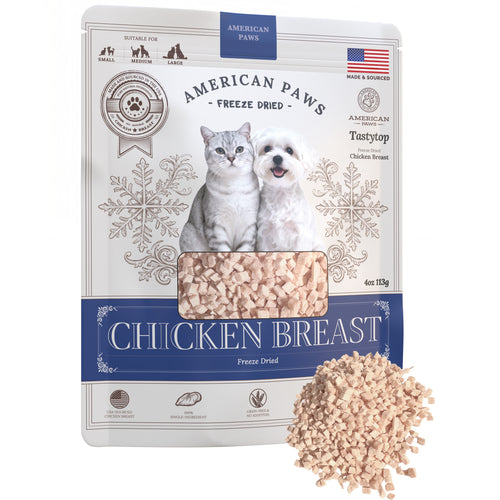
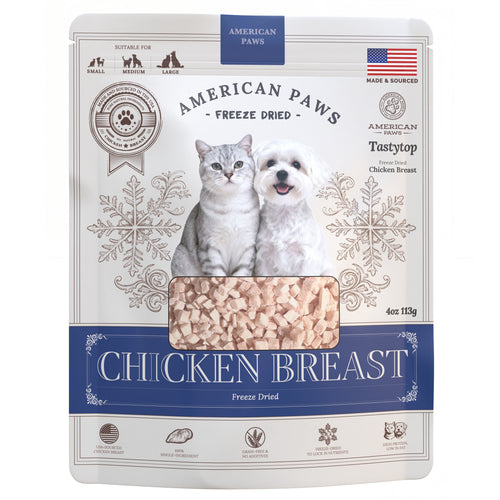
American Paws currently makes several chicken treat formats and one freeze-dried beef-liver product. We do not currently sell a turkey treat, and we will not turn an educational comparison into a fake turkey recommendation.
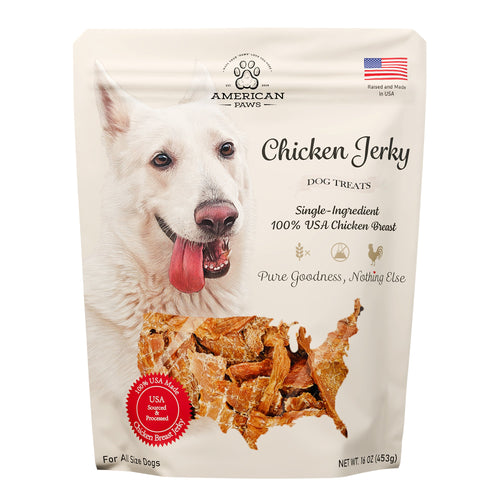
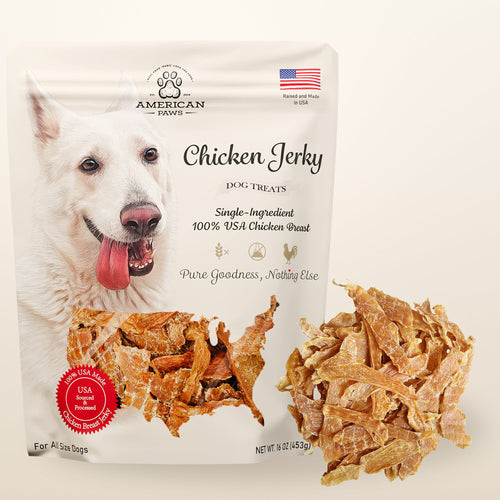
For a dog that tolerates chicken, our single-ingredient whole-cut chicken breast jerky is made from 100% USA chicken breast and made in the USA. The whole-cut product's one-ingredient label makes the protein easy to identify and the strips easy to portion. Do not extend that claim to every item: different products and formats can have different recipes.
The American Paws chicken jerky collection shows the current chicken formats. Read each individual label instead of assuming the entire collection is identical. For the broader informational case for chicken jerky as a high-value reward, see our guide to why dogs value chicken jerky.
If a veterinarian has ruled chicken out and approves beef, our current single-ingredient freeze-dried beef liver is a real non-chicken option. Beef is not automatically hypoallergenic either, and it should not be introduced during a diagnostic trial unless the veterinarian specifically permits it.
Frequently asked questions
Is turkey better than chicken for dogs with allergies?
Not automatically. Turkey is a different protein, but it is useful only if the dog tolerates it and it fits the veterinary plan. It is not novel if the dog has eaten turkey before, and a retail turkey treat may contain other animal ingredients or cross-contact. Confirm suspected allergy with a veterinarian.
Is turkey leaner than chicken in dog treats?
You cannot tell from the bird name. Skinless cuts of both birds can be lean, while skin, dark meat, added fat, coatings, and dehydration can change the finished treat. Compare the guaranteed analysis, moisture, calories, serving size, and ingredient list on the actual products.
Can dogs eat turkey and chicken treats together?
A healthy dog that already tolerates both may have both within the same overall treat budget. There is rarely a reason to mix them during the first introduction. Never combine proteins during a veterinary elimination trial unless the managing veterinarian directs it.
Can turkey be a novel protein for dogs?
Yes, but only for a dog with no previous turkey exposure. Check complete diet history, including treats, mixed poultry formulas, table scraps, broths, chews, flavored medications, and supplements. The veterinarian chooses a truly novel or hydrolyzed plan when diagnosis is the goal.
How do I switch from chicken to turkey treats?
For an ordinary healthy dog, stop the old treat, offer one tiny piece of the new turkey product, and keep every other food familiar. Repeat a small amount on separate days while observing skin, ears, stool, vomiting, and comfort. For a suspected chicken reaction, do not conduct an informal switch; ask the veterinarian whether a controlled diet trial is needed.
Choose the clearest protein the individual dog tolerates
Turkey and chicken are both workable treat proteins. The better choice is the one with a transparent recipe, suitable calories and texture, a purpose that matches the training or reward job, and a history of good tolerance in the individual dog. Turkey is not automatically leaner or safer; chicken is not automatically more nutritious or more allergenic.
American Paws currently offers chicken and beef-liver treats, not turkey. If chicken fits your dog, start with the transparent whole-cut option or compare the chicken collection. If it does not, involve the veterinarian before using another protein as a workaround. You can also browse all current American Paws dog treats to compare real labels and formats—then keep every reward, regardless of bird, within a small part of the daily diet.