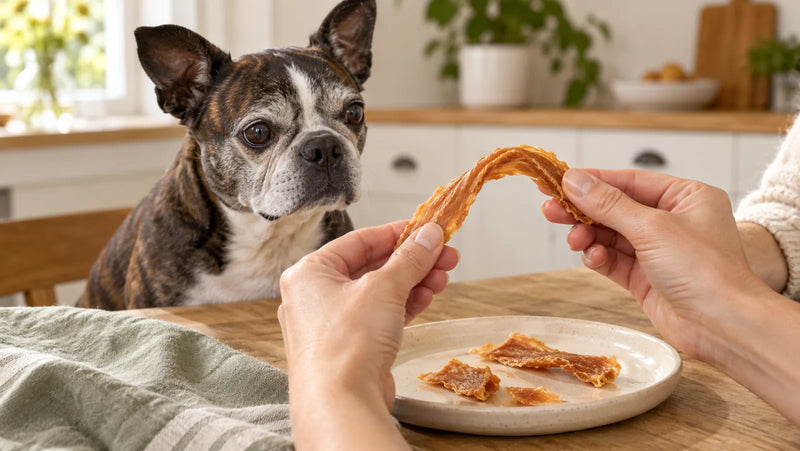

Wholesale dog treats for grocery stores should be unmistakably labeled for dogs, easy to explain from the package, supported by a documented unopened shelf-life window, and practical to test in a compact set. American Paws’ current wholesale program starts at 10 lb per product, with pricing from $14/lb in the current catalog. Confirm the selected item, package route, date window, freight, and timing before ordering.
A grocery or natural-food buyer has a different job from a pet-specialty buyer. The pet section may occupy one short run, an endcap, or a checkout-adjacent fixture rather than a full department. Each product therefore needs a clear role, visible product identity, and enough evidence to survive a quick decision without a long staff explanation.
Wholesale Dog Treats for Grocery Stores: Quick Buying Facts
| Decision | Current American Paws fact | What to confirm |
|---|---|---|
| Minimum | 10 lb per product | Selected product and pounds for each product—not a mixed 10 lb total |
| Starting price | From $14/lb; see the current catalog | Current item price, packaging route, freight, and delivered cost |
| Unopened shelf life | Current company documentation lists 12 months for chicken jerky, freeze-dried chicken breast, and freeze-dried beef liver | The exact SKU, package, date code, storage directions, and time remaining at receipt |
| Private label | Customer supplies approved bags; American Paws fills the confirmed product, adds an oxygen absorber, and heat-seals | Bag fit, label status, fill weight, scope, timing, and current requirements |
| Facility fact | Highland, California; FDA Food Facility Registration No. 13526766664 | Registration is not FDA approval, certification, endorsement, or a product ranking |
Use the American Paws wholesale program to submit the real buying scenario: item, pounds per item, channel, destination, desired date, and whether the project uses current American Paws packaging or customer-supplied private-label bags.
Grocery and Natural-Food Stores Need a Different Pet-Treat Set
Start with a compact set of distinct shelf jobs
A grocery shelf does not need five bags that answer the same question. Start with one candidate for each job the store can clearly support. A whole-cut meat jerky can serve shoppers seeking a recognizable meat reward. A freeze-dried item can serve shoppers seeking a light, dry format that is easy to divide. A longer chew or a small training format belongs only when it adds a genuinely different use.
The separate evidence-based dog-treat assortment guide explains how to compare exact SKUs by movement, repeat demand, inventory days, waste, and complaints. It does not declare one national winner, because a product that moves in a destination pet boutique may not move beside a neighborhood grocery checkout.
Keep intended species and product identity unmistakable
Natural-food merchandising can create a special risk of visual ambiguity. A kraft pouch of dried meat may resemble a human snack from several feet away. Keep the dog-treat identity, intended species, package, ingredient panel, net quantity, responsible company, and price visible. Do not decant sealed inventory into an attractive anonymous jar or build a display that makes pet food look like human food.
AAFCO’s label-reading guidance explains that pet-food labels identify the product, intended species, quantity, guaranteed analysis, ingredients, and responsible company information. Those fields do more retail work than a vague front-of-pack lifestyle claim.
“Clean Label” Must Become Verifiable Label Facts
“Clean label” is shopper and retailer shorthand, not a universal regulatory certification. Translate it into questions that produce evidence. How many ingredients are listed? Are they named clearly? Does the exact product support a single-ingredient claim? Is the intended species conspicuous? Can staff find the net quantity, responsible company, feeding information, storage directions, and date or lot identity?
The FDA animal-food labeling overview identifies federal label elements such as product identity, net quantity, manufacturer or distributor name and place, and an ingredient list. FDA also notes that state requirements apply. Check current requirements for every market where the product will be sold.
Read the exact ingredient statement
American Paws whole-cut chicken breast jerky and freeze-dried chicken breast pieces are concrete single-ingredient examples. That claim belongs to those exact products; it does not automatically describe every American Paws dog treat. A grocery buyer should preserve that SKU-level precision on shelf cards, online listings, and staff talking points.
Ingredient count is only one part of fit. A one-ingredient product is not automatically appropriate for every dog, allergy plan, prescription diet, chewing style, or calorie budget. Keep medical promises and universal suitability claims off the display.
Keep marketing language narrower than the evidence
Use observable statements such as “one listed ingredient,” “whole-cut strips,” or “freeze-dried pieces” only when the exact current label and product support them. Avoid “allergy safe,” “human grade,” “therapeutic,” “vet approved,” or other claims that require evidence beyond an attractive package. A natural-food customer may value simple labels, but the shelf still needs product-specific facts rather than borrowed halo language.
Shelf-Stable Means the Exact SKU, Package, and Storage Plan
“Shelf-stable dog treats” is not a category-wide promise. The useful retail question is whether the exact unopened product, in the exact sealed package, has a documented date window and storage plan that fit the store’s receiving and selling cycle.
Verify the unopened window and time remaining at receipt
Current American Paws documentation lists a 12-month unopened shelf life for chicken jerky, freeze-dried chicken breast, and freeze-dried beef liver. Do not extend that number to another product or to an opened or repacked bag. Before the purchase order, confirm the selected SKU and package. At receiving, record the printed date or date basis, lot identity, package condition, received date, and remaining window.
A nominal 12-month window does not mean a store receives all 12 months. Production date, packing, transit, and receiving timing affect the window left for sale. Agree on the evidence the buyer needs instead of assuming every incoming case has the same remaining time.
Preserve seals, dates, lots, and storage directions
Keep sealed dog treats cool, dry, away from direct sunlight, and handled according to the exact package directions. Rotate by the earliest usable documented date, not arrival order alone. Never top off an open bin with a new lot, hide a damaged seal behind a shelf card, or separate a sample from its product identity and lot record.
The retailer shelf-life and rotation guide provides a full receiving-to-sale system for date codes, lots, storage, open containers, quarantine, and complaint evidence. Use it when building the store’s operating procedure rather than inventing one shelf-life number for every format.
Build the First Order Around 10 lb per Product
Convert pounds into a documented pack plan
The minimum is 10 lb per product. It is not permission to assume a pouch count, case pack, fill weight, or shelf capacity. First choose the exact product. Then confirm whether it will arrive in current American Paws retail-ready packaging, bulk packaging for an authorized store operation, or customer-supplied approved private-label bags. Only after the fill and package route are confirmed can the buyer calculate how many sellable units and how much shelf space the order represents.
Build the first order from the display backward. Record the number of facings, units per facing, backstock limit, review date, and replenishment trigger. Compare that plan with the 10 lb minimum and documented remaining date window. If the planned display and expected review cycle cannot absorb the quantity, reduce the number of products instead of creating a wall of overlapping inventory.
Do not create a mixed-SKU minimum or a universal case count
Ten pounds of one product plus ten pounds of another are two product minimums. Do not describe a mixed assortment as one combined 10 lb order. Pricing starts at $14/lb in the current catalog, but the selected item, packaging, freight, availability, and timing need a current quote. Case counts and delivered unit economics depend on facts that should be confirmed, not guessed.

Run an Endcap or Checkout Test You Can Read
Keep the test conditions stable
An endcap can create visibility, but it can also make a weak comparison look strong if placement, price, staff prompts, and sampling all change at once. Give the test a written start date, review date, exact SKUs, starting units, location, price, and replenishment rule. Keep the product sealed and the intended-species identity obvious, especially near human snacks.
If the store uses samples, follow current local requirements and preserve the exact product, ingredient, lot, date, and handling identity. Do not mix products in one bowl or let an open-sample program become the only reason a bag moves.
Measure movement, stockouts, waste, and repeat demand
Track opening inventory, receipts, units sold, returns, markdowns, samples, damage, waste, stockouts, and ending inventory by exact SKU. A product that sells out on day two needs a stockout note; otherwise the remaining test period can look like low demand. A product with gross sales but frequent torn bags or date risk may be less useful than the topline suggests.
Record customer questions too. Repeated confusion about intended species, texture, ingredient count, or package size is merchandising evidence. Repeat requests and clean reorders are stronger signals than one heavily promoted weekend.
Grocery Store vs Pet Specialty Store: What Changes?
| Buying issue | Grocery or natural-food store | Pet specialty store |
|---|---|---|
| Assortment depth | Usually benefits from a compact set with visibly different jobs | May support deeper protein, texture, life-stage, and use-case choices |
| Staff explanation | Package and shelf card often need to stand on their own | Associates may provide a longer pet-specific consultation |
| Product identity | Must be especially clear near human food and checkout | Pet context is already established by the department |
| Display test | Endcap, checkout fixture, or short pet run may be the test unit | Category bay, training section, chew wall, or dedicated display may be available |
| Success signal | Movement with low confusion, controlled backstock, and clean repeat demand | Movement plus fit within a broader category and advisory role |
For the broader supplier-evaluation decision, use the wholesale guide for pet-specialty stores. Grocery buyers can borrow its questions about ingredient clarity, supplier evidence, packaging, and reordering without copying the deeper pet-store assortment.
How American Paws Fits a Grocery or Natural-Food Review
American Paws operates in Highland, California and lists FDA Food Facility Registration No. 13526766664. That is a facility registration—not FDA approval, certification, endorsement, or proof that one item will sell in a particular store.
The current assortment includes dog treats in whole-cut jerky, freeze-dried, dehydrated, topper, and training formats. Review current American Paws dog treats by exact product rather than treating the catalog as one formula. The current wholesale minimum is 10 lb per product, and pricing starts at $14/lb in the current catalog.
Retail-ready wholesale uses the confirmed current packaging. For a scoped private-label project, the customer supplies approved bags; American Paws fills the confirmed product, adds an oxygen absorber, and heat-seals the pouch. The private-label dog treat manufacturer guide explains minimums, packaging responsibilities, fulfillment, and the questions to settle before ordering. Use the private-label inquiry when the project has a customer-supplied bag plan.
A Seven-Step Buyer Checklist
- Name the shelf job. Define the shopper need and the closest item already in the store.
- Select the exact product. Record title, ingredient statement, intended species, format, package route, and observable texture.
- Verify the unopened window. Confirm the selected SKU and package, date basis, storage directions, and minimum remaining window at receipt.
- Translate the minimum. Convert 10 lb per product into a confirmed fill, unit count, display quantity, and backstock plan only after packaging is known.
- Protect product identity. Keep the sealed package, label, lot or date, dog-treat identity, and price visible through receiving and sale.
- Write the test. Fix the location, starting units, price, start date, review date, replenishment rule, and any sampling method.
- Make one evidence-based decision. Reorder, adjust one documented condition, reduce space, or replace the item based on movement, stockouts, repeat demand, waste, and customer questions.
Frequently Asked Questions
What wholesale dog treats work well in grocery stores?
Start with clearly labeled products that perform different jobs and fit the store’s actual shelf space. A recognizable meat jerky and a freeze-dried format can provide two distinct choices, but no category is a guaranteed seller. Test exact SKUs, protect intended-species identity, and keep only products that earn clean repeat demand.
What does clean-label mean for dog treats?
It is not a universal certification. Treat it as a prompt to inspect the exact ingredient statement, intended species, net quantity, responsible company, feeding information, and substantiated claims. Use “single ingredient” only when that precise product label supports it.
Are dog treats shelf-stable?
Some sealed products have a documented unopened shelf-life window, but “dog treats” as a category do not share one duration. American Paws currently documents 12 months unopened for chicken jerky, freeze-dried chicken breast, and freeze-dried beef liver. Confirm the selected SKU, package, date code, storage directions, and remaining window.
What is the American Paws wholesale minimum?
The minimum is 10 lb per product. It is not one mixed 10 lb total across several products. Pricing starts at $14/lb in the current catalog; ask for current item pricing, availability, freight, packaging, and timing for the actual order.
Can a grocery store order private-label dog treats?
Yes, within a confirmed project scope. The customer supplies approved bags; American Paws fills the selected product, adds an oxygen absorber, and heat-seals. Confirm the bag, label status, fill weight, product, minimum, timing, and destination before committing.
Should dog treats go on an endcap or at checkout?
Either location can be tested when the dog-treat identity stays obvious and the sealed packages fit safely. Use one written test with exact SKUs, stable conditions, a review date, and stockout and waste records. Placement is an experiment, not proof that the product will keep selling.
Start With One Clear Shelf Job per Product
A grocery or natural-food store does not need a pet-store-sized wall to learn whether dog treats fit its customers. Start with a compact, non-overlapping set; verify the exact labels and unopened windows; preserve product identity; and give the endcap or checkout test a readable beginning and end.
Ready to scope the first order? Send the selected product, pounds per product, retail-ready or customer-supplied private-label route, destination, target date, and required unopened window through the wholesale inquiry. American Paws can then confirm current availability, catalog pricing, packaging, freight, and timing for the actual plan.