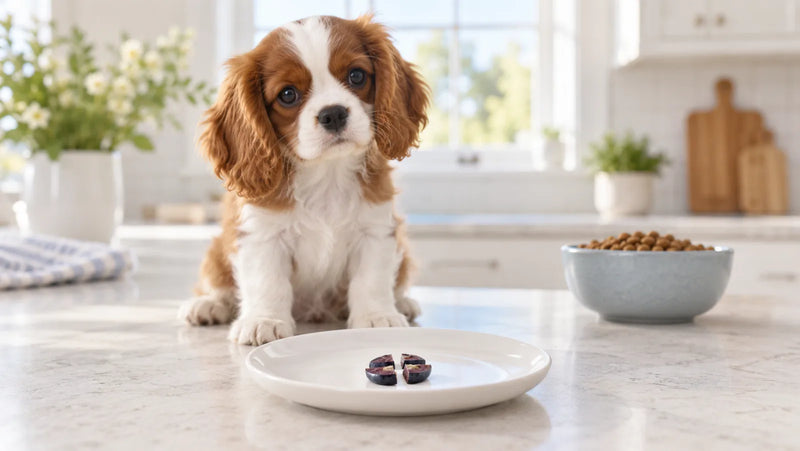

Apple dog treats can be made at home with a short ingredient list, but the fruit must be washed, cored, and completely deseeded before it is chopped or pureed. Use plain unsweetened ingredients, verify that any peanut butter contains no xylitol, bake flour-based dough fully, cool every biscuit before storage, and keep all finished treats inside the dog's daily calorie allowance.
Below are two small baked apple dog biscuit recipes and one frozen option. They are occasional extras, not complete meals, and the exact number a dog can have depends on the finished yield, ingredient labels, body size, health, and total calories from every other treat that day.
Apple dog treats start with a seedless apple base
Wash, stem, core, and deseed before chopping
Rinse a firm, mature apple under cool running water and rub the surface with clean hands. Do not use soap or a produce detergent. Cut away bruised or damaged areas, remove the stem and entire firm core, and inspect every section for seeds before grating, dicing, or pureeing.
Apple seeds contain cyanogenic glycosides that can release cyanide when crushed or chewed. A few accidentally swallowed seeds should not be framed as certain poisoning, but there is no reason to grind seeds into a batch. The hard core can also be a choking or obstruction hazard. The AKC apple-safety guidance likewise recommends removing the seeds, core, and stem.
Apple skin is not a toxic part of the fruit. You may leave clean skin on for a dog that already tolerates it, but peeling creates a smoother puree and a more uniform biscuit. For the broader fruit verdict, preparation, and accidental-ingestion questions, use our complete apple preparation and safety guide. This article stays with recipes.
Make plain apple puree or choose safe unsweetened applesauce
For homemade puree, dice one prepared, seedless apple, place it in a small covered pan with 2 tablespoons of water, and cook over low heat until the pieces are fully soft, usually about 10–15 minutes. Stir to prevent scorching, then mash or blend the cooked flesh until smooth. Add no sugar, syrup, butter, spice, salt, or sweetener. Cool before measuring it into dough.
Store-bought applesauce can save time if its complete ingredient list is plain and unsweetened. Reject products with xylitol, added sweeteners, cinnamon or spice blends, flavor mixes, or dessert ingredients. “No sugar added” is useful but does not replace reading every ingredient. If the sauce is very thin, the dough may need a little more oat flour after its rest.
Check every peanut-butter label for xylitol
Recipe 2 uses peanut butter. Check the label every time, even if you have bought the product before. It must not contain xylitol, which may also appear as birch sugar, wood sugar, or birch bark extract. Do not use chocolate peanut butter, a sweetened dessert spread, or an unlabeled scoop.
The FDA warns that some peanut and nut butters contain xylitol. In dogs it can cause a rapid, dangerous drop in blood sugar and other severe effects. If a dog may have eaten xylitol, contact a veterinarian, emergency animal hospital, or animal poison-control service immediately rather than waiting for symptoms.
Recipe 1: Egg-free apple-oat dog biscuits
This is the simpler, lower-fat baked option: just plain apple puree and oat flour, plus a measured spoonful of water only if the rested dough truly needs it. Because homemade puree and ground oats vary, texture is the final guide.
Ingredients and equipment
- 1/2 cup (120 g) plain unsweetened, seedless apple puree or applesauce
- 1 1/2 cups (about 135 g) plain oat flour
- plain water, only if needed, added 1 teaspoon at a time
- mixing bowl, spoon, two sheets of unprinted parchment, rolling pin, baking sheet, small cutter or knife, and wire cooling rack
You can make oat flour by grinding plain rolled oats to a fine meal. Do not use a flavored oatmeal packet or a mix containing raisins, chocolate, sugar, salt, sweetener, or spices.
Bake at 325°F for 25–30 minutes
- Heat the oven to 325°F (165°C) and line the baking sheet with parchment.
- Mix the apple puree and oat flour until no dry pockets remain. Let the dough rest for 5 minutes so the oats can absorb moisture.
- Press a small amount between clean fingers. The dough should be soft, non-flowing, and able to hold together. If it is very sticky, mix in oat flour 1 tablespoon at a time. If it cracks apart, add plain water 1 teaspoon at a time.
- Roll between parchment sheets to about 1/4 inch (6 mm) thick. Cut roughly 1-inch squares or rounds so the pieces bake evenly and remain portionable.
- Bake for 25–30 minutes. Begin checking at 25 minutes. The surface should look dry and matte, the edges should be set, and the center should not be wet or tacky.
- Move the biscuits to a wire rack and cool completely for at least 60 minutes. A cooled biscuit should be firm enough to handle but still break with your fingers; do not deliberately bake it rock-hard.
Yield is approximately 35–50 small biscuits, depending on the cutter and re-rolling. Count your actual pieces rather than borrowing that range for calorie calculations.
Recipe 2: Xylitol-free peanut butter apple minis
Peanut butter helps this dough bind and adds aroma, but it also adds substantial fat and calories. Keep the pieces smaller than a decorative biscuit and skip this recipe unless every label check and the dog's individual diet allow it.
Ingredients and equipment
- 1/2 cup (120 g) plain unsweetened, seedless apple puree or applesauce
- 1/4 cup (about 64 g) smooth peanut butter verified to contain no xylitol, birch sugar, wood sugar, or birch bark extract
- 2 cups (about 180 g) plain oat flour
- plain water, only if needed, added 1 teaspoon at a time
- the same clean mixing, rolling, cutting, baking, and cooling equipment used above
Prefer a simple peanut butter without a dessert flavor or added sweetener. A little salt in a product is a nutrition consideration, but the non-negotiable toxicology screen is zero xylitol. Dogs with fat restriction, previous pancreatitis, obesity, or a therapeutic diet need veterinary approval before this recipe.
Bake small pieces and cool completely
- Heat the oven to 325°F (165°C) and line a clean baking sheet.
- Stir the puree and checked peanut butter until uniform. Add the oat flour, mix thoroughly, and rest for 5 minutes.
- Adjust only if necessary: oat flour 1 tablespoon at a time for sticky dough, or water 1 teaspoon at a time for a dry dough that will not hold together.
- Roll to about 1/4 inch (6 mm) thick and cut 3/4- to 1-inch minis. Keep every piece close to the same size.
- Bake for 25–30 minutes, checking the center of a representative piece. Continue only until the surface is dry, the edges are set, and the middle is fully baked rather than wet.
- Cool on a rack for at least 60 minutes before handling, storing, or serving.
Never let a person or dog taste either raw dough. Flour is a raw food and may carry germs. The FDA's raw-flour safety guidance recommends fully cooking dough and washing hands, bowls, tools, and work surfaces after handling it. Pick up spills before the dog can lick them.
Recipe 3: Frozen seedless apple bites
The fastest recipe is simply prepared apple flesh. Freezing changes the texture; it does not create a calorie-free food, remove the need for supervision, or make a hard piece suitable for every mouth.
Cut and freeze in one layer
- Wash one firm apple and remove the stem, core, and every seed. Peel if desired for a softer, more uniform piece.
- Cut the flesh into roughly 1/4-inch cubes for a dog that chews calmly, or make 1/8-inch thin slices and cut those into small sections. Match every piece to the individual dog rather than serving a whole wedge.
- Pat the surface dry, arrange pieces in one layer on a parchment-lined tray, and freeze for 2–3 hours.
- Transfer the frozen pieces to a dated, airtight freezer container. Remove only the day's small serving so the rest stays frozen.
Offer one supervised piece at first. Too much apple may cause digestive upset, and frozen fruit can be slippery or swallowed quickly. This recipe intentionally does not expand into the broader benefits question; our separate guide explains apple nutrition, sugar limits, and measured portions.
Match the texture to the dog
A rock-hard cube is not appropriate for a puppy, a senior with dental disease, a small dog, a gulper, or a dog with chewing or swallowing difficulty. Let one piece soften in the refrigerator until it bends or crushes easily, use a very thin piece, or offer a tiny amount of plain puree instead. Stop if the dog tries to swallow pieces whole.
Freezing does not make a known food sensitivity disappear. If apple is new, introduce a tiny amount on an otherwise normal day and watch for vomiting, diarrhea, marked itching, facial swelling, or breathing difficulty. Facial swelling or abnormal breathing needs urgent veterinary care.

How to store these apple dog treats
Homemade treats do not carry a tested water-activity result, preservative system, or guaranteed shelf life. Moisture varies with the puree, biscuit thickness, oven, weather, and cooling. For that reason, this page does not promise countertop storage.
Refrigerate baked biscuits for 3–4 days
Cool every biscuit completely before packing it; warmth trapped in a container creates condensation. Place the cooled pieces in a clean airtight container, refrigerate at 40°F (4°C) or below, label the baking date, and use within 3–4 days.
This applies the USDA's conservative cooked-leftover refrigerator window to a moist, untested home recipe. It is a cautious household maximum, not a laboratory-validated expiration date for these apple biscuits.
Freeze extra biscuits for up to two months
Once completely cool, freeze extra biscuits in small daily packets for up to two months for best quality. Thaw one packet in the refrigerator and use those pieces within the same conservative 3–4-day refrigerator window. Do not repeatedly thaw and refreeze the whole batch.
Freezing slows change; it does not rescue biscuits that were packed warm, left out for an uncertain period, or already beginning to spoil.
Keep apple bites frozen and discard questionable pieces
Use frozen apple pieces within one month for best texture. Take out only the immediate serving and soften it in the refrigerator if needed. Prepared fresh apple held only in the refrigerator should be used within two days or discarded.
Throw away any homemade treat with visible mold, an off or fermented smell, slime, unexpected wetness, condensation that persists, insect activity, or a major texture change. Do not taste a questionable dog biscuit to decide whether it is still good.
Count calories before choosing a serving
A home recipe has no guaranteed calorie statement. Use the calorie information from the exact applesauce or apple, oat flour, and peanut-butter labels. Add the calories in the measured batch, then divide by the actual number of equal finished pieces.
For example, if the ingredients total 900 calories and the batch makes 45 equal minis, the estimate is 20 calories per piece. That is an illustration of the calculation—not the calorie count of either recipe here. Brands, puree moisture, bowl residue, cutter size, and finished yield all change the result.
The World Small Animal Veterinary Association's treat guide recommends keeping all treats and other extras at no more than 10% of daily calories, while at least 90% comes from complete-and-balanced food. Ten percent is a ceiling, not a target, and it is based on calories rather than bowl volume or biscuit count.
Training rewards, chews, toppers, table bites, food used for medication, and these recipes all share the same allowance. Our daily dog-treat calorie budget explains how to plan those extras together. The peanut-butter minis will generally be more calorie-dense than the egg-free biscuits, so “one piece” is not a meaningful comparison unless sizes and calories are known.
When a recipe needs veterinary approval
Ask the veterinary team before using these recipes for a dog with diabetes, pancreatitis or a fat restriction, obesity, kidney or gastrointestinal disease, a diagnosed food allergy, an elimination trial, or a prescription diet. Apple, oat, and peanut can each conflict with an individual plan, and even an allowed ingredient can use calories reserved for complete therapeutic food.
“Egg-free” does not mean allergy-safe, grain-free, or appropriate for every dog. Oats are a grain. Products may also have cross-contact with wheat or other ingredients. Do not improvise a new flour during a diagnostic diet; the treating team should approve the exact product and recipe.
Puppies need complete growth nutrition and have a small extras allowance. Use only a tiny, fully baked, finger-breakable piece if the veterinarian approves the ingredients. Do not let a hard biscuit or frozen cube displace puppy food or create a chewing hazard.
Frequently asked questions
Can I use store-bought applesauce?
Yes, if the full ingredient list is plain and unsweetened, with no xylitol, other added sweetener, spice blend, or dessert mix-in. A very thin sauce may require a little extra oat flour after the dough rests. Measure the adjustment rather than pouring freely.
Do I have to peel the apple?
No. Washed apple skin is not toxic, and a dog that already tolerates it may have it in a puree. Peeling is useful for a smoother dough or a dog that handles skin poorly. The stem, firm core, and every seed must still be removed.
Can I substitute another flour?
Not one-for-one without a recipe developed for that flour. Wheat, coconut, almond, chickpea, rice, and oat flours absorb moisture differently and change texture, calories, allergens, and baking time. If oats are excluded for a medical reason, ask the veterinarian for a suitable tested formula.
Why should dogs not taste the raw dough?
Flour is a raw agricultural food and may contain harmful germs. The oven—not the bag—provides the cooking step. Keep the dog out of the work area, clean spills, bake the center fully, and wash hands, bowls, cutters, counters, and other equipment after mixing.
Can puppies have homemade apple biscuits?
A weaned puppy may be able to taste a very small, soft, fully baked piece if the veterinarian confirms that apple and oats fit the growth diet. Keep puppy food nutritionally dominant, avoid hard frozen pieces, supervise chewing, and count the calories inside the same under-10% extras ceiling.
Make a small batch and keep the main diet complete
Good homemade apple dog treats begin before the oven: wash the fruit, remove the stem, core, and every seed, then measure plain ingredients. Keep the first batch small, make uniformly thin pieces, bake flour-based dough completely, cool on a rack, and store it cold.
If apple-oat or checked peanut butter does not fit your dog's diet, skip the substitution experiment. Try a veterinarian-approved option, compare our homemade pumpkin dog-treat recipes, or browse all current American Paws dog treats for labeled, portionable choices in ingredients and textures your dog already tolerates.