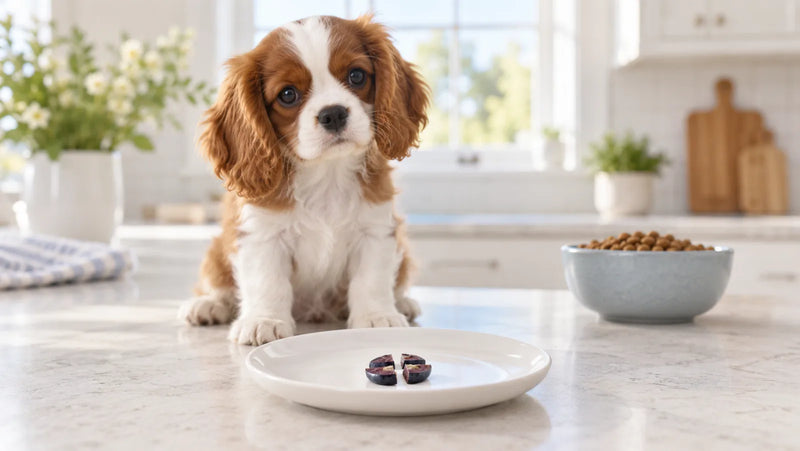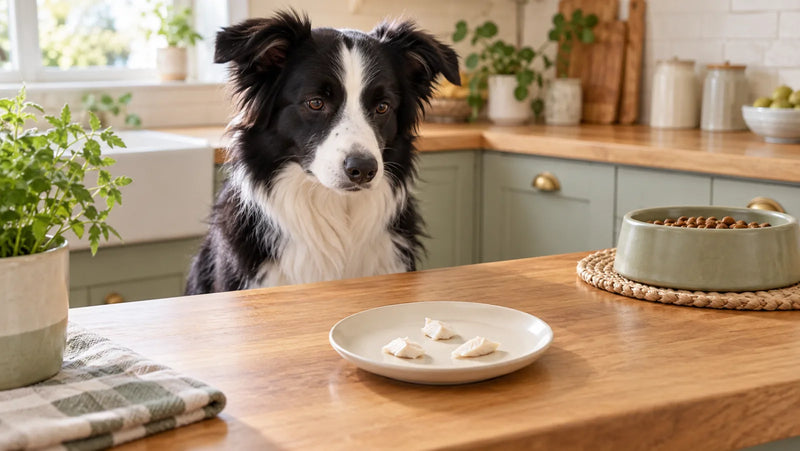

Can dogs eat peas? Yes—most healthy dogs can eat a few plain fresh, frozen, thawed, or gently cooked green peas as an occasional treat. Skip canned peas because they commonly come with added sodium. Shell garden or English peas, cut edible snow-pea and sugar-snap pods into dog-sized pieces, and serve every form without butter, salt, onion, garlic, or sauce.
A pea snack is optional, not a nutritional requirement or a home treatment. It also is not the same exposure as eating a complete dog food in which peas or other pulse ingredients make up a large share of the formula. That distinction matters when discussing the FDA's ongoing work on diet-associated dilated cardiomyopathy, or DCM.
Can Dogs Eat Peas? Yes, with Four Plain-Food Rules
The short answer applies to familiar culinary peas—not every plant called a pea and not every prepared dish containing peas. The AKC's veterinarian-reviewed pea guidance identifies snow peas, sugar snap peas, and garden or English peas as options in tiny amounts. Use four rules to turn that permission into a sensible serving:
- Choose the right form. Fresh, frozen, thawed, or plain cooked peas are easier to evaluate than canned or seasoned food.
- Prepare the pod correctly. Shell garden peas. Snow and sugar snap pods are edible for people, but they still need inspection and crosswise cutting for the dog in front of you.
- Keep the portion small. Peas belong inside the total daily allowance for treats and table-food extras, not on top of it.
- Respect the dog's medical plan. Kidney disease, urate stones, heart disease, swallowing trouble, food trials, and therapeutic diets change what counts as an appropriate extra.
For the wider safe-versus-toxic produce picture, use our complete vegetable-safety guide. This page owns the pea-specific decision, including pods, canned peas, the DCM question, and low-purine diet concerns.
Which Peas Can Dogs Eat?
Fresh, frozen, or thawed green peas
Plain green peas can be offered raw, thawed, or cooked until tender. Rinse fresh peas and check frozen packages for sauces, salt, butter, seasoning, or a mixed vegetable blend. A loose frozen pea may be manageable for some dogs, but a hard frozen clump is easy to gulp and unnecessary. Thawing or briefly cooking the peas gives you a softer, more predictable shape.
For a toy dog, puppy, senior dog, or any fast gulper, flattening or lightly mashing a few peas into the regular meal can be easier than offering a round mouthful. Let cooked peas cool fully before serving.
Snow peas and sugar snap peas
People eat the pods of snow peas and sugar snap peas, so the whole pod is not automatically off-limits. That does not mean an entire long pod is a good dog treat. Remove stems and tough strings, rinse the pod, and cut it crosswise into short pieces. Crosswise cuts shorten the long fibers and create a shape better matched to the dog's mouth.
Discard any pod that is moldy, slimy, badly wilted, or difficult to chew. For a dog with dental pain, weak chewing, an airway concern, or a history of swallowing food whole, choose a softer reward or ask the veterinarian rather than testing a fibrous pod.
Garden or English pea pods
Garden and English peas must be shelled. Their pods are tough and are not normally eaten by people. Do not assume that “natural” makes a pod digestible, and do not use a hard pod as a chew. Offer only the peas inside, in a small plain amount.
Canned, seasoned, creamed, or mixed dishes
Canned peas are the form to skip. As AKC notes, many canned vegetables contain substantial added sodium. Rinsing may remove some surface liquid, but it does not make the sodium content known or turn the can into a better choice than plain fresh or frozen peas. Dogs on heart, kidney, or sodium-restricted plans have even less room for guesswork.
Creamed peas, pea soup, pot pie, fried rice, casseroles, restaurant sides, and seasoned vegetable mixes must be assessed as complete recipes. Butter, cream, gravy, bacon, broth, salt, onion, garlic, and other ingredients can change the answer. Picking visible peas out of a seasoned dish does not remove a sauce that coats them.

How to Prepare Peas for a Dog
Keep them plain and choose a soft, dog-sized shape
Wash fresh peas and edible pods under running water. Shell garden peas. Remove pod stems and strings, then cut snow or sugar snap pods crosswise. If cooking, steam or simmer in plain water only and cool before serving. There is no need for oil, salt, stock, sweetener, or seasoning.
Match the shape to the individual dog rather than copying a human serving. A pea is small, but several round peas can still be inhaled by an excited small dog. Serve a few loose pieces, lightly mash them, or mix them through the normal meal. Do not toss a large frozen handful for a dog to catch.
Start with a few and watch tolerance
On the first trial, use only a few peas—fewer for a very small dog—and do not introduce another new food at the same time. Watch for vomiting, diarrhea, gas, abdominal discomfort, itching, coughing, gagging, or difficulty swallowing. Mild digestive upset means stop the new food and call the clinic if it persists or concerns you. Breathing trouble, collapse, repeated unproductive retching, or an ongoing choking episode needs urgent veterinary help.
Peas contain fiber, and suddenly adding a bowlful can cause more digestive trouble than a tiny taste. A dog that tolerates a few peas has not been cleared for unlimited portions or a complete diet change.
Count peas inside the total treat budget
Peas are extras. The dog's complete and balanced main food should supply the required nutrients, while all extras share one limited calorie allowance. Our daily dog-treat calorie guide explains the commonly used 10-percent ceiling and why the dog's body condition, activity, medical needs, and main food still matter.
Do not add peas because an online list calls them a “superfood.” The practical advantage is much simpler: plain peas can be divided into tiny pieces. They do not treat obesity, heart disease, kidney disease, inflammation, or any nutrient deficiency.
Peas, Grain-Free Diets, and DCM: What the FDA Actually Says
The investigation concerns complete diet patterns and formulation
In 2018, the U.S. Food and Drug Administration began investigating reports of non-hereditary canine DCM associated with certain diets. DCM is a disease in which the heart muscle becomes enlarged and pumps less effectively. The FDA's current questions and answers on non-hereditary DCM says many reported diets had non-soy pulse ingredients—such as peas or lentils—high in their ingredient lists.
That context is about what a dog eats repeatedly as its main diet, including ingredient proportions, nutrient availability, processing, formulation, feeding practices, genetics, and underlying conditions. It is not a finding that one pea, one ingredient name, or every grain-free label causes heart disease.
Association does not prove peas are inherently dangerous
The FDA explicitly says legumes and pulses have been used in pet foods for years with no evidence that they are inherently dangerous. Reports included both grain-free and grain-containing foods, although pulses were often used in greater proportions in many grain-free formulas. The agency does not know the specific connection and describes non-hereditary DCM as a complex condition with multiple possible factors.
The FDA also says it has no definitive information showing that the associated diets are inherently unsafe and require recall. Report totals are safety signals, not incidence rates or proof of cause. That is why “peas cause DCM” and “the investigation proved nothing matters” are both poor summaries.
When to discuss the main diet with a veterinarian
A few plain peas offered occasionally do not reproduce a complete diet with pulses high in the formulation. There is no reason to panic over a tiny snack in an otherwise healthy dog. But if peas, pea protein, lentils, chickpeas, or other pulses appear high in the ingredient list of the food your dog eats every day, discuss the whole diet with your veterinarian rather than removing ingredients at random.
Do not switch an important medical or complete diet abruptly based on a social-media list. Contact the veterinarian promptly if a dog develops unusual exercise intolerance, coughing, weakness, difficulty breathing, a swollen abdomen, or collapse. Those signs have many possible causes and cannot be diagnosed through an ingredient label.
Kidney Disease, Urate Stones, and the Purine Question
Online discussions sometimes borrow the human word “gout” and conclude that every dog must avoid every food containing purines. That is not a useful rule for healthy dogs. The more practical canine concerns are diagnosed kidney disease, hyperuricosuria, urate urinary stones, portosystemic shunts, and veterinarian-prescribed therapeutic diets.
The University of Minnesota Urolith Center's veterinary treatment recommendations list legumes, including beans and peas, among human foods to use sparingly when planning for purine uroliths. The same resource emphasizes matching nutrition to the stone type and following a veterinary prevention plan.
This does not mean a few peas create urate stones in a healthy dog. It means dogs already managed for urate stones, high urinary uric acid, a liver shunt, kidney disease, or a low-purine or renal prescription should not receive improvised extras. Ask the treating veterinarian whether peas fit the actual plan. Do not calculate a purine allowance from a human chart, replace the prescribed food, or use peas to increase urine output.
Canned peas are especially unhelpful here because they add an avoidable sodium variable. A dog on a therapeutic diet may need every treat to come from that same diet. “Only a vegetable” is not a medical exemption.
When Peas Are Not the Right Treat
- A therapeutic diet is in place: use only extras approved by the veterinarian, especially for kidney, urinary, heart, gastrointestinal, allergy, or weight-management care.
- The dog has swallowing difficulty: round peas and fibrous pods can be gulped. Choose a texture recommended for that dog.
- The dog is in a food-elimination trial: an unplanned pea changes the ingredient exposure and can make the trial harder to interpret.
- The dish is canned or seasoned: sodium and co-ingredients create unnecessary uncertainty.
- A first taste caused symptoms: stop serving it. Persistent vomiting, diarrhea, pain, swelling, coughing, or behavior change deserves veterinary advice.
Peas should never be used to persuade a dog to eat when the dog has suddenly lost appetite, seems weak, or is struggling to breathe. Those are reasons to contact the veterinary team, not opportunities to test a new snack.
Peas Compared with Green Beans and Other Vegetables
| Food | Default decision | Preparation priority |
|---|---|---|
| Fresh or thawed green peas | A few can be offered | Plain, loose, soft enough to chew, and counted as treats |
| Snow or sugar snap peas | Small pieces can be offered | Remove stems/strings and cut the edible pod crosswise |
| Garden/English pea pods | Do not offer the pod | Shell and serve only a few peas |
| Canned peas | Skip | Added sodium makes fresh or frozen peas the clearer option |
| Green beans | A separate vegetable choice | Use our plain green-bean serving guide for raw, cooked, frozen, and canned forms |
| Mixed vegetable dish | Check every ingredient | Onion, garlic, fat, salt, sauces, and recipe context can change the answer |
Frequently Asked Questions
Can dogs eat frozen peas?
Yes, if the ingredient list is plain peas. Offer them loose rather than as a hard frozen clump. Thawing or gently cooking them makes a softer choice for small dogs, seniors, and fast gulpers. Avoid frozen vegetable mixes with sauce, salt, onion, garlic, or seasoning.
Can dogs eat canned peas if they are rinsed?
Rinsing may remove some surface liquid, but many canned peas begin with added sodium and there is no need to guess how much remains. Choose plain fresh or frozen peas instead. A dog on a sodium-restricted or medical diet should receive only veterinarian-approved extras.
Can dogs eat pea pods?
Snow-pea and sugar-snap pods are edible, but remove stems and strings and cut them crosswise into short dog-sized pieces. Garden or English pea pods are tough and should be discarded after shelling. Any pod can be a poor choice for a dog that gulps or has swallowing trouble.
Are peas bad for a dog's heart?
A few plain peas as an occasional treat are not equivalent to a complete diet with pulse ingredients high in the formula. The FDA has observed common diet patterns in DCM reports but has not identified a simple cause-and-effect relationship or declared peas inherently dangerous. Ask your veterinarian to assess the full everyday diet.
Can dogs with kidney disease eat peas?
Do not add peas without the treating veterinarian's approval. Kidney disease and urinary stone types require different nutrient, mineral, sodium, moisture, and sometimes purine strategies. The prescribed diet and approved-treat list should take priority over general internet advice.
How many peas can a dog eat?
There is no universal pea count for every dog. Start with only a few, use fewer for a tiny dog, and keep peas inside the total daily treat allowance. Body condition, main-food calories, medical needs, and other rewards all affect the available room. Your veterinarian can give a case-specific amount.
Keep Peas Plain, Small, and Occasional
The household rule is straightforward: choose plain fresh or frozen peas, shell tough garden-pea pods, cut edible pods crosswise, skip the can, and serve only a small amount. Treat the DCM discussion as a complete-diet question and let any renal or low-purine plan override a general snack list.
If peas are not a good fit, there is no nutritional need to force them. For routine training and enrichment, browse current American Paws dog treats and choose a clearly labeled, appropriately sized reward that fits your dog's chewing style and veterinary diet plan.