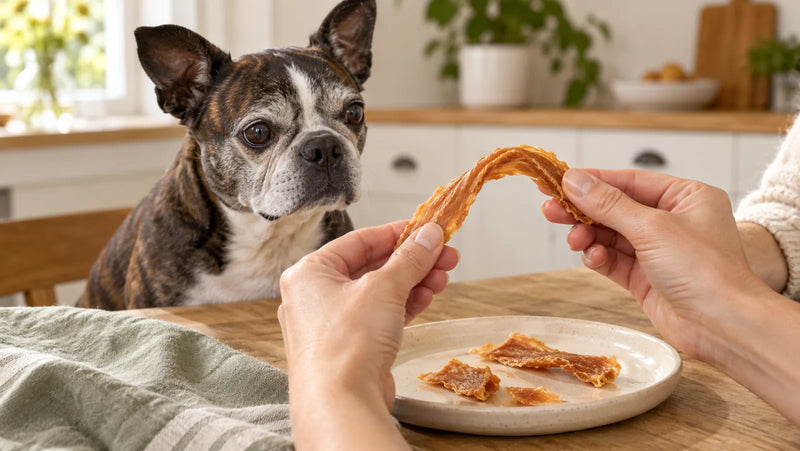

Chicken jerky vs cooked chicken for dogs is mainly a choice between a dry portable reward and a moist perishable one. Labeled chicken jerky usually fits training, walks, and travel because it is low-mess and easy to portion before leaving home. Plain fully cooked chicken usually fits a soft reward, a moist topper, or a short session near the refrigerator.
The important catch is water. Jerky has had much of its water removed, so the same weight can carry more calories than moist cooked chicken. Do not swap a one-ounce handful of one format for one ounce of the other. Read the current jerky label, measure the cooked chicken, and fit either choice inside the same daily treat allowance. Neither format is a complete main food.
Chicken Jerky vs Cooked Chicken for Dogs: The Quick Pick
| Decision point | Labeled chicken jerky | Plain cooked chicken |
|---|---|---|
| Water and texture | Dry, concentrated, usually firm or chewy | Moist, softer, and easier to mince |
| Calories by weight | Usually more concentrated because much of the water is gone; use the exact label | Usually less concentrated by weight because it retains more water; preparation still matters |
| Best job | Pre-portioned training, walks, travel, and a tidy occasional reward | Home training, a moist topper, or a softer high-value reward |
| Portability | Good when the package permits cool, dry storage and pieces stay clean and sealed | Needs cold control; not a leave-in-the-car or all-day pouch food |
| Storage rule | Follow the exact bag's resealing, temperature, and best-by directions | Refrigerate promptly at 40°F or below and use within the safe leftover window |
| Meal status | Treat or supplemental food unless the label explicitly says complete and balanced | Plain meat alone is not complete and balanced dog food |
If the dog needs ten quick repetitions on a walk, small pieces prepared from one measured jerky allowance are usually more practical. If the goal is to moisten dinner with a teaspoon-size measured extra at home, diced cooked chicken is usually easier. “Better” depends on the job, the dog, and the amount—not on which format sounds more natural.
Same Chicken, Different Physical Job
Chicken breast can become very different rewards after preparation. Plain cooked breast holds substantial water and should feel moist. Chicken jerky is dried, lighter, and firmer. That physical change affects chewing time, mess, transport, storage, and the number of calories that fit into a gram or ounce. Our guide to cooking chicken for dogs covers the plain preparation side.
It does not automatically make one format healthier. A single-ingredient label answers one question—what is in the product—but not how much a particular dog should eat, whether the texture suits that dog, or whether it balances a meal. The broader chicken jerky for dogs guide explains how to read a jerky label, evaluate traceability, prepare pieces, and supervise the dog.
For a clean comparison, keep the ingredient lanes narrow:
- Jerky lane: a dog treat labeled for dogs, with a readable ingredient list, calorie statement, feeding guidance, lot information, and storage directions.
- Cooked lane: boneless, skinless chicken cooked plain, without salt, onion, garlic, broth, oil, butter, sauce, spice blends, or drippings.
- Complete-food lane: the dog's usual nutritionally complete food, which continues to supply the planned diet.
Once seasoning, skin, bones, breading, smoke flavor, curing salt, or a mixed human meal enters the picture, it is no longer this simple comparison.
Water and Calorie Density Change the Portion
Why equal weight is not an equal swap
Water contributes weight and volume without contributing calories. When water leaves chicken during drying, the remaining protein, fat, minerals, and calories occupy less total weight. That is why dry jerky can be more calorie-dense by ounce than moist cooked chicken made from similar meat.
This does not create a universal conversion. Chicken cuts differ in visible fat, cooked chicken loses different amounts of water depending on method and time, and commercial jerky products can differ in formulation and final moisture. Even natural strips from the same bag vary in size. Compare stated calories and measured weight instead of assuming that one strip equals one cube or one ounce equals one ounce nutritionally.
A label-first comparison workflow
- Set one daily extras budget. Ask the veterinary team for the dog's total daily calories, especially for a puppy, a dog with weight change, or a dog on a prescribed diet.
- Count every extra together. Jerky, cooked chicken, dental chews, table tastes, pill pockets, and other rewards all use the same allowance.
- Use the jerky's current calorie statement. Do not rely on a remembered package, count torn pieces as calorie-free, or copy a serving from a different brand.
- Weigh the cooked chicken. A kitchen scale is more repeatable than “one chunk.” Use the calorie reference approved by the dog's veterinarian for the exact plain cut and preparation.
- Prepare the session amount once. Put only that measured amount in the pouch or topper cup, then stop when it is empty.
The WSAVA treat guide uses no more than 10% of daily calories from treats as a general ceiling for an average healthy adult dog. It is not a target, and a veterinarian may set a lower limit. For a complete calculation rather than a visual guess, use the guide to building one daily dog-treat budget.
Choose Chicken Jerky for Training, Walks, and Travel
Jerky earns its place when dry handling matters. A labeled strip can be divided at home, carried in a clean pouch, and delivered without a refrigerated container during an ordinary short outing—provided the package permits that storage and the pieces are not left in heat, moisture, or a vehicle.
The current American Paws single-ingredient Chicken Breast Jerky page identifies 100% USA chicken breast with no fillers, preservatives, or added ingredients. It describes whole-cut, chewy strips and directs owners to keep the resealed bag in a cool, dry place away from direct sunlight. The same page lists approximately 15 kcal per treat and a guaranteed moisture maximum of 12%. Those are facts about this product, not promises about every jerky on the market.
Break one measured allowance before the session
Do the calorie decision before the dog starts working. Select the day's jerky amount, break it into pieces appropriate for the individual dog's mouth and training pace, and return the bag to storage. Ten tiny training deliveries made from one measured strip do not become ten full-treat calories; they are simply subdivisions of the same allowance.
For rapid practice, the dog should be able to take, chew, and swallow a piece without stopping the session or gulping a long strip. Reserve a larger prepared piece for a single finish-line reward only when the dog's chewing style supports it. Supervise every format.
Match dry texture to the individual dog
Firm, chewy jerky may suit a healthy adult dog that chews deliberately. It may be a poor fit for a dog with painful dental disease, missing teeth, a swallowing problem, a history of gulping, or a medical diet that excludes chicken. “Breakable” does not mean risk-free, and jerky is a reward—not a long-lasting chew or dental device.
If the decision is between jerky and a different dried format, our dehydrated versus freeze-dried chicken comparison covers texture and product-format choice.
Choose Plain Cooked Chicken for a Moist Topper or Home Reward
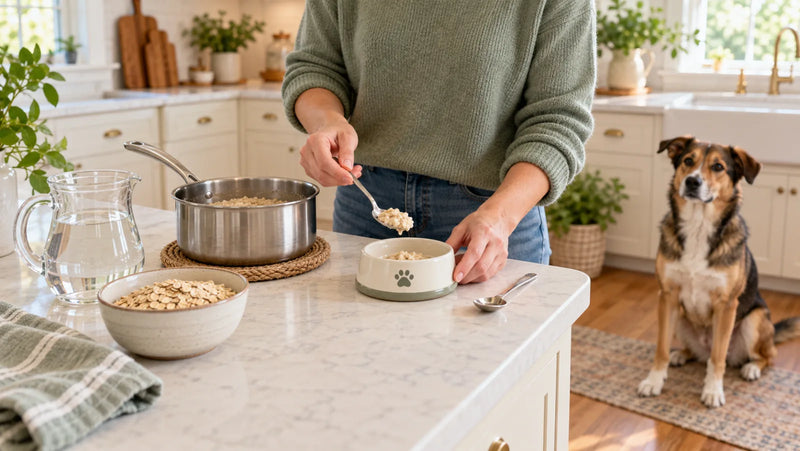
Plain cooked chicken is useful when moisture, softness, or easy mincing matters more than portability. A measured spoonful can make the aroma of the complete meal more noticeable, and finely diced pieces can function as high-value rewards during a short home session.
Keep the purpose narrow. A topper should sit on or mix into the complete food, not displace a large share of it. If a dog refuses the usual food, repeatedly increasing chicken can teach selective eating and can conceal pain, nausea, dental trouble, medication effects, or another medical problem. Persistent appetite change needs veterinary attention rather than an escalating topper.
Cook it plain and verify 165°F
Use boneless, skinless chicken and a clean food thermometer. FDA poultry guidance says all poultry should reach a minimum internal temperature of 165°F. Check the thickest representative piece, cool it safely, remove any overlooked bone or cartilage, and dice it to match the dog.
Boiling, baking, or poaching can all produce plain cooked chicken. The method matters less than full cooking and the absence of seasoning, skin, bones, and added fat. Do not use a sauce-coated pan, seasoned broth, onion or garlic powder, butter, or oil to make it more appealing.
Refrigeration starts the moment it cools
Cooked chicken is perishable. Refrigerate it promptly in a shallow covered container at 40°F or below. FDA's cooked-meat and poultry storage chart gives a refrigerator window of three to four days. Freeze measured portions if they will not be used within that window.
During training, start the food-safety clock when chicken leaves cold storage. Do not keep moist chicken in a warm pouch all afternoon, return warmed leftovers to the main container, or assume a car is a refrigerator. Discard pieces that sat out too long, smell wrong, feel slimy, or contacted a dirty surface.

Storage and Portability Side by Side
| Moment | Jerky control | Cooked-chicken control |
|---|---|---|
| Before use | Check seal, best-by information, odor, appearance, and label storage | Cook to 165°F, cool promptly, date the container, and refrigerate |
| At home | Keep in the original resealed bag in its labeled environment | Keep a measured portion cold; return the main container to the refrigerator |
| On a walk | Carry only the planned pieces in a clean dry pouch | Use an insulated cold container or choose another reward |
| In a vehicle | Do not leave in heat or direct sun | Do not leave unrefrigerated; a parked car is not safe cold storage |
| After use | Discard contaminated pouch crumbs and reseal the original bag | Discard warmed or questionable leftovers; wash the container and utensils |
FDA pet-food storage guidance recommends preserving original package information, keeping dry food and treats cool and dry, and securing treats so a pet cannot consume the whole supply. The original bag also keeps the product name, lot code, manufacturer, and best-by date available if a problem arises.
Rotisserie, Human Jerky, and Raw Chicken Are Different Decisions
Grocery rotisserie chicken is not automatically “cooked chicken” for this comparison. Skin, drippings, brines, onion, garlic, salt, and cooked bones can change the answer. The dedicated guide to rotisserie chicken for dogs shows how to separate a potentially plain meat portion from the parts that stay off the dog's plate.
Human jerky is also outside the lane. It may contain substantial salt, onion or garlic seasoning, sweeteners, curing agents, or spicy flavoring. Choose a product labeled for dogs and read the entire ingredient panel rather than borrowing from a convenience-store bag.
Raw chicken is not a softer version of cooked chicken. It adds foodborne-pathogen and household cross-contamination questions, and raw bones are a separate hazard. If that is the choice under consideration, use the evidence-based guide to raw chicken for dogs rather than carrying the cooked guidance over.
Neither Chicken Jerky nor Cooked Chicken Is a Complete Main Food
Chicken supplies protein, but a single meat does not supply every required nutrient in the correct amount and ratio for a dog's life stage. “Single ingredient,” “high protein,” “whole cut,” and “home cooked” describe attributes; none is a nutritional-adequacy statement.
AAFCO's pet-food selection guide explains that complete means all required nutrients are present and balanced means they are present in the correct ratios. Treats and supplements are generally fed in addition to a complete diet. Look for the nutritional-adequacy statement on the main dog food rather than asking chicken breast to do a formulated diet's job.
The article why chicken jerky cannot replace dog food takes this meal boundary further. The same limit applies to a bowl of plain cooked chicken: useful as a measured extra, not a nutritionally complete meal plan.
A Five-Step Decision for Today's Reward
- Name the job. Repeated outdoor training favors a clean, dry format; a moist home topper favors cooked chicken.
- Check the dog. Consider chicken tolerance, dental comfort, swallowing behavior, medical conditions, body-weight plan, and prescribed-diet rules.
- Check the food. For jerky, read the dog-specific label and storage directions. For cooked chicken, confirm plain ingredients, 165°F cooking, and refrigerated age.
- Measure the calories. Work from the day's shared extras budget, not equal-looking pieces or equal ounces.
- Prepare and supervise. Cut the selected amount to the dog's safe eating size, offer it under observation, and store or discard the remainder correctly.
There is no need to choose one format forever. A dog may use pre-portioned jerky on class day and a measured cooked-chicken topper at home another day. The controlling number is the combined weekly and daily pattern, not the number of containers in the kitchen.
When Neither Format Is the Right Choice
Pause both chicken options if the dog has a known or suspected chicken sensitivity, is in a formal elimination trial, eats a veterinary therapeutic diet, has pancreatitis or another condition requiring strict nutrient control, struggles to chew or swallow, or develops vomiting, diarrhea, itching, ear trouble, coughing, or repeated gulping around the food.
Choose the veterinary team's approved reward instead. Sometimes part of the dog's complete meal can be reserved for training, which protects the diet formulation and makes calorie accounting simpler. For dogs that can use ordinary dog treats but need another protein or texture, compare current labels across American Paws dog treats.
Frequently Asked Questions
Is chicken jerky or cooked chicken better for dog training?
Jerky is usually more practical for walks and repeated dry delivery. Plain cooked chicken can be useful for a short high-value session near cold storage. The better choice is the one that fits the setting, the dog's chewing style, and the measured calorie budget.
Is cooked chicken lower in calories than chicken jerky?
By equal weight, moist plain cooked chicken is generally less calorie-dense than dried jerky because it retains more water. Exact values depend on the cut, preparation, and product, so compare the jerky's current calorie statement with a reliable value for the measured cooked chicken. Do not compare by visual piece count.
Can I use cooked chicken as a dog-food topper every day?
A small measured amount may fit some healthy dogs, but it must remain inside the total extras allowance and should not displace complete food. Daily topping is not appropriate for every medical or prescribed diet. Ask the veterinarian if appetite change is new, persistent, or requires progressively more topper.
How long can cooked chicken stay out during training?
Use the ordinary food-safety clock: refrigerate perishable food within two hours, or within one hour when the temperature is above 90°F. A warm pocket or car may shorten the practical window. Carry a small cold portion and discard questionable leftovers.
Can chicken jerky replace a dog's meal?
No, unless a specific product explicitly carries a complete-and-balanced nutritional-adequacy statement for that dog—which ordinary chicken jerky treats do not. A meat-only treat cannot supply the full nutrient pattern of a formulated diet.
Is rotisserie chicken the same as plain cooked chicken?
Only a small amount of verified plain, boneless, skinless meat may fit; the skin, bones, drippings, brine, and onion or garlic seasoning do not. Grocery recipes vary, so read the label and see our guide to rotisserie chicken for dogs.
Match the Chicken Format to the Job
Choose labeled chicken jerky when the reward needs to be dry, portable, and prepared into training pieces. Choose plain fully cooked chicken when moisture, softness, or a refrigerated home topper is the real need. Compare calories rather than ounces, respect each format's storage rules, and keep the complete diet in charge.
Need the portable option? Review the current ingredient, calorie, and storage information for American Paws Chicken Breast Jerky, then select the bag that fits your routine from the chicken jerky collection. If chicken or chewy texture is not the right match, browse all dog treats and confirm the choice with your veterinarian.