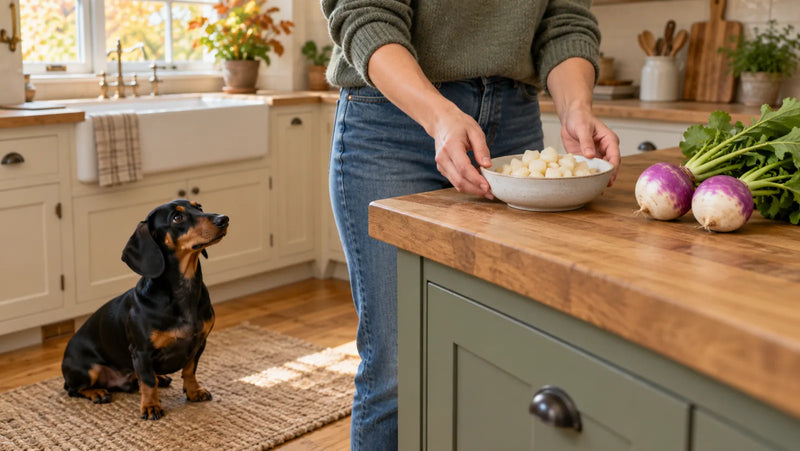

Green tripe for dogs is the cleaned but unbleached stomach lining of a ruminant such as a cow, sheep, or goat; “green” refers to its minimally processed state, not a guaranteed color. Its strong smell may make it appealing to some dogs, but the ingredient name does not prove that a finished product supplies clinically useful probiotics or digestive enzymes. Raw green tripe also carries the household pathogen concerns that apply to other raw animal foods.
That distinction matters because green tripe is often sold with a stack of benefits that sound more precise than the evidence: balanced calcium and phosphorus, living probiotics, digestive enzymes, immune support, cleaner teeth, and relief for digestive problems. Some statements may describe a laboratory result for one sample or a plausible property of fresh tissue. They do not automatically describe every frozen, dried, ground, canned, or mixed tripe product—or predict a health result in the dog eating it.
Green Tripe for Dogs: The Evidence-Based Answer
Green tripe can be an animal-protein ingredient or supplemental treat for a dog whose diet, health, and tolerance allow it. The strongest practical case is simple: many dogs find its intense aroma rewarding, so a small measured amount may encourage interest in food or work as a high-value reward. Palatability is not the same as therapeutic benefit.
Use the exact product record to decide what else can be said. A complete ingredient list can identify the source animal and additions. A guaranteed analysis and calorie statement can help with portions. A nutritional adequacy statement can tell you whether a food is complete for a stated life stage or only intermittent or supplemental. Process documentation can describe whether it is raw, frozen, dried, heat-treated, canned, or made with a validated pathogen control. None of those facts can be reconstructed from the word “tripe” alone.
| Claim or question | What can be said responsibly | Evidence still needed |
|---|---|---|
| Dogs may like the smell | The strong aroma can be highly motivating for some individual dogs | The dog’s actual response and tolerance |
| It contains protein and nutrients | Tripe is animal tissue, but nutrient amounts vary | Current analysis for the exact product and serving |
| It is a probiotic | Raw tissue may contain microorganisms; that alone does not establish a probiotic benefit | Named strains, viable amount through use, safety, and relevant clinical evidence |
| It supplies digestive enzymes | Tissue may contain enzymes, but presence is not proof of useful activity after processing and digestion | Identity, activity, stability, dose, and demonstrated outcome |
| It is balanced or complete | No single ingredient should be assumed complete | Appropriate nutritional adequacy statement or a veterinary nutritionist’s complete formula |
| It is safe because it is frozen | Freezing can preserve a raw product; it does not make it sterile | Product-specific process controls, testing, storage, and safe handling |
Green Tripe vs Bleached Tripe
Both products begin with the stomach of a ruminant. “Green tripe” generally refers to stomach lining prepared for pet food without the intensive cleaning, scalding, and whitening used to make the pale tripe commonly sold for human cooking. Most stomach contents are normally removed, but the exact cleaning and processing method belongs to the producer. Green tripe may look gray, brown, olive, or nearly black; a vivid green color is not a freshness test.
White or bleached tripe has been more thoroughly cleaned and processed for the human-food market. It is usually milder in odor and pale in appearance. That does not make it nutritionally identical to a particular pet-food tripe product, and it does not make the household cooking version a complete dog food. Seasoning, sauce, onion, garlic, fat, and recipe additions can make a prepared human dish inappropriate even when plain tripe itself is not toxic.
Do not choose between them by color alone. Ask for the source species, complete ingredient list, intended species, processing method, storage directions, calorie information, feeding statement, lot and date identification, and nutrient evidence. “Unbleached” is not a synonym for raw, and “dried” is not a synonym for pathogen-free.

What Green Tripe Actually Provides
Tripe is stomach tissue, so it supplies animal protein and fat along with vitamins and minerals in amounts that depend on the source animal, stomach compartment, trimming, retained contents, processing, and water loss. Removing water can make nutrients and calories more concentrated per ounce. Grinding, drying, freezing, or mixing with other ingredients can also change the serving unit a shopper actually feeds.
This is why a generic web chart is a poor substitute for the package. A table for raw beef tripe cannot be silently applied to a dehydrated lamb-tripe chew, a frozen blended food, or a canned formula. If calcium, phosphorus, fat, calories, or a micronutrient matters to the dog’s plan, use an analysis for the exact item and amount.
Tripe also sits awkwardly inside the everyday phrase “organ meat.” It is an internal organ anatomically, but feeding discussions often reserve “secreting organ” for nutrient-dense glands such as liver and kidney. Stomach tissue is not interchangeable with liver, heart, kidney, pancreas, or gizzard. The organ meats for dogs guide explains those categories, nutrient differences, and why one organ should not be swapped gram-for-gram for another in a formulated diet.
Claimed Benefits: What Is Plausible and What Needs Proof
Strong aroma and palatability
Green tripe’s odor is the easiest claim to observe. A strong-smelling animal food may interest a dog that ignores a less aromatic reward. That can make a tiny portion useful during training or as a topper when the dog’s veterinary plan allows extras.
It does not follow that tripe treats the cause of poor appetite. Sudden appetite loss, repeated meal refusal, vomiting, diarrhea, pain, weakness, weight loss, or trouble swallowing needs veterinary attention. Masking a symptom with a powerful smell can delay the diagnosis the dog needs.
Protein and nutrients
Tripe contributes protein and other nutrients because it is animal tissue. The useful question is not whether it contains nutrients, but how much the exact serving contributes to the entire diet. “Nutrient-rich” does not mean unlimited, low-fat, or complete. Some raw diets can be high in fat, and fat tolerance matters for dogs with a history of pancreatitis, gastrointestinal disease, obesity, or a prescribed diet.
A complete food has to deliver all required nutrients in appropriate amounts and relationships for its intended life stage. A single tripe ingredient does not demonstrate that. If the package says intermittent or supplemental feeding only, keep it in that role.
Probiotics and beneficial bacteria
A microorganism in raw tissue is not automatically a probiotic. A useful probiotic claim needs more than the general idea that some bacteria are beneficial: it needs the organism identified, a viable amount delivered through the end of use, evidence of safety, and evidence that the strain and dose support the promised outcome in the target animal.
Without those details, “naturally full of probiotics” is a marketing story rather than a dosing instruction. Processing and storage can change microbial survival, and the microbial population in a raw animal product may include organisms a household does not want. This does not prove that every green-tripe product contains no potentially beneficial microbes; it means the ingredient name cannot establish a reliable clinical probiotic effect.
Digestive enzymes
Stomach tissue and residual material may contain enzymes. The missing steps are identity, activity, stability after processing and storage, survival through the dog’s digestive tract, effective dose, and a demonstrated benefit. A label that lists only green tripe answers none of those questions.
Dogs already produce digestive enzymes. A dog with a diagnosed enzyme deficiency, such as exocrine pancreatic insufficiency, needs veterinary diagnosis and an appropriate enzyme product and dose—not a guessed amount of tripe. Do not replace prescribed treatment with a food claim.
Calcium-to-phosphorus and “complete food” claims
Some sellers quote a favorable calcium-to-phosphorus ratio as though that makes green tripe a complete meal. Even an accurate ratio for one sample addresses only two minerals. Complete nutrition also depends on total amounts, energy, protein and amino acids, fatty acids, vitamins, trace minerals, digestibility, life stage, and the rest of the formula.
Use a current laboratory analysis for the exact item when a mineral ratio matters. Then evaluate it inside the whole diet. Growing puppies, pregnant or nursing dogs, and dogs with kidney, urinary, pancreatic, gastrointestinal, or other medical needs should not receive a home-designed raw formula based on an isolated ratio.
Raw Green Tripe Has a Real Pathogen Risk
Raw tripe should be handled as raw animal tissue. The FDA’s raw pet food study and handling guidance reports that, among 196 commercially available raw dog and cat food samples, 15 tested positive for Salmonella and 32 for Listeria monocytogenes. The survey was not a green-tripe-only study, so those numbers should not be presented as a contamination rate for tripe. They do establish why “raw” cannot be treated as sterile.
The risk reaches beyond the bowl. People can spread organisms from raw food to hands, utensils, counters, refrigerators, floors, children, other pets, and their own mouths. Dogs may also carry or shed organisms without looking ill. Young children, older adults, pregnant people, and people or animals with weakened immune systems deserve especially cautious household decisions.
The FDA advises washing hands with soap and water for at least 20 seconds after handling raw pet food, cleaning and then disinfecting contacted surfaces and objects, thawing frozen raw products in the refrigerator or microwave rather than on the counter or in the sink, keeping raw food separate, and promptly refrigerating or safely discarding leftovers. It also warns not to rinse raw meat because splashing can spread contaminated juices.
The Tufts Cummings School veterinary nutrition FAQ says current evidence does not show raw diets offer benefits over cooked diets and notes bacterial, parasitic, nutritional, and human-health concerns. That broad raw-diet conclusion is not a trial of one green-tripe treat; it is a reason to demand product-specific evidence instead of assuming rawness creates a health advantage.
How to Evaluate a Green-Tripe Product
- Identify the animal and ingredient. Look for beef, lamb, goat, or another named source plus every addition. “Tripe blend” is not enough for an allergy or elimination trial.
- Confirm the form. Raw frozen, freeze-dried raw, dehydrated, air-dried, canned, cooked, and mixed foods need different handling and cannot borrow one another’s safety claims.
- Read the feeding statement. Determine whether the item is complete and balanced for a stated life stage or intermittent or supplemental only.
- Find calories and analysis. Use the unit on the label and ask for product-specific nutrient evidence when fat, minerals, or another value matters.
- Ask about process controls. Do not infer a kill step from drying, freezing, color, smell, or the word natural. Ask what the producer actually documents.
- Check storage and dates. Follow the package for freezing, thawing, refrigeration, resealing, opened life, and discard conditions.
- Preserve lot identity. Keep the original package, lot and date codes, receipt, and photos if a problem occurs.
- Interrogate special claims. For probiotic or enzyme promises, ask for the named organism or enzyme, amount or activity, stability, safety, and relevant outcome evidence.
Walk away from a product with an incomplete ingredient list, no responsible company, unclear species, damaged or leaking packaging, missing storage directions for a perishable form, an unreadable lot identity, or disease-treatment promises. A strong odor is normal for many tripe products; it cannot tell you whether a package is microbiologically safe.
Portion and Diet Role Depend on the Exact Product
There is no responsible universal scoop of green tripe. Raw tripe, dried tripe, a complete commercial raw formula containing tripe, and a small tripe treat have different water content, calories, nutrient density, feeding statements, and physical form. Start from the label, the dog’s total daily calories, and the role the item is meant to play.
For a dog already eating a complete-and-balanced main diet, a common planning ceiling is to keep all dog treats and other noncomplete extras together at about 10% or less of daily calories. That is a ceiling for the combined extras, not permission to devote the full amount to tripe, and it is not a prescription for a dog with a medical diet.
If tripe is part of a home-prepared main diet, work from a complete recipe formulated for the dog by a board-certified veterinary nutritionist. Do not replace muscle meat, liver, another organ, bone, calcium, or a supplement by visual similarity or by a seller’s isolated mineral ratio.
American Paws Does Not Sell Green Tripe
American Paws does not currently make or sell green tripe. For a buyer specifically seeking beef or another ruminant protein, raw tripe, or a veterinarian-directed novel-protein item, a chicken product is not a substitute.
American Paws does sell single-ingredient dehydrated chicken gizzards, which are a different muscular-organ reward. The current product page lists 100% USA chicken gizzards, a 4 oz bag, and approximately 47 kcal per piece. That calorie figure makes counting the actual portion important; use the live label, choose a piece that fits the dog, supervise, and break it only when doing so creates an appropriate, trackable serving.
Chicken gizzard is not tripe, not beef, not a probiotic, and not evidence for any green-tripe enzyme claim. Use the chicken gizzard benefits and safety guide for that ingredient’s specific role. If the goal is a plain cooked muscular-organ preparation rather than a packaged treat, the separate guide on how to cook chicken hearts safely keeps the methods and portions attached to the right food.
You can compare current American Paws dog treats by the exact ingredient, calorie information, texture, package, and feeding directions shown on each live page. The collection is not uniformly single-ingredient and no product should be inserted into a therapeutic or elimination diet without checking its current label and the veterinarian’s plan.
When to Call a Veterinarian
Contact the veterinary team before offering raw green tripe to a puppy, a pregnant or nursing dog, a dog or household with immune compromise, or a dog with a history of pancreatitis, chronic gastrointestinal disease, kidney disease, a prescribed diet, or a medically managed food reaction. The risk decision includes the people and other animals in the home, not only the dog at the bowl.
After eating tripe or another animal product, seek veterinary advice for repeated vomiting or diarrhea, blood, fever, marked lethargy, weakness, abdominal pain or swelling, inability to keep water down, trouble swallowing, repeated gagging or retching, breathing difficulty, collapse, or any rapidly worsening sign. Preserve the package, ingredient list, lot and date codes, storage history, amount, timing, and a photo of the product.
Do not diagnose Salmonella, Listeria, pancreatitis, an allergy, or an enzyme deficiency from a symptom list. Do not induce vomiting or give an antidiarrheal, antibiotic, probiotic, enzyme, oil, charcoal, or another home remedy unless the veterinarian directs that product and amount for this dog.
Frequently Asked Questions
Why is green tripe called green?
“Green” generally means the ruminant stomach lining has not undergone the intensive cleaning, scalding, and whitening used for pale human-food tripe. It may look gray, brown, olive, or dark rather than bright green. The word does not prove freshness, grass-fed sourcing, retained stomach contents, or a particular process.
Is bleached tripe the same as green tripe?
No. Bleached or white tripe is more thoroughly cleaned and processed, usually for human cooking, while green tripe is prepared as a minimally processed pet-food ingredient. Neither term makes the food complete, and prepared human dishes may contain unsafe seasonings or rich additions.
Is green tripe a proven probiotic for dogs?
Not from the ingredient name alone. A probiotic claim needs identified organisms, a viable amount delivered through use, safety evidence, and support for the promised outcome. Raw tissue may contain microorganisms, but an unknown microbial mixture is not a reliable probiotic dose.
Does green tripe contain digestive enzymes?
Fresh tissue may contain enzymes, but that does not show which enzymes remain active after processing and storage, survive digestion, reach a useful dose, or improve a dog’s health. A dog with a diagnosed enzyme deficiency needs veterinary treatment rather than a guessed serving of tripe.
Can green tripe be a complete meal?
Only use a product as a complete meal when its label carries an appropriate nutritional adequacy statement for the dog’s life stage. Plain green tripe should not be assumed complete from one nutrient, one mineral ratio, or a natural-food claim.
Is dried green tripe safer than raw green tripe?
Do not assume so from the format name. Safety depends on the documented process, controls, testing, packaging, storage, and handling for the exact item. Ask whether the producer uses a validated pathogen-control step; drying alone is not proof of sterility.
Choose Evidence Over the Smell Test
Green tripe has a distinctive identity and may be highly appealing to some dogs. Those are not reasons to turn it into a probiotic, enzyme therapy, balanced meal, or risk-free raw food. The honest decision uses the complete label, documented process, product-specific nutrition, household safety, and the dog’s veterinary context.
If tripe is truly the desired ingredient, choose a supplier that answers those questions directly. If the goal is simply a clearly labeled reward, compare current products by ingredient, calories, texture, and feeding role—then introduce one measured dog treat at a time.