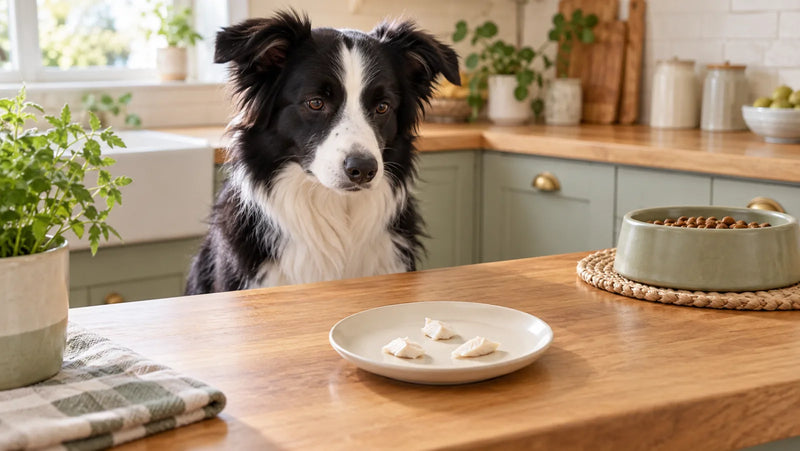

Organ meats for dogs can be useful in small, deliberate portions, but the organs are not interchangeable and more is not better. Liver, heart, gizzard, kidney, and lung provide different nutrients and textures. Liver needs the strictest limit because it is especially rich in preformed vitamin A.
For a dog eating complete-and-balanced food, keep every treat and noncomplete extra together at or below about 10% of daily calories. For a professionally designed home-prepared diet, concentrated secreting organs are commonly limited to roughly 5–10% of the formula by weight, with liver only a smaller part of that amount. That ratio is a planning convention, not a complete recipe.
Are organ meats for dogs a good idea?
Yes, many healthy dogs can eat properly sourced and prepared organ meat. Organs supply protein plus concentrated vitamins and minerals, and their aroma can make tiny pieces valuable for training. The useful word is supplemental: organ treats do not replace complete-and-balanced food and do not treat anemia, heart disease, joint disease, or a nutrient deficiency.
Nutrient density creates both the benefit and the limit. A small liver reward contributes far more preformed vitamin A and copper than the same size piece of ordinary muscle meat. A dog does not need a bowl of organ meat to receive a rewarding flavor. Start with one small piece, count it with all other extras, and use the product label or a veterinary nutritionist’s formula rather than guessing.
“Organ meat” includes two different feeding groups
Secreting organs are concentrated ingredients
Liver and kidney are the most familiar secreting organs. Spleen, pancreas, and some other glands also fall into this nutritional group. They are often used in carefully formulated home-prepared diets because their micronutrient profiles differ from skeletal muscle.
They are not free-form supplements. Substituting a large amount of liver for kidney, or adding a handful of several organs to an already complete food, can change vitamin and mineral intake substantially. A recipe needs analysis across the whole diet.
Heart and gizzard are muscular organs
Heart and gizzard are organs anatomically, but they are working muscles. In recipe formulation they are usually counted closer to muscle meat than to a secreting organ such as liver. That is why “10% organ meat” is confusing unless the writer says which category and which measurement the percentage describes.
Heart and gizzard still count as treats when fed outside the main diet. Their muscular classification does not create extra calorie room, and it does not make unlimited portions balanced.
What each organ contributes—and what limits it
Liver: vitamin A and iron, with the strictest limit
Liver provides protein and is naturally rich in preformed vitamin A, iron, vitamin B12, and copper. Those nutrients are why liver appears in complete foods and why a tiny piece can be a useful high-value reward. They are also why liver should not become the bulk of an organ rotation.
Use the chicken-liver serving guide for liver-specific introduction and vitamin-A cautions. To compare nutrient profile, texture, and use rather than assuming all liver is identical, see chicken liver versus beef liver.
Heart: taurine and lean protein
Heart is a dense muscular organ that supplies high-quality protein and naturally contains taurine. That makes it nutritionally distinct from liver, but a few heart treats do not prevent or treat dilated cardiomyopathy and should not be used as a taurine prescription.
Our guide to chicken-heart benefits and portions explains the muscular-organ distinction, preparation choices, and conservative serving approach.
Gizzard: lean protein and a chewable muscle texture
A chicken gizzard is the bird’s muscular stomach. Plain cooked gizzard can provide protein in a firm, chewy texture, but that texture is not a dental-health promise. Cut it for the dog’s size and supervise so a large or rubbery piece is not gulped whole.
Read the full guide to the benefits and limits of chicken gizzards for dogs, or go directly to how to cook chicken gizzards for dogs for trimming, plain preparation, cutting, and storage.
Kidney: concentrated micronutrients in a small serving
Kidney is a secreting organ with protein, B vitamins, and trace minerals. It belongs in the concentrated-organ side of a formulated diet, not as a direct one-for-one replacement for heart or gizzard. Strong flavor and richness make small introductions especially sensible.
Dogs with kidney disease do not automatically benefit from eating kidney. An organ’s name does not identify which food is appropriate for a medical condition; follow the prescribed diet.
Lung: light texture, still supplemental
Lung is structurally different from liver, kidney, heart, and gizzard. When dried, its airy texture can be easy to break into small pieces, but the finished product’s calories, ingredients, processing, and serving guidance still control how it fits.
Lung is not a “detox” food and is not a nutritional substitute for liver in a formulated recipe. Treat it as a separate supplemental food with its own label.

How much organ meat can a dog eat?
The correct limit depends on whether organ meat is an extra beside complete food or an ingredient inside a veterinary-formulated home diet. Do not switch between calories and food weight as if they were the same percentage.
| Feeding context | Practical guardrail | What it does not mean |
|---|---|---|
| Complete-and-balanced food plus treats | All treats, toppers, scraps, chews, and organ pieces together stay at or below about 10% of daily calories | Not 10% for liver plus another 10% for every other extra |
| Veterinary-formulated home-prepared diet | Follow the exact recipe by weight and ingredient; do not swap organs freely | A recipe remains balanced after substitutions |
| Common home-prepared/raw convention | Concentrated secreting organs are often kept to roughly 5–10% of total food weight, with liver only part—commonly about half or less—of that organ allotment | A universal prescription or a complete diet formula |
Complete-and-balanced food plus treats
The WSAVA guide to feeding treats keeps treats below 10% of daily calories so at least 90% comes from complete-and-balanced nutrition. Organ treats share that allowance with every biscuit, chew, table bite, topper, and training reward.
Use our daily dog-treat calorie budget to estimate the whole allowance. If the product does not provide calories per piece, contact the manufacturer or use a smaller, pre-portioned amount rather than guessing upward.
The 5–10% home-prepared-diet convention
A rough 5–10% band is commonly used for concentrated secreting organs in home-prepared or raw recipe discussions. Liver should be only a smaller share of the total diet—not 5–10% liver plus another full allotment of kidney and spleen. Heart and gizzard are muscular organs and are usually categorized separately during formulation.
This convention cannot balance calcium and phosphorus, essential fatty acids, amino acids, vitamins, trace minerals, energy, or life-stage needs by itself. Puppies, pregnant or lactating dogs, and dogs with medical conditions should never have a DIY percentage used as their complete nutrition plan. Ask a board-certified veterinary nutritionist to formulate or review the diet.
Why liver needs a smaller share
Preformed vitamin A is fat-soluble and stored in the body. The issue is usually repeated high intake over weeks or months, especially when large liver servings are stacked with cod liver oil or vitamin-A supplements—not one tiny appropriately portioned reward.
VCA’s vitamin-A toxicosis guidance identifies chronic feeding of vitamin-A-rich liver or supplements as a common route to excess. Possible chronic signs include poor coat or dry skin, weakness, weight loss, constipation, abnormal bone growth, and painful or limited movement. The Merck Veterinary Manual likewise documents skeletal and joint effects from vitamin-A toxicity in dogs.
Do not try to treat a suspected deficiency with extra liver. If a dog eats a very large amount at once, receives multiple vitamin-A sources, or develops concerning signs, call the veterinarian with the product, amount, timing, weight, and supplement list.
Raw, cooked, dehydrated, or freeze-dried?
Raw organ meat
Raw organ meat can carry pathogens that matter to the dog and the household. In FDA testing, raw pet food was more likely than other tested pet-food types to contain disease-causing bacteria, including Salmonella and Listeria monocytogenes. Freezing does not reliably sterilize raw meat.
The FDA raw pet-food safety guide recommends preventing cross-contamination, washing hands and surfaces, and recognizing that pets may spread pathogens even without appearing ill. Raw feeding creates added concern when the dog or anyone in the household is very young, older, pregnant, or immunocompromised.
For one organ-specific example, read our raw chicken-heart safety and handling guide. It owns the raw-heart question; this pillar covers the category-level decision.
Plain cooked organ meat
Thorough cooking to an appropriate internal temperature reduces bacterial risk. Prepare organ meat plain—without onion, garlic, chives, salt, butter, oil, gravy, or spice blends—then cool it and cut it into pieces suited to the dog’s size and chewing behavior.
Cooking does not turn an unbalanced ingredient into a complete diet and does not remove liver’s vitamin-A concentration. Portion rules still apply.
Dehydrated and freeze-dried organ treats
Dried formats are portable and easy to divide, but water removal makes nutrients and calories more concentrated by weight. Freeze-dried does not automatically mean sterile, complete-and-balanced, or unlimited. Read the ingredient list, intended use, calories, storage instructions, and manufacturer’s handling guidance.
American Paws single-ingredient freeze-dried beef liver training treats list 100% USA beef liver. That verified claim applies to this product, not the whole catalog. Use a few small pieces as supplemental rewards and keep them inside the shared treat budget.
How to rotate organ meats without overdoing them
- Inventory the current diet. Check the main food, toppers, treats, chews, fish oils, cod liver oil, vitamins, and home-cooked additions before adding anything.
- Choose the job. Use tiny heart or liver pieces for high-value training, gizzard for a supervised texture change, or another organ only because its label and portion fit—not because more variety sounds automatically healthier.
- Introduce one item. Start with a small piece on an otherwise ordinary day so stool, appetite, or skin changes are easier to describe.
- Pre-portion the day. Break dried pieces small and put the rest away. Rotation changes the type of reward; it does not expand the calorie allowance.
- Avoid nutrient stacking. Do not combine frequent liver treats, liver-heavy homemade food, cod liver oil, and vitamin-A supplements without veterinary direction.
If loose stool, vomiting, appetite change, itching, or another recurring sign appears, stop the new extra and contact the veterinarian. Persistent vomiting, marked weakness, collapse, severe pain, or inability to keep water down needs prompt care.
Which dogs need an individualized plan?
- Puppies: growth diets have narrow nutrient targets, especially for large breeds.
- Pregnant or lactating dogs: energy and micronutrient needs change, while vitamin excess can also matter.
- Dogs on prescription diets: an organ treat can defeat a controlled protein, mineral, fat, or calorie plan.
- Dogs with liver or copper-storage disease: liver may not fit the prescribed nutrient limits.
- Dogs with kidney disease: “kidney feeds kidney” is not a treatment principle; follow the veterinary renal diet.
- Dogs with pancreatitis history or fat restriction: organ type and finished-product fat content need case-specific review.
- Dogs with recurrent gastrointestinal signs: introduce nothing new until the underlying plan is clear.
Organ-meat cluster guides
Use this pillar to choose the right subtopic instead of asking one organ page to answer every question:
- Are chicken gizzards good for dogs? covers benefits, texture, safe forms, and portions.
- How to cook chicken gizzards for dogs covers trimming, plain cooking, temperature, cutting, and storage.
- Are chicken hearts good for dogs? covers the muscular-organ role, taurine context, and measured serving.
- Are raw chicken hearts safe for dogs? focuses on pathogens, household exposure, handling, and lower-risk alternatives.
- Chicken livers for dogs covers liver-specific nutrient density, vitamin-A moderation, preparation, and amount.
- Chicken liver vs beef liver for dogs compares the two without declaring one universally best.
Frequently asked questions
Can dogs eat organ meat every day?
Some complete foods include organs every day because the full formula is balanced. An organ treat can also fit regularly in tiny measured amounts, but all extras still share the 10% calorie ceiling and liver must stay modest. Do not turn a daily treat into a daily organ-heavy meal.
What is the best organ meat for dogs?
There is no universal best organ. Liver is highly concentrated, heart and gizzard are muscular, kidney is a secreting organ, and lung has a different texture. Choose by the dog’s complete diet, health plan, protein tolerance, serving purpose, and product label.
Are chicken hearts and gizzards organ meat?
Anatomically, yes. Nutritionally, they are muscular organs and are usually treated more like muscle meat than liver or kidney during recipe formulation. They still count as treats when served outside the main diet.
Can dogs eat raw organ meat?
Raw organ meat can contain pathogens and create household cross-contamination. FDA advises that raw pet food carries risks to pets and people. Discuss the choice with your veterinarian, especially around vulnerable dogs or household members, and never assume freezing makes raw meat sterile.
Can too much liver hurt a dog?
Yes. Repeated large liver servings or stacking liver with vitamin-A-rich oils and supplements can create chronic vitamin-A excess. Keep liver a small part of the organ allotment and call your veterinarian after a large accidental intake or concerning signs.
Use organ meats as small, deliberate rewards
Organ meats can add variety and high reward value when each one has a defined role, a measured portion, and an honest limit. Keep complete-and-balanced food in charge, separate muscular organs from concentrated secreting organs, and reserve the smallest share for liver. For how organs sit beside muscle meat and fish, see our overview of protein sources for dog treats.
If beef already fits your dog’s diet, use a few pieces of American Paws freeze-dried beef liver as supplemental training rewards. You can also browse all American Paws dog treats to compare current formats. Whatever you choose, count every piece, introduce it gradually, and let a veterinary nutritionist—not a percentage copied from the internet—design any complete home-prepared diet.