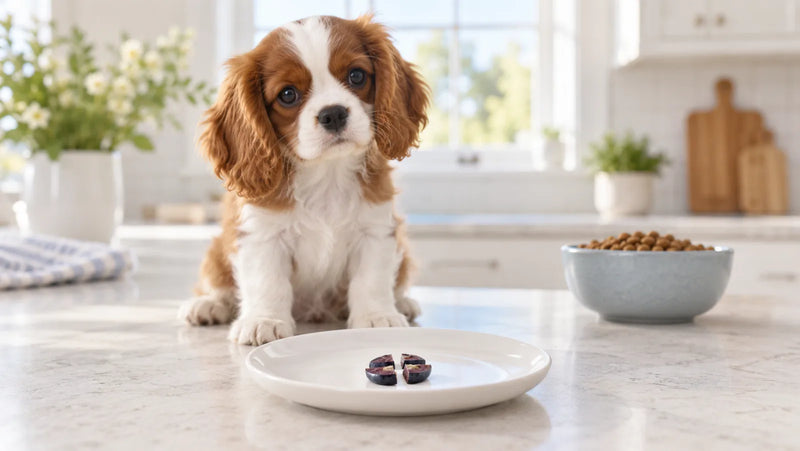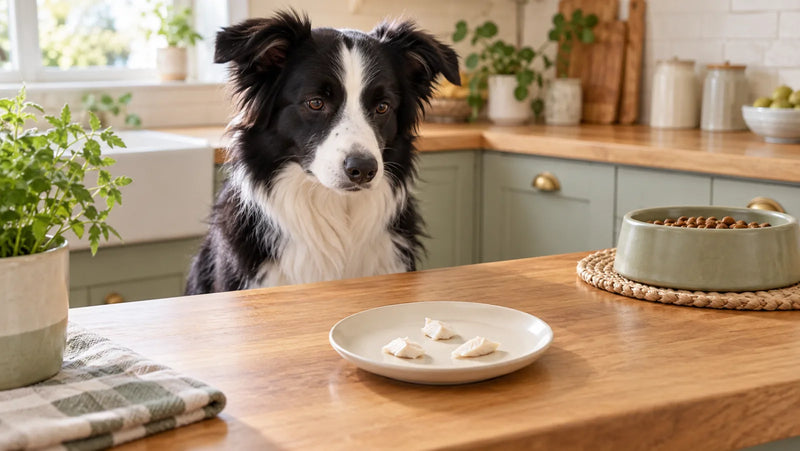

If you need to know how to cook chicken hearts for dogs, keep them plain and boil, bake, or heat-then-dehydrate them until the thickest heart reaches 165°F internally. Boiling usually takes about 10–15 minutes after the water returns to a gentle simmer; baking at 375°F often takes 15–25 minutes. Time only tells you when to start checking—the food thermometer decides when the center is done.
For dried hearts, reach 165°F with a controlled heat step first, then dry evenly cut pieces until the thickest cooled piece has no moist center. Cool every method before cutting or serving. Refrigerate cooked hearts promptly, use moist cooked pieces within three to four days, and freeze measured portions you will not use in that window.
How to Cook Chicken Hearts for Dogs: The Quick Method
- Thaw safely. Defrost frozen hearts in the refrigerator, not on the counter.
- Trim and separate. Remove obvious clots, tough connective tissue, or excess surface fat as desired. Keep raw tools away from cooked food.
- Keep them plain. Do not add oil, butter, salt, broth, onion, garlic, sauce, or seasoning.
- Choose one method. Simmer, bake, or apply a verified heat step before dehydrating.
- Check the thickest center. Insert a food thermometer from the side into the largest piece and verify 165°F.
- Cool, cut, and portion. Match pieces to the dog's mouth and chewing style, then count them with every other treat.
- Chill promptly. Refrigerate or freeze in small dated portions; do not leave a home batch on the counter.
The CDC's chicken-safety guidance identifies raw chicken as a possible source of foodborne germs, advises against washing it, and says poultry should reach 165°F. The FDA's safe-handling guidance likewise emphasizes clean hands, separation, a food thermometer, and prompt chilling. Those household controls apply whether the hearts are intended for people or a dog.
Before You Cook: Trim, Separate & Keep Plain
Buy hearts from a food supplier, keep them cold, and follow the package date and storage directions. If frozen, thaw only the amount you plan to cook in the refrigerator. Put the package in a bowl or tray so drips cannot reach ready-to-eat food. Do not thaw on the counter or let the dog lick the package, sink, board, or raw juices.
Do not rinse chicken hearts. Splashing water can move raw-poultry germs to the sink, faucet, nearby utensils, and food. Lift the hearts from the package with clean tongs, blot surface moisture with a disposable towel if needed, and discard the towel immediately.
Examine each heart under good light. Trim a visible clot, tough vessel, loose connective tissue, or a large flap of surface fat if you want a more even piece. Exact trimming is not a safety test; the thickest center still needs to reach 165°F. Wash hands with soap and running water for at least 20 seconds after touching raw poultry, and clean then sanitize the contacted board, knife, counter, sink, and faucet.
Use no seasoning. Plain water is enough for simmering, and a bare lined pan is enough for baking. Broth can contain onion, garlic, or more sodium than expected; “natural” spice blends can hide the same problem. Hearts are already a rich extra, so oil and butter add no useful cooking advantage for the dog.
Method 1: Boiled Chicken Hearts for Dogs
Boiling is the simplest method when you want soft, moist pieces that are easy to dice for training or a food topper. Whole hearts can cook evenly if they are similar in size; butterfly unusually large hearts so one oversized center does not control the whole pot.
- Place the trimmed hearts in a small pot and add enough plain water to cover them.
- Bring the water to a boil, then reduce it to a gentle simmer. Hard rolling water can split small pieces but does not replace an internal-temperature check.
- Start the timer once the water returns to a simmer. Begin checking at 10 minutes; most small-to-medium hearts finish in roughly 10–15 minutes, while very large or crowded batches can take longer.
- Remove the largest heart with clean tongs. Insert an instant-read thermometer from the side into its thickest center. If it reads below 165°F, return it and continue simmering before checking again.
- Drain the cooked hearts in a clean colander. Spread them on a clean plate or shallow container so they cool quickly; never return them to the raw-food plate.
Do not use pinkness, floating, firmness, or “the water boiled” as the endpoint. Heart muscle can stay dark even when fully cooked, and surface color cannot tell you the center temperature. If a piece is too small for a reliable thermometer reading, test the largest piece in the batch and cut it open after cooling to confirm there is no cool raw-looking center.
Method 2: Baked Chicken Hearts for Dogs
Baking gives you a firmer, less watery result and makes it easy to spread the hearts in one layer. Preheat the oven to 375°F. Pat the hearts dry, trim as needed, and butterfly very large pieces so the batch is reasonably uniform.
- Line a rimmed sheet pan with parchment paper or a reusable liner approved for the oven. Do not add oil or cooking spray.
- Arrange the hearts in one layer with space between them. Avoid piles, folded pieces, and a pan so crowded that released liquid pools around the batch.
- Bake on the center rack. Begin checking at 15 minutes; many batches finish in about 15–25 minutes, but heart size, starting temperature, pan material, oven accuracy, and load can move the endpoint.
- Test the thickest center from the side. Continue baking until that piece reaches 165°F.
- Transfer the cooked hearts with clean utensils to a clean shallow plate or cooling rack. Do not leave them on the hot pan longer than needed, because carryover heat can make small pieces tough.
One pan can contain hearts of several sizes. Remove small pieces that have reached temperature while larger pieces continue, using clean tools each time. The method is finished only when every size group has a verified representative piece.
Method 3: Dehydrated Chicken Hearts for Dogs
A dehydrator is a drying tool, not proof of a pathogen-control step. For a cautious home method, butterfly or slice the hearts to a consistent thickness, bring the thickest representative piece to 165°F in a controlled oven, steam, or simmer step, and then move the cooked pieces with clean utensils to clean preheated dehydrator trays.
- Arrange the heat-treated pieces in one layer without touching or folding. Leave space for airflow.
- Use the appliance maker's setting for meat. Do not assume the number on the dial equals the coldest internal temperature of the food.
- Begin checking around six hours. Uniform butterflied or sliced hearts often need roughly 6–10 hours, while thicker pieces, a fuller load, humid air, or a different machine can take longer.
- Remove the thickest test piece and let it cool completely before judging it. Warm food can feel softer and wetter than the final texture.
- Cut the cooled test piece. It should be firm and dry through the center, with no soft, spongy, cool-wet, or tacky pocket. Continue drying and retest if uncertain.
Do not promise pantry life from dryness alone. A home batch has not been validated for water activity, packaging, or shelf life. Our general guide to dehydrator dog treats explains the heat gate, case-hardening check, batch notes, and refrigerator/freezer-first storage plan in more detail.

Cool and Cut for the Dog in Front of You
Cool hearts before serving. A piece that feels merely warm on the surface can still hold steam in the center. Cooling also makes the final texture easier to judge and lets you cut neat, consistent pieces instead of squeezing a hot heart.
There is no safe universal “one whole heart” serving unit. Raw hearts vary in size, trimming changes weight, and moist cooking changes water content. That variation is why the table below uses grams and small pieces rather than assuming every heart is equivalent.
- Toy and small dogs: mince or dice the cooked heart into pieces no larger than a pea.
- Medium dogs: start with small pea-size pieces; larger does not make the treat more valuable.
- Large dogs and gulpers: cutting still matters. Offer controlled pieces one at a time instead of allowing a whole heart to disappear without chewing.
- Training use: make many tiny rewards from one measured portion rather than adding a new handful for each session.
Supervise the first serving and provide fresh water. Stop and contact a veterinarian for repeated vomiting or diarrhea, facial swelling, hives, breathing difficulty, marked lethargy, choking, or another concerning reaction. Dogs with a history of pancreatitis, a prescribed diet, chicken allergy, or another nutrition-sensitive condition need individual veterinary guidance before this recipe.
Cautious First-Taste Portion Table by Body Weight
This table is an editorial starting point for a healthy adult dog's first taste of plain cooked heart, not a daily allowance and not a complete feeding plan. Weigh the cooled cooked portion when possible. If the dog is medically restricted, very young, or has never tolerated chicken, skip the table and ask the veterinary team first.
| Dog's body weight | Cautious first taste | How to serve it |
|---|---|---|
| Under 10 lb | 1–2 g cooked heart | One or two tiny, pea-size-or-smaller pieces |
| 10–25 lb | 2–4 g cooked heart | One to three small pieces |
| 26–50 lb | 4–7 g cooked heart | Several small pieces offered one at a time |
| 51–75 lb | 7–10 g cooked heart | A measured group of small pieces |
| Over 75 lb | 10–14 g cooked heart | A measured portion, still cut and supervised |
Wait until the next day before increasing a new food, and change only one thing at a time so a reaction is easier to interpret. For routine use, calculate the dog's complete diet rather than scaling this first-taste table upward. The World Small Animal Veterinary Association's treat guide recommends that treats and extras stay below 10% of daily calories so complete and balanced food supplies at least 90%.
Chicken heart shares that allowance with every training reward, chew, topper, table bite, and food used for medication. For the nutrient profile and ongoing-feeding decision, use our guide to chicken-heart benefits and feeding. A first taste is not a hearts-per-day rule; ongoing amounts depend on the dog's whole diet.
Refrigerate or Freeze the Batch
Move cooked hearts into shallow containers and refrigerate within two hours of cooking—or within one hour when the room or outdoor temperature is above 90°F. Keep the refrigerator at 40°F or below. Divide a large batch before chilling so heat can escape; do not seal a deep container packed with steaming hearts and expect the center to cool quickly.
Use moist boiled or baked hearts within three to four days. The FDA refrigerator and freezer storage chart gives that refrigerator window for cooked meat and poultry leftovers. Label the container with the cook date. Freeze any portion you will not use in time, ideally in the measured amounts you expect to thaw.
Thaw frozen cooked hearts in the refrigerator. Avoid repeated thawing and refreezing, discard food left out too long, and throw away any portion with mold, slime, unexpected tackiness, package swelling, or an unusual or rancid odor. For a home-dehydrated batch, refrigeration or freezing remains the conservative default; dryness does not create a verified shelf life.
Related Chicken-Heart Guides
Cooking is only one of the chicken-heart questions owners ask. Use the companion pages according to the decision you are making:
- Chicken-heart benefits and feeding covers what heart is, what nutrients it contributes, and how to think about routine extras.
- Raw chicken-heart safety covers foodborne-pathogen exposure, household risk, sanitation, and why fully cooked is the conservative home choice.
- The organ-meat guide for dogs explains how heart differs from liver, kidney, and other organ-style treats when building a varied treat plan.
- The guide to giblets for dogs separates heart, liver, and gizzard preparation instead of treating a mixed giblet packet as one ingredient.
That separation matters because “organ,” “giblet,” and “heart” are not interchangeable serving instructions. A preparation method can make a food easier to handle, but it does not make the food nutritionally complete or appropriate for every medical diet.
When a Ready-to-Serve Heart Treat Is Easier
Home cooking makes sense when you want a soft texture or have a small fresh batch to use. It also means handling raw poultry, checking temperature, cooling quickly, cleaning the kitchen, and managing refrigerator space every time.
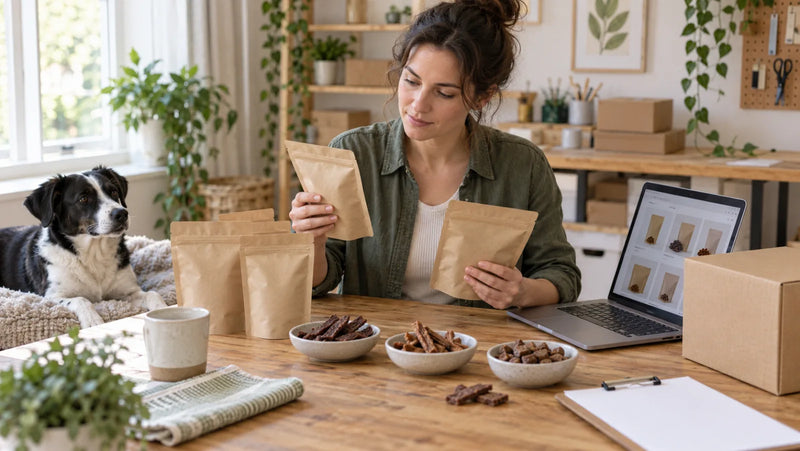
For a labeled alternative without home raw-organ preparation, American Paws offers single-ingredient dehydrated chicken-heart dog treats made with 100% U.S. chicken hearts and nothing added, in a resealable 4 oz bag. The product is intended for intermittent or supplemental feeding, not as a complete meal. The product page lists approximately 20 kcal per piece, a guaranteed-analysis moisture maximum of 10%, and a feeding guide of one to four hearts per day by dog size. Treat those as the packaged product's numbers, not as a rule for fresh cooked hearts.
Do not transfer the home first-taste table to a packaged treat or treat a product's serving suggestion as a universal rule for fresh cooked hearts. Read the current package directions, account for the actual product within the dog's treat calories, and reduce other extras accordingly. You can also browse all current American Paws dog treats by ingredient and format.
Frequently Asked Questions
How long do chicken hearts take to boil for dogs?
Begin checking about 10 minutes after the water returns to a gentle simmer. Many small-to-medium hearts reach 165°F in roughly 10–15 minutes, but size, starting temperature, and pot load vary. Test the largest heart rather than relying on the clock.
How long do chicken hearts take to bake for dogs?
At 375°F, start checking at about 15 minutes. A typical single-layer batch may take 15–25 minutes. Continue only until the thickest center reaches 165°F, then move the hearts off the hot pan to cool.
Can I cook chicken hearts in an air fryer?
You can cook plain hearts in an air fryer, but small pieces and strong airflow make exact timing highly machine-dependent. Use a clean basket, avoid oil and seasoning, keep one layer, and verify 165°F in the thickest center. Boiling or baking is easier to document for a first batch.
Do I need to cut chicken hearts before cooking?
Not always. Similar small hearts can cook whole, but butterfly unusually large ones so the batch is more uniform. For dehydration, butterfly or slice them before the drying stage. Cut serving pieces after cooking and cooling so they match the dog's mouth and chewing style.
Can dogs eat chicken hearts every day?
Daily frequency cannot be decided from one ingredient alone. The dog's calorie needs, complete food, all other extras, medical conditions, and the size of the heart portion matter. Keep treats and extras below 10% of daily calories unless the veterinarian or veterinary nutritionist provides a different plan.
Can puppies eat cooked chicken hearts?
A tiny fully cooked plain piece may be tolerated by some puppies, but growth diets leave little room for nutritionally incomplete extras. Ask the puppy's veterinarian, keep the piece very small, introduce only one new food, and never replace complete puppy food with heart.
Choose the Method, Then Verify the Center
Boil for a soft easy-to-dice result, bake for a firmer batch, or use a verified heat step before dehydrating for a dry treat. Whichever route you choose, the core controls do not change: plain ingredient, clean separation, 165°F in the thickest center, full cooling, dog-appropriate cutting, a modest portion, and prompt cold storage.
Write the cook date and method on the container, freeze what will not be used within three to four days, and discard anything questionable. A thermometer reading and a conservative storage plan do more for a dependable batch than color, a fixed timer, or a whole-heart serving shortcut.