To learn how to cook cauliflower for dogs, rinse it under running water, cut uniform small florets, and steam them plain for about 5–7 minutes, starting the fork test at 3 minutes. Stop when the thickest attached stem pierces easily and mashes under a fork. Cool the batch completely, then chop the dog's piece again for that dog's mouth and eating style.
Small florets can also be gently boiled. Begin checking after about 3 minutes and continue only until the center is soft, often around 4–6 minutes in a small batch. Use no oil, salt, butter, cheese, cream, broth, onion, garlic, or seasoning.
The clock is a planning tool, not the endpoint. Floret size, stem thickness, batch depth, pot, burner, altitude, and starting temperature all change the timing. Easy piercing and mashing decide when the dog batch is ready.
How to Cook Cauliflower for Dogs: The Short Method
Make a tiny dog-only batch rather than cooking a whole head and feeling pressure to serve it. The table below gives useful times for uniform pieces, followed by the texture test that actually controls.
| Cut and method | When to check | Dog-batch endpoint |
|---|---|---|
| About 1-inch florets, steamed | Start at 3 minutes; often about 5–7 minutes total | Thickest attached stem pierces easily and the piece mashes under a fork |
| About 1-inch florets, gently boiled | Start after about 3 minutes; often about 4–6 minutes total | Soft through the center, drained promptly, with no firm core |
| Peeled tender stem in small dice, cooked separately | Start around 6 minutes; continue as needed | Every cube mashes easily, with no stringy or springy resistance |
- Choose a firm head and remove spoiled, bruised, or slimy areas.
- Rinse under plain running water; do not use soap or produce wash.
- Separate small uniform florets from the thick core and outer leaves.
- Steam or boil a small amount in plain water until fork-soft.
- Spread the pieces on a clean plate and cool completely.
- Chop or mash the dog's serving again, then offer one tiny piece first.
- Refrigerate the untouched batch promptly in a clean covered container.
Select, Wash, and Separate the Cauliflower Head
Choose a compact white or cream-colored head with firm florets and no slime, mold, deep decay, or unpleasant odor. A few superficial color changes do not automatically mean spoilage, but any soft, wet, or rotten section belongs in the discard pile. Do not try to rescue a badly deteriorated head for a dog.
The FDA's produce-safety guidance says to wash hands, cut away damaged or bruised areas, and rinse produce thoroughly under running water. Soap, detergent, and commercial produce wash are not recommended. Wash the whole head before the knife moves through it so surface dirt is not carried into the cut areas.
Use a clean board, knife, pot, basket, colander, and cooling plate. Keep raw meat, poultry, seafood, and their utensils away from the cauliflower. If both foods are being prepared in the same kitchen session, the plain chicken cooking guide for dogs covers the animal-protein workflow and its separate doneness checks.
Break the crown into florets of roughly the same size, aiming for pieces around an inch across for even cooking. The cooking cut is not the serving cut; the pieces will be made smaller after cooling. Remove the coarse outer leaves and the thick woody core from the intentional dog batch. If a section of inner stem is genuinely tender, peel the fibrous exterior, dice the center finely, and cook those cubes separately.
Step-by-Step Plain Steamed Cauliflower
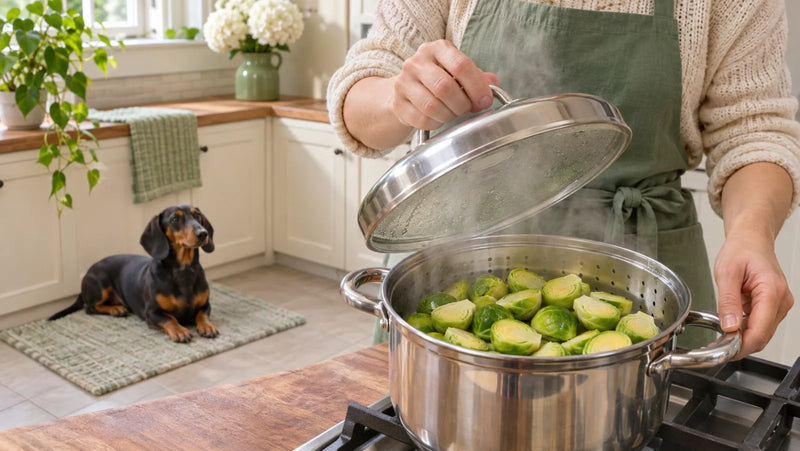
Steaming keeps the florets easy to inspect and does not require fat or seasoning. Utah State University Extension's cauliflower preparation guide gives 3–5 minutes for ordinary steamed cauliflower that is barely fork-tender. A dog batch may need another minute or two to reach an easily mashed texture, so begin checking at 3 minutes and let the fork—not the timer—finish the decision.
- Set the water level. Add enough water to maintain steam without letting it touch the basket. Bring it to a steady boil before loading the cauliflower.
- Use one loose layer. Place a small amount of uniform florets in the basket. A deep pile cooks unevenly and makes timing less useful.
- Cover and start checking early. Cover the pot and test at 3 minutes. Push a fork through the thickest attached stem, not only the soft flowering top.
- Continue to the texture endpoint. Many small batches become easily mashable in about 5–7 minutes. Keep checking rather than automatically extending every batch to the top of the range.
- Remove the basket. Transfer the cauliflower to a clean plate in a single layer so trapped steam does not keep heating the center.
- Cool completely. Open one of the thickest pieces and check its center before making the final serving cut.
Do not add oil to prevent sticking; nothing should be touching a dry pan. Do not add salt to the water, and do not finish the batch with butter, cheese, cream, sauce, herbs, garlic, onion, or seasoning. Plain preparation makes the serving easier to measure and any digestive response easier to interpret.
Plain Boiled Cauliflower Is a Second Option
Boiling can make a very soft texture, but it is easier to overcook or waterlog the pieces. The University of Minnesota Extension's vegetable blanching table gives 3 minutes in boiling water for one-inch cauliflower florets. Blanching aims at a different result than this dog-soft method, so treat 3 minutes as the first check, not an automatic finish.
- Bring a small pot of plain, unsalted water to a boil.
- Add one loose layer of uniform florets and let the water return to a gentle boil.
- Begin the fork test at about 3 minutes. Continue only until the thickest center pierces and mashes easily, often about 4–6 minutes total.
- Drain immediately in a clean colander. Do not leave the florets soaking in hot water.
- Spread them on a clean plate, cool completely, and make the final dog-size cut.
Never borrow salted pasta water, soup, stock, pan drippings, or liquid that held onion, garlic, seasoning, or raw animal food. A plain vegetable placed into a seasoned or contaminated liquid is no longer a plain batch.

Florets and Stems Need Separate Timing
A floret includes the flowering top and a short attached stem. Those parts are relatively small and cook together when their sizes are uniform. The thick central stem and core are denser. If a large core chunk goes into the same basket, the top may collapse while the center remains firm and stringy.
For the simplest batch, use florets and discard the coarse core and outer leaves. There is no nutritional requirement to make a dog eat the entire plant. If using a tender inner-stem section, peel away the fibrous outside, cut the center into small even dice, and cook it by itself. Do not mix the dice with the florets until every cube passes the mash test.
A thick cauliflower stem is not a chew. Cooking can soften plant tissue, but it does not turn a large or stringy piece into a controlled serving. The existing guide to whether dogs can eat cauliflower handles the broader floret, stem, leaf, raw-versus-cooked, portion, and accidental-exposure questions.
Cool, Then Chop for the Individual Dog
Uniform one-inch florets are useful for even cooking, but they are too large to treat as a universal serving size. After the batch is fully cool, cut or mash the selected piece again. A small dog, fast gulper, senior dog, puppy, or dog with dental or swallowing limitations may need rice-size fragments or a soft mash—and some dogs should skip the experiment entirely unless their veterinarian approves it.
A calm larger dog still does not need a whole floret. Offer the first tiny piece while supervising and watch how the dog picks it up, chews, and swallows. No cut size can guarantee against choking. Serve the piece cool or only mildly lukewarm, never steaming hot or frozen hard.
Do not place a mound in the regular bowl before the first test. Keeping the taste separate makes it possible to see whether the dog wants it, handles the texture, and tolerates it without changing an entire meal.
The Portion Ceiling Is Shared With Every Extra
One tiny cooled piece is a tolerance test, not a daily allowance. There is no universal cup, floret count, or body-weight chart that accounts for each dog's complete diet, calorie need, size, medical plan, and digestive response. A large dog does not need a bowl merely because it has more body weight.
The WSAVA dog-treat guide uses no more than about 10% of daily calories for treats. That ceiling covers every extra together: cauliflower, training rewards, chews, toppers, table tastes, and anything used to hide medication. It is not a 10% cauliflower target, and a gas-prone vegetable should occupy only a small fraction of the available room.
The FDA's explanation of complete and balanced pet food is the other boundary. Plain cauliflower is not formulated to replace complete food. It may be an optional taste for an eligible dog, but the regular diet should keep supplying the nutrition that a vegetable side cannot.
The ASPCA includes cauliflower among plain vegetables that can be shared as small snacks and advises bite-size pieces without seasoning. That is not permission for every dog. A prescription diet, elimination trial, restricted ingredient plan, swallowing problem, current gastrointestinal illness, or veterinarian-set calorie plan takes priority.
Why a Soft Batch Can Still Cause Gas
Softness solves a texture problem; it does not promise digestive tolerance. Cauliflower contains plant material that reaches the intestine, where bacteria may ferment some fibers. The Merck Veterinary Manual explains in its small-animal nutrition review that fiber fermentation produces gases and that highly fermentable material in sufficient amounts can contribute to cramping or diarrhea.
That general mechanism does not mean every dog will become gassy after one crumb, and it does not establish cauliflower as a cause of gastric dilatation-volvulus. It does explain why a first serving should be small, isolated, and observable. Cooking until soft does not justify a larger amount.
Stop offering the food if the dog develops repeated gas with discomfort, loose stool, vomiting, reduced appetite, or other concerning change. Call the veterinarian for persistent or severe signs, or whenever the dog has a relevant medical condition. Do not respond by adding another home ingredient to “settle” the stomach.
Refrigerate a Plain Dog-Only Batch Promptly
Move the untouched cooled batch into a clean, shallow, covered container and refrigerate it promptly at 40°F/4°C or below. Do not leave it on the counter through a meal or training session. FoodSafety.gov's leftover guidance says to chill cooked leftovers within two hours, use shallow containers for rapid cooling, and use them within four days.
For a small dog batch, label the date and use or freeze it within three days rather than stretching the outer limit. Portion before freezing so only one small amount must be thawed. Thaw in the refrigerator, then serve cool or mildly lukewarm. Do not hand over an ice-hard piece, and do not repeatedly warm and cool the entire container.
Discard the batch if it becomes slimy, moldy, discolored with decay, or foul-smelling, or if its room-temperature time or refrigerator history is uncertain. Smell and appearance cannot prove safety, so the date and storage history still matter even when the food looks normal.
Seasoned Cauliflower Is a Different Dish
Butter, oil, cheese, cream, salt, and rich sauce are not needed to make cauliflower edible for a dog. They add fat, calories, sodium, dairy, or multiple variables to what should be a plain first test. Onion and garlic add a separate toxic-ingredient concern rather than merely “extra seasoning.”
Mashed cauliflower, gratin, cauliflower cheese, pizza crust, soup, restaurant sides, frozen blends, and flavored cauliflower rice all require the complete ingredient list. A product may also contain stock, sweetener, spice, dough ingredients, or other vegetables. Picking a piece out of the dish or rinsing sauce from its surface does not restore a known plain history.
Reserve the dog's portion before the family batch is seasoned. Use a separate clean utensil, cool it away from the serving dish, and store it in its own labeled container.
Keep the Broader Guides in Their Own Lanes
This page is the cooking workflow. The cauliflower safety article covers whether the vegetable fits, raw and cooked forms, broad portions, gas, plant parts, mixed dishes, and what to do after an accidental exposure. For a related kitchen method, the guide to cooking broccoli for dogs uses the same plain-batch principle but has broccoli-specific cuts and timing.
The vegetable guide for dogs compares the wider produce category without treating every plant as interchangeable. A dog that tolerates cauliflower has not automatically been cleared for another vegetable, and one method should not be copied blindly across different stems, rinds, seeds, and textures.
For other plain preparation paths, cooking squash for dogs addresses hard winter rinds and tender summer squash, while the parsnip guide handles that root's form and texture. Each remains a separate ingredient decision.
A Separate Labeled Topper for Dogs That Can Eat Chicken
Cauliflower is optional, and not every dog wants or tolerates it. For a dog whose current plan permits chicken, the live American Paws Chicken Meal Topper page lists one ingredient—100% USA chicken breast—finely ground and freeze-dried into crumbles. Its current calorie statement is approximately 25 kcal per teaspoon, and the label identifies it for intermittent or supplemental feeding only.
That product contains no cauliflower, does not prove that chicken fits every dog, and is not complete food. Measure it by its own label and count it in the same shared extras budget rather than adding it on top of an unmeasured vegetable serving.
Frequently Asked Questions
How long should I steam cauliflower for a dog?
For uniform florets about an inch across, start testing at 3 minutes. An ordinary barely tender result may take 3–5 minutes; a dog-soft piece that mashes easily often takes about 5–7 minutes. Cut, batch, equipment, and altitude change the clock, so the fork test controls.
Can I boil cauliflower for my dog instead?
Yes, for an eligible dog. Use plain unsalted water, begin testing at about 3 minutes, and drain when the center is easily pierced and mashed—often around 4–6 minutes for a small batch. Do not use stock, soup, salted water, or family cooking liquid.
Can dogs eat cooked cauliflower stems?
A tender peeled inner-stem section can be diced finely, cooked separately, and tested until fully mashable. Discard the coarse woody core from the intentional batch and never offer a thick stem as a chew. The floret is easier to standardize.
Should I mash cauliflower for a dog?
Mashing can help make one cooled taste easier to portion for a small dog or a dog that gulps, but it does not make cauliflower appropriate for a swallowing disorder or dental problem. Ask the veterinarian when texture safety is uncertain.
Can I add cheese or oil to cauliflower for a dog?
Skip both. They are unnecessary and add fat, calories, dairy, sodium, or another tolerance variable. Steam or boil the dog batch in plain water and reserve it before seasoning the human portion.
How much cooked cauliflower can a dog have?
Begin with one tiny cooled piece, not a bowl. There is no universal floret or cup allowance. Any repeat amount must fit the individual veterinary plan and the shared ceiling for all treats and extras, while staying small enough to limit gas and digestive upset.
How long does cooked cauliflower last in the refrigerator?
Safely refrigerated leftovers generally have a three-to-four-day window. Label a dog-only batch and use or freeze it within three days as a conservative working rule. Discard it sooner if storage history is uncertain or spoilage appears.
Can I freeze plain cooked cauliflower for a dog?
Yes. Freeze tiny portions while the batch is still within its safe refrigerator window, date the container, and thaw one portion in the refrigerator. Serve it cool or mildly lukewarm, never ice-hard or steaming.
Steam a Tiny Plain Batch, Then Cool and Resize It
The repeatable method is simple: rinse, make uniform florets, separate the thick stem, steam or boil in plain water, test until the center mashes, cool completely, and cut the serving again. Keep the first taste tiny, count it with every other extra, and store the untouched batch promptly.
If a labeled chicken option fits the dog's diet better, review the current meal-topper page before measuring it. Otherwise, browse all American Paws dog treats and check each product's live ingredient, calorie, texture, and feeding statements. A deliberate small choice is better than turning a vegetable side into an unmeasured meal.