Here is how to cook green beans for dogs: wash and trim fresh beans or use plain frozen beans, then steam or gently boil them with no salt, oil, butter, broth, garlic, onion, or seasoning. Begin checking thin cut beans at about 5 minutes and continue until a fork passes through easily. Drain them, cool completely, and make a smaller final cut that suits the dog's mouth and eating style.
Fresh and frozen beans need cooking; canned beans are already cooked. For canned beans, choose a plain no-salt-added product when possible, read every ingredient, drain and rinse, and skip any can made with sauce, broth, bacon, onion, garlic, or seasoning. Do not recook a questionable recipe and assume the added ingredients disappear.
This page owns the cooking workflow. The broader question of suitability, raw and frozen formats, digestive tolerance, and the “green bean diet” belongs to the guide on whether dogs can eat green beans. A dog with a medical condition, swallowing concern, prescription diet, or weight-loss plan needs case-specific veterinary guidance before a new extra is added.
How to Cook Green Beans for Dogs: The Short Method
Use these times to plan when to start checking, not as proof that a bean is ready. Bean thickness, age, batch size, frozen state, pan, steamer, heat, and altitude all change timing. The finished bean should be easy to pierce, flexible rather than fibrous, fully cooled, and resized after cooking.
| Plain method | Preparation | Planning range | Endpoint |
|---|---|---|---|
| Steam fresh | Wash, trim, cut into uniform 1- to 2-inch cooking pieces | About 5–8 minutes | Fork passes through easily; piece bends or mashes |
| Steam frozen | Use plain beans; break apart clumps; no thawing required | About 6–9 minutes | Hot through and fork-soft, with no icy center |
| Boil fresh | Wash, trim, cut uniformly; add to plain gently boiling water | About 4–7 minutes | Fork-soft without a tough string or hard center |
| Boil frozen | Add plain separated pieces to gently boiling water | About 5–8 minutes | Hot through and fork-soft; drain fully |
| Canned | Choose plain no-salt-added when possible; drain and rinse | No additional cooking needed | Ingredient list approved and piece soft; serve cool |
Cook only a small household batch the first time. One cup of beans is a preparation amount, not a dog serving. Most of the batch belongs in measured storage portions, not in the bowl at once.
Choose Fresh, Frozen, or Canned Green Beans
Fresh beans
Choose firm beans without mold, slime, deep bruising, or a sour odor. The surface should look fresh rather than dried and leathery. Older beans can be more fibrous and may take longer to soften. Trim the tough stem end; the narrow tail can stay if it is tender, although trimming both ends makes the batch more uniform.
Fresh beans let the cook control washing, trimming, size, and texture. They do not need peeling. If a pod has a noticeable string after cooking, remove it or discard that piece rather than serving a long fibrous strand.
Frozen beans
Use a package whose ingredient list is simply green beans. Avoid seasoned steam-in-bag recipes, butter sauces, garlic blends, casserole kits, and mixed vegetables until every ingredient has been checked. Plain frozen beans can go straight into the steamer or boiling water; separate a frozen clump so the center does not stay icy while the outside overcooks.
Frozen pieces are often pre-trimmed, but size still needs attention. A whole frozen pod is not the final serving shape. Cooking softens it; cooling and making a dog-specific final cut finish the method.
Canned beans are already cooked
Canned green beans do not need a steam or boil step. Choose no-salt-added when possible and read the full ingredient list. Drain the liquid, rinse the beans under water, let them drain again, and inspect their texture and size. Regular canned beans are not automatically poisonous, but they may bring unnecessary sodium or recipe ingredients that a plain batch avoids.
Do not use beans canned with onion, garlic, bacon, ham, broth, butter, sauce, spice blends, or sweeteners. The existing guide to green bean casserole and dogs owns the holiday-dish risk, including fried onions, cream soup, dairy, fat, and sodium. This cooking method begins with plain beans before a family recipe is assembled.
Before Cooking: Wash, Trim, and Use a Clean Surface
The FDA's produce-safety guidance says to wash fresh produce thoroughly under running water before preparing it and not to use soap, detergent, or commercial produce wash. It also advises removing damaged areas and keeping produce separate from raw meat, poultry, seafood, and tools that touched them.
- Wash hands and the work surface. Use a clean board, knife, pot or steamer, colander, and storage container.
- Rinse fresh beans under running water. Rub away visible soil; do not soak them in soap or spray them with household cleaner.
- Trim and inspect. Remove tough stem ends, damaged areas, fibrous strings, and any questionable pod.
- Make a uniform cooking cut. Cut fresh beans into roughly 1- to 2-inch lengths so pieces in the same batch soften at a similar rate.
- Keep raw animal foods separate. If chicken or another meat was prepared, use clean tools and a sanitized surface before handling beans.
The 1- to 2-inch cut is for even cooking, not for serving. The final serving cut happens after the bean is soft and cool, when its real texture can be judged for the individual dog.
Method 1: Steam Green Beans for Dogs
Steaming softens beans without submerging them and requires no oil or seasoning. A steamer basket, collapsible insert, or covered steaming pan can work as long as the beans stay above the water and the lid closes safely.
- Add enough plain water to create steam without letting it rise through the basket.
- Bring the water to a steady simmer.
- Spread about 1 cup of prepared fresh or plain frozen beans in the basket. Avoid packing a dense mound.
- Cover. Begin checking fresh beans around 5 minutes and frozen beans around 6 minutes.
- Use a clean fork on a thick piece. Continue in 1-minute steps until it pierces easily and the bean bends or can be mashed.
- Move the beans to a clean plate in one layer so steam can escape. Do not season them.
- Cool completely, then make the final dog-specific cut.
A bright color does not prove a safe texture, and a duller color does not automatically make a bean unusable. Judge the actual piece. If a puppy, senior, dental patient, or swallowing patient needs a particular texture, ask the veterinary team rather than relying on appearance.
Method 2: Boil Green Beans for Dogs
Boiling is simple and often softens a fibrous bean quickly. Use plain water only. Broth, bouillon, meat drippings, salted cooking water, and family-pot liquid can add ingredients that do not belong in this dog-specific batch.
- Bring a small pot of plain water to a gentle boil.
- Add about 1 cup of prepared fresh beans or separated plain frozen beans.
- Return the water to a gentle boil rather than an aggressive rolling boil.
- Begin checking fresh pieces around 4 minutes and frozen pieces around 5 minutes.
- Continue in 1-minute steps until a clean fork passes through easily and no hard or icy center remains.
- Drain fully in a clean colander. Discard the cooking water rather than turning it into a dog drink or “broth.”
- Spread the beans to release steam, cool completely, and cut again for serving.

Do not use the clock alone. A thin frozen cut bean may be ready before a thick fresh pod. Take out a thick piece, cool it briefly, and press it with a fork. If the center resists or the skin stays stringy, continue cooking and check again.
Texture Beats the Clock
The cooking endpoint is functional: easy fork penetration, a flexible piece, and no firm or icy core. For a dog that needs a very soft format, the bean should mash under fork pressure. “Tender-crisp” may be enjoyable for a person but can be the wrong endpoint for a dog with limited chewing comfort.
Texture does not remove every risk. A soft long strand can still be awkward for a fast gulper, and a whole pile can still be swallowed too quickly. Cooling and cutting are separate gates. Supervise the first piece while the dog is calm rather than tossing several pieces during excited group feeding.
For another plain vegetable workflow, the guide to cooking carrots for dogs uses the same principle: a time range tells you when to check, while the fork-soft endpoint and final cut decide when the batch is ready. The larger vegetable guide for dogs keeps safe, limited, and toxic vegetable decisions in one place.
Cut Cooked Green Beans for the Individual Dog
Let the beans cool before the final cut. Hot beans can burn the mouth, and steam can hide inside a thicker piece. Then choose a shape based on mouth size, chewing behavior, dental comfort, swallowing history, and the dog's response to similar foods.
- Toy or small calm chewer: use finely chopped soft pieces or a small mash, not a full pod.
- Medium calm chewer: use short soft irregular pieces that cannot line up as a long string.
- Large calm chewer: soft short pieces are still preferable to handing over several whole pods at once.
- Puppy, senior, dental limitation, or reduced chewing comfort: ask whether a mash or another food is appropriate; complete life-stage food remains the priority.
- Gulper or dog with prior choking, coughing, regurgitation, or swallowing concern: do not use a generic measurement as a safety guarantee. Ask the veterinarian for an approved texture or skip the bean.
No piece length prevents choking. Even a carefully cut food can be swallowed poorly. Present one piece, observe the chew and swallow, and stop if the dog coughs, gags, repeatedly lip-licks, paws at the mouth, regurgitates, struggles to breathe, or seems distressed. Breathing difficulty is an emergency.
A Conservative First Portion
There is no evidence-based universal bean count because pod length, cut size, dog size, calorie needs, health, and the rest of the diet differ. To stay consistent with the green-bean safety guide, use this as a conservative first taste for an eligible healthy adult—not a daily allowance, calorie prescription, meal replacement, or toxicity threshold:
| Dog size | First serving of short, soft cut pieces |
|---|---|
| Under 15 lb | 1 small piece |
| 15–40 lb | 1–2 small pieces |
| 41–70 lb | 2–3 small pieces |
| Over 70 lb | 3–4 small pieces |
A piece means a short segment resized for the dog's mouth, not a whole pod. Offer it apart from a rich meal so tolerance is easier to interpret. Watch for vomiting, diarrhea, gas, appetite change, itching, facial swelling, coughing, gagging, or swallowing trouble. Some dogs do not need green beans at all.
The WSAVA Nutrition Committee's dog-treat guidance says treats should provide no more than 10% of daily calories and advises owners to involve the veterinary healthcare team when a dog has a medical condition, dietary sensitivity, or veterinary-prescribed diet. Green beans, packaged dog treats, chews, toppers, training food, and table tastes share that one extras budget.
Can Green Beans Replace a Richer Treat for Weight Loss?
A measured plain green-bean portion may replace a richer reward in a veterinarian-approved plan. The replacement matters: adding beans on top of the existing food and treats does not reduce intake. Replacing a large share of complete food with beans can dilute essential nutrients even if the bowl looks full.
AAHA's veterinarian-reviewed dog weight-loss guidance tells owners to consult a veterinarian before starting a program and names vegetables such as carrots or green beans as possible lower-calorie treats. That does not turn green beans into a home treatment. The veterinary team still needs to assess body condition, health, complete food, calorie needs, activity, medications, and a safe rate of change.
Low calorie and low fat are not interchangeable label decisions. A dog on a veterinarian-managed fat restriction, pancreatitis plan, diabetes plan, kidney plan, elimination trial, or another therapeutic diet needs more than a vegetable swap. The guide to comparing low-fat dog treats owns crude-fat labels, calories, portions, and the boundary between general weight goals and medical fat restriction.
Refrigerate or Freeze the Plain Batch
Move cooled beans into a clean, shallow, sealed container and refrigerate them promptly. A conservative household rule is to use the plain cooked batch within three days. Date the container and discard beans that become slimy, moldy, sour, dried beyond recognition, or otherwise questionable. Never taste questionable food to decide whether it is safe.
For longer storage, freeze small measured portions in a clean container. Thaw one portion in the refrigerator, then check texture and temperature before serving. Do not hand over a rock-hard frozen clump under this cooking method, and do not repeatedly warm and refreeze the same portion.
Keep the dog batch separate from family leftovers. Once beans are mixed with butter, salt, sauce, onion, garlic, bacon, casserole, or meat drippings, they no longer match this plain method. Label the dog container clearly for the household even though no label appears in the serving bowl.
Common Green-Bean Cooking Mistakes
- Seasoning the water: salt, broth, bouillon, drippings, onion, garlic, and spice blends turn a plain batch into another recipe.
- Adding oil or butter: neither is needed to steam or boil a bean for a dog.
- Using a family casserole: cream soup, fried onions, dairy, fat, and sodium are not equivalent to a plain cooked bean.
- Choosing pickled or dilly beans: vinegar, salt, garlic, and spices make these a different food.
- Trusting time without testing: batch variables change the endpoint; press a thick piece with a fork.
- Serving straight from the pot: drain and cool completely before cutting and offering.
- Keeping the cooking cut: a uniform 2-inch piece may cook evenly but still be too long for the individual dog.
- Pouring a bowl because beans are low calorie: fiber and calories still count, and extras can displace complete food.
- Using beans as a complete meal: they do not supply a dog's required nutrients in complete and balanced proportions.
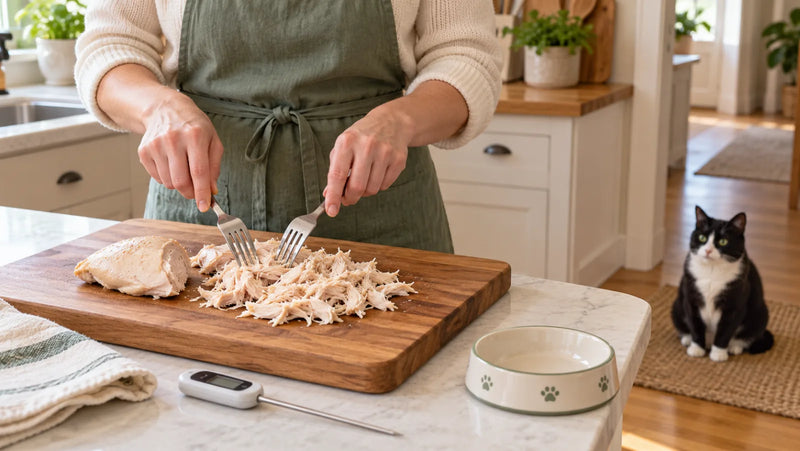
A plain batch also stays separate from animal-protein preparation. If a meal includes chicken, follow the distinct plain chicken cooking workflow, use clean tools, and do not treat chicken plus green beans as a complete homemade diet.
A Separate Chicken Meal Topper Option
American Paws does not sell a green-bean treat. The current Chicken Meal Topper product page identifies a dog-labeled 4 oz product made from finely ground, freeze-dried 100% USA chicken breast crumbles and says it is intended for intermittent or supplemental feeding only. It contains no green bean and is not part of either cooking method above.
A veterinarian or the dog's established feeding plan should decide whether chicken and a concentrated topper fit the individual dog. Do not assume that a meat topper is low calorie, use it to treat appetite or disease, or add it on top of every other extra without measuring the shared allowance. Pet parents comparing current formats can browse all American Paws dog treats and verify each product's own ingredient list and feeding information.
Frequently Asked Questions
How long should I steam green beans for my dog?
Begin checking fresh cut beans around 5 minutes and frozen beans around 6 minutes. Many batches fall near 5–8 minutes for fresh and 6–9 minutes for frozen. Continue in 1-minute steps until a fork passes easily through a thick piece. Time alone does not prove the center is soft.
How long should I boil green beans for my dog?
Begin checking fresh cut beans around 4 minutes and frozen beans around 5 minutes. A common planning range is about 4–7 minutes for fresh and 5–8 minutes for frozen. Use plain gently boiling water, drain fully, and rely on the fork-soft endpoint.
Can I cook frozen green beans without thawing them?
Yes, when the package contains plain green beans. Break apart frozen clumps, steam or boil directly, and allow a little more time than a comparable fresh cut. Confirm that no icy center remains, then cool and make the final serving cut.
Do canned green beans need to be cooked for dogs?
No. They are already cooked. Choose plain no-salt-added when possible, read the complete ingredient list, drain and rinse, let them drain again, and resize the soft pieces. Skip seasoned, sauced, broth-based, bacon, onion, garlic, and casserole products.
Can dogs eat green beans cooked in broth?
Do not use broth as the default. Commercial and homemade broths can contain sodium, onion, garlic, fat, seasonings, or ingredients that do not fit the dog's diet. Steam or boil the dog batch in plain water and keep family recipes separate.
How small should I cut cooked green beans?
There is no universal safe measurement. Cool the bean, then use short soft irregular pieces or a mash that fits the dog's mouth, chewing, teeth, and swallowing history. A gulper or dog with a prior swallowing problem needs veterinarian-approved texture rather than a generic chart.
How much cooked green bean should I offer first?
Use one small soft piece for a dog under 15 lb, one to two for 15–40 lb, two to three for 41–70 lb, or three to four for a dog over 70 lb. These are conservative first tastes, not daily allowances; a piece means a short dog-sized segment, not a pod.
Can I freeze cooked green beans for my dog?
Yes. Freeze cooled plain beans in small measured portions. Thaw a portion in the refrigerator and check texture and temperature before serving. Do not serve a frozen clump, and do not repeatedly thaw and refreeze the same portion.
Steam or Boil Plain, Then Cool and Measure
The reliable sequence is simple: choose a plain form, wash or read the label, trim, cut uniformly, steam or boil, test a thick piece with a fork, drain, cool, make the final dog-specific cut, and measure a first taste. Keep the batch free of salt, fat, broth, sauce, onion, garlic, and family-recipe ingredients.
If green beans fit your dog's established diet, prepare a small plain batch and observe one cooled piece before offering more. Ask the veterinary team before using beans for weight management, a puppy, a swallowing concern, or any medical diet; then keep every vegetable, topper, chew, and packaged treat inside the same measured extras plan.