
Low-fat dog treats can fit a thoughtful reward plan, but the right choice depends on why fat is being limited. For an overweight dog, total daily calories and portion size matter most. For a dog with a history of pancreatitis or a veterinarian-prescribed fat limit, use only rewards that the veterinary team has approved.
A chicken treat, a freeze-dried treat, or a tiny treat is not automatically low in fat. Freeze-drying removes water; it does not remove the fat already present in the ingredient. A useful choice starts with the back label, the calories in the actual portion, and the dog's complete diet—not a front-of-bag promise. For the broader checklist, see our guide to choosing safe dog treats.
Low fat dog treats: the quick answer
Choose low fat treats for dogs by checking four things: whether a low-fat claim is supported by a maximum fat guarantee, how many calories the serving contributes, whether the treat can be divided into genuinely small rewards, and whether it fits the dog's veterinarian-approved nutrition plan.
Those checks lead to different answers for different dogs. A healthy dog working toward a safer body condition may do well with fewer calories and smaller rewards. A dog recovering from pancreatitis may need a therapeutic diet with no unapproved extras at all. The phrase low fat cannot settle both questions by itself.
If your dog is vomiting, refusing food, unusually tired, having diarrhea, or showing signs of abdominal pain, skip the shopping experiment and call a veterinarian. Treats do not diagnose or treat a pancreatic problem.
Low fat is not the same as low calorie
Fat and calories are related, but they are not interchangeable. Fat supplies more calories per gram than protein or carbohydrate, so reducing fat can reduce calorie density in some foods. Still, a product can be lower in fat and easy to overfeed, or higher in fat but fed in such a tiny amount that its calorie contribution stays small.
Weight goals depend on the whole calorie budget
For dog treats for weight loss, the useful unit is the calories actually fed. A large low-fat biscuit may contribute more calories than a crumb-sized meat reward. The dog's meals, toppers, chews, table scraps, supplements, and training rewards all belong in the same daily total.
The AAHA nutrition and weight-management guidance advises counting every extra and keeping treats within no more than 10% of daily calories as a general ceiling. That is not a target every dog should reach. A veterinarian may set a smaller allowance—or no separate treats—during a structured weight-loss plan.
Fat restriction is a separate nutrition target
When a veterinarian limits fat because of pancreatitis, high blood triglycerides, or another condition, calories alone are not enough. Clinical nutrition plans often compare grams of fat per 1,000 calories, along with the dog's symptoms, laboratory results, complete diet, and history. A crude-fat percentage printed as a minimum cannot substitute for that assessment.
This is why low calorie dog treats are not automatically suitable treats for dogs with pancreatitis. A small serving can be low in calories yet still come from a fat-rich food. Medical fat restriction belongs with the veterinarian who knows the entire case.
How to read fat on a dog treat label
Turn the package over before trusting words such as lean, light, healthy, or low fat. The ingredient list explains what the treat contains. The guaranteed analysis and calorie statement help explain what the product supplies. Each field answers a different question.
Find the guaranteed analysis
Most treat labels list minimum crude protein, minimum crude fat, maximum crude fiber, and maximum moisture. “Crude” describes the laboratory method; it is not a judgment about ingredient quality. Read the direction attached to every number because minimum and maximum mean opposite things.
If label terms feel confusing, our guide to how to read a dog treat label explains ingredient order, guaranteed analysis, calorie statements, and serving guidance in more detail.
Know why crude fat “minimum” is not a ceiling
A label that says crude fat 10% minimum promises that the product contains at least that much crude fat on the as-fed basis. It does not say the product contains exactly 10%, and it does not tell you the highest amount a batch may contain. Treating that minimum as a precise value can create a false comparison.
AAFCO's pet-food label guidance makes the distinction explicit: ordinary labels guarantee crude fat as a minimum, while products making a low-fat or lean claim must also provide a maximum crude-fat guarantee. That maximum is the important ceiling a shopper needs for a genuine low-fat claim.
Look for a maximum when the package claims low fat
If the front says low fat but the guaranteed analysis shows only “crude fat (min),” you do not yet have enough information to verify the claim. Look for a maximum fat value and the supporting comparison or regulated claim language. When the diet is medically restricted, ask the manufacturer for typical nutrient analysis and fat per 1,000 calories, then let the veterinarian judge the fit.
Moisture matters too. Percentages on a moist food and a very dry freeze-dried treat are not directly comparable without adjusting for water. For medical decisions, do not improvise a dry-matter calculation from incomplete minimum guarantees.
Compare calories per piece and portionability
A calorie statement tells you more about weight management when you pair it with the size you will actually feed. Can one piece be split into four or eight rewards? Will crumbs still motivate the dog? Do the package directions describe a full piece when you only need a taste?
Portionability is not a nutrient claim, but it is a practical advantage. A fragrant, breakable reward can deliver a clear training signal without turning each repetition into a full snack.

Choosing dog treats for weight management
Successful weight management protects nutrition while reducing excess calories. It is not a race to feed as little as possible. Your veterinarian can assess body condition, muscle condition, current intake, activity, age, and health before setting a safe calorie target and monitoring progress.
Set the treat budget with the veterinary team
Ask how many daily calories may come from rewards after the complete and balanced food is accounted for. The familiar 10% rule is a broad upper limit for extras, not a promise that 10% will support weight loss. Dogs on therapeutic weight-loss diets often need tighter control so the main food can provide enough essential nutrients.
For a simple way to understand the arithmetic without inventing a piece count, see our daily dog treat calorie budget guide. Use the veterinarian's calorie number and the current package statement rather than a generic chart based only on body weight.
Make each reward smaller, not less meaningful
Dogs usually respond to the timing and value of a reward, not its visual size. Break suitable treats into tiny pieces before a walk or training session. Deliver one small piece, then switch some repetitions to praise, a toy, sniffing time, or access to a favorite activity.
Pre-portion the day's allowance into one container. Everyone in the household uses that supply, so five generous hands do not unknowingly become five separate treat budgets.
Count toppers, chews, scraps, and training rewards together
A spoonful of topper, a dental chew, food used to hide medication, and tastes from dinner can quietly outweigh the planned training treats. Write down everything the dog receives for three normal days. That honest history gives the veterinary team much better information than the treat bag alone.
Healthy dog treats still have calories. “Natural,” “single-ingredient,” and “made in USA” can describe sourcing or recipe simplicity, but none of those phrases cancels the portion.
Treats for dogs with pancreatitis need a veterinarian's plan
Pancreatitis is inflammation of the pancreas and can range from mild to life-threatening. Dietary fat may be one risk or management factor in dogs, but it is not the only cause, and an owner cannot confirm the condition by symptoms alone.
Do not self-diagnose or improvise during symptoms
Texas A&M Veterinary Medicine notes that fatty treats and high-fat foods can contribute to risk in some dogs, while vomiting, appetite loss, lethargy, abdominal pain, and diarrhea can occur with pancreatitis. Its current overview of pancreatitis in dogs emphasizes veterinary diagnosis and treatment.
If those signs are present, stop offering new foods and contact a veterinarian promptly. A bland-looking or low-calorie snack is not home treatment, and withholding food without professional direction can also be inappropriate.
Use prescribed food as rewards when advised
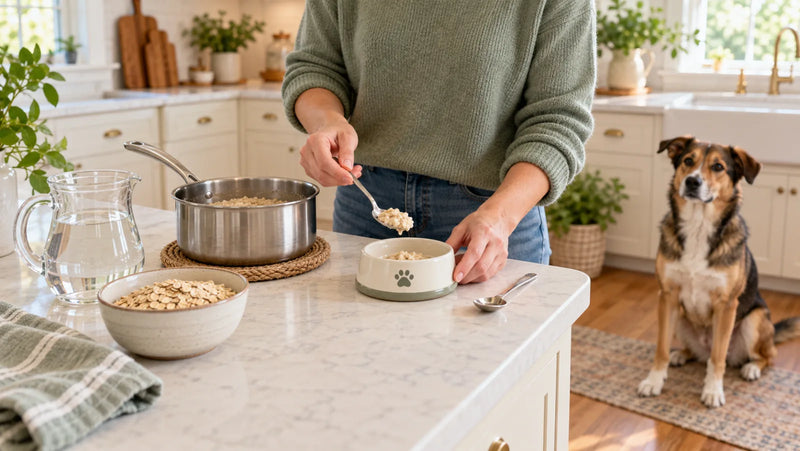
One of the cleanest ways to preserve a therapeutic plan is to reserve part of the veterinarian-approved complete food and use those pieces as rewards. The dog gets training opportunities without adding an unreviewed ingredient or changing the planned fat and calorie intake.
Depending on the dog and the food, the veterinarian may suggest small portions of an approved therapeutic product or another specific option. Follow that plan instead of borrowing a list made for a different dog.
Get approval before adding any retail treat
The Merck Veterinary Manual describes low-fat diets and low-fat treats as part of management in appropriate canine pancreatitis cases. The important word is management: the veterinarian decides the diet, the fat target, the duration, and whether any extra treat is compatible.
Bring the ingredient list, calorie statement, moisture value, crude-fat minimum and maximum, and any manufacturer typical analysis to that conversation. If a maximum or energy-based fat value is missing, treat the product as unverified for a fat-restricted dog.
Are freeze-dried chicken and beef liver low fat?
Not automatically. Freeze-drying is a preservation process that removes moisture at low temperature. It can create light, aromatic, breakable pieces, but it does not selectively remove fat. The original ingredient and the finished product analysis determine the result.
What the American Paws chicken label does—and does not—prove
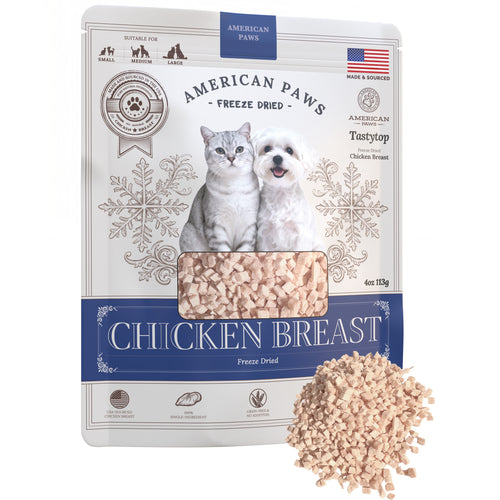
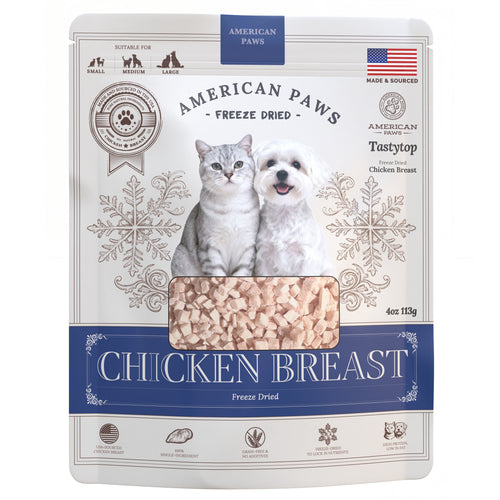
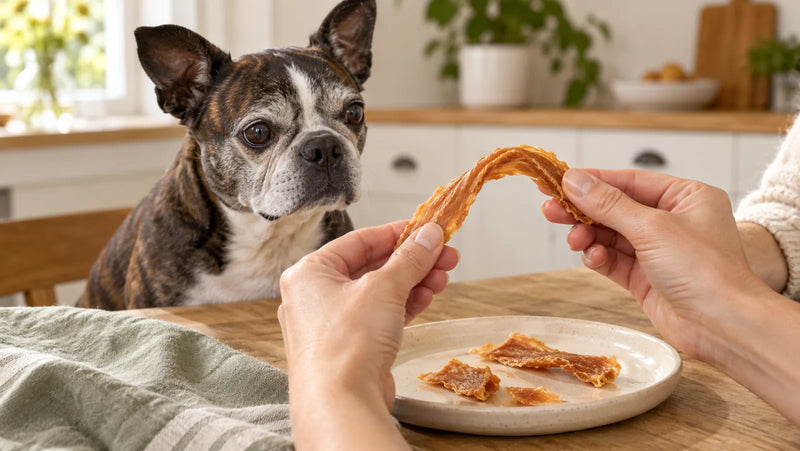
American Paws single-ingredient freeze-dried chicken training treats contain 100% USA chicken breast. The current label lists crude protein 74% minimum, crude fat 10% minimum, moisture 5% maximum, and approximately 5 calories per piece. The pieces can be broken smaller for training.
Those are useful facts for portion planning, but the crude-fat number is a floor and the label does not state a maximum fat guarantee. We therefore do not call this product low-fat or pancreatitis-safe. For a healthy dog whose approved plan allows chicken treats, its simple recipe and breakability can make the portion easier to understand.
Why beef liver is a rich reward, not the default low-fat choice
American Paws freeze-dried beef liver training treats contain 100% USA beef liver. The current label lists crude protein 60% minimum, crude fat 15% minimum, moisture 7% maximum, and approximately 5 calories per piece.
Liver is aromatic and high-value, which is why a tiny crumb can work well for training healthy dogs that tolerate it. It is also a rich organ-meat reward, and its label does not establish a low-fat ceiling. Do not make it the default choice for a dog with pancreatitis history or a prescribed fat restriction; ask the veterinarian first.
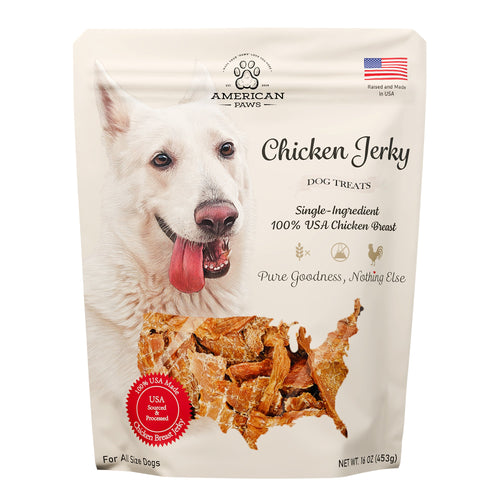
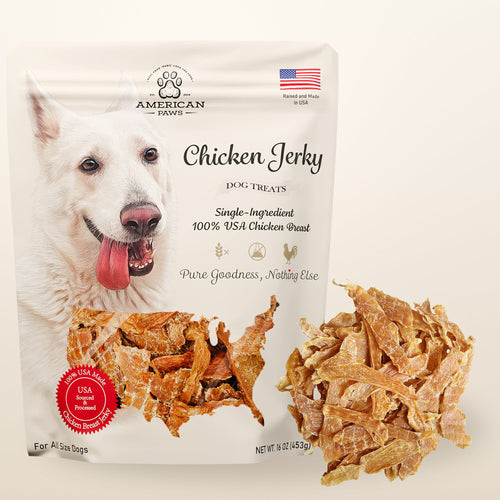
You can browse all American Paws dog treats to compare ingredients, calories, textures, and guaranteed analyses. Compare each product on its own label rather than assuming every chicken, liver, jerky, or freeze-dried format shares the same nutrition profile.
A five-step low-fat treat checklist
- Name the goal. Is the dog reducing calories, following a medical fat limit, or simply needing smaller training rewards?
- Read beyond the front claim. Check the ingredient list, guaranteed analysis, moisture, calorie statement, and serving size.
- Find the ceiling. A crude-fat minimum alone cannot verify a low-fat claim; look for the maximum and, for medical use, energy-based data.
- Plan the real portion. Break approved treats before training and count every extra in the same daily budget.
- Confirm the fit. For pancreatitis history, recurring digestive signs, high triglycerides, prescription food, or active weight treatment, get the veterinarian's approval before feeding.
If your dog's main issue is digestive tolerance rather than a prescribed fat target, read our separate guide to dog treats for sensitive stomachs. A sensitive stomach and pancreatitis are not interchangeable diagnoses, and each needs its own decision process.
Common mistakes when shopping for low-fat dog treats
- Assuming low fat means low calorie. Calories depend on the product and portion, not one nutrient phrase.
- Assuming freeze-dried means fat removed. The process removes water, so check the finished-product analysis.
- Reading a minimum as an exact value. Crude fat minimum is a floor, not a maximum or typical result.
- Using the 10% ceiling as a feeding goal. Weight-loss and therapeutic plans may allow less.
- Forgetting invisible extras. Toppers, chews, scraps, medication foods, and rewards all count.
- Treating symptoms with shopping. Repeated vomiting, pain, lethargy, diarrhea, or appetite loss needs veterinary care.
Frequently asked questions
What percentage is considered low fat in dog treats?
Do not judge a treat from one crude-fat minimum. AAFCO's model labeling framework ties low-fat or lean claims to moisture-specific limits and requires a maximum crude-fat guarantee. For a medically fat-restricted dog, the veterinarian may instead compare grams of fat per 1,000 calories and other clinical details.
Are freeze-dried treats low in fat?
Not necessarily. Freeze-drying removes moisture, not fat. Chicken breast, beef liver, salmon, and other ingredients begin with different nutrient profiles, and the dry finished treat can concentrate nutrients by weight. Check the specific label and do not infer low fat from texture.
What treats can a dog with pancreatitis have?
Only treats approved for that dog's veterinary plan. The simplest option may be a reserved portion of the prescribed complete food. If the veterinarian allows another product, confirm its ingredients, maximum or typical fat analysis, calories, and permitted portion before feeding.
Are low-fat treats automatically good for weight loss?
No. Weight loss depends on the full calorie intake, adequate nutrition, activity that is safe for the dog, and consistent monitoring. A low-fat treat can still slow progress if portions are large or if multiple people feed extras.
Can I use my dog's regular food as treats?
Often, yes. Reserving part of the measured daily food can be an effective reward strategy, especially when the dog is on a prescription or weight-management diet. Ask the veterinarian how much to reserve and keep the total daily amount unchanged.
Build a reward plan around the dog, not the claim
Low-fat dog treats are not one universal product category for every health goal. For weight management, start with the veterinarian's calorie target, use small rewards, and count every extra. For pancreatitis or a prescribed fat limit, start with the medical plan and add nothing the veterinary team has not approved.
When ordinary treats are appropriate, choose labels that give you enough information to make a careful decision. Browse all American Paws dog treats, compare ingredients and calorie statements, and select a portionable format that fits your dog's approved routine. Clear facts and small portions make a better reward plan than a reassuring phrase on the front of a bag.