
Yes—dogs can eat a small amount of plain pumpkin seed kernel, but the safest practical form is unsalted, shelled, dry-roasted, and finely crushed or ground. If you are asking, “can dogs eat pumpkin seeds?” the important limits are the form and the amount. Whole hull-on seeds, seasoned snack seeds, and free-access handfuls add avoidable chewing, digestive, salt, and calorie risks.
Pumpkin seeds are also food, not a dog dewormer. They should never replace a fecal test, a veterinarian-selected antiparasitic medicine, or follow-up that confirms the infection has cleared. This guide separates a tiny optional taste from a treatment claim so one does not get mistaken for the other.
Can dogs eat pumpkin seeds? The short answer
A healthy adult dog may try a tiny amount of a plain pumpkin-seed kernel. The veterinary-reviewed PetMD pumpkin guide recognizes pumpkin seeds as edible for dogs and recommends roasting and grinding them as the easiest way to serve them. That is a useful preparation direction, not permission to share a human snack bag.
- Best practical form: food-grade green kernels, also called pepitas, with the white outer hull removed.
- Best preparation: dry-roasted without oil or seasoning, cooled completely, then finely crushed or ground.
- Best first amount: one kernel finely ground, or an equally tiny pinch—not a spoonful and not a handful.
- Forms to skip: salted, flavored, candy-coated, chocolate-covered, oily, spicy, garlic-seasoned, or moldy seeds.
- Medical boundary: no pumpkin-seed serving is a substitute for parasite testing or deworming medicine.
The seed is optional. A complete and balanced dog food should already carry the nutrition job, and a dog does not need pumpkin seeds to be healthy. If the dog dislikes them, has a medical diet, or already receives enough extras, there is no reason to add them.
The safest pumpkin-seed form for a dog
Choose plain, shelled kernels
A whole pumpkin seed commonly has a white or cream outer hull surrounding the green edible kernel. A pepita is the green kernel sold without that tough outer covering. For a dog, the shelled kernel is the conservative choice because it removes an unnecessary hard, fibrous layer.
Read the ingredient statement even when the front of the bag says “natural” or “roasted.” The useful list is simply pumpkin seeds, with no salt, oil, seasoning blend, onion, garlic, chile, sugar, artificial sweetener, chocolate, or candy coating. A snack made for people may contain several of those additions even when the seed itself is dog-appropriate.
Dry-roast without salt or oil
Dry-roasting makes a food-grade kernel drier and easier to grind. It does not erase calories, remove a food allergy, or guarantee sterility. Home cooking conditions vary, so do not describe a lightly toasted seed as pathogen-free or use roasting to rescue damp, moldy, rancid, or questionable seeds.
Use a clean tray or skillet and make a separate unseasoned batch before preparing the family's salted snack. The dog portion needs no butter, cooking spray, olive oil, salt, garlic powder, onion powder, paprika, chile, cinnamon sugar, or other flavoring. Cool it completely before grinding or serving.
Crush or grind before serving
Grinding changes the physical form, not the nutritional budget. It makes one tiny kernel easier to distribute over regular food and reduces the chance that a small dog tries to gulp a firm whole seed. Use a clean mortar, spice grinder, or the flat side of a spoon, and keep the texture fine enough that no hard whole kernel remains.
Do not grind a large jar “for health” and free-pour it over meals. Ground seed exposes more surface area to air and can develop an off odor faster than an intact kernel. Prepare only a small amount, follow the package's storage directions, keep it dry, and discard it if it smells paint-like, bitter, stale, musty, or otherwise abnormal.
Raw seeds and shells: what changes the risk?
Raw kernels are not automatically poisonous
A plain raw green kernel is not established as a dog toxin. The reason this guide prefers a dry-roasted, ground kernel is practical: that form is easier to portion, easier to identify as a dog-only unseasoned batch, and less likely to be swallowed as a firm whole piece.
Do not stretch that into “raw is toxic” or “roasted is unlimited.” A raw kernel can still add fat and calories, and a roasted kernel can still be too much, badly seasoned, or unsuitable for the individual dog. Preparation improves handling; it does not cancel dose or medical context.
Hulls and whole seeds are harder to chew and digest
The white hull is tougher than the green kernel. One accidentally swallowed hull-on seed in a dog that remains completely normal is different from a small dog gulping a pile of pumpkin-carving scraps. Size, quantity, chewing behavior, and symptoms change the response.
Do not deliberately feed hull-on seeds to a dog that gulps food, has swallowing trouble, or has a history of gastrointestinal obstruction. Whole firm pieces can become choking concerns, and a bulk of poorly chewed material can behave differently from one tiny ground taste. The Merck Veterinary Manual's gastrointestinal-obstruction guidance explains why repeated vomiting, loss of appetite, lethargy, and abdominal pain after foreign-material ingestion need prompt veterinary attention.
A handful is different from a measured taste
Seeds contain much less water and more fat than pumpkin flesh. That makes them calorie-dense by comparison. A human handful can crowd a small dog's daily extras quickly and may trigger vomiting, diarrhea, or abdominal discomfort even when every seed is plain.
A ripped snack bag also introduces questions the planned taste did not: How much is missing? Were the seeds salted, coated, or mixed with raisins, chocolate, macadamia nuts, onion, garlic, or an artificial sweetener? Keep the package for the veterinary team and call promptly when the amount or ingredients are concerning.
How to prepare pumpkin seeds for a dog
Keep the method deliberately boring. The goal is a small, plain food trial—not a supplement recipe.
- Start with food-grade shelled kernels. Use a fresh package whose ingredient list is pumpkin seeds only. Do not collect slimy seeds from a decomposing porch pumpkin.
- Inspect before cooking. Discard kernels that are damp, moldy, insect-damaged, discolored, or off-smelling. Roasting does not repair spoilage.
- Spread a dog-only portion in one layer. Use parchment or a clean dry pan. Add no oil, salt, sweetener, or seasoning.
- Dry-roast gently. A low oven around 300°F for roughly 10–15 minutes is a planning range; stir once and stop when the kernels are dry and lightly toasted, not dark or scorched. Oven and seed size vary, so watch the food rather than treating the clock as a safety test.
- Cool completely. A warm seed can burn a mouth and can create condensation if sealed too soon.
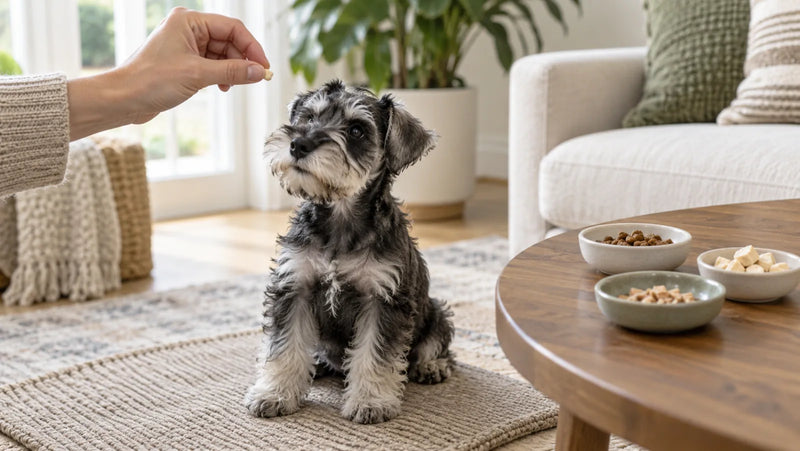
- Grind one kernel for the first taste. Crush it into a fine meal and dust that tiny amount over the dog's regular food. Keep the rest separate from the dog's reach.
Introduce only one new food that day so any vomiting, diarrhea, itching, facial swelling, or appetite change is easier to interpret. Our guide to introducing one new treat at a time explains the same controlled-trial logic.

How many pumpkin seeds can a dog eat?
Use a first-taste test, not a treatment dose
There is no validated universal pumpkin-seed maximum for dogs that can be responsibly copied into a body-weight chart. Seed size, calorie density, the dog's complete diet, health, and every other treat change the answer. A precise-looking online scoop can be less honest than a deliberately tiny trial.
| Question | Conservative practical answer |
|---|---|
| What should the first taste be? | One plain shelled kernel, finely ground, or an equally tiny pinch. |
| Should it become a daily supplement? | No automatic daily use. It is an optional food extra, not a required nutrient or treatment. |
| What is the safe maximum? | No universal internet maximum. Measure the actual food and fit its calories into the dog's individual plan. |
| What is the parasite-treatment amount? | None. Pumpkin seeds are not a reliable canine deworming dose. |
After a tiny first taste, wait and observe rather than increasing the same day. If a veterinarian agrees that occasional seed fits the dog, keep future amounts as a small measured sprinkle and use the package's calorie information when available. Do not convert a human one-ounce serving into a dog portion.
Count seed calories with every other extra
The World Small Animal Veterinary Association's dog-treat guide recommends keeping all treats below 10% of daily calories while complete and balanced food supplies at least 90%. Ten percent is a ceiling for all extras combined, not a pumpkin-seed target.
Training rewards, chews, table tastes, toppers, fruit, puree, and ground seed all share that small allowance. The daily dog-treat calorie guide helps account for the whole day. Breaking or grinding one seed into many flecks creates more reward moments, but the flecks together still contain the original seed's calories.
Skip routine pumpkin seeds or ask the veterinary team first when a dog has pancreatitis history, a prescribed fat restriction, obesity, diabetes, chronic gastrointestinal disease, swallowing difficulty, a food allergy, or a prescription or elimination diet. “Plant food” does not override a medical feeding plan.
Pumpkin seeds do not replace dog deworming medicine
Why laboratory or folk claims are not a canine treatment plan
Pumpkin seeds should not be used to deworm a dog. A folk tradition, a test-tube observation, a study in another species, or an experiment using a concentrated extract does not establish that grocery-store ground seeds clear a specific parasite from dogs. A usable canine treatment needs evidence for the organism, preparation, dose, safety, treatment length, and confirmed clearance.
Those details matter because “worms” is not one disease. Roundworms, hookworms, whipworms, and tapeworms have different life cycles, diagnostic challenges, reinfection routes, and medication choices. Some infections can also affect people. A seed sprinkle cannot identify which parasite is present or show that eggs and larvae are gone.
What evidence-based parasite care looks like
The Merck Veterinary Manual's guide to gastrointestinal parasites in dogs describes fecal testing, parasite-specific prevention, and approved antiparasitic drugs as the basis of control. The veterinary plan depends on the dog's age, exposure, symptoms, test result, current preventives, and the parasite involved.
- Contact the veterinarian. Share visible stool findings, symptoms, travel, flea exposure, hunting or scavenging, and the dog's preventive history.
- Bring the requested stool sample. A photo of a suspicious segment can help, but it does not replace the clinic's identification process.
- Use the medication exactly as directed. Do not borrow another pet's product or improvise a dose from the internet.
- Complete prevention and cleanup steps. Flea control, prompt stool pickup, environmental hygiene, and repeat treatment may matter depending on the parasite.
- Perform follow-up when advised. Looking better or no longer seeing worms does not always prove the infection has cleared.
A dog may still eat one tiny plain ground kernel as food if the veterinarian approves it. That food decision and the parasite-treatment decision are separate.
When to call a veterinarian
Call promptly after a large hull-on-seed ingestion, a torn bag with an unknown amount missing, or exposure to seeds mixed with potentially dangerous ingredients. Keep the package and ingredient list. Do not induce vomiting unless a veterinary professional specifically directs it.
Seek urgent care for any of these signs:
- repeated vomiting, unproductive retching, gagging, or trouble swallowing;
- abdominal pain, a tense or swollen belly, or a hunched posture;
- marked lethargy, weakness, collapse, or refusing food and water;
- inability to keep water down, bloody stool, or black tarry stool;
- breathing trouble, facial swelling, or widespread hives; or
- persistent diarrhea or vomiting after a new food trial.
Parasite concerns also deserve a clinic call even when the dog seems comfortable. Visible rice-like segments, worms, persistent diarrhea, weight loss, a pot-bellied puppy, pale gums, or repeated scooting can have several causes. A veterinarian can choose the right test instead of guessing from one symptom.
Pumpkin seeds versus pumpkin flesh and puree
Seed, flesh, and puree come from the same plant but are not interchangeable portions. The seed is a dry, fat-containing, calorie-dense food. Plain pumpkin flesh and puree contain much more water and are usually served by a different method. Do not use a puree spoonful as a seed serving or expect ground seed to behave like fiber-rich flesh.
- For broad benefits, forms, and limitations, use the complete pumpkin guide for dogs.
- For a canned-versus-fresh label check, use the guide to plain pumpkin puree for dogs.
- For steaming or roasting the edible flesh, follow the method for preparing plain cooked pumpkin flesh.
This seed page owns only the seed-specific safety, preparation, portion, and deworming-myth questions. It does not turn pumpkin seeds into a broader pumpkin supplement or parasite remedy.
Frequently asked questions
Can dogs eat raw pumpkin seeds?
A plain raw green kernel is not established as toxic, but dry-roasting and grinding is the more practical serving method. It creates a dog-only unseasoned batch and makes one tiny amount easier to distribute. Do not feed slimy seeds from an old carved pumpkin or use roasting to rescue spoiled food.
Can dogs eat pumpkin seed shells?
Do not deliberately serve the white hull. It is tougher than the kernel and adds an avoidable chewing and digestive burden. One accidental seed in a dog that remains normal is not the same as a pile, but call the veterinarian for a large ingestion, a small dog that gulps, or any gagging, vomiting, abdominal pain, appetite loss, or lethargy.
Can dogs eat salted or flavored pumpkin seeds?
Skip them. A human snack may add salt, oil, onion, garlic, chile, sugar, chocolate, candy coating, or other ingredients the dog does not need. “Roasted” on the front does not mean plain; the ingredient list makes the decision.
Do pumpkin seeds kill worms in dogs?
No reliable canine treatment conclusion supports using grocery pumpkin seeds instead of veterinary deworming care. Different parasites require different diagnosis, medication, prevention, and follow-up. Contact the veterinarian and bring the requested stool sample.
Can puppies eat pumpkin seeds?
A growing puppy has little room for extras that displace a complete growth diet, and a firm whole seed is a poor reward shape. Ask the veterinarian first. If approved, use only one finely ground plain kernel as a supervised taste and never use it for puppy deworming.
Keep pumpkin seeds plain, ground, and optional
A tiny amount of plain pumpkin-seed kernel can fit some healthy adult dogs, but the responsible version is narrow: choose food-grade shelled kernels, dry-roast without additions, cool completely, grind one kernel for the first trial, and count any future sprinkle with every other extra. Whole hulls, seasoned bags, large amounts, and medical promises do not belong in that plan.
American Paws does not currently sell pumpkin seeds or another pumpkin product, so we will not point you to an imaginary SKU. For purpose-made rewards with clear ingredient and serving information, browse all current American Paws dog treats. For suspected worms, skip the pantry experiment and call the veterinary team.