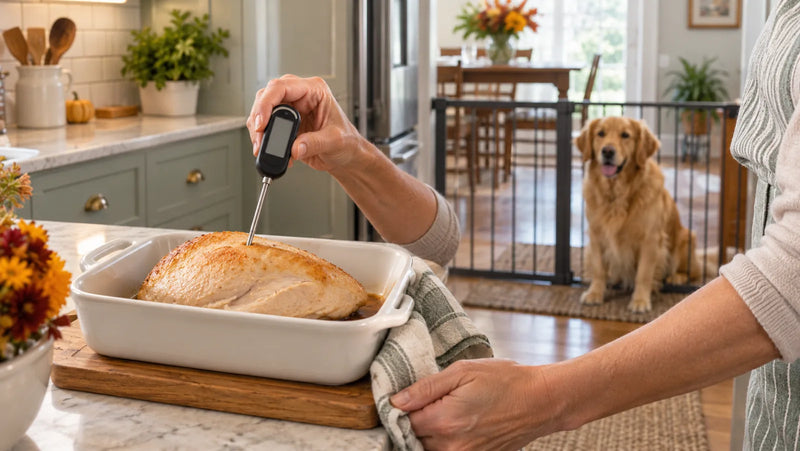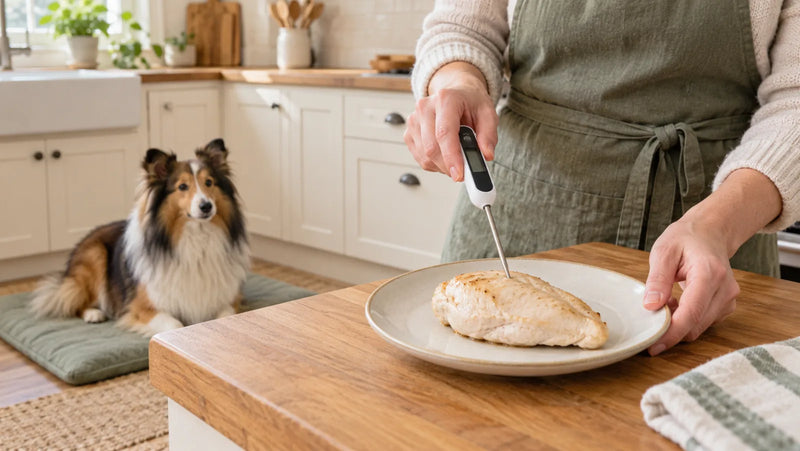

How to cook turkey necks for dogs safely begins with one rule: do not cook and feed the bone-in neck. Ordinary cooking can make poultry bones brittle and able to break into sharp or irregular pieces. If the goal is a cooked turkey treat, start with completely boneless, skinless turkey meat, cook it plain to 165°F, cool it, and serve only a measured amount.
Keep a boiled, roasted, grilled, smoked, fried, air-fried, slow-cooked, pressure-cooked, or microwaved turkey neck off the dog's plate. If a dog already swallowed a cooked neck, call a veterinarian or emergency clinic rather than inducing vomiting or trying a home “cushion.” Trouble breathing, pale or blue gums, collapse, repeated retching, severe pain, or repeated vomiting needs urgent care.
How to Cook Turkey Necks for Dogs: The Safe Answer
There is no household recipe that turns the whole cooked neck into a risk-free dog chew. The useful answer depends on what the owner is actually trying to accomplish:
| Goal or form | What to do | What the decision avoids—and does not avoid |
|---|---|---|
| Cook the whole bone-in neck for the dog | Do not do it | Rejecting it avoids intentionally serving a cooked poultry bone that can break into hazardous fragments. |
| Give a small cooked turkey reward | Use a separate piece of boneless, skinless turkey; cook it plain to 165°F, cool, dice, and measure | Avoids the neck bone, but calories, dietary fit, hygiene, and portion still matter. |
| Use a raw turkey neck as a chew | Do not treat raw as the safe version; discuss the exact dog and plan with a veterinarian | Avoids cooking-created brittleness, but not pathogens, choking, obstruction, tooth damage, constipation, or nutritional imbalance. |
| Buy a commercially dehydrated turkey neck | Audit the finished pet product, process, size, hardness, calories, storage, and dog fit | Commercial processing may differ from raw or home-dried food, but “dehydrated” is not a guarantee of sterility or mechanical safety. |
| Use the neck in human stock or gravy | Keep the dog out of the prep area and secure the entire cooked neck in inaccessible trash afterward | Prevents a holiday leftover from becoming an accidental bone exposure. |
For the broader question of whether dogs can eat any turkey bone and what to do after ingestion, use our separate turkey-bone emergency guide.
Why Cooking the Bone Is the Wrong Answer
Every ordinary kitchen method still counts as cooking
Boiling does not neutralize the bone. Neither does simmering it for stock, roasting it inside the bird, pressure-cooking it, slow-cooking it, grilling it, smoking it, air-frying it, frying it, or reheating it. The outside may look soft or the meat may fall away, but the vertebrae and small bone pieces remain.
Cooking can make poultry bone dry and brittle. A bite can produce sharp or irregular pieces that injure the mouth, lodge in the throat or esophagus, or damage and obstruct the gastrointestinal tract. An archived FDA consumer update on bone hazards lists gastrointestinal obstruction, choking, cuts and wounds in the mouth or on the tonsils, vomiting, diarrhea, and rectal bleeding among illnesses reported after dogs ate bones, and notes that turkey and chicken bones are simply too brittle. Current AKC turkey guidance likewise describes cooked poultry bones as brittle and lists choking, throat or intestinal obstruction, and puncture injuries among the possible problems.
A cooking timer cannot certify that every small bone has become harmless. A bone that seems crushable between fingers is not proof it will travel safely through a particular dog's mouth, esophagus, stomach, and intestines. Do not use pressure, long cook time, vinegar, or another home test as a feeding validation.
Removing seasoning does not reverse the bone change
Rinsing gravy from a cooked neck does not return the bone to its raw structure. Pulling off visible skin, onion, or garlic also cannot remove absorbed brine, tiny bone fragments, or every ingredient from a cooked dish. A neck used in stock, gravy, stuffing, soup, or a roasted turkey remains human-food waste after cooking.
Do not pick meat from between the cooked vertebrae for the dog. Small fragments can be hard to see and easy to transfer with the meat. If the goal is a plain cooked turkey reward, choose boneless meat from the beginning.
If You Want Cooked Turkey, Use Boneless Meat Instead
The safe cooking path changes the ingredient. Do not start with a turkey neck and try to make its bones edible. Start with a piece sold as completely boneless turkey meat and keep it separate from the seasoned holiday bird.
- Choose boneless and skinless turkey. Check for bones, skin, netting, absorbent pads, plastic, clips, and packaging. A labeled boneless cut is easier to audit than meat picked from a cooked neck.
- Read the product label. Avoid pre-brined, injected, self-basting, marinated, seasoned, smoked, or deli-style turkey for this plain dog portion. Choose an ingredient the dog already tolerates.
- Use a clean, separate prep zone. Keep raw poultry, its board, knife, hands, and juices away from cooked food and the dog's bowl. Do not rinse raw turkey, because splashing can spread contamination.
- Cook without additions. Add no onion, garlic, leek, chive, salt, broth, butter, oil, gravy, sauce, rub, stuffing, or alcohol.
- Verify 165°F. The FoodSafety.gov safe-temperature chart uses 165°F for poultry. Check the thickest part with a food thermometer rather than color or time alone.
- Move it with clean tools. Put cooked turkey on a clean plate that never held the raw meat. Let it cool promptly in a shallow arrangement.
- Inspect, dice, and measure. Confirm there is no bone, cartilage, skin, string, or clip; cut a small portion suited to the dog's mouth and daily calorie plan.
- Refrigerate promptly and freeze excess. Keep only a short working supply, label it with the date, and discard anything with an uncertain handling history.
Plain cooked turkey is still a supplemental extra, not a meal replacement. The WSAVA dog-treat guide recommends keeping all treats below 10% of daily calories. Ten percent is a ceiling shared by every topper, table taste, chew, pill food, and training reward; it is not a target for turkey.
A dog with pancreatitis history, kidney disease, diabetes, gastrointestinal disease, an allergy or elimination trial, obesity treatment, or a prescription diet needs the veterinary team's approval before any holiday extra. “Plain” answers the seasoning question, not the medical-diet question.
Thanksgiving Workflow: Separate the Neck Before the Oven
The easiest time to prevent a cooked-neck problem is while the turkey is still raw and the dog is outside the kitchen. A whole bird may contain a loose neck and a separate packet of organs in one or both cavities. Do not assume every cavity is empty because one packet was removed.
- Put the dog behind a closed door or sturdy gate before unwrapping the turkey.
- Open the package over a contained raw-poultry zone and inspect both cavities according to the product directions.
- Separate the neck from the heart, gizzard, and liver. The neck contains bone and is not itself a giblet.
- If the neck will be used for human stock or gravy, place it in a labeled, covered container away from the dog's food.
- If it will not be used, wrap and secure it immediately in inaccessible trash rather than leaving it at the counter edge.
- Clean and disinfect contacted surfaces, wash hands, and keep raw juices away from bowls, toys, phones, towels, and ready-to-eat food.
- After cooking and carving, inventory bones, string, foil, skewers, pop-up parts, packets, and scraps before the dog returns.
Heart and gizzard are muscular organs, liver is nutrient-dense organ tissue, and the neck is a bone-in part. They should not be treated as one interchangeable handful. Our plain cooked giblet guide explains how to sort and handle the non-neck contents without turning the bone into a serving.
The rest of the holiday plate needs the same separation. Turkey gravy, stuffing, fried onions, casseroles, rich skin, and seasoned drippings do not become dog food because they sit beside plain meat. In particular, keep the recipe and serving dish in our green bean casserole safety guide away from the dog's bowl; plain green beans and the finished casserole are different foods.
Raw Turkey Necks Are Not a Safe Cooking Substitute
A raw turkey neck avoids the specific brittleness created by cooking, but that does not make it safe. It can still be swallowed whole or in a large section, obstruct the esophagus or intestine, fracture a tooth, cause constipation or injury, contribute unbalanced bone and mineral intake, or expose the dog and household to foodborne germs.
The WSAVA raw-meat diet guide lists bacterial contamination, gastrointestinal obstruction, and fractured teeth among the concerns associated with raw meat and bone feeding. “Raw” is therefore a different risk set, not a solved version of cooked bone.
The FDA's raw pet-food guidance reports that raw pet food was more likely than other tested pet foods to contain disease-causing bacteria. A dog can become ill or spread germs through saliva, bowls, floors, fur, and stool even without obvious symptoms.
Any owner considering a raw turkey neck should first ask the veterinarian whether a bone-containing raw item fits this dog and household. Homes with young children, older adults, pregnant people, or immunocompromised people deserve particular caution. So do puppies, older dogs, and dogs with immune, digestive, dental, swallowing, or nutrition problems.
If a veterinarian supports a raw-feeding plan, use strict raw-poultry hygiene: keep the product cold and separate from human food, thaw it in the refrigerator, do not rinse it, contain the feeding area, wash hands and utensils, disinfect contacted surfaces, prevent face licking immediately afterward, and handle stool promptly. Those steps reduce exposure; they do not make the bone mechanically risk-free.
Commercially Dehydrated Turkey Necks Need a Product Audit
A purpose-made dehydrated pet product is not the same thing as a neck roasted for dinner. It is also not automatically safe. Manufacturers may use different sourcing, heat steps, dehydration curves, moisture or water-activity targets, testing, packaging, and storage controls. The word “dehydrated” alone does not reveal which controls apply.
Before considering a commercial dehydrated turkey neck, find:
- the complete ingredient statement and intended species;
- manufacturer identity and a way to ask process questions;
- country or source information stated for that exact product;
- lot code, best-by information, intact packaging, and storage directions;
- calories per piece or gram and realistic piece dimensions;
- whether the product is marketed as raw and what pathogen-control steps are documented;
- hardness, sharp points, brittleness, moisture, odor, mold, or damage when the package opens; and
- whether the dog's veterinarian agrees a bone-containing chew fits the teeth, swallowing behavior, digestion, diet, and history.
Do not recreate a commercial process by placing a raw turkey neck in a home dehydrator and guessing from time or dryness. A dry surface does not prove a pathogen kill step, safe internal structure, validated shelf life, or appropriate storage.
Size and Supervision for Any Bone-Containing Chew
No body-weight chart can assign a universally safe turkey neck. Birds and products vary in length, diameter, vertebra size, moisture, and hardness. Dogs of the same weight vary in mouth shape, tooth health, bite force, chew pace, guarding, and whole-swallow behavior.
The piece must not fit wholly inside the dog's mouth at the start, but that is only a first check. A long neck can fold. A dog can crush off a large section. A dampened or shortened end can become swallowable during the session. Supervision means watching every bite closely enough to stop the session—not being elsewhere in the house.
- Use one dog in a quiet, child-free area with no food competition.
- Inspect the product before offering it; reject package damage, mold, foul odor, unexpected moisture, or hazardous edges.
- Watch whether the dog works slowly or repeatedly tries to move the whole piece toward the throat.
- End the session at the first gulping attempt, dangerous fracture, distress, guarding, or loss of control.
- Trade for and discard the final end before it becomes small enough to swallow whole.
- Record the portion and count its calories with all other dog treats and extras.
Skip a turkey-neck chew for a gulper, a dog that swallows chew ends, a resource guarder, or a dog with a history of choking, obstruction, constipation, broken teeth, dental disease, oral surgery, swallowing trouble, gastrointestinal disease, or a conflicting prescription diet unless the treating veterinarian says otherwise. Puppies and senior dogs do not receive automatic clearance based on age or enthusiasm.
For the same preparation, size, and behavior gates applied to a smaller poultry neck, read our chicken-neck safety guide. The species and dimensions change; the need to reject cooked bone and evaluate the exact chew does not.

If a Dog Ate a Cooked Turkey Neck
Do not assume a dog is fine because the neck went down or because no symptom appeared immediately. The right next step depends on the dog's size and history, the cooked neck's size, whether it was chewed, how long ago it happened, and current signs.
- Remove access. Secure the remaining turkey, bones, plates, trash, and other pets.
- Do not induce vomiting. Sharp or irregular material can cause additional injury on the way back up.
- Do not give a home cushion. Bread, cotton, oil, pumpkin, or a large meal is not a universal antidote and can delay appropriate care.
- Call promptly. Tell the veterinarian or emergency clinic the dog's weight, the neck's approximate size and cooking method, the possible amount, the time, whether it was swallowed whole, and any symptoms.
- Follow the monitoring or examination plan. Do not substitute online timelines for the professional's instructions.
Trouble breathing, blue or pale gums, collapse, repeated gagging or retching, heavy drooling, pawing at the mouth, repeated vomiting, a swollen or painful abdomen, blood, black stool, inability to pass stool, refusal of food, or marked lethargy needs urgent veterinary attention. Do not reach blindly into the throat; only remove material that is clearly visible and safely reachable if an emergency professional directs you.
Our dog-ate-turkey-bone guide covers the accidental-ingestion decision in more depth; no article can clear an exposure remotely.
A Current Dehydrated Poultry Alternative
American Paws does not sell turkey necks. For a dog whose veterinarian approves a different bone-containing poultry chew, the current American Paws dehydrated chicken feet for dogs are a real alternative format: the product page identifies 100% USA chicken feet, about 30 kcal per piece, and a dehydrated—not fried—process.
Those facts do not make one foot risk-free or suitable for every dog. It still contains bone, can be a poor match for a gulper or a dog with dental or swallowing problems, and requires sizing, continuous supervision, removal of a swallowable remainder, calorie accounting, and adherence to the current storage directions. One approximately 30-kcal piece can also use much of a small dog's total extras allowance.
Use our natural dog-chew comparison to screen teeth, medical history, chewing behavior, calories, and product geometry before choosing a category. A commercially available alternative is useful only when the actual dog and actual item fit.
Frequently Asked Questions
Can I boil turkey necks for dogs?
Do not boil a bone-in turkey neck and feed it to a dog. Boiling is cooking, and soft meat around the neck does not make the small vertebrae safe. If you want a cooked turkey reward, use a separate completely boneless, skinless piece and cook it plain to 165°F.
Can I pressure-cook a turkey neck until the bones are soft?
Do not use a household pressure-cooking time or finger-crush test as proof that every fragment is safe to swallow. Pressure-cooked bone is still cooked bone, and a home recipe is not a validated pet-food process. Use boneless meat instead.
Can dogs eat meat picked from a cooked turkey neck?
It is safer not to pick meat from between cooked neck bones because tiny fragments can transfer unnoticed. Start with a boneless cut, cook it separately without seasoning, inspect it, and portion it as a treat.
Are raw turkey necks safer than cooked turkey necks?
Raw necks avoid cooking-created brittleness, but “avoids one risk” does not mean safe. Raw poultry can carry disease-causing bacteria, and the neck can still cause choking, obstruction, tooth injury, constipation, or nutritional imbalance. Discuss the exact plan with a veterinarian.
Are dehydrated turkey necks cooked?
It depends on the manufacturer's process. Some products may include heat; others may be marketed as raw-dehydrated. Ask the maker for the process and pathogen controls. Regardless, dehydration does not remove size, hardness, tooth, choking, obstruction, calorie, or supervision concerns.
Can puppies or small dogs have turkey necks?
Do not use size or youth alone to approve one. A puppy has growing teeth and limited calorie room; a small dog may struggle with the piece; and either can gulp. Ask the veterinarian before offering any bone-containing chew and choose a different format when the fit is uncertain.
Is the turkey neck part of the giblets?
The neck is often packaged beside the heart, liver, and gizzard, but it is a bone-in part rather than a giblet. Sort it separately before cooking. The non-neck organs require their own preparation and portion decisions.
How often can a dog have a turkey neck?
There is no responsible universal frequency. Product size, calories, hardness, process, chewing behavior, teeth, medical history, and the rest of the diet all change the answer. A veterinarian may recommend a different chew or no bone-containing chew at all.
Cook Boneless Meat; Keep the Neck Bone Out
The answer to a cooking query should not hide the boundary: ordinary kitchen cooking does not turn a turkey neck into a safe dog bone. Use the whole neck only for its intended human-food recipe and discard it securely afterward, or leave it raw only within a veterinarian-guided plan that acknowledges pathogen and mechanical risks. Audit any commercial dehydrated product rather than trusting the process word.
If the dog needs a cooked taste of turkey, start with boneless, skinless meat, cook it plain to 165°F, cool it, inspect it, and measure a small amount inside the day's total extras. You can browse the current American Paws dog-treat assortment for other formats, but choose by ingredients, calories, geometry, chewing behavior, and veterinary fit—not by holiday tradition.