
The best natural chews for dogs are matched to the individual dog's teeth, mouth, chewing behavior, diet, and supervision—not selected by the word “natural” or by a promise to last the longest. Chicken feet, beef tendons, bully sticks, dried fish skins, duck feet, and chicken necks all vary by size and processing. Any of them can become a tooth-fracture, choking, or obstruction hazard when the chew and the dog are a poor match.
Start with the finished item rather than the category's reputation. It should have some give, be too large to fit wholly inside the dog's mouth, stay intact under that dog's chewing style, and come with enough label information to fit the daily calorie plan. Then supervise from the first bite until you trade for and discard the shrinking remnant.
There is no risk-free “best” natural chew
“Natural” describes a marketing category, not a regulated safety grade. “Edible” and “digestible” do not mean that a chunk can safely pass through the airway, esophagus, stomach, or intestines. Likewise, hard and long-lasting are not automatic quality advantages: a chew hard enough to resist a forceful bite may also be hard enough to fracture a tooth.
The American Kennel Club's guide to edible chews emphasizes that dogs use chews differently. A product that softens safely for a patient gnawer may be bitten into large pieces by a power chewer. A softer item can still be gulped, while a very hard one can injure teeth or gums.
That makes “best” a current fit, not a permanent badge. Reassess when a puppy matures, an adult begins gulping, a senior develops dental changes, a dog starts a prescription diet, or the maker changes a product's thickness or process.
Screen the dog before comparing chews
Teeth and medical history come first
Skip an animal-part chew and ask your veterinarian for an appropriate alternative if the dog has dental pain, a loose or fractured tooth, advanced dental disease, recent oral surgery, difficulty swallowing, or a history of choking or intestinal obstruction. A dog on a prescription, elimination, kidney, or medically restricted low-fat diet—including a pancreatitis management plan—also needs an individualized answer before any extra is added.
Puppies and seniors do not receive blanket approval. A puppy's changing teeth and chewing skills, and a senior dog's current enamel, gums, restorations, and missing teeth, matter more than a life-stage label printed on a bag.
Watch behavior, not breed stereotypes
Observe what the dog actually does with a test item. A deliberate nibbler works gradually at an edge. A steady gnawer applies repeated pressure without trying to swallow the item whole. A forceful crusher clamps hard enough to crack or shear pieces. A gulper tries to swallow a large section with little chewing.
Body weight alone cannot distinguish those behaviors. A small dog can be a crusher; a large dog can be careful. Competition can also change the pattern, so give chews to dogs in separate, calm spaces rather than creating a race to finish.
How to choose the best natural chews for dogs
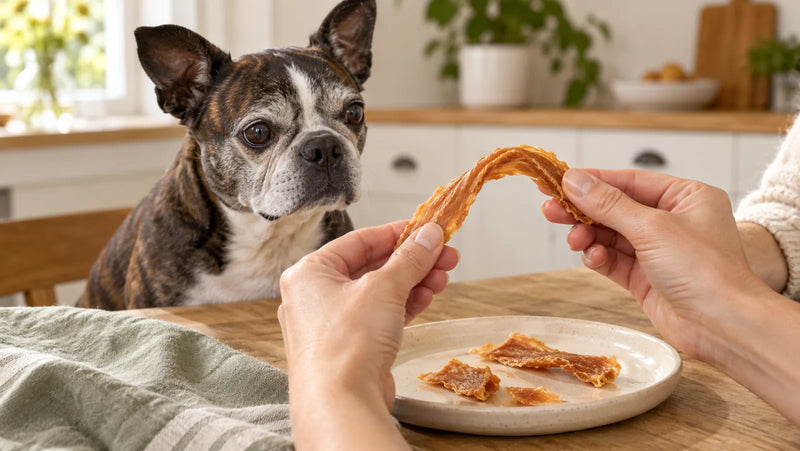
- Test hardness. The Cornell veterinary dental guidance on fractured teeth describes the practical thumbnail test: favor an item that a thumbnail can indent. This is a conservative screening heuristic, not proof that the chew cannot break a tooth.
- Check the finished size. A new chew should not fit entirely inside the dog's mouth. It also needs enough width and length that the dog cannot immediately line it up for a whole swallow. There is no universal inch cutoff because mouth dimensions and technique differ.
- Inspect the structure. Reject a chew with sharp edges, brittle fragments, loose flaps, mold, dampness where it should be dry, contamination, or an abnormal rancid odor. Recheck it while the dog works because the shape changes.
- Read the label. Look for the animal species, ingredient list, processing method, origin, feeding instructions, and calories per item or unit of weight. If calories are missing, ask the manufacturer rather than assuming that one chew equals one serving.
- Plan the session and exit. Choose a quiet place where an adult can observe continuously. Decide before starting which behavior or size will end the session, and have a calm trade ready.

Natural dog chew comparison at a glance
These are comparison starting points, not safety ratings. Dryness, thickness, shape, batch variation, storage, and the individual dog can move an item from one column to another.
| Chew type | Typical work and durability | Calories | Digestibility limit | Possible fit | Remove when |
|---|---|---|---|---|---|
| Chicken foot | Dry, irregular, bone-containing; often a short-to-moderate session, but highly dog-dependent | Use the actual label; the current American Paws page estimates about 30 kcal per foot | Edible tissue and bone do not eliminate sharp-piece or obstruction risk | A deliberate chewer with suitable teeth and an oversized finished foot | It cracks sharply, sheds brittle pieces, triggers gulping, or becomes swallowable |
| Beef tendon | Fibrous and sometimes yielding; duration varies with width, thickness, and dryness | Check the package or ask the maker; do not infer from size | A softening strip, flap, or chunk can still be swallowed too large | A patient gnawer using a broad, oversized piece with some give | It becomes rope-like, sharply edged, chunked, or small enough to swallow |
| Bully stick | Dense and often moderate-to-long for a steady gnawer; may soften during use | Can occupy a meaningful treat budget; obtain kcal per stick or weight | Digestible material can still choke or obstruct as a large chunk or final nub | A controlled gnawer with suitable diameter and length | A chunk separates, the dog starts gulping, or only a swallowable nub remains |
| Dried fish skin | Crisp, twisted, or rolled; often short-to-moderate, with wide format variation | Species, fat, size, and process change calories; use the label | Loose strips, brittle edges, or fragments can be swallowed before breaking down | A lighter, deliberate chewer when the finished format yields and is oversized | It unravels, turns sharp or brittle, smells rancid, or reaches a swallowable end |
| Duck foot | Bone-containing and often thicker than a chicken foot, but natural variation can reverse that | Use item-specific data; “one foot” is not a calorie standard | Bone and edible tissue can still create sharp-piece, choking, or obstruction risk | Some deliberate medium or large chewers when the actual item passes the screen | It cracks, gets sharp or soggy, sheds pieces, or becomes swallowable |
| Chicken neck | Bone-in shape; duration varies, and some dogs may attempt to swallow it whole | Use the label and count the whole item unless it is safely portioned by the maker | Raw or dehydrated does not cancel mechanical obstruction risk | Only a deliberate chewer with veterinary-approved fit and a neck too large to mouth whole | The dog lines it up to gulp, it fractures sharply, or the remainder becomes swallowable |
If the dog is a forceful crusher or gulper, the correct result of this comparison may be none of these six. Ask the veterinary team about a softer, size-controlled option rather than looking for an even harder animal part.
Six common natural chews and who they may fit
Chicken feet: a shorter bone-containing option
A dehydrated chicken foot is an irregular whole-animal chew containing small bones, connective tissue, skin, and nails. It may provide a shorter, more involved chewing session for a deliberate dog, but it is not a soft meat treat and is not appropriate merely because the dog is small. The actual foot must be too large to fit wholly in the mouth and must not invite immediate crushing or gulping.
Skip it for a dog with compromised teeth, a forceful bite, whole-swallow behavior, or a veterinary restriction on animal-part treats. Never offer a cooked poultry foot. During a dehydrated-foot session, stop for sharp or brittle pieces, a cracked structure, repeated attempts to gulp, or a remnant that is becoming swallowable. Our complete chicken-feet safety guide covers that ingredient in depth.
Among the six types compared here, American Paws currently sells only single-ingredient dehydrated chicken feet. The current product page says they are slowly dehydrated, sourced and made in the USA at our Highland, California facility, and estimates about 30 calories per foot. Those facts do not make the product right for every dog or replace dental screening, sizing, supervision, and early removal.
Beef tendons: fibrous, but still variable
A beef tendon is connective tissue rather than bone. That can make some finished tendons more flexible than bone-containing chews, but category names hide important differences: a thin, glassy-dry strip and a broad tendon with some give do not behave alike.
A wide, oversized, yielding tendon may fit a deliberate gnawer. A crusher can shear off a section, while a gulper can swallow a softened strip. Retire it when it forms a loose flap, rope-like strand, hard sharp edge, separated chunk, or swallowable end. Use the beef-tendon selection guide to compare finished pieces, then apply the more detailed beef-tendon safety screen before a first session.
Bully sticks: softening does not remove nub risk
A traditional bully stick is dried bovine pizzle. Thickness, density, moisture, odor, processing, and calories vary, so the category can only supply a rough durability expectation. A steady gnawer may work on a thick stick longer than a crisp foot or skin, but a power chewer may bite through it quickly.
Softening is not the same as becoming harmless. Watch for large bitten-off pieces and remove the final nub before it can be swallowed. A correctly fitted holder may make removal easier, but it is not a safety guarantee and does not replace observation. Bully sticks can also consume a meaningful part of a dog's calorie budget, so look for kcal per stick or by weight. For ingredient identity, processing, label, odor, and calorie questions, use our bully-stick identity and label guide.
Dried fish skins: shape and fat vary
Dried fish skin may be crisp, folded, braided, twisted, or tightly rolled. Those shapes change how quickly a dog can break it down. Fish species and finished-product fat also vary, which means neither calories nor nutrient content can be assigned from the phrase “fish skin.”
A yielding, oversized roll may suit a lighter, deliberate chewer. It is a poor match when the dog inhales strips or attacks brittle edges. Before and during the session, look for exposed bone or fin fragments, sharp shards, unusual moisture, mold, or rancid odor. Remove loose strips and the final swallowable end. Our dried-fish-skin label and freshness guide explains species, format, storage, and claim checks without treating omega-3 content as a medical dose.
Duck feet: compare the item, not the species reputation
Duck feet are often larger, thicker, and firmer than chicken feet, but the individual bird and the maker's process can reverse that pattern. They remain bone-containing chews. “Duck” does not automatically mean a safer fit for a large dog or a harder challenge for a power chewer.
Some deliberate medium or large chewers may handle an appropriately oversized finished foot with some give. Gulpers, forceful crushers, and dogs with compromised teeth should skip it or seek veterinary advice. Never offer a cooked duck foot. Remove a dehydrated foot when it becomes cracked, sharp, soggy, fragmenting, or swallowable. See the duck-foot selection guide for the item-level comparison.
Chicken necks: high caution for whole-swallow behavior
A chicken neck is bone-in and shaped in a way that some dogs may try to line up and swallow whole. Cooked chicken necks are never suitable. Raw necks introduce household pathogen exposure, while dehydrated necks still carry tooth, fragment, choking, and obstruction risk; dehydration is not a guaranteed sterilization step.
Consider this format only for a deliberate chewer when the actual neck is too large to fit wholly inside the mouth and the veterinary team agrees with the diet and dental fit. Many gulpers should skip it. End the session for an attempted whole swallow, a fracture, a sharp edge, or a shrinking remnant. The chicken-neck preparation and safety guide owns the deeper raw, dehydrated, cooked, sizing, and hygiene decisions.
Calories and digestibility can overturn the shortlist
Natural chews count as dog treats, and all treats, toppers, and table extras share the same daily calorie allowance. The World Small Animal Veterinary Association treat guide recommends keeping treats below 10% of daily calories so the complete-and-balanced diet supplies at least 90%. That is a ceiling, not a target, and a veterinarian may set a stricter limit for an individual dog.
Do not convert 10% into a number of feet, sticks, or strips without calorie information. One large chew can exceed the entire allowance for some dogs. Our daily treat-calorie budget shows how all extras share the limit.
The Association of American Feed Control Officials' explanation of treats and chews notes that animal-part chews may have different labeling obligations, especially when they make no nutritional claims. If a package does not list calories, contact the manufacturer or choose a product that provides enough information for your dog's plan.
Digestibility is also conditional. Tissue that can be digested over time can still block an airway or lodge in the esophagus or intestine when swallowed too quickly or in a large piece. Do not rely on “digestible” to remove the immediate risk of a large or fast swallow. These items are supplemental and do not replace a complete-and-balanced meal.
Supervise from first bite to final trade
Supervision means active observation in the same room—not giving the chew before leaving for work, placing it in a crate overnight, or checking occasionally from another floor.
- Before the first bite: inspect the whole item, test its give, compare it with the dog's mouth, read the label, and place each dog in a separate calm area.
- During chewing: watch the technique and the changing object. Stop for forceful cracking, large pieces, a loose flap, sharp edge, gulping, repeated coughing or gagging, mouth discomfort, bleeding, or escalating guarding.
- At the exit: trade calmly before the remnant can fit wholly inside the mouth. Discard it; do not save a contaminated, splintered, or soggy nub for another session. If the dog guards, do not reach into the mouth—use barriers and seek qualified behavior help for a safer future trade.
The Texas A&M veterinary guidance on choosing chews similarly advises removing an item once it is small enough to choke or obstruct, or when a dog can break off and swallow large pieces.
Trouble breathing, blue or pale gums, collapse, or active choking is an emergency. Repeated retching or vomiting, abdominal pain or swelling, refusal to eat, marked lethargy, blood, drooling, oral bleeding, or a suspected broken tooth needs prompt veterinary advice. The FDA's foreign-object warning guide notes that gastrointestinal signs can appear later even when the initial swallow was not witnessed. Do not induce vomiting after a suspected bone, sharp object, or foreign-body ingestion unless a veterinarian or poison professional directs you.
A natural chew is not a dental-care plan
Chewing can occupy a dog, but visible chewing action is not proof that an item controls plaque, tartar, or periodontal disease. The same resistance that makes a chew last may put a tooth at risk. Use the thumbnail test as a conservative filter and stop if the dog is trying to crush rather than gnaw.
The Veterinary Oral Health Council evaluates specific products for plaque or tartar control when used as directed and describes toothbrushing as the gold standard for home care. A VOHC seal is evidence for the named product's oral-health claim; it is not a promise of zero ingestion risk. Natural animal-part chews without that evidence should not be marketed as a replacement for brushing, veterinary dental exams, or treatment.
What American Paws sells in this comparison
American Paws currently sells dehydrated chicken feet, and it does not sell the beef tendons, bully sticks, dried fish skins, duck feet, or chicken necks compared above. That means our commercial recommendation is deliberately narrow: consider the chicken-foot product only if the individual dog passes the dental, behavior, size, calorie, and supervision screens.
The chicken feet are a single-ingredient product with no added coating, additive, or preservative. They are slowly dehydrated and sourced and made in the USA at our Highland, California facility. The current page estimates about 30 calories per foot, so a whole foot may use a large share of a small dog's daily treat allowance. The presence of naturally occurring cartilage compounds is composition, not proof of a therapeutic joint dose, and the chewing action is not a dental-treatment claim.
For other formats that are genuinely in stock, browse the current American Paws catalog and judge each item by its own label and your dog's current fit. We do not use the catalog link as a claim that every product suits every dog.
Frequently asked questions
What is the safest natural chew for dogs?
There is no universally safest type. A safer starting point yields to a thumbnail, is too large to fit wholly inside the dog's mouth, stays intact under that dog's actual chewing style, fits the diet and calorie plan, and is used only under active supervision. Some dogs should skip animal-part chews entirely because of dental disease, gulping, prior obstruction, or medical diet restrictions.
What natural chew lasts the longest?
Bully sticks and thick tendons may last longer than crisp feet or fish skins for some deliberate gnawers, but product thickness and the dog's technique create more variation than the category name suggests. Do not choose a harder chew solely to extend time; extra resistance can increase tooth-fracture risk.
Which natural chew is best for a power chewer?
A forceful crusher may not be a good candidate for any of these six edible chews. The answer is not automatically an antler, hoof, bone, or harder product. Ask the veterinarian about a yielding, correctly sized alternative and stop any item the dog shears into chunks or attacks with tooth-cracking force.
Can a dog eat the whole natural chew?
Do not assume so. A manufacturer may describe an item as edible, but the remaining end can still be swallowed too large. Supervise, count the planned amount in the day's calories, and trade for the item before it becomes swallowable, sharp, fragmented, or soggy.
Are natural chews good for dogs' teeth?
Chewing activity alone does not prove a dental benefit. Very hard chews can fracture teeth, and untested animal parts should not replace brushing, professional exams, or products with evidence for a specific plaque or tartar claim. Ask the veterinary team what fits the dog's present mouth.
How often can dogs have natural chews?
Frequency depends on calories per item, the dog's total daily energy target, stool tolerance, dental condition, chewing behavior, and medical diet. Count every chew with all other extras under the daily treat allowance. A whole item is not automatically one serving, and a dog with a restricted plan may need none.
Choose for today's dog, then keep watching
Choose from the dog outward: current teeth, observed chew style, mouth dimensions, diet, and history first; finished-item give, size, structure, label, and calories second. Supervise every second of the session and retire the item before it becomes a nub, loose strip, sharp fragment, or attempted whole swallow.
If a dehydrated chicken foot fits all of those checks, you can review the American Paws product page and its current calorie information before deciding. If it does not fit, the honest choice is another format—or no animal-part chew at all. The best session is not the longest one; it is the one you end before the chew becomes swallowable or the dog shows a reason to stop.