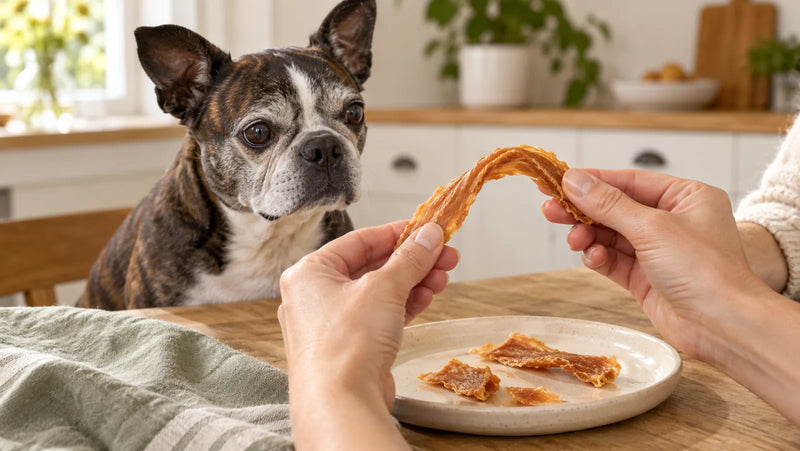

Beef tendons can be a satisfying edible chew for some dogs when the product, dog, and session are a good match. The appeal of beef tendons for dogs is easy to understand: tendon is rich in protein and collagen, and a dried piece often lasts longer than a small food reward. But “natural” does not mean risk-free.
Choose a tendon that is too large to fit wholly in the dog's mouth, has some give rather than bone-like hardness, and comes from a reputable maker with a clear label. Watch the entire chewing session from the same room. Take the chew away when it becomes small enough to swallow, develops a large loose chunk, turns rope-like and gulpable, or causes the dog to bite down so forcefully that teeth may be at risk.
Beef tendons for dogs: the quick answer
A dried beef tendon is an edible animal-part chew, not a bone or chew toy. It may fit a moderate, deliberate chewer that slowly works the surface and swallows only small softened pieces. It is a poor fit for a dog that tries to gulp the whole item, shears off large chunks, guards chews, or attacks very hard objects with full jaw force.
The American Kennel Club's edible-chew guide describes tendon and backstrap chews as protein- and collagen-rich options that are often relatively low in fat. The same guide stresses that an edible product is not automatically safe: hardness, durability, size, ingredients, and the individual dog's chewing style all matter.
Use six gates before serving one:
- Dog fit: teeth are healthy, and the dog chews slowly rather than swallowing objects.
- Size fit: the tendon is longer and wider than the dog can place entirely behind the teeth.
- Texture fit: it has some bend and does not feel like bone, antler, hoof, or stone.
- Label fit: ingredients, processing, origin, date, storage, and maker contact information are clear.
- Diet fit: beef, calories, and fat are compatible with the dog's normal or therapeutic diet.
- Session fit: an adult can actively observe, trade for the remnant, and end the chew before it becomes hazardous.
What is a beef tendon dog chew?
A tendon is strong connective tissue that joins muscle to bone. It contains a dense collagen framework, which is why a cleaned and dried tendon can become fibrous and chewy. Products vary widely: one may be flat and flexible, another twisted and dense, and another dried until it is extremely hard.
A beef tendon is not the same thing as:
- rawhide, which is made from an inner layer of animal hide;
- a bully stick, which is made from beef pizzle;
- a collagen stick, which may be formed from processed hide-derived collagen rather than an intact tendon;
- beef jerky, which is dried muscle meat used mainly as a food reward; or
- a bone, antler, horn, or hoof, which can be much harder and carry different tooth and fragment risks.
The ingredient name on the front is not enough to identify every detail. Read the full label and ask the manufacturer what tissue is used, how it is processed, whether anything is added, where it is sourced and made, and how many calories the chew contains.
What are the benefits of beef tendons for dogs?
A longer supervised chewing activity
Chewing is a normal canine behavior, and a well-matched edible chew can provide a focused activity. The ASPCA's position on dog chews recognizes chewing as a natural behavior while emphasizing that chew choice must reflect the individual dog's size and chewing habits.
A tendon may last longer than a bite-size training reward because the dog has to soften and work the connective tissue. “Longer” is relative, however. A gentle chewer may spend a meaningful session on one piece, while a power chewer may split the same product in minutes. Fast destruction is a warning that the chew is not durable in a safe way for that dog.
The activity is valuable only while it remains controlled. A tendon should not be handed out as a babysitter when everyone leaves the room. Same-room observation lets an adult see changes in bite force, texture, length, and chunk size before the situation becomes an emergency.
Protein and collagen, without a joint-treatment promise
Tendon is collagen-dense connective tissue, so it contributes protein when eaten. During digestion, collagen is broken into peptides and amino acids, just as other dietary proteins are broken down. Those nutrients can be part of a dog's total intake.
That does not prove that chewing tendon rebuilds cartilage, treats arthritis, relieves pain, or replaces a veterinarian-selected joint product. “Contains collagen” is a composition statement. “Supports or repairs joints” is a health claim that needs evidence for the actual product and dose.
If a dog is stiff, limping, reluctant to rise, or losing interest in normal activity, schedule a veterinary assessment. Pain control, body weight, exercise, rehabilitation, medication, and a nutritionally defined EPA/DHA or joint plan are more precise tools than an undosed animal-part chew.
Often leaner than some animal chews—but verify the label
The AKC describes tendon chews as low in fat and high in protein and collagen relative to other animal-part options. That is a useful category clue, not permission to call every bag “low fat.” Natural tissue varies, and processing or coatings can change the final product.
Look for a guaranteed analysis and a calorie statement. If calories are missing, contact the manufacturer. A chew may be consumed slowly, but every swallowed gram still counts. A large edible chew can use much of a small dog's daily treat allowance even if it looks lean.
Flavor coatings, smoke, oil, sweeteners, colors, and long ingredient lists can also turn a simple chew into something else. Choose the clearest product the dog tolerates rather than assuming that all brown, dried animal parts are nutritionally interchangeable.
Which dogs are a good fit for beef tendon chews?
Moderate, deliberate chewers
The best candidate pauses, gnaws, and softens a chew rather than trying to swallow it. During the first session, watch how the dog uses the front teeth and back teeth, whether the material gradually frays, and whether any chunk separates. The goal is slow, small-particle consumption—not a contest to finish.
Size and breed do not perfectly predict style. A small terrier may dismantle a chew faster than a much larger, gentle dog. Age can also change the fit: a product that worked for a young adult may become too hard for the same dog after dental wear, gum disease, a fractured tooth, or senior-life changes.
Dogs that gulp, shear chunks, or have dental disease
Skip tendon when a dog repeatedly swallows treats whole, bites through durable items in a few forceful motions, or becomes frantic around high-value food. The ASPCA warns that rapid consumption and large chunks can lead to obstruction and that inappropriately small chews may be swallowed whole.
Dogs with broken or worn teeth, periodontal disease, oral pain, missing chewing teeth, recent dental work, jaw disease, or a history of fractured teeth need veterinary guidance before hard or durable chews. A tendon that is rigid and non-bending is not made safer by being edible.
Resource guarding also changes the plan. Do not grab, chase, or pry a chew from a dog that stiffens, growls, or snaps. Keep children and other pets away, and ask a qualified reward-based trainer or veterinary behavior professional for a safe trade protocol.
Puppies, seniors, and medically managed dogs
Puppies have developing teeth and small calorie allowances, and they may experiment by swallowing objects. Ask the veterinarian when an edible tendon is appropriate for the puppy's age, mouth, and diet. A rubber enrichment toy sized for the puppy may be a better first chewing outlet.
Senior dogs are not automatically excluded, but dental comfort matters more than age on a calendar. If the dog drops food, chews on one side, avoids hard food, paws at the mouth, or has new breath or appetite changes, arrange an oral exam before testing another chew.
Beef tendon also conflicts with some medical diets. Avoid it unless approved for dogs with a beef allergy, pancreatitis history, fat restriction, kidney or liver disease, gastrointestinal disease, obesity plan, hydrolyzed diet, novel-protein trial, or strict elimination diet.
How to choose a beef tendon chew
Match size and shape to the dog
Choose a piece that cannot fit wholly in the dog's mouth at the start. It should be long and broad enough for the dog to hold while keeping a substantial section outside the teeth. A thin short strip that disappears behind the molars is not a good match, even if the package lists the dog's weight range.
Reassess during the session. The original size is irrelevant once half the chew is gone. Retire it when the remainder can fit in the mouth, when the dog can orient it for a single gulp, or when one large flap is barely attached.
Check hardness, bend, and fracture behavior
Press and gently bend the dry chew before serving. A tendon can be firm, but it should not feel like a rock or a non-bending bone. If it snaps into hard sharp pieces, has rigid edges, or requires the dog to hammer down with extreme force, choose another product.
VCA's veterinary dental guidance explains that hard, non-bending objects can fracture canine teeth. Warning signs include chewing on one side, dropping food, drooling, pawing at the mouth, facial swelling, and refusing hard food. Dogs can also hide dental pain, so a normal-looking session does not erase the value of routine dental exams.
Texture can vary even within one bag. Check every piece rather than approving the product once and assuming all future chews behave identically.
Read ingredients, processing, origin, calories, and guarantees
Our dog-treat label guide applies to edible chews too. Look for:
- the exact ingredient list, including coatings and preservatives;
- a guaranteed analysis and calorie statement;
- country of sourcing and manufacture when those claims matter to you;
- a lot code, best-by or use-by date, and manufacturer contact information;
- clear storage directions and package integrity; and
- instructions for dog size, supervision, and removal.
Do not infer “single ingredient,” “chemical-free,” “sterilized,” “100% digestible,” or “made in USA” from appearance. Those claims belong to the actual package and maker. Prefer a reputable commercial product with traceability over an unlabeled loose or raw animal part.
How to serve beef tendons more safely
Introduce one chew during a short observed session
Offer the first tendon when the dog is calm, separated from other animals, and already familiar with a trade cue. A five- to ten-minute first observation window can reveal whether the dog gnaws slowly or immediately attempts to break and gulp. That clock is not a guarantee; end sooner at the first unsafe behavior.
Keep both hands free and stay close enough to see the chew. Do not hold one end while the dog pulls hard, because tugging changes the bite pattern and can bring fingers near teeth. Let the dog chew on a stable nonslip surface without furniture or another pet creating competition.
Use the take-away-and-trade routine
Before the tendon becomes small, offer a familiar higher-value reward a short distance away. When the dog releases and moves to the reward, pick up the tendon calmly. This turns removal into a predictable exchange instead of a chase.
Practice the trade with low-stakes objects before using a highly valued animal chew. If the dog guards the tendon, stop offering that item until a qualified professional has helped create a safe plan. Physical confrontation increases bite risk and may make future guarding worse.
Retire the chew before it becomes a nub
Take the tendon away when:
- the remainder can fit wholly in the dog's mouth;
- a large chunk or flap is separating;
- the dog begins gulping, coughing, gagging, or repeatedly repositioning it to swallow;
- long stringy material could be swallowed as one rope-like mass;
- the surface develops a hard sharp point or edge;
- the dog bites with escalating force rather than softening the chew;
- the chew becomes dirty, slimy after storage, moldy, rancid, or otherwise questionable; or
- the dog shows mouth pain, bleeding, a damaged tooth, vomiting, diarrhea, or discomfort.

Tooth, choking, and obstruction risks
Three separate mechanical risks matter:
- Tooth trauma: an extremely hard chew can crack a tooth or injure oral tissues.
- Airway or esophageal obstruction: a whole tendon or large piece can lodge before reaching the stomach.
- Stomach or intestinal obstruction: swallowed material may fail to move through normally, even when the ingredient itself is edible.
The FDA's pet-treat safety guidance notes that unchewed treat pieces can get stuck in the windpipe or gastrointestinal tract. Frantic behavior, drooling, choking, breathing difficulty, pale or blue gums, and collapse are emergencies. Gulping, repeated drooling, or bringing up undigested food can signal an esophageal blockage.
Vomiting, diarrhea, appetite loss, reduced activity, abdominal pain, repeated straining, or inability to pass stool after swallowing a piece can indicate a later digestive obstruction. Contact a veterinarian promptly and explain the product, approximate dimensions swallowed, time, and symptoms. Do not induce vomiting or force food without veterinary direction.
“Digestible” does not cancel geometry. A large piece can obstruct faster than digestive enzymes can break it down. Prevention means sizing generously, observing continuously, and retiring early.
Beef tendon vs rawhide vs bully stick
These chews may sit on the same store shelf, but they are different materials. The table positions them without declaring a universal winner:
| Chew | What it is | Main selection questions |
|---|---|---|
| Beef tendon | Collagen-rich connective tissue that joins muscle to bone | Does it have some give? Does it fray slowly rather than shear into chunks? Is the actual label clear? |
| Rawhide | Processed inner layer of animal hide | How was it processed? Does the dog tear off large pieces? When does the softened remainder become swallowable? |
| Bully stick | Dried beef pizzle | How calorie-dense is it? How quickly does the dog bite through it? Can a holder or early removal prevent swallowing the nub? |
A tendon is often chosen for collagen-rich animal tissue and a fibrous chew; rawhide for longer hide chewing; and a bully stick for a highly palatable beef chew. Every category can produce products of different size, hardness, calories, processing, and quality. The dog remains part of the safety equation.
For the full purpose, calorie, odor, and chunk-risk comparison, see our chicken jerky vs bully sticks comparison. For a closer look at hide processing, digestion, and format choice, read the chicken jerky vs rawhide guide. Those pages own the detailed comparisons; the job here is to place tendon accurately among the options.
Storage and hygiene for animal-part chews
Follow the package directions. Keep unopened chews cool, dry, sealed, and away from pests. After a session, a saliva-wet tendon is no longer the same shelf-stable dry product. Some makers permit short-term covered storage; others advise disposal. When directions are absent, contact the manufacturer rather than inventing a multi-day reuse schedule.
Wash hands after handling the chew, clean the mat or floor, and keep it away from food-preparation areas. Do not offer raw or unsterilized tendon. Animal-derived chews can carry bacteria, especially when processing, package integrity, or damp storage is uncertain.
Discard any chew with mold, slime, an off or rancid odor, insect damage, a torn wet package, or uncertain storage history. The cost of one replacement chew is small compared with the risk of feeding a contaminated item.
What to do if a dog swallows a large tendon piece
Remove access to the rest and note the product, approximate length and width swallowed, time, and dog’s weight. Call a veterinarian promptly for a large piece, a small dog, a known gulper, previous obstruction, or any uncertainty. Save the package and a similar unused chew so the veterinary team can understand the material and size.
Go to an emergency veterinarian immediately for breathing difficulty, frantic choking, blue or pale gums, collapse, or inability to move air. Repeated drooling, gulping, regurgitation, vomiting, refusal to eat, severe lethargy, abdominal pain, bloating, or repeated unproductive straining also needs urgent guidance.
Do not reach blindly into the throat, induce vomiting, pull on material extending from the mouth or rectum, or give bread, oil, bulky food, or another home remedy to “push it through.” The correct response depends on where the object is and how the dog is doing.
Frequently asked questions
Are beef tendons digestible for dogs?
Tendon is animal connective tissue, so its protein can be digested when the dog chews it into small pieces. That does not make every dried tendon completely or quickly digestible. A large swallowed piece can choke or obstruct before digestion solves the problem, and processing and hardness vary by product.
Do beef tendons clean dogs’ teeth?
Chewing may create some mechanical contact with tooth surfaces, but a generic tendon has not thereby earned a dental claim. Do not use it as a substitute for brushing, veterinary dental exams, or a product with evidence for plaque or tartar control. Stop if the chew is hard enough to risk a fracture.
Are beef tendons good for puppies?
Some puppies may eventually handle an appropriately sized, not-too-hard tendon under direct supervision, but age, tooth stage, chewing style, and growth-diet calories matter. Ask the veterinarian first. Never leave a puppy alone with an edible chew, and remove it at the first attempt to gulp or shear chunks.
How long should a dog chew a beef tendon?
There is no universal safe number of minutes. Start with a short observed session and end based on behavior and condition: forceful biting, large pieces, a swallowable remainder, mouth discomfort, soft rope-like material, or stomach upset all override the clock. A five-minute first check is useful; it is not a guarantee.
Can a dog eat the whole beef tendon?
The chew is sold as edible, but “edible” does not mean the dog should swallow the final nub or finish a large piece in one session. Remove it before it can fit wholly in the mouth. Count the consumed amount within all daily treat calories and follow the product's feeding directions.
Choose the dog, the chew, and the session together
A beef tendon can be a useful supervised chew when it has a clear label, suitable size, some give, and a slow fracture pattern—and when the dog has healthy teeth and deliberate chewing habits. The benefit is a longer, protein-rich chewing activity. The responsibility is to watch, trade, and retire the piece before it becomes a tooth, choking, or obstruction problem. For how tendons compare with other options, see our guide to the best natural chews for dogs.
American Paws does not currently sell beef tendons, rawhide, or bully sticks, so we will not pretend there is a tendon SKU in our catalog. If a portionable food reward fits your dog better than a durable chew, browse all current American Paws dog treats, read the actual product label, and choose a texture that matches the dog's mouth and eating style. Whatever the format, keep treats below 10% of daily calories and put individual dental or medical needs ahead of trends.