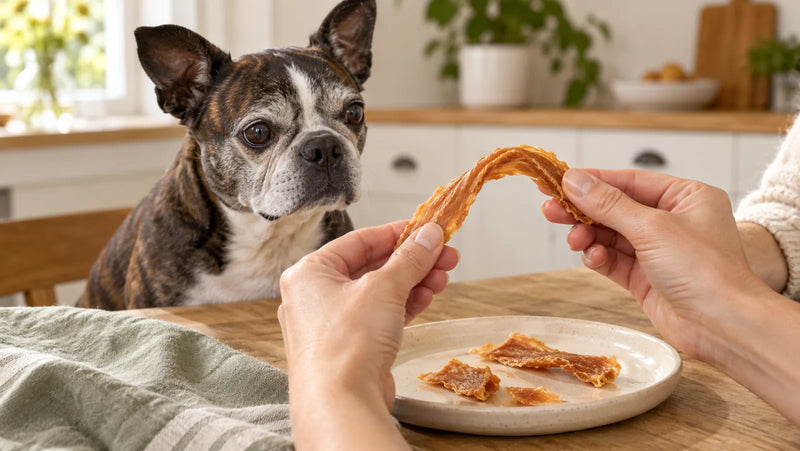

Dog trachea chews—usually sold as dried beef trachea—are hollow, cartilage-based treats with a softer, often crunchy break than dense bones or antlers. They may suit a careful dog that gnaws while a person watches, but they are a poor fit for a dog that crushes off large pieces or tries to swallow a chew whole.
The natural glucosamine and chondroitin language on this category describes the cartilage tissue. It does not tell you the amount in one finished chew, prove a treatment dose, or turn a snack into arthritis care. Before buying, look past the front-label promise and check the individual dog, the complete ingredient list, the whole-piece size, the calorie statement, and the way that exact product breaks.
Dog Trachea Chews: The Quick Fit Test
No edible chew is universally safe. The same hollow ring that one dog works on slowly can be cracked and swallowed by another in seconds. Use chewing behavior—not breed label or body weight alone—as the first screen.
| A supervised trial may be reasonable | Choose another format |
|---|---|
|
|
If the right-hand column sounds familiar, a larger piece is not a complete fix. Size can reduce whole-swallow risk, but it cannot make a fast, destructive chewing pattern safe.
What Is Beef Trachea?
Hollow rings and variable finished texture
The trachea is the windpipe. In cattle, connected cartilage rings help hold that airway open; Cornell’s bovine anatomy resource identifies those rings as hyaline cartilage joined by connective tissue. After cleaning and processing, pet-treat makers may sell trachea as a long tube, shorter section, split piece, or cross-cut ring.
That anatomy explains the recognizable hollow center and ribbed surface, but it does not standardize the finished product. Thickness, attached tissue, drying or roasting method, moisture, coatings, fillings, and storage all affect how hard, rich, or breakable a particular chew becomes. A package labeled dehydrated beef trachea may behave differently from a dry-roasted tube or a stuffed trachea.
Softer does not mean swallow-proof
The American Kennel Club’s edible-chew guide describes trachea as a softer chew. That is a relative comparison, not a promise that every piece is soft, gentle on every tooth, or incapable of breaking into hazardous chunks. Softer and more brittle can actually be a poor combination for a dog that bites through treats and gulps what comes loose.
Do not rely on claims such as edible, digestible, natural, or long-lasting as safety guarantees. An edible piece can still enter the airway, lodge in the esophagus, or cause a gastrointestinal obstruction if its size and the dog’s chewing style do not match.
Natural Glucosamine and Chondroitin: What the Claim Means
Cartilage contains structural compounds, and beef trachea is commonly marketed as a natural source of glucosamine and chondroitin. The AKC guide uses that category description, and laboratory work indexed by PubMed has characterized chondroitin sulfate from bovine tracheal cartilage. That supports the tissue-source statement. It does not answer how many milligrams are in the chew in your hand, how much survives processing, or how much a dog absorbs.
Keep three questions separate:
- What is the tissue? It is primarily a cartilage structure, so the natural-source description is plausible.
- What is in this finished product? Only product-specific testing and a complete label can answer that. Size alone cannot.
- What will it do clinically? A casual chew is not a standardized joint supplement, pain medicine, or treatment plan.
The caution is not merely semantic. A 2022 systematic review of canine and feline osteoarthritis treatments found no convincing pain-relief effect for measured glucosamine-chondroitin nutraceuticals in the evidence it reviewed. That does not prove trachea has no nutritional value; it means a natural-glucosamine headline should never become a promise to repair cartilage, relieve arthritis, reduce inflammation, or improve mobility.
If a dog is stiff, painful, reluctant to rise, or losing mobility, ask a veterinarian for an examination and an evidence-based plan. Do not replace prescribed care with a chew, and do not add a joint supplement based on the assumption that the chew already provides a known dose.
Which Dogs May Be a Reasonable Match?
A beef trachea trial may be reasonable for a healthy dog that handles edible chews slowly, tolerates beef, and has no diet or medical restriction that rules out the product. The dog should be able to hold and gnaw the piece without immediately shearing off and swallowing large sections.
A good first session is intentionally boring: one intact, size-appropriate chew; one dog; one adult observer; and no competition from another pet. Watch the first few bites closely. The dog’s actual break pattern is more useful than a manufacturer’s broad small-, medium-, or large-dog label.
Temperament matters too. You must be able to trade for or calmly remove the chew before it becomes a swallowable nub. If the dog guards high-value food, work with a qualified behavior professional rather than reaching toward the mouth or creating a confrontation.
Which Dogs Should Skip Beef Trachea?
Choose another reward and ask the veterinary team for guidance when the dog:
- is a power chewer that cracks edible chews into big pieces;
- gulps food, steals chews, or tries to swallow long items intact;
- has fractured teeth, painful dental disease, swallowing trouble, or an esophageal condition;
- has previously needed care for a swallowed object or gastrointestinal obstruction;
- must avoid beef during a food trial or because of a documented reaction;
- has a prescription, fat-restricted, or otherwise medically managed diet;
- currently has vomiting, diarrhea, poor appetite, abdominal discomfort, or unexplained weight change; or
- is a puppy whose changing teeth, calorie needs, and chewing skills have not been discussed with the veterinary team.
These are screening reasons, not diagnoses. A veterinarian who knows the dog can weigh dental health, body condition, diet, medications, and previous incidents together.
How to Choose a Beef Trachea Chew
Read the exact product label
Start with the ingredient list. Some products may contain only beef trachea; others may be smoked, flavored, coated, or stuffed with another food. Do not assume single-ingredient, additive-free, low-fat, raw, dehydrated, sterile, or made in the USA unless the specific maker documents it.
Look for a calorie statement, net weight, lot identification, storage directions, country-of-origin or sourcing information, and a way to contact the manufacturer. If the product makes a quantitative glucosamine or chondroitin claim, ask whether that value is guaranteed per piece or based only on the source tissue.
Choose a whole piece the dog cannot swallow intact
The ASPCA’s position on dog chews and treats warns that small products may be swallowed whole and that overly aggressive chewers may consume large pieces that can obstruct the intestine. Choose a piece that cannot fit entirely in the dog’s mouth, then keep reassessing as it gets smaller.
Do not cut a long tube into small rings merely to make the calories look easier to manage for a gulper. That can create pieces that are easier to swallow without chewing. When a full-size product does not fit the dog’s calorie budget or chewing behavior, choose a different kind of dog treat.
Inspect the piece before every session
Use the package’s storage directions and discard a chew that is damp when it should be dry, visibly moldy, unusually sticky, rancid-smelling, contaminated, or damaged in a way that creates sharp edges. Natural variation is expected, but a safety inspection still matters. Wash your hands and the feeding surface after handling an animal-based chew.
A Safe Supervision Session, Step by Step
- Set up one calm area. Separate other pets, remove distractions, and use a washable mat where you can see every fragment.
- Record the starting point. Note the intact length, width, weight, and appearance. Keep the package and lot information.
- Watch continuously. Supervision means staying close and alert, not checking from another room or leaving the chew in a crate.
- Study the break pattern. Slow scraping and small, thoroughly chewed bites are different from cracking off a wide ring and gulping it.
- Remove detached large pieces. End the session if the chew fractures rapidly, develops a sharp edge, or produces chunks the dog may swallow.
- Take away the nub. Stop before the remaining piece becomes small enough to fit completely in the mouth.
- Check the dog and the mat. Account for missing pieces and watch for vomiting, diarrhea, poor appetite, or discomfort after a new treat.
The World Small Animal Veterinary Association’s treat guide likewise recommends supervising chews and selecting a size and shape appropriate for the individual dog.

Beef Trachea Calories and Portion Planning
A hollow chew can still use a meaningful share of a dog’s daily calories. Attached tissue, thickness, length, fillings, and processing vary, so there is no honest category-wide calorie number. Never estimate calories from the empty center or copy another brand’s figure.
Use the exact package’s kcal-per-piece or kcal-per-ounce value. If the maker provides only kcal/kg and you can weigh the chew in grams, the arithmetic is:
estimated chew calories = chew weight in grams × labeled kcal/kg ÷ 1,000
That calculation is only as good as the manufacturer’s calorie statement and the weight you measured. It does not solve the choking problem created by trimming a chew into small pieces.
WSAVA recommends that all treats together provide no more than 10% of a dog’s daily calories. That is one shared ceiling for trachea, training rewards, toppers, table bites, medication foods, and every snack from every person—not 10% for each category. Complete and balanced food should provide the nutritional foundation. Our daily dog-treat calorie guide shows how to build an individual allowance.
If one whole chew exceeds the available allowance, do not automatically divide it into gulpable rings. Feed it less often only if the veterinary plan and safe session permit, or choose a smaller-calorie reward whose physical size remains safe.
Beef Trachea vs Tendons and Bully Sticks
These are all animal-based edible chews, but they are not interchangeable. Compare the finished product and the dog’s response rather than assuming one category always wins.
| Chew | Basic structure | Main fit question |
|---|---|---|
| Beef trachea | Hollow cartilage rings and connective tissue; generally softer and more breakable than dense bone | Does the dog gnaw, or crack off and gulp rings or chunks? |
| Beef tendon | Dense, fibrous connective tissue with a more stringy or chewy structure | How does the individual tendon soften, fray, and shrink during use? |
| Bully stick | Dense beef pizzle tissue formed into a stick, braid, or other shape | Will the dog bite through or swallow the final dense nub? |
Our beef-tendon chew guide covers tendon-specific selection and removal. If ingredient identity is the question, see what bully sticks are made of. For a wider comparison by hardness, durability, size, calories, and chewing style, start with the natural dog-chew selection guide.
What If a Large Piece Was Swallowed?
If the dog cannot breathe normally, has blue or very pale gums, collapses, or is in obvious choking distress, seek emergency veterinary care immediately. Do not delay to search for a home technique.
If a large piece was swallowed and the dog is breathing, remove the remaining chew and call a veterinarian or emergency clinic promptly. Have the package, a matching piece or photo, the approximate dimensions and amount, the time, the dog’s weight, and current signs ready. Do not induce vomiting unless a veterinarian specifically directs it; bringing a rough cartilage piece back through the esophagus can add harm.
Repeated retching or vomiting, heavy drooling, trouble swallowing, refusal or inability to eat, abdominal pain or swelling, marked lethargy, straining, blood, or black tarry stool warrants prompt veterinary care. A dog can look normal before an obstruction becomes obvious, so the individual case—not a generic online timetable—should determine monitoring and imaging.
American Paws Does Not Sell Beef Trachea
American Paws does not currently sell a beef-trachea product. We would rather state that clearly than dress a different item up as the same chew.
For dogs whose size and chewing behavior suit the format, American Paws offers single-ingredient dehydrated chicken feet. Chicken feet are a distinct, crunchy, bone-containing supervised chew—not a soft trachea substitute, not a beef option, and not a measured joint supplement. Read the product page, consider poultry tolerance, and apply the same size, calorie, supervision, and removal discipline.
Frequently Asked Questions
Is beef trachea safe for dogs?
It may be a reasonable supervised chew for a dog that gnaws slowly, cannot swallow the whole piece, tolerates beef, and can fit the exact product into its diet. It is not universally safe. Dogs that crush and gulp chunks, have swallowing or dental problems, or need a restricted diet should use a veterinarian-approved alternative.
Is beef trachea good for power chewers?
Usually not. Because trachea is relatively soft and breakable, a powerful dog may crack off wide sections and swallow them before they are chewed down. If that happens during the first bites, end the trial; simply buying a longer tube does not correct the chewing pattern.
Does beef trachea help a dog’s joints?
Beef tracheal cartilage is marketed as a natural glucosamine and chondroitin source, but an ordinary chew does not provide a known therapeutic dose unless the manufacturer has valid product-specific testing. Do not use it to treat pain, stiffness, arthritis, or mobility change. Ask a veterinarian about diagnosis and joint-care options.
Is beef trachea low in calories?
Do not assume so. Calories vary with length, weight, attached tissue, processing, and any filling or coating. Use the exact label or contact the maker, then count that amount inside the same daily treat allowance as every other extra.
How long should a beef trachea chew last?
There is no safe universal answer in minutes. Product thickness and the dog’s bite pattern matter more than a marketing duration. A chew that vanishes quickly because the dog swallows big pieces is a failed fit, not an efficient snack.
Choose the Chew for the Dog in Front of You
Beef trachea has a clear identity: a hollow cartilage chew that is generally softer and more breakable than dense bone. Its natural glucosamine story may sound appealing, but size, calories, break pattern, and uninterrupted supervision should decide whether it enters the home.
If trachea is not a sound match, there is no reason to force it. Compare chew formats, ask the veterinary team when health or diet complicates the choice, and browse all current American Paws dog treats for clearly labeled alternatives that fit the individual dog. The safest product is the one whose ingredients, calories, texture, and use rules you can actually verify.