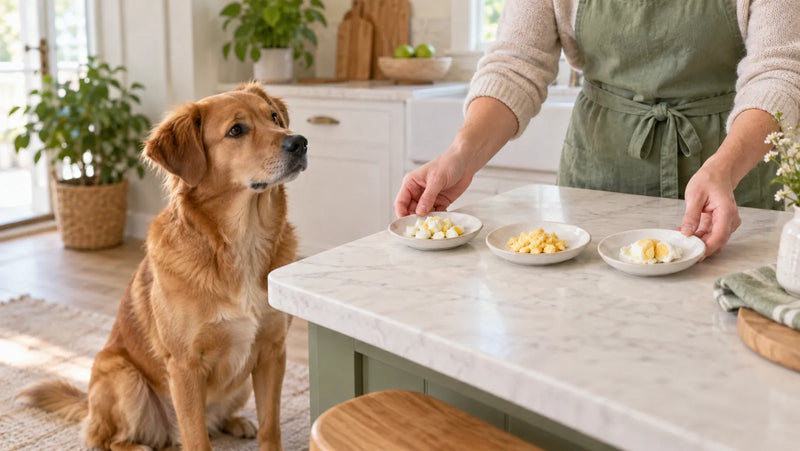

Can puppies eat peanut butter? Yes—some can have a tiny taste of xylitol-free peanut butter from about 8 weeks, once they are fully weaned, reliably eating complete puppy food, and able to lick and swallow normally. Read the exact ingredient list first: xylitol, wood sugar, birch sugar, or birch bark extract makes the product an emergency risk, not a puppy treat. Start with a paper-thin smear for one or two licks, not a spoonful.
Age alone does not clear the jar. Peanut butter is calorie-dense, sticky, and different from a puppy’s complete growth diet. The puppy must be ready for a new food, the exact product must pass the xylitol check, and the caregiver must be able to supervise one measured introduction.
Can Puppies Eat Peanut Butter? The Four-Gate Answer
| Gate | What must be true | Stop when |
|---|---|---|
| Readiness | The puppy is fully weaned, eating complete growth food reliably, and swallowing normal food comfortably | The puppy is still weaning, eating poorly, vomiting, having diarrhea, or struggling to swallow |
| Ingredient screen | The exact current jar contains no xylitol, wood sugar, birch sugar, or birch bark extract | An ingredient is positive, unreadable, or uncertain |
| Amount | The first taste is a paper-thin smear for one or two licks and fits the day’s shared extras budget | The plan starts with a spoonful, filled toy, or unmeasured access to the jar |
| Supervision | One caregiver can watch the puppy, preserve the label, and introduce no other new food at the same time | The puppy would be left with the jar, toy, or an untracked mixture |
All four gates matter. Passing the age gate does not cancel a dangerous ingredient, and a xylitol-free jar does not create a universal serving size. If one gate fails, use the puppy’s measured meal food as the reward and revisit the question with the veterinary team.
Check for Xylitol Before the Puppy Gets Near the Jar
Read the exact ingredient list every time
The FDA xylitol warning for dog owners lists sugar-free nut butters among products that may contain xylitol. It also lists wood sugar, birch sugar, and birch bark extract as names that may be used for the same sweetener. Search the complete ingredient list for every one of those terms.
Do not infer safety from “natural,” “organic,” “no added sugar,” “low sugar,” a familiar brand, or a jar that was safe last month. Formulas and varieties can change. If the text is damaged, hidden, in another container, or unclear, do not offer it.
For an ordinary first taste, the simplest candidate is usually smooth, unsalted peanut butter whose ingredient list says peanuts only. That preference removes extra sweeteners and mix-ins; it does not override a puppy’s diet restriction, peanut reaction history, fat restriction, or veterinary plan.
What to do after a known, possible, or unclear exposure
If the puppy may have eaten xylitol—or the ingredient list is unavailable after access—call the veterinarian, emergency veterinary clinic, or ASPCA Animal Poison Control at 888-426-4435 immediately. A consultation fee may apply. Bring the original package or clear photos, product name, ingredient list, puppy’s weight, maximum amount missing, and earliest possible exposure time.
FDA warns that xylitol poisoning can begin within 20 minutes. Possible signs include vomiting, decreased activity, weakness, trouble walking or standing, shaking, seizures, collapse, coma, liver failure, and bleeding problems. Do not wait for a sign before calling.
The Merck Veterinary Manual’s xylitol review explains that dogs can develop profound hypoglycemia and, less commonly, severe liver injury. Signs may begin within 30 minutes or be delayed for 12–18 hours in a product that slows absorption. Do not make the puppy vomit, give syrup or food, or use activated charcoal as a home response. Merck places vomiting under veterinary supervision and says charcoal does not appreciably bind xylitol.
Use the separate xylitol poisoning emergency guide for the full exposure timeline, evidence checklist, symptoms, and prevention steps. A peanut-butter serving discussion no longer applies once exposure is positive or uncertain.
About 8 Weeks Is Context, Not Automatic Clearance
Many puppies are fully weaned and moving into new homes around 8 weeks, which is why that age appears in first-treat advice. Some puppies are not ready. The first-treat readiness guide uses the individual puppy’s development, regular food, health, and swallowing ability instead of treating the birthday as permission.
- Fully weaned: the puppy eats independently and is no longer transitioning from milk or milk replacer.
- Stable growth diet: complete-and-balanced puppy food is going well, without unexplained appetite loss, repeated vomiting, or diarrhea.
- Normal licking and swallowing: the puppy can manage its usual food and a thin smear without gulping a sticky mass or chewing the toy.
- No conflicting plan: the puppy is not fasting, on a prescription or elimination diet, or under instructions that exclude extras.
- Trackable introduction: the household can name the exact jar, measure the amount, and keep every other new food out of the test.
A puppy who is younger, not fully weaned, newly ill, underweight, failing to grow as expected, or struggling with food texture needs a feeding plan rather than a peanut-butter experiment.
How Much Peanut Butter Can a Puppy Have?
First taste: a thin smear for one or two licks
For the first introduction, spread only a paper-thin film across one shallow groove of a clean toy or the flat tip of a small silicone spatula. The puppy should take one or two supervised licks. That is enough to test interest and introduce the flavor; it is not a daily dose.
Do not begin with a teaspoon, tablespoon, heaped spoon, filled toy cavity, or open jar. Those units hide how much a small puppy consumes, turn a taste into a substantial calorie load, and make it harder to stop after a reaction. Never allow the puppy to lick from the jar, both because the amount is uncontrolled and because the jar should remain clean and identifiable.
Count it inside one shared extras ceiling
The WSAVA dog-treat guide advises keeping treats under 10% of daily calories and asking the veterinary team for the individual dog’s energy requirement. For a puppy, that is one ceiling shared by peanut butter, training rewards, chews, toppers, lick mats, pill foods, table tastes, and every other noncomplete extra. It is not a 10% allowance for each category and not a target to fill.
Read the exact jar’s calories and work from the puppy’s veterinarian-confirmed daily plan. The daily puppy-treat amount guide shows how to calculate the shared ceiling and subtract other extras. There is no responsible universal spoon size by puppy weight because calorie needs, growth stage, diet, medical history, and peanut-butter formulas differ.
For repeated training, move measured kibble from the puppy’s regular meal whenever that food is motivating. A sticky smear is slow to deliver, difficult to count across repetitions, and easy to overuse.
Use Peanut Butter in a Toy Without Filling the Toy With It
- Pass the label check. Use the exact current jar and confirm there is no xylitol or alias.
- Measure before loading. Put a tiny trace on a clean spatula; do not dip the toy into the jar.
- Coat one shallow area. Spread a paper-thin film across one accessible groove rather than packing a deep cavity.
- Supervise on a stable surface. Hold or place the toy where the puppy can lick calmly without carrying, tearing, or swallowing part of it.
- Stop after the planned licks. Remove the toy instead of adding another layer.
- Wash and inspect. Clean the toy according to its instructions and discard it if damaged.

Do not use peanut butter as glue for an oversized chew, to make a puppy accept an unsafe object, or to keep the puppy occupied without supervision. If the toy design is too deep to measure a tiny amount or the puppy chews off pieces, choose another enrichment method.
Introduce One New Food and Watch the Puppy
Keep the rest of the day familiar. Do not introduce a new chew, topper, recipe, and peanut butter together. Save the jar and note the time and amount so a change can be connected to the correct food.
Mild digestive or skin changes
Stop the peanut butter and tell the owner or veterinary team if the puppy develops vomiting, loose stool, repeated gas, unusual scratching, redness, ear irritation, or another new change after the trial. Do not keep offering the food to “prove” the connection. A symptom can have many causes, and the veterinarian decides whether and how to investigate it.
Emergency signs need immediate help
Facial swelling, widespread hives, breathing difficulty, collapse, severe weakness, seizures, or inability to stand needs immediate emergency veterinary care. A positive or possible xylitol exposure also takes the immediate poison-response route even if the puppy looks normal.
Keep the two problems distinct. A food reaction requires the exact food history and clinical assessment; xylitol creates a toxin emergency with possible rapid hypoglycemia and delayed liver effects.
When to Skip Peanut Butter and Ask the Veterinarian First
Ask before offering peanut butter when the puppy is not fully weaned, eats a prescription or elimination diet, has a known or suspected peanut reaction, has pancreatitis history or a prescribed fat restriction, needs tightly controlled calories, has chronic digestive trouble, is underweight or overweight, or is not growing as expected.
Also wait when the puppy is vomiting, has diarrhea, refuses regular food, appears painful, cannot swallow normally, is preparing for anesthesia, or is recovering from illness. Peanut butter is an optional extra, not a treatment for appetite, anxiety, teething, medication acceptance, or weight gain.
Peanut Butter, Whole Peanuts, and Training Treats Are Separate Choices
The xylitol-free peanut-butter label and recipe guide covers general adult-dog selection and recipes. It does not replace the puppy readiness and tiny first-taste rules here. For the ingredient in its whole form, the whole-peanut safety guide covers shells, salt, coatings, choking considerations, calories, and accidental access.
Peanut butter is also not the default high-repetition reward. The puppy training reward guide explains how to choose delivery size, texture, calories, and session roles. Measured meal kibble is often the simplest starting reward because it preserves the puppy’s planned growth food instead of adding a separate rich extra.
If the puppy’s plan allows a separate product, the current training-treat collection shows available formats. Read the exact label and feeding information for the selected item; the collection is not a blanket promise that every product fits every puppy or peanut restriction. The broader American Paws dog treats assortment should be read the same way—product by product, not as one ingredient claim.
A Seven-Step Puppy Peanut-Butter Check
- Confirm the puppy is fully weaned, stable on complete growth food, and able to lick and swallow normally.
- Read the exact ingredient list for xylitol, wood sugar, birch sugar, and birch bark extract.
- Prefer a simple smooth, unsalted product with peanuts as the only ingredient when the puppy’s plan allows it.
- Use a paper-thin smear for one or two supervised licks—never a spoonful or filled toy.
- Count the calories with every other treat and extra inside one shared daily ceiling.
- Introduce no other new food at the same time; preserve the jar and record the amount.
- Stop for any change and call immediately after positive, possible, or unclear xylitol exposure.
Frequently Asked Questions
Can an 8-week-old puppy eat peanut butter?
Some can, but 8 weeks is not automatic clearance. The puppy should be fully weaned, eating complete growth food reliably, able to lick and swallow normally, and free of a conflicting veterinary plan. The exact peanut butter must be xylitol-free, and the first taste should be a paper-thin smear.
What peanut butter is safe for puppies?
No jar is safe by front-label reputation alone. Read the exact ingredient list and reject xylitol, wood sugar, birch sugar, and birch bark extract. A smooth, unsalted product listing peanuts only is the simplest candidate when the individual puppy’s diet permits it.
How much peanut butter can a puppy have?
For a first exposure, use only a paper-thin smear that produces one or two licks. For any repeat use, read the jar’s calories and count it with all other extras under the puppy’s veterinarian-confirmed daily ceiling. There is no universal puppy spoon size.
Can I put peanut butter in a puppy toy?
Yes, when the puppy is ready and the exact jar is xylitol-free. Spread a thin film across one shallow groove instead of filling the cavity, supervise the puppy, remove the toy after the planned licks, and wash and inspect it afterward.
Can puppies be allergic to peanut butter?
A puppy can react to a food, including peanuts, but symptoms are not a do-it-yourself diagnosis. Introduce one tiny new food at a time. Stop after vomiting, diarrhea, itching, redness, or another change; facial swelling, breathing difficulty, collapse, severe weakness, or seizures requires emergency care.
What should I do if a puppy ate xylitol?
Call the veterinarian, emergency clinic, or ASPCA Animal Poison Control at 888-426-4435 immediately and bring the package. Do not wait for symptoms or induce vomiting, give syrup or food, or use charcoal unless the professional managing the case gives a specific instruction.
Read the Jar, Offer a Tiny Taste, and Keep Growth Food in Charge
The useful answer to “can puppies eat peanut butter?” is conditional: some fully weaned puppies can try a tiny xylitol-free smear from about 8 weeks, but the exact label, readiness, supervision, and shared calorie plan all matter. One or two licks answer the first-taste question; a spoonful does not make the test more useful.
Need a repeatable training reward instead? Use measured puppy meal kibble for most repetitions. If the veterinary plan allows a separate product, compare exact labels and textures in the training-treat collection, introduce one tiny piece at a time, and count it with every other extra.