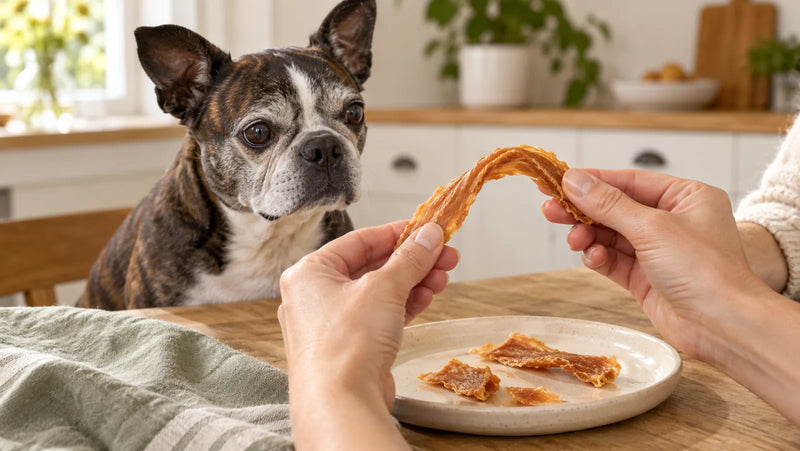

Chicken jerky calories for dogs must come from the current product label or manufacturer because strip size, thickness, moisture, and recipe vary. To estimate how many pieces fit, allow no more than about 10% of the dog’s daily calories for all treats, subtract every other reward or topper, divide the remainder by labeled kcal per piece, and round down. For American Paws chicken breast jerky, use the current calorie statement on the product page rather than a number copied into this article.
The result is a ceiling, not a goal or a prescription. A dog may need less because of body condition, activity, life stage, a therapeutic diet, or a health condition. Complete-and-balanced food should remain the nutritional base; chicken jerky is one optional reward competing for a small shared treat budget.
Chicken Jerky Calories for Dogs: The Four-Number Answer
You need four numbers before a piece count means anything:
- D = daily calories: the dog’s veterinarian-set target or the current intake that is maintaining an appropriate body condition.
- B = total treat budget: D × 0.10.
- E = other extras: calories from every other treat, chew, topper, table bite, and calorie-containing supplement planned that day.
- K = jerky kcal per piece: the current label or manufacturer value for the exact product and serving definition.
Maximum whole jerky pieces = round down (B − E) ÷ K. If B − E is zero or negative, no whole piece remains in the day’s treat budget. Do not round up: a calculator answer of 2.7 means two whole labeled pieces, not three.
This page owns that label-to-piece arithmetic. For the broader decision about total chicken jerky amount, individual tolerance, and portion planning, use our guide to how much chicken jerky a dog can have.
First, Read “kcal per Piece” Correctly
On pet-food labels, a capital-C “Calorie” is a kilocalorie, abbreviated kcal. Read the entire calorie statement and its unit. “Per piece,” “per treat,” “per serving,” “per ounce,” and “per kilogram” are different denominators. A serving may contain more than one piece, and a piece may be defined as an average when a natural whole-cut product varies.
Match the calorie statement to the exact item and variant in your hand. A soft strip, a whole-cut dehydrated strip, and a freeze-dried cube should not borrow one another’s values. Package size can also matter if products or serving definitions differ. Check the physical package first, then the current manufacturer page or customer service when the wording is unclear.
If the statement gives kcal per ounce rather than per piece, weigh the planned portion and calculate by weight. If it gives only a serving value, find the labeled serving definition before dividing. Do not search a generic “chicken jerky calories” number and apply it to a different recipe.

The 10% Rule Comes Before the Piece Count
The WSAVA Nutrition Committee’s dog-treat guide says treats should make up no more than 10% of a dog’s daily calorie intake. That protects room for complete-and-balanced food to provide essential nutrients in appropriate proportions.
The word all matters. Chicken jerky does not receive a separate 10% allowance after biscuits, a dental chew, cheese, a lick mat, and a dinner topper. Add every extra outside the complete diet, including small training pieces that seem negligible one at a time.
Ten percent is also not an instruction to fill the entire allowance. A dog that stays engaged with one small torn strip does not need extra pieces merely because the arithmetic leaves room. Start with the smallest amount that accomplishes the purpose.
Body-Weight × Piece Conversion Table
WSAVA publishes the following maximum daily treat calories for an average healthy adult dog in ideal body condition. The values are general guidance, not individualized feeding prescriptions. If your veterinary team has set a different daily calorie target, use 10% of that target instead.
In the formula column, E means calories already assigned to other extras and K means the exact current label kcal per whole jerky piece. Subtract first, divide second, then round down.
| Dog body weight | WSAVA maximum kcal/day from all treats | Maximum whole jerky pieces after other extras |
|---|---|---|
| 2 kg / 4.4 lb | 14 kcal | Round down: (14 − E) ÷ K |
| 4 kg / 8.8 lb | 24 kcal | Round down: (24 − E) ÷ K |
| 6 kg / 13.2 lb | 32 kcal | Round down: (32 − E) ÷ K |
| 8 kg / 17.6 lb | 40 kcal | Round down: (40 − E) ÷ K |
| 10 kg / 22 lb | 47 kcal | Round down: (47 − E) ÷ K |
| 15 kg / 33 lb | 64 kcal | Round down: (64 − E) ÷ K |
| 20 kg / 44 lb | 79 kcal | Round down: (79 − E) ÷ K |
| 25 kg / 55 lb | 94 kcal | Round down: (94 − E) ÷ K |
| 30 kg / 66 lb | 108 kcal | Round down: (108 − E) ÷ K |
| 35 kg / 77 lb | 121 kcal | Round down: (121 − E) ÷ K |
| 40 kg / 88 lb | 134 kcal | Round down: (134 − E) ÷ K |
| 45 kg / 99 lb | 146 kcal | Round down: (146 − E) ÷ K |
A weight between rows does not require guessing to the nearest convenient answer. Use the dog’s known daily calorie target when available. Body weight alone cannot account for age, neuter status, activity, metabolism, muscle condition, climate, or disease.
One Worked Example—With Hypothetical Numbers
Consider a hypothetical healthy adult dog weighing 10 kg, or about 22 lb. The WSAVA table lists up to 47 kcal from all treats for that example weight. Suppose the dog has already used 12 kcal on other extras and the exact jerky label hypothetically states 10 kcal per piece.
- Start with the 47-kcal total treat ceiling.
- Subtract 12 kcal already spent: 47 − 12 = 35 kcal remaining.
- Divide by the hypothetical 10 kcal per piece: 35 ÷ 10 = 3.5.
- Round down to three whole pieces.
The 10-kcal figure is a math example, not American Paws product data and not a recommended serving. A real dog’s current calorie target and the exact current product statement control. Even when three whole pieces fit the arithmetic, one or two may be enough for the day.
Why Whole-Cut Jerky Pieces Are Not Identical Units
Real chicken breast has natural variation. One strip may be longer, thicker, wider, or drier than another. If a package gives an approximate kcal-per-treat value, it may describe an average piece rather than promising that every strip contains exactly the same energy.
That makes the label’s serving basis important. If a manufacturer also supplies calories by weight, weighing the total planned portion can reduce the false precision created by irregular strip counts. Use a kitchen scale that can read the needed small amount, and follow the exact unit on the current statement.
Tearing one labeled piece into ten training bits does not create ten full-piece servings. The ten bits together still contain the energy of the original planned piece. The benefit is behavioral: more timely reward moments from the same measured portion.
Make One Planned Piece Last Through Training
Measure the session’s jerky before the first repetition. Put the bag away, then cut or tear the planned portion into pieces just large enough for the dog to notice and swallow comfortably. A strong aroma and prompt delivery often matter more than reward size.
- Use part of the measured regular meal for easy skills when the dog finds it motivating.
- Reserve tiny jerky pieces for new behaviors, difficult environments, or high-value recalls.
- Keep one daily container so family members, walkers, and trainers draw from the same allowance.
- Count food used in toys, lick mats, toppers, and chews before assigning the jerky amount.
- Stop when the pre-portioned supply is gone rather than reaching back into the bag.
Cut pieces to suit the individual dog. Supervise every serving. A dog that gulps, has dental pain, coughs while eating, or struggles with a chewy texture needs a safer format and veterinary guidance, not simply more pieces cut from the same strip.
Chicken Jerky vs Freeze-Dried Treat Calories
Dehydrated jerky and freeze-dried chicken differ in structure, texture, shape, and typical use, but the format name does not tell you which exact piece has fewer calories. A small airy freeze-dried cube may be easier to portion for one dog, while a jerky strip may be easier to tear for another. Piece dimensions and label definitions still control the comparison.
Compare the current kcal per piece, serving, ounce, or kilogram using the same unit. Also compare how predictably the item divides and whether crumbs or fragments will still be fed. Do not assume “freeze-dried,” “dehydrated,” “single-ingredient,” “high-protein,” or “natural” means calorie-free or unlimited.
For process, texture, storage, and use-case differences rather than calorie arithmetic, read our guide to dehydrated versus freeze-dried chicken for dogs. This article keeps the narrower kcal-to-piece job.
When the 10% Worksheet Is Not Enough
Ask your veterinarian to set the treat plan if the dog is gaining or losing weight, has diabetes, kidney disease, a history of pancreatitis, a chicken reaction, swallowing difficulty, or a therapeutic diet. Puppies, pregnant or nursing dogs, senior dogs with changing body condition, and highly active working dogs can also need individualized energy and nutrient decisions.
Do not remove a meaningful portion of complete food merely to make room for more jerky without professional guidance. Matching total calories does not guarantee that a treat replaces the vitamins, minerals, essential fats, amino acids, and other nutrients supplied by a complete diet.
Recheck the plan when weight, body condition, activity, health, food, or treat product changes. The correct K value comes from the current jerky, and the correct D value comes from the current dog.
Choose a Jerky With a Current Calorie Statement
American Paws’ single-ingredient whole-cut chicken breast jerky and its current calorie information give you the product-specific starting point for the worksheet. Check the current page or package when you portion; this article intentionally does not freeze a per-piece number that may be misunderstood or become outdated.
That linked product contains chicken breast as its single ingredient. The claim applies to that verified product, not automatically to every jerky recipe or every item in the American Paws catalog. Use the American Paws chicken jerky collection to compare current formats, and the complete chicken jerky guide for dogs for safety, labels, life stages, storage, and selection.
Every treat shares the day’s allowance. Our daily dog-treat budget guide shows how to coordinate all reward types, while the full American Paws dog treat collection lets you check current products and labels before choosing.
Frequently Asked Questions
How many calories are in one piece of chicken jerky for dogs?
There is no universal number. Read the current label or manufacturer page for the exact product because recipe, moisture, size, thickness, and the definition of “piece” vary.
How do I calculate how many pieces my dog can have?
Take 10% of the dog’s daily calories, subtract every other treat and extra, divide the remainder by the current label kcal per piece, and round down. Use a veterinarian-set daily target when available.
Is the 10% rule based on weight or calories?
It is based on calories. Body weight can help estimate a general calorie allowance, but the dog’s actual energy need depends on more than weight and may require veterinary adjustment.
Can I cut one piece into ten training treats?
Yes, if the texture and fragment size are safe for that dog. Ten bits cut from one planned strip create ten reward moments but still contain the original strip’s total calories.
Are freeze-dried chicken treats lower in calories than jerky?
Not necessarily. Compare current labels in the same unit. Format, piece size, moisture, and serving definition can change the per-piece result.
What if the label lists kcal per ounce instead of per piece?
Weigh the total planned portion and calculate from kcal per ounce. Do not estimate by strip count when natural pieces vary substantially.
What if other family members also give treats?
Use one shared daily container or record. Jerky, biscuits, chews, toppers, table bites, and training rewards all draw from the same treat-calorie budget.
Check the Label, Portion the Day, Then Open the Bag
The useful answer comes from today’s four numbers: the dog’s current daily calories, the 10% ceiling, calories already assigned to other extras, and the exact jerky’s labeled kcal per piece. Round down, pre-portion the result, and make each planned piece last through appropriately small rewards.
Ready to do the calculation? Check the current American Paws chicken breast jerky product page, record its current calorie statement, and portion the day before opening the bag. For the broader format choice, browse the chicken jerky collection.