
How much chicken jerky can I give my dog? Give only enough that it—and every other treat that day—stays within about 10% of your dog's daily calories. There is no responsible universal answer in strips because products vary in calories, thickness, and size, while dogs vary in energy needs. Find your dog's daily calorie target, multiply it by 0.10, subtract other treats, and use the jerky label's calorie statement to portion what remains.
That result is a ceiling, not a goal. Your dog may need less because of body condition, health, activity, or a veterinary diet. Chicken jerky is a treat; complete and balanced dog food should remain the nutritional foundation.
How much chicken jerky can I give my dog? Calculate calories, not strips
The widely used guideline is to keep treats at no more than about 10% of a dog's daily calories. The other roughly 90% should come from complete and balanced food appropriate for that dog. The treat allowance includes everything outside regular meals: jerky, biscuits, chews, table scraps, toppers, training rewards, and calorie-containing supplements.
A strip count cannot tell you whether a serving fits. One brand may sell thin, light pieces while another sells wide, dense strips. Even pieces in the same bag can vary because real meat is not molded into identical shapes. A small torn reward and a full strip are both one “piece” in casual conversation, but they are not the same portion.
If you are also deciding whether a particular product and texture are appropriate, begin with our chicken jerky safety guide. Amount calculations do not replace ingredient checks, supervision, or individual veterinary advice.
How to calculate a chicken jerky serving for your dog
Step 1: establish the dog's daily calorie target
Use the daily calorie target supplied by your veterinarian or the feeding plan that is maintaining an appropriate body condition. Package feeding directions are useful starting points, but they cannot account perfectly for age, activity, neuter status, metabolism, or health. If you do not know the target, ask your veterinary team rather than guessing from body weight alone.
Step 2: calculate the total treat-calorie ceiling
Multiply the dog's daily calories by 0.10. For example, a dog eating 500 calories per day would have a maximum of about 50 calories available for all treats under the 10% guideline. This does not mean the dog needs 50 treat calories. It means regularly exceeding that amount can crowd out balanced nutrition or add excess energy.
Step 3: subtract every other extra
Count treats already given and those planned for later. If family members use biscuits in the morning, a walker carries training rewards, and someone adds a topper at dinner, all of those extras share one allowance. A small container or phone note for the day's rewards can prevent accidental double feeding.
Step 4: convert the remaining calories into jerky
Read the current package for calories per piece, per ounce, or per serving. If calories are listed per ounce and strips vary, a kitchen scale is more dependable than estimating by sight. Divide the calories remaining by the product's calories per ounce to find the maximum weight that fits. Always use the actual label, not a value copied from a different product or an old online listing.
A sample chicken jerky portion calculation
Consider a hypothetical dog with a veterinary feeding target of 500 calories per day:
- Ten percent of 500 calories is 50 calories for all daily extras.
- The dog has already received 20 calories from other treats.
- That leaves no more than 30 calories for chicken jerky.
- If the hypothetical jerky contains 60 calories per ounce, 30 divided by 60 equals 0.5 ounce.
Half an ounce would be the remaining ceiling in this example—not a recommendation for every 500-calorie dog. If the real package says 90 calories per ounce, the result changes. If the dog needs weight loss, has a health condition, or receives a therapeutic diet, the veterinarian may set a lower limit or recommend avoiding that treat.

Why dog size alone cannot determine the number of strips
Body weight affects calorie needs, but it is only one input. A young, active dog and a sedentary dog of the same weight may have different energy targets. Body condition, life stage, reproductive status, muscle mass, climate, activity, and health also matter. That is why a “one strip for small dogs, two for medium dogs” chart can create false precision. If you are weighing the treat itself, our guide on whether chicken jerky is good for dogs covers quality and sourcing.
Small dogs usually have less room for treat calories, so one dense strip can consume much of the daily allowance. Tear the planned amount into many tiny rewards rather than assuming a small dog needs a whole strip. Large dogs have a larger calorie budget, but that does not make unlimited jerky appropriate. Their regular diet still needs to supply balanced nutrition.
Make chicken jerky portions work for training
Chicken jerky can be aromatic and easy to divide, so a small measured amount may create many useful training repetitions. Portion the entire session before you begin. Put the rest of the bag away, then tear or cut the measured amount into pieces just large enough for your dog to notice and swallow comfortably.
- Use measured kibble for easy repetitions when it motivates your dog.
- Reserve tiny jerky pieces for harder skills or distracting environments.
- Reward promptly; a larger piece does not improve timing.
- Count rewards used by every caregiver, walker, trainer, or family member.
- Stop when the planned portion is gone rather than returning to the bag.
One strip divided into twenty small rewards may support more learning than one strip handed over whole, while using the same calories. Pieces should still match the dog's chewing style, and every serving should be supervised.
When to give less or ask your veterinarian
Ask your veterinarian to set the treat plan if your dog is overweight, losing weight, on a therapeutic diet, has a history of pancreatitis, reacts to chicken, or has persistent vomiting, diarrhea, itching, or appetite changes. Dogs with dental pain, swallowing difficulty, or a habit of gulping also need an appropriate texture and serving method—not merely a smaller calorie number.
Do not routinely remove a substantial part of a complete meal to “make room” for jerky without professional guidance. Calories are only one part of nutrition. Replacing balanced food with enough treats can change the intake of essential nutrients even when total calories appear correct.
Supervise chewing and stop if your dog coughs, struggles, or tries to swallow an unsuitable piece whole. Trouble breathing or a suspected airway blockage is an emergency. For ordinary quality and food-handling precautions after opening a bag, use our chicken jerky storage guide.
Choose a clearly labeled chicken jerky
Compare the full ingredient list, calorie statement, feeding directions, texture, and piece variability. A short label can be easy to understand, but no label makes a treat unlimited or right for every dog. Our chicken jerky for dogs guide walks through those label checks step by step.
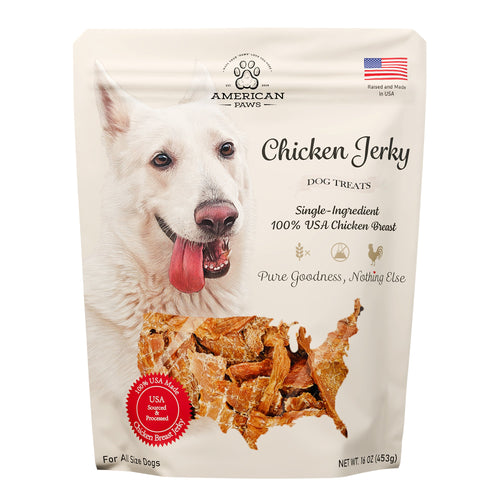
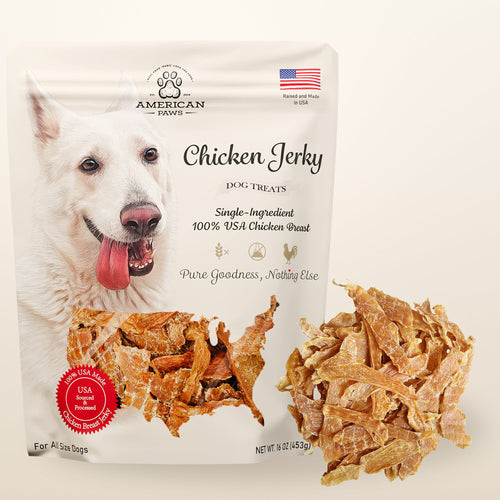
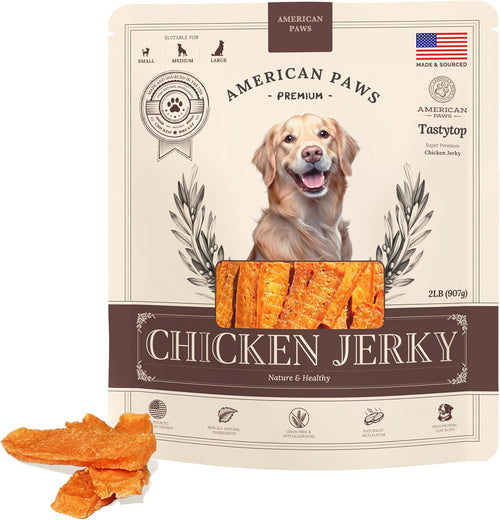
American Paws' single-ingredient whole-cut chicken breast jerky contains chicken breast and can be torn into smaller portions. That single-ingredient description applies to this verified product, not automatically to every jerky format or every item in the catalog. Browse the American Paws chicken jerky collection to compare current formats and labels before calculating a serving.
American Paws makes these real-meat treats in Highland, California. Made-in-USA production is a verifiable sourcing attribute, but it does not replace reading the label, following feeding directions, measuring the serving, or checking individual suitability.
Frequently asked questions
Can dogs eat chicken jerky every day?
Some dogs can have a measured amount daily if chicken and the full recipe suit them, all treats remain within their calorie allowance, and their main food stays complete and balanced. Daily use is not appropriate for every dog, especially those with dietary restrictions or food reactions.
How many chicken jerky treats can a small dog have?
Do not use a universal piece count. Establish the small dog's daily calories, calculate up to 10% for all treats, subtract other extras, and convert the remainder using the package's calorie statement. Often the practical answer is part of a strip torn into tiny pieces.
Does the 10% rule mean 10% of food by weight?
No. It refers to calories, not ounces, grams, volume, or number of pieces. Jerky and regular dog food can have very different calorie densities, so weighing ten percent of the meal is not the same calculation.
Should I reduce dinner after giving chicken jerky?
Occasional small adjustments may be part of a veterinarian-approved plan, but do not regularly replace a meaningful amount of complete food with treats. If rewards are disrupting meals or weight, ask your veterinary team to rebalance the feeding and training plan.
What if the package does not list calories per strip?
Look for calories per ounce or per serving and weigh the portion when possible. Contact the manufacturer if the calorie statement or serving definition is unclear. Do not borrow calorie numbers from a different jerky because recipes and moisture levels vary.
Set today's portion before opening the bag
Use four numbers: the dog's daily calorie target, 10% of that target, calories already spent on other extras, and the jerky's current label calories. Measure the remaining allowance, divide it into dog-appropriate pieces, and stop when it is gone. Compare the American Paws chicken jerky collection, choose a clearly labeled format, and portion today's rewards before the first one is given.