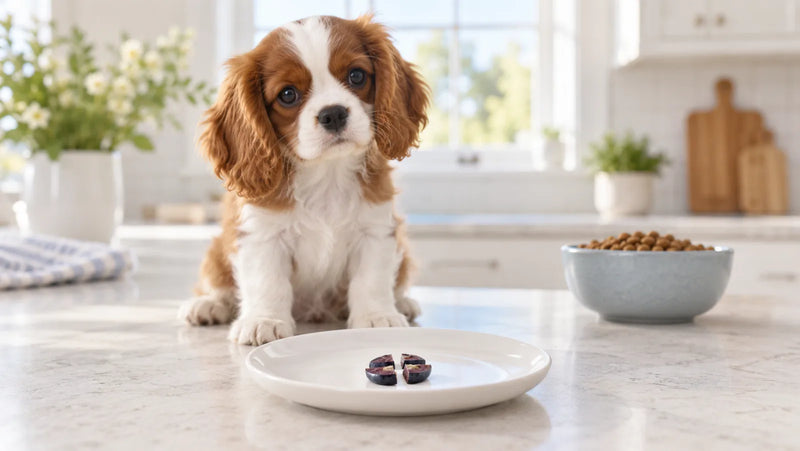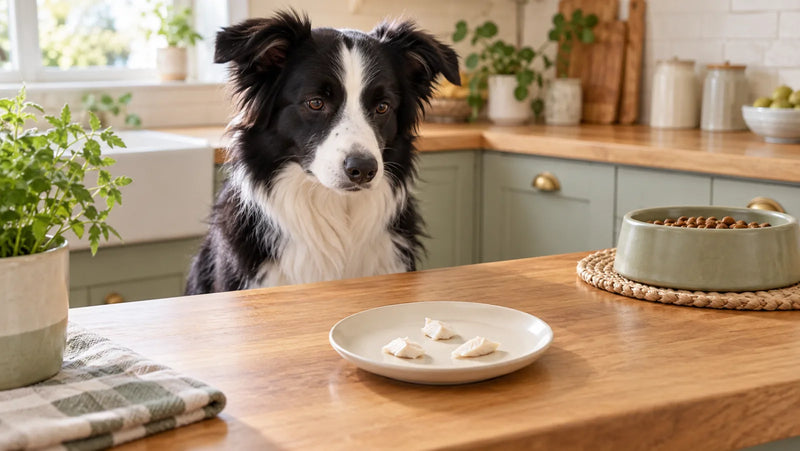

Freeze-dried raw dog food and freeze-dried treats can look almost identical, but they do different jobs. A product can replace a dog's main food only when the label identifies it as complete and balanced for the appropriate life stage. A treat, snack, topper, or product for intermittent or supplemental feeding should stay supplemental.
The words “freeze-dried” and “raw” describe processing, not nutritional completeness. A bag can be freeze-dried without being raw, raw without being nutritionally complete, or complete and balanced while still requiring raw-food precautions. Turn the package over before deciding what belongs in the bowl.
The 30-second label test
- Find the intended purpose. Does the package say dog food, treat, snack, topper, or mixer?
- Find the nutritional adequacy statement. For a main diet, look for “complete and balanced” and the dog life stage it covers.
- Look for limiting language. “For intermittent or supplemental feeding only” means the product is not meant to be the sole diet.
- Check whether the product says raw. That changes the food-safety conversation, not the nutrition test.
- Use the right serving directions. Meal directions and treat directions are not interchangeable.
If the label is vague, ask the manufacturer before using the product as a meal. An attractive meat photo, a high protein percentage, or the words ancestral, premium, whole food, and minimally processed do not substitute for a nutritional adequacy statement.
Freeze-dried raw dog food vs treats at a glance
| Label question | Complete freeze-dried dog food | Freeze-dried treat or topper |
|---|---|---|
| Primary job | Supply the whole diet for the stated species and life stage | Reward, train, add aroma, or supplement a complete diet |
| Label proof | A complete-and-balanced nutritional adequacy statement | Usually labeled treat, snack, topper, or intermittent/supplemental |
| Formulation | Nutrients must be present in suitable amounts and ratios for the stated use | May be one ingredient or a simple recipe without complete nutrition |
| Serving directions | Meal amounts based on body weight, life stage, and product calories | Small portions counted with all other extras |
| Can it be raw? | Yes, if it contains uncooked animal protein without an adequate kill step | Yes; a treat or topper can also be raw |
| Does freeze-drying prove safety? | No | No |
These are two separate axes. “Complete versus supplemental” describes nutritional purpose. “Raw versus adequately heat-treated” describes processing and microbial risk. A buyer needs both answers.
What makes a freeze-dried product a complete dog food?
“Complete and balanced” is a nutritional claim
The FDA's complete-and-balanced pet-food guide says the nutritional adequacy statement is the place to determine whether a food is intended as a pet's sole diet. The statement should also identify the species and life stage, such as adult maintenance, growth, reproduction, or all life stages.
A complete-and-balanced claim is typically substantiated by meeting an AAFCO Dog Food Nutrient Profile or by using an animal-feeding test under AAFCO procedures. That does not mean AAFCO approved, certified, tested, or endorsed the specific bag. It means the company is using one of the recognized routes behind the label claim.
Life stage matters. A food complete and balanced for adult maintenance is not automatically appropriate for puppy growth, gestation, or lactation. Follow the exact label and ask a veterinarian about puppies, medical conditions, prescription diets, or a major diet change.
Ingredients alone cannot prove completeness
A short ingredient list can make a treat easy to understand, but a pile of meat is not automatically a full diet. Dogs need essential amino acids, fatty acids, vitamins, and minerals in appropriate amounts and relationships. Calcium and phosphorus balance is one familiar example; a front label cannot show the entire nutritional job.
The same caution applies to guaranteed analysis. Crude protein, fat, fiber, and moisture are useful label facts, but they do not show every essential nutrient or prove that all of them are balanced for long-term feeding. High protein, visible meat, premium pricing, and expensive processing are not alternative adequacy standards.
What makes it a treat, snack, or topper?
Treats are rewards, not meal replacements
The AAFCO label guide explains that products conspicuously identified as snacks or treats are usually not intended to provide a complete-and-balanced diet. Some unusual treats may carry their own adequacy claim, so read the actual package rather than turning “usually” into “always.”
A single-ingredient meat treat can still be an excellent measured reward. Its simplicity answers “what am I giving?” It does not answer “can this provide every nutrient my dog needs every day?” Those are different questions.
A topper changes a meal without completing it
A topper can make familiar food more aromatic or add texture. Unless the topper independently carries an appropriate complete-and-balanced statement, it should go on top of a complete meal—not become the meal. “For intermittent or supplemental feeding only” is a direct instruction to use it that way.
Count topper calories with training rewards, chews, table extras, and every other treat. If an appealing topper causes a dog to pick around or routinely refuse the balanced food underneath, stop increasing it and talk with the veterinary team. The goal is not to build a new diet accidentally out of supplemental pieces.
What “freeze-dried” and “raw” actually tell you
Freeze-dried describes moisture removal
Freeze-drying freezes food and then removes much of its water under vacuum. The result is light and porous, often with a strong aroma and a texture that breaks into pieces. For a broader look at process, texture, and storage, use our format pillar on freeze-dried vs dehydrated dog treats.
The method does not establish the product's intended use. Complete meals, treats, and toppers can all be freeze-dried. It also does not tell you by itself whether the ingredients were raw when dried or whether the manufacturer used another validated pathogen-control step.
Raw changes the food-safety question
The CDC's pet-food safety guidance defines raw pet food as containing uncooked animal protein that has not been heated high enough to kill germs. It lists freeze-dried products as one possible raw format and states that freezing, dehydrating, or freeze-drying raw animal protein can reduce germs but does not kill all of them.
CDC does not recommend raw pet food or treats because of foodborne-germ risk to pets and people. “Complete and balanced” does not mean pathogen-free; it is a nutrition statement. “Raw” does not mean complete, superior, or more digestible; it is a processing description that calls for a separate risk decision.
Our guide to freeze-dried raw dog treats goes deeper into raw-treat shopping and handling. This comparison stays focused on whether a product has the nutritional job of a meal or the supplemental job of a reward.
Read the package in this order
- Product identity and purpose: dog food, treat, snack, topper, mixer, or supplement.
- Nutritional adequacy: complete and balanced for which species and life stage, or intermittent/supplemental only.
- Feeding directions and calories: meal portions, treat portions, rehydration instructions, and transition guidance serve different jobs.
- Ingredient list and guaranteed analysis: identify every protein and addition, then interpret nutrient percentages in the product's moisture context.
- Storage and handling: follow the maker's directions before and after opening and after adding water.
- Traceability: keep the lot code, best-by date, company contact, and original package in case of a quality problem or recall.
Front-label claims are a starting point, not a verdict. Our full guide to reading a dog-treat label explains ingredient order, calorie statements, guaranteed analysis, and claim checking in more detail.

Three bags, three different jobs
1. Complete-and-balanced freeze-dried raw food
This product may serve as the main diet only when its adequacy statement covers dogs and the correct life stage. Follow its feeding directions, weigh or measure portions consistently, and follow any rehydration and storage rules. If it is labeled raw, the complete nutrition claim does not cancel the raw-handling risk.
2. Freeze-dried meat treat
This product is a reward. Use a small amount during training, enrichment, or ordinary bonding, and keep the dog's complete food as the nutritional foundation. A one-ingredient recipe can be beautifully clear without being a meal.
3. Freeze-dried topper
This product adds aroma or variety to a complete meal. Use the labeled amount and count it as an extra. A topper becomes a main food only if its own label—not the food beneath it—makes an appropriate complete-and-balanced claim.
Raw-product handling protects people too
Raw pet food can spread germs through hands, bowls, scoops, counters, floors, storage containers, and the pet's mouth or stool. A dog may carry and shed organisms without looking ill. Risk management therefore protects the household as well as the animal.
- Wash hands with soap and water before and after handling pet food or treats.
- Use a dedicated scoop; wash bowls, utensils, mats, and contacted surfaces with soap and hot water.
- Keep raw pet food and its tools separate from human food and food-preparation areas.
- Follow the label's refrigeration, freezing, thawing, and discard instructions. Do not assume every dry-looking product has the same rules.
- Once water is added, treat the food as perishable and follow the maker's time and temperature limits.
- Keep the original package or preserve its lot code and date. Do not use damaged, recalled, moldy, damp, or abnormal-smelling product.
- Avoid face licking immediately after a pet eats raw food, especially around mouths, open wounds, or broken skin.
The FDA's pet-food handling guidance recommends clean hands, clean utensils, sound packaging, and storage according to the product. Households with children under five, adults 65 or older, pregnant people, or anyone with weakened immunity should be especially cautious. Puppies and pets with weakened immune systems or other health conditions also warrant a veterinarian's guidance before raw feeding.
Where American Paws products fit
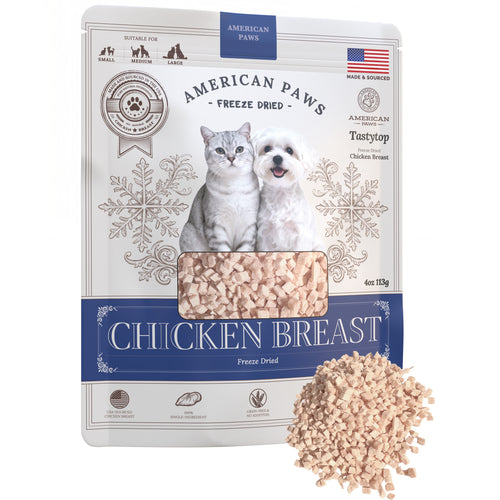
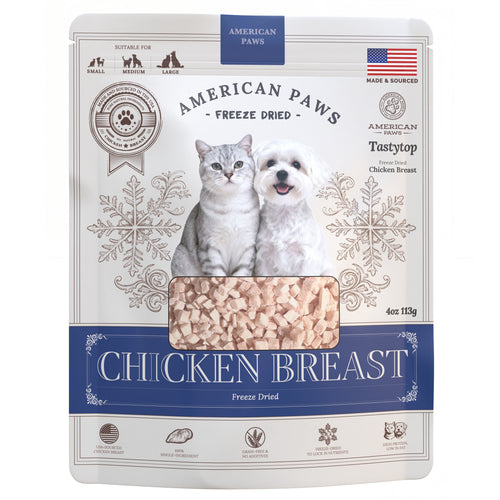
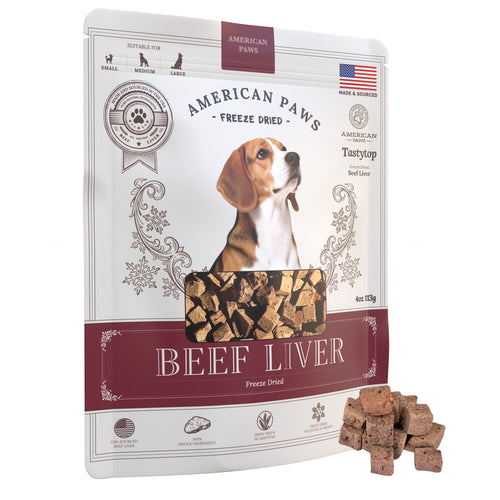
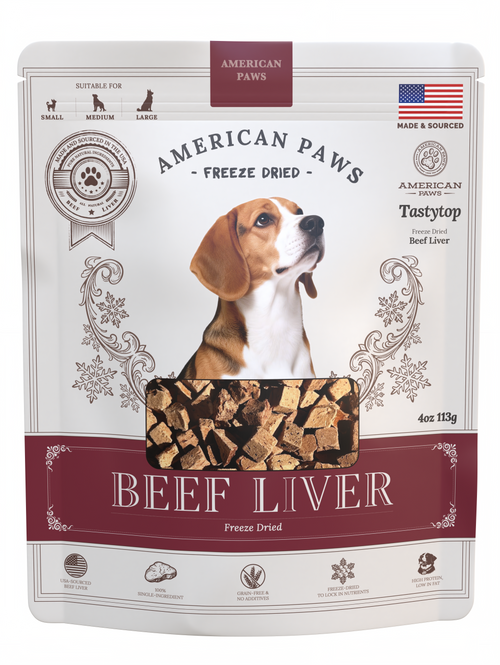
American Paws' single-ingredient freeze-dried chicken and single-ingredient freeze-dried beef liver are sold as treats. They are not complete dog foods, and we do not present either product here as raw.
Use them as measured rewards that complement a complete diet. The short labels make the ingredient easy to identify; they do not turn either bag into a nutritionally complete meal. The same boundary applies to any brand: trust the product's actual intended-use and adequacy statements, not a look-alike shape.
Frequently asked questions
Can freeze-dried raw dog food replace kibble?
It can replace another main food only if its label says it is complete and balanced for dogs at the correct life stage and you feed it according to directions. A raw claim or freeze-dried texture alone is not enough. Ask a veterinarian before changing a puppy's diet or a diet used for a medical condition.
Are freeze-dried raw treats complete and balanced?
Usually not. Products identified as treats, snacks, or intermittent/supplemental foods are normally intended as extras. Check the individual label because a rare treat could also carry a complete-and-balanced adequacy statement.
Is every freeze-dried product raw?
No. Freeze-dried describes the moisture-removal process. Some products begin with raw animal protein; others may have been cooked or received another validated control. Look for the word raw and ask the manufacturer when processing matters.
Does freeze-drying kill Salmonella?
Do not assume it does. CDC says freeze-drying raw animal protein may reduce germs but does not kill all of them. A manufacturer may use additional controls and finished-product testing, but those need to be verified for the actual product.
Can I use a topper as a full meal?
Not unless the topper's own label identifies it as complete and balanced for the dog and life stage. A product labeled for intermittent or supplemental feeding should remain an addition to a complete meal, even if the dog prefers its aroma.
Let the adequacy statement make the decision
Freeze-dried raw dog food earns a place as a main diet through its nutritional adequacy statement, not through its shape, meat content, price, or processing buzzwords. Treats and toppers have useful jobs too, but those jobs stay supplemental unless the package explicitly proves otherwise.
Read purpose first, adequacy second, life stage third, and raw-handling directions next. If you are shopping for rewards rather than a full diet, compare the actual labels on all current American Paws dog treats, choose a format your dog can handle comfortably, and keep every extra inside the treat allowance.