
The most thoughtful gifts for dog lovers serve the person first and include the dog only with the owner’s permission. Pair a useful item—such as a washable treat pouch, travel bowl, or photo keepsake—with one clearly labeled treat the dog already tolerates, then let the owner decide when and how it is served.
This two-part formula keeps the gesture personal without turning someone else’s dog into a dietary surprise. The owner may be managing allergies, an elimination trial, a prescription diet, training calories, dental limits, or a simple house rule that visitors do not feed the dog. Asking first is part of the gift.
Gifts for dog lovers: the safe two-part formula
| Part of the gift | What makes it thoughtful | What to avoid |
|---|---|---|
| One owner-focused item | Fits the person’s routine: training, walking, travel, photography, organization, or relaxing with the dog | Novelty clutter that ignores how the person actually lives |
| One optional dog extra | A familiar, clearly labeled treat approved by the owner | An unknown protein, mystery mix, huge assortment, or food the owner did not approve |
| Original package | Preserves ingredients, lot, storage, best-by, and feeding information | Loose treats in an unlabeled jar, decorative bag, or homemade “sampler” |
| Serving control | The person receives the food and decides the dog’s portion | Handing a retail bag to the dog or implying the whole bag is one celebration serving |
The dog extra is optional. If the owner says “no food,” the correct two-part formula becomes a one-part human gift. A thoughtful present does not need to prove itself by crossing a boundary.
Ask these questions before buying a treat for someone else’s dog
Does the owner want food gifts at all?
Ask plainly: “May I include a treat for your dog?” Do not make the person explain a private medical reason. A yes should be specific enough to guide the purchase; a no should end the food idea without pressure.
Also ask whether the dog is allowed to receive food from visitors. Some families use a one-handler rule to prevent begging, resource guarding, accidental overfeeding, or interference with training. Hand the sealed package to the person rather than feeding the dog during the exchange.
Which proteins and diets are approved?
Ask which proteins the dog already eats and whether the dog has an allergy, food intolerance, prescription diet, elimination trial, pancreatitis history, kidney or heart restriction, or another veterinary feeding plan. “The dog loves chicken” is useful only when the owner confirms chicken is currently allowed.
A gift is not the right moment to introduce a novel protein. If the dog is in an elimination trial, even one unapproved bite can make the result harder to interpret. If the owner does not know what fits, choose a non-food human gift.
What size, texture, and training system fit the dog?
Body size affects calorie room and piece size, but chewing behavior and dental comfort matter too. A toy dog may need crumbs; a fast gulper needs hand-delivered prepared pieces; a senior dog may need an easy-to-break texture. A large dog is not automatically suited to a hard chew.
Ask whether the owner wants tiny training rewards, a snippable strip, a topper, or no edible gift. The owner may also reserve one particular reward for recall or difficult environments. Do not weaken that training value by handing it out casually.
Paired gift ideas by dog-lover type
The active trainer
Pair a washable treat pouch, clicker case, or training notebook with one bag of small, easily divided rewards the owner already uses. The human gift improves the routine; the dog treat is simply the refill. A strong smell or high enthusiasm can make a food “high value,” but only the individual dog decides what is motivating.
Keep the session practical. Tiny pieces create many reinforcement moments without giving a human-size snack each time. Let the trainer open the bag and set the day’s amount.
The daily walker and traveler
A collapsible travel bowl, washable walking pouch, compact towel, leash light, or small gear organizer can solve a real daily problem. If food is approved, add one familiar shelf-stable treat in its original package—not loose pieces tucked into the fabric gear.
A travel gift should reduce mess, not create it. Choose something easy to clean and sized for the person’s actual bag or vehicle. Avoid attaching edible food to a leash, collar, or dog-worn accessory.
The senior-dog household
Consider a washable blanket, framed photo, memory book, nonslip feeding mat, or help with a favorite low-key outing. If the owner approves a treat, ask about teeth, swallowing, calories, and prescription restrictions before choosing texture.
Do not assume that a senior dog wants or can manage a hard chew. An easy-to-crumble reward or no-chew option may fit better, but the owner and veterinarian know the dog’s mouth and medical plan.
The ingredient-focused pet parent
Pair a sturdy storage clip, washable measuring scoop, or label-friendly pantry organizer with one product whose ingredient list is easy to audit. This recipient will appreciate that the original bag remains sealed and that you did not hide the lot and storage information inside a decorative container.
Single-ingredient can be a useful label feature, but do not write “hypoallergenic” on the card. A dog can react to the single protein itself, and a simple product can still be calorie-dense or incompatible with a medical diet.
The new adopter
A new-dog journal, contact-card holder, washable mat, or gift card for an owner-chosen need respects the fact that the person and dog are still learning each other. Food is often best deferred until the current diet, digestion, training plan, and veterinary history are clear.
Never give a puppy or another live animal as a surprise. Choosing an animal changes years of housing, cost, care, training, travel, and family responsibility; it requires the recipient’s direct participation.
How to choose a dog treat that will not surprise the diet
Familiar protein before novelty
A familiar protein is a thoughtful choice, not a boring one. If the owner says the dog regularly eats chicken, choose a chicken product whose ingredient list matches that answer. If beef is approved, a beef reward may fit. If no protein is clearly approved, stop there.
Do not infer tolerance from a breed, age, or another dog in the household. Each dog has its own history, and foods should not be shared automatically between pets with different diets.
Original label, lot, storage, and calories
Use our dog treat label guide as a practical checklist. The AAFCO pet-food label guide explains why ingredient statements, intended use, calories, feeding information, and responsible-party details matter. Pet treats generally are not intended to replace a complete-and-balanced diet.
Keep the original bag sealed. A decorative jar may look generous, but it can erase the ingredient panel, lot code, best-by date, storage directions, and product identity the owner needs. If you add ribbon or tissue to the human gift, keep it separate from the dog and the food package.
Single-ingredient is simple, not allergy-proof
A one-ingredient label removes hidden flavors and fillers from the comparison. It does not prove the food is low-fat, low-calorie, medically appropriate, or unable to trigger an allergy. The ingredient still has to be one the dog can eat.
For a dog on a prescription or elimination diet, follow the owner’s exact approved list. “Natural,” “real meat,” or “made in USA” does not override a veterinary restriction.
Current American Paws options to consider individually
American Paws currently sells these as individual products, not as parts of a prebuilt gift set:
| Current product | Verified identity | When it may fit |
|---|---|---|
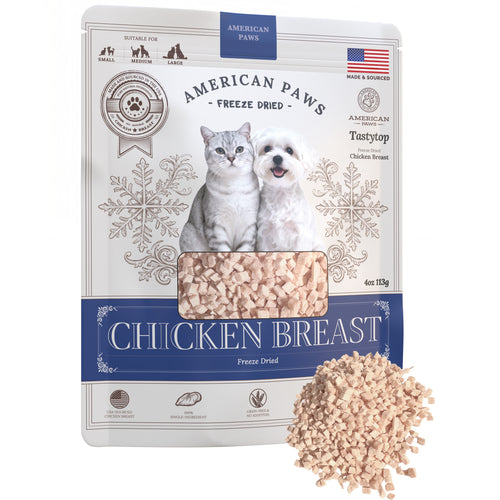
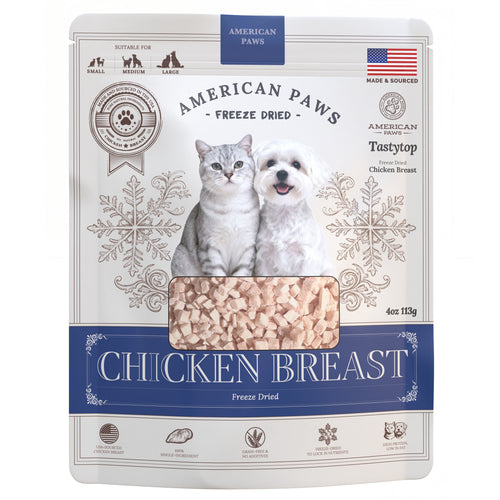
| Single-ingredient freeze-dried chicken training treats | 100% USA chicken breast; supplemental dog treat | Owner approves chicken and wants small pieces that can be divided |
| Single-ingredient freeze-dried beef-liver training treats | 100% USA beef liver; supplemental training treat | Owner approves beef and wants a strong-smelling reward used in small amounts |
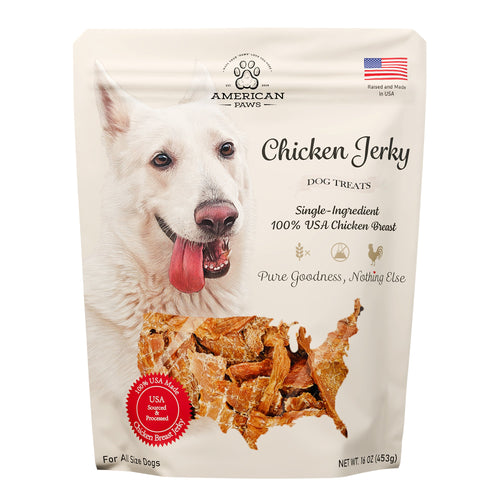
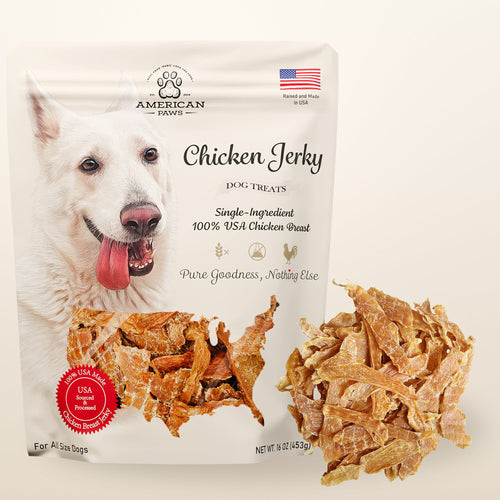
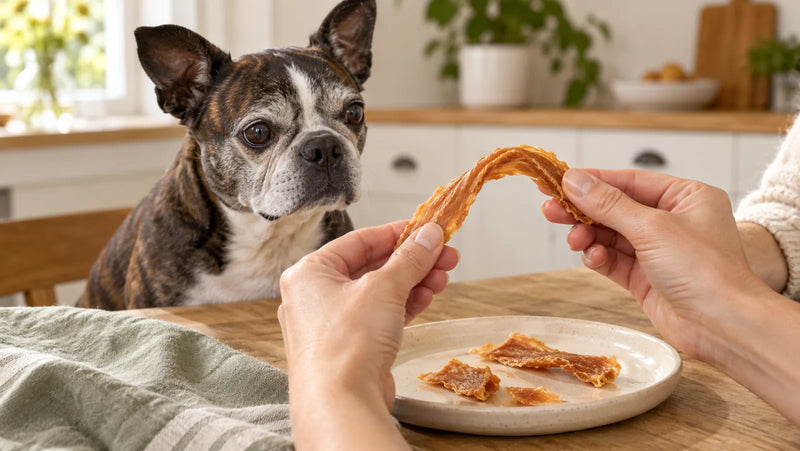
| Whole-cut single-ingredient chicken jerky | 100% USA chicken breast; supplemental jerky treat | Owner approves chicken and wants a strip that can be snipped before serving |
These examples are not universal recommendations. Chicken is wrong for a chicken-allergic dog; beef liver is wrong for a dog whose diet excludes beef or organ treats; a strip format is wrong when the dog’s teeth or swallowing behavior do not fit. The owner’s answer selects the product.

How to assemble your own paired gift without inventing a gift box
- Choose the human gift first. Match a real habit or memory instead of buying generic dog-themed clutter.
- Get permission for food. Ask for the approved protein, product type, and any medical or training limits.
- Select one individual treat. More bags do not make the gift more thoughtful and create more ways to miss the diet.
- Keep the retail bag sealed. Do not pour it into an unlabeled jar, decorative pouch, stocking, or homemade sampler.
- Wrap only the person’s item. Keep ribbon, twine, tissue, tags, clips, and small decorations away from the dog.
- Hand both items to the person. Say that the treat is optional and the owner controls introduction and serving.
American Paws does not currently sell a ready-made gift box, bundle, sampler, kit, stocking, card, or wrapping service. “Build your own” means selecting individual products yourself; it does not mean a hidden commercial package exists.
Keep the dog’s share inside the normal treat budget
A gift does not create extra calorie room. The WSAVA guide to feeding treats recommends keeping treats below 10% of a dog’s daily calories and maintaining complete-and-balanced food as the diet’s foundation. It also advises veterinary guidance for medical conditions, sensitivities, and prescribed diets.
Give the unopened retail bag, not a gift-day portion. The owner can use the food over many sessions and decide how it fits beside chews, toppers, dental products, table bites, and every other extra. Our daily dog-treat calorie budget explains why the limit belongs to the whole day, not each gift giver.
Do not write “give one bag” or “let the dog finish it” on a card. A package is a supply, not a serving.
What not to give a dog lover—or the dog
- An unapproved food: owner permission comes before a surprise protein.
- A mystery assortment: loose or rebagged treats hide ingredients, lot, date, and storage information.
- A huge edible bundle: quantity creates waste and calorie pressure, not thoughtfulness.
- An extreme chew: do not guess from the dog’s size; teeth, chewing behavior, and supervision matter.
- Human sweets or party food: chocolate, xylitol, grapes or raisins, onion, garlic, alcohol, and other hazards have no place in a dog gift.
- Wrapping for the dog to open alone: ribbon, tissue, plastic, tags, twine, and clips can be swallowed.
- A fake American Paws gift set: individual products are available; a gift box or bundle is not.
- A surprise animal: a puppy or other pet is a family decision, not a novelty present.
When in doubt, give the human a useful non-food item and a note offering to buy the owner’s chosen treat later. That preserves the surprise without gambling on the dog’s diet.
Choose the right Q4 guide for the exact recipient
This page owns the human-recipient question: what to give a person who loves a dog, and how to include that dog only with permission. For a dog-first choice based on body size, age, teeth, and chewing behavior, use our size-and-age treat selection guide.
If the physical Christmas stocking is the project, the build-your-own stocking guide covers sealed packaging, piece preparation, and stocking materials. If guests, table food, and a live gathering are the concern, follow the holiday gathering treat plan. Keeping those jobs separate makes each decision easier.
Frequently asked questions
What is a good gift for a dog lover whose dog has allergies?
Choose a human-only gift unless the owner gives an exact approved product or ingredient. Do not assume a novel or single-ingredient treat is safe. An elimination or prescription diet may exclude foods that otherwise look simple.
Should I surprise someone else’s dog with treats?
No. Surprise the person with the presentation, not the dog with an unknown food. Ask the owner first, keep the product sealed, and let the owner introduce and portion it.
Are single-ingredient treats safe for every dog?
No. A dog can be allergic or intolerant to the single protein, and medical diets may restrict its fat, protein, minerals, calories, or ingredient source. Single-ingredient describes the label, not universal suitability.
How much dog treat should go in the gift?
Give one normal retail bag only when the owner has approved that product. Do not treat the bag as a serving. The owner should fit small pieces across future training sessions while all daily treats stay within the dog’s calorie plan.
Does American Paws sell a ready-made gift box?
No. American Paws currently sells individual products, not a gift box, bundle, sampler, kit, stocking, or wrapping service. You can select one owner-approved item and pair it with a separate human gift yourself.
Make the owner feel known and let the dog stay on plan
The best dog-lover gift recognizes a real part of the person’s life: the early walks, training sessions, senior-dog routines, travel gear, photographs, or quiet evenings shared with a dog. Add food only when the owner has said exactly what fits.
For an approved treat, keep the choice simple, labeled, sealed, and portion-controlled. Browse all current American Paws dog treats, choose one individual product that matches the owner’s answer, and let the person decide when the dog receives it. The gift stays generous because it respects both members of the pair.